
Edible
Woad
Isatis tinctoria
Also known as Dyer's woad, Glastum
How to grow woad, Isatis tinctoria. Sowing, harvesting first-year leaves, making blue dye and the history of painted Britons.
At a glance
- Difficulty
- Easy
- Water
- Weekly in dry weather in year one
- Light
- Full sun
- Temperature
- Fully hardy. The rosette overwinters outdoors
- Hardiness
- USDA 4-8, RHS H6, hardy to -20 C
- Type
- Hardy biennial
- Height
- 60-120 cm
- Native to
- western Asia, southeastern Europe
- Best month
- June and July in the Northern Hemisphere, December and January in the Southern Hemisphere
A biennial that gives its dye from first-year leaves and its seed from the second, so a woad bed runs on a two-year cycle. It seeds heavily. It is a declared noxious weed across several western United States, where it has spread through rangeland, so cut the seed heads if you grow it for dye.
Hardiness zones describe winter cold alone. Summer heat, humidity, rainfall and the length of the growing season decide as much, so treat the range as the outer limit rather than as a recommendation.
Every month named in this guide is for the temperate Northern Hemisphere. If you garden in the Southern Hemisphere, shift each one by six months, so June becomes December. Closer to the equator the wet and dry seasons matter more than the calendar, and the shift stops being a useful guide.
Skin irritant
- Do not eat
- The dye vat, which is strongly alkaline
- Harm from
- Handling it
- Affects
- People
Woad is not a poisonous plant. It is a brassica, related to cabbage and mustard, and it appears on neither the RHS list of potentially harmful garden plants nor the ASPCA list. It is not a food plant either, and there is no reason to eat it. The hazard associated with woad is the dyeing process rather than the plant. A woad vat is made strongly alkaline, often with washing soda or slaked lime, and reduced with a fermentation or a chemical reducing agent. That liquid burns skin and eyes, so gloves and eye protection are the standard equipment for anyone dyeing with it. As with all brassicas, grazing animals eating large quantities can suffer, though stock generally leave it alone.
Sources: RHS potentially harmful garden plants, ASPCA toxic and non-toxic plants
About
Woad was the source of blue in Europe for two thousand years, until indigo arriving from India and then synthetic indigo in the 1890s destroyed the trade. The dye is chemically identical to indigo. Woad contains far less of it, which is why a woad crop needs a great deal of leaf for a small amount of colour.
The famous story about blue-painted Britons is shakier than it looks. Caesar describes Britons stained with vitrum, which later writers translated as woad, and modern experiments show woad makes a poor body paint. The most likely candidate is a copper compound, and the woad version has survived because it is a better story.
As a garden plant it is easy, handsome in flower, and generous with seed to a degree that has made it a declared noxious weed in the western United States. Cut the seed heads off.
Appearance and character
In year one, a rosette of smooth blue-green leaves up to 20 cm long, oval to lance-shaped, with a pale midrib.
In year two, a branching flowering stem 60 cm to 1.2 m, wiry and much branched at the top.
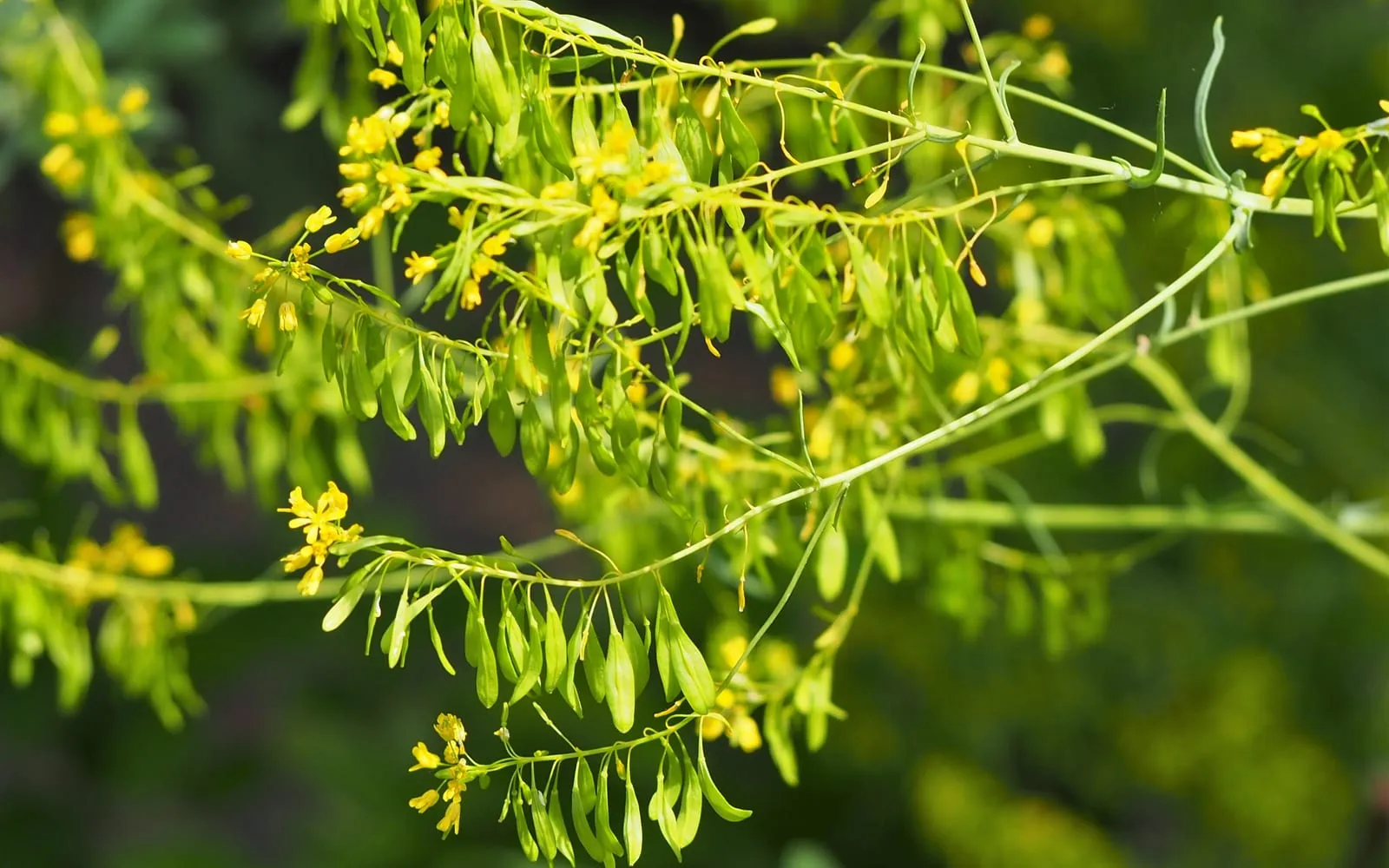
Flowers are small and bright yellow, four-petalled as every brassica’s are, carried in an airy cloud of heads in May and June. A stand in flower is a fine thing in its own right.
Seed pods are the striking part. Flat, oblong, pendulous and hanging in quantity, turning from green through purple to near black, and they persist for weeks.
Leaves are the dye crop and only the first-year rosette is worth harvesting. The indigo precursor drops away sharply once the plant runs to flower.
There is no scent worth mentioning, and the plant is unremarkable close up until it flowers.
Where it is from
Woad is native to western Asia and south-eastern Europe and it has been cultivated across Europe for so long that its natural range is uncertain.
Its European industry was substantial and it shaped whole towns. Toulouse grew rich on woad in the fifteenth and sixteenth centuries, trading the dye in compressed balls called cocagne, which is where the phrase pays de cocagne comes from. Erfurt in Germany and Lincolnshire and Somerset in England all had woad economies.
The arrival of Indian indigo broke it. Indigo yields perhaps thirty times more dye per weight of plant, and European woad growers spent two centuries lobbying for bans and tariffs against it. Germany prohibited indigo on pain of death in 1577, which delayed rather than prevented the outcome.
Synthetic indigo finished the job. BASF commercialised it in 1897 and both the woad trade and the natural indigo trade collapsed within a decade.
Small-scale woad growing survives among dyers and craft producers, and there have been commercial revivals in France and England on a modest scale.
How it grows
Sow direct where it is to grow, from March to May, or in late summer for an overwintered crop.
Sow at 1 cm in rows and thin to 30 cm. Germination is fast, within one to two weeks.
Prepare the ground properly. Woad is a hungry crop and it wants deep, fertile, free-draining alkaline soil to produce the leaf a dyer needs.
Harvest first-year leaves from about eight weeks after sowing, cutting the outer leaves and leaving the crown. A well-grown plant gives two or three cuts in its first season.
Use the leaves fresh. The indigo precursor degrades on storage, so process them within hours of cutting for the best yield.
Let a few plants run to flower in year two if you want seed, and cut the seed heads off the rest.
Rotate. Woad is a brassica and it shares clubroot with cabbages, so do not grow it where brassicas have recently been.
Pull the plants after they seed. They are biennial and die.
Through the seasons
Winter is a flat green rosette in a first-year plant, entirely hardy and needing nothing.
Spring brings the first sowing from March, and the flower stem on second-year plants.
Early summer is flowering, in May and June, in an airy cloud of yellow. The leaves are no longer worth harvesting on those plants.
Midsummer is the main dye harvest from first-year rosettes, cutting outer leaves as they mature.
Late summer brings the hanging black seed pods, and a second cut of leaf from the rosettes.
Autumn is when second-year plants die. Cut the heads before the pods shed if you want to keep control.
Care difficulty
Easy to grow and demanding to use, which is an unusual split.
Growing it needs nothing beyond a fertile bed, sun and space. It is hardy, vigorous and untroubled by drought.
Getting dye out of it is the real work. The process involves extracting the precursor in hot water, oxygenating the liquid, precipitating the pigment, making a strongly alkaline reduced vat and then dyeing. It is a craft rather than a garden operation and it is worth reading properly before starting.
Brassica pests apply. Flea beetle riddles the leaves and spoils a dye crop, caterpillars strip them, and clubroot is a risk on ground that has grown cabbages.
Self-seeding is heavy. Woad is a declared noxious weed in several American states for that reason, and in a temperate garden it means cutting the seed heads off.
Timing decides the yield. First-year leaves carry the pigment, and a plant that has bolted is worthless for dye.
Watering
Water first-year plants weekly in dry weather. Leaf yield is the whole crop and drought reduces it sharply.
Water the seedbed before sowing and keep it damp until germination.
Water established second-year plants only in a genuine drought, since the crop from them is seed rather than leaf.
Water at the base in the morning.
A container will grow a plant and not a crop. Woad needs ground and room to produce useful quantities of leaf.
Mulch to hold moisture in a dry summer, which does more for leaf yield than watering does.
Warning signs, diseases and pests
Flea beetle peppers the leaves with small round holes, which is cosmetic on a vegetable and ruinous on a dye crop. Cover the row with fine mesh from sowing.
Cabbage white caterpillars strip the leaves in July and August. Mesh keeps the butterflies off.
Clubroot swells and distorts the roots and stunts the plant. It persists in soil for twenty years, so rotate and never grow woad where clubroot is known.
Slugs take seedlings. Protect a new sowing.
Plants that bolt in their first year have been checked, usually by drought or transplanting, and the leaves are then worthless for dye.
Yellow lower leaves on a crowded row mean the plants need thinning.
Seedlings across the garden mean the pods shed. Cut the heads earlier.
Growing environment
Full sun. Woad in shade makes thin leaves with less pigment.
Deep, fertile, free-draining soil. This is a crop plant and it responds to good ground in a way most of the herbs here do not.
Alkaline is preferred, around pH 6.5 to 7.5. Lincolnshire and Somerset grew it on limestone and lias.
A vegetable bed is the right place, with the rotation treated as a brassica.
It is fully hardy anywhere in its range and needs no protection.
Give it space and expect it to seed. A bed of its own is better than a border slot, and it is worth keeping away from ground you want to stay clear.
Feeding
Feed it, which sets woad apart from most of this wave. Leaf yield is the crop and a hungry brassica grown lean gives you very little.
Work compost or well-rotted manure into the bed before sowing.
A nitrogen-rich liquid feed every three weeks through the first summer increases leaf, which is exactly what a dyer wants.
Lime acid ground before sowing. Woad prefers alkaline soil, and liming also suppresses clubroot.
Do not bother feeding second-year plants. They are producing seed rather than leaf.
Rotate rather than feeding the same ground harder, since woad takes a good deal out of a bed.
Troubleshooting
Did the ancient Britons paint themselves with it? Probably not with woad. Caesar wrote that Britons stained themselves with vitrum, later translated as woad, and practical experiments show woad makes a poor body paint. A copper compound is the more likely candidate. The woad version has survived because it is a better story.
I got almost no colour. Woad contains far less pigment than true indigo, the precursor degrades within hours of cutting, and only first-year leaves carry useful amounts. Use fresh leaves from unbolted plants, and expect a modest yield from a large quantity of leaf.
The leaves are full of holes. Flea beetle. Cover the row with fine mesh from sowing, since holed leaves are a spoiled dye crop.
It flowered in its first year. The plant was checked, usually by drought. Those leaves are no longer worth harvesting.
Seedlings everywhere. Cut the seed heads before the pods shed. Woad is a declared noxious weed in parts of the United States for exactly this reason.
Can I eat it? No. It is a brassica and it is not a food plant.
Do I need special equipment to dye with it? A woad vat is strongly alkaline and needs gloves and eye protection. Read a proper dyeing guide before starting.