
Outdoor plant
Winged Spindle
Euonymus alatus
Also known as Burning Bush, Winged Euonymus
How to grow winged spindle, Euonymus alatus. Why its corky-winged stems identify it even in winter, the cardiac glycosides that make every part of the plant toxic, and the invasive spread that has led several US states to restrict its sale.
At a glance
- Difficulty
- Easy
- Water
- Rarely once established
- Light
- Full sun for the strongest autumn colour; tolerates partial shade
- Temperature
- Fully hardy, to about -34 deg C
- Hardiness
- USDA 4-8, RHS H7, hardy to -34 C
- Type
- Deciduous shrub, long lived
- Height
- 2-3 m
- Native to
- eastern Asia
Tolerant of both severe cold and summer heat, and untroubled by poor or alkaline soil. The strength of the autumn colour depends on light rather than on the winter minimum: a plant in full sun turns a far more intense scarlet than one in shade, which fades toward a duller pink-red.
Hardiness zones describe winter cold alone. Summer heat, humidity, rainfall and the length of the growing season decide as much, so treat the range as the outer limit rather than as a recommendation.
Toxic if eaten
- Do not eat
- All parts, and the fruit and seeds most of all
- Harm from
- Eating it
- Affects
- People, cats, dogs and horses
Every part of winged spindle contains cardiac glycosides, the same class of compound found in its European relative, common spindle. The small orange-red fruit is the practical hazard, since it splits open in autumn to show seeds bright enough to draw a child's attention. Symptoms of eating fruit or seed typically begin some hours after ingestion rather than straight away, and include vomiting, diarrhoea and abdominal cramping; a large quantity can affect heart rhythm. The RHS lists Euonymus as harmful if eaten, and the ASPCA lists it as toxic to cats, dogs and horses, producing gastrointestinal upset and, less commonly, cardiac effects. Treat a delayed onset of symptoms as no reassurance that nothing was swallowed, and get medical advice if a child has eaten any fruit, or a vet's advice for a pet that has chewed the stems or fruit.
Sources: RHS potentially harmful garden plants, ASPCA toxic and non-toxic plants
About
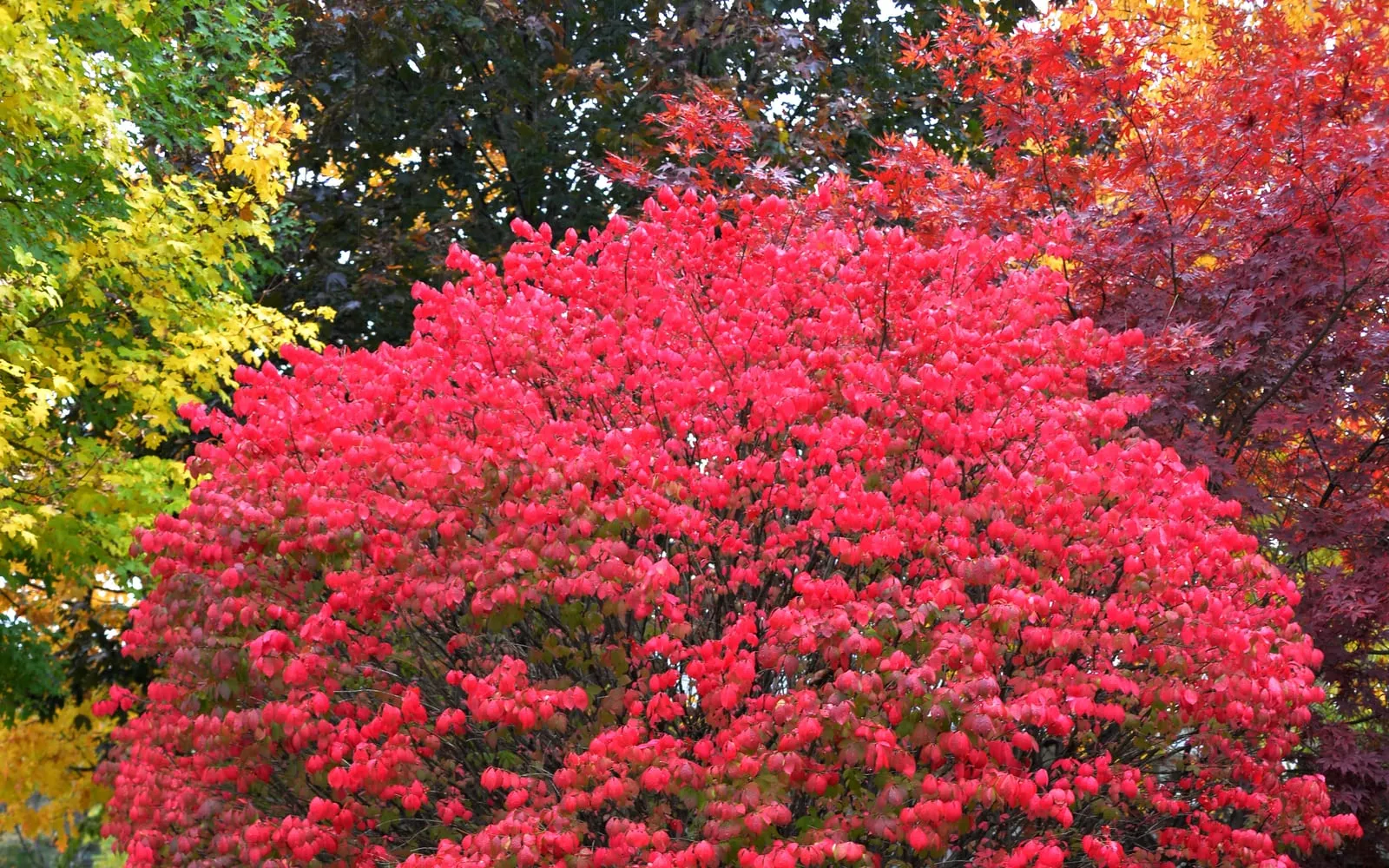
Winged spindle is grown almost entirely for one effect: leaves that turn an intense, near-fluorescent scarlet in autumn, dense enough to colour a whole hedge or border from a distance. The rest of the year it is a modest, twiggy, rounded shrub, identified even without leaves by the flat corky ridges, or wings, that run along its younger stems.
It needs very little once established, tolerating poor soil, drought and hard pruning. In several parts of North America it has also become a genuine problem outside the garden, seeding into woodland and crowding out native understorey plants, which is worth knowing before planting it there.
Appearance and character
The defining feature is the stem rather than the leaf: young branches carry two to four flat, corky wings running their length, giving a square, winged cross-section that is unlike almost any other garden shrub and identifies the plant in winter when nothing else is visible.
Leaves are opposite, elliptical and finely toothed, a plain mid-green through summer that gives no hint of what is coming. In autumn they turn a uniform, saturated scarlet to crimson, a colour change strong enough that the plant is sold and recognised by that single trait more than any other.
Flowers are small, greenish-yellow and easy to miss in late spring, followed by small four-lobed capsules that split in autumn to show orange-red seeds, a much smaller and less showy fruit display than the related common spindle’s bright pink capsules.
Growth is dense and twiggy, building into a rounded, congested shrub over years, and it tolerates being clipped into a formal hedge shape as readily as it tolerates being left to its natural rounded outline.
Where it is from
Euonymus alatus is native to eastern Asia, from China through Korea to Japan, growing in woodland edges and scrub on a wide range of soils.
That broad native tolerance for poor ground, summer heat and severe winter cold is exactly what has made it so easy to grow in cultivation, and also what has let it establish outside gardens where birds carry the seed into wild woodland. It is listed as invasive or restricted for sale in several US states, including Massachusetts and New Hampshire, and land managers in parts of the northeastern and midwestern United States treat it as a weed of forest understorey rather than only an ornamental. Check local restrictions before planting it in North America; the concern does not apply in most of Europe, where it has not shown the same tendency to naturalise.
How it grows
Plant in any well-drained soil in full sun for the best autumn colour, though it also tolerates partial shade, poor soil and chalk without difficulty.
Little aftercare is needed once it is through its first summer. Water during establishment and then leave it largely alone; it copes with drought, heat and cold with equal indifference.
Prune after leaf fall or in late winter if shape needs correcting, cutting into old wood without harm, since it regrows readily from a hard cut. Left unpruned it keeps a naturally dense, rounded habit that rarely needs correcting on an open site.
Where it has shown invasive tendencies, deadheading before the fruit matures and disperses reduces self-seeding into nearby wild ground, and you should check for volunteer seedlings nearby each year.
Through the seasons
Spring brings small, easily missed greenish flowers as new leaves emerge.
Summer is plain, dense green growth with no particular seasonal interest.
Autumn is the main event: leaves turn scarlet over a few weeks, and capsules split to show the orange-red seed inside.
Winter shows the bare, winged stems clearly once the leaves have dropped, which is the season the plant is easiest to identify at a distance.
Care difficulty
Easy, and about as low-maintenance as a garden shrub gets. It needs no particular soil, no regular feeding, and no protection from cold, heat or drought once established. The only real judgement call is where to plant it: in a region where it is known to escape into wild ground, restraint or an alternative native shrub is worth considering over the strength of its autumn display.
Watering
Water regularly through the first growing season while roots establish, a deep soak rather than frequent light watering.
Once established, it needs no supplementary watering except in the most prolonged drought, and even then it usually recovers without lasting harm.
Warning signs, diseases and pests
Euonymus scale shows as small, flattened, greyish-white bumps on stems and the undersides of leaves, sometimes heavy enough to weaken a plant and cause premature leaf drop. Horticultural oil applied at the right point in the pest’s life cycle is the standard treatment.
Aphids cluster on soft spring growth, distorting new leaves and leaving sticky honeydew behind. A strong jet of water or an insecticidal soap controls light infestations.
Powdery mildew appears as a pale, dusty coating on leaves in humid, still conditions, more a cosmetic issue than a serious threat; improving air circulation around a congested plant reduces it.
Honey fungus occasionally affects older or stressed plants, showing as gradual dieback and, eventually, fungal growth at the base. There is no reliable treatment once established.
Growing environment
Full sun gives by far the best autumn colour; a plant in shade still turns colour but in a duller pink-red rather than the vivid scarlet the species is grown for.
Almost any well-drained soil suits it, including poor, sandy or chalky ground that would limit many other flowering shrubs.
No shelter is needed. It tolerates wind, urban pollution and roadside conditions as well as it tolerates drought and cold, which is part of why it has been planted so widely.
Feeding
None is needed on ordinary soil. A mulch of well-rotted organic matter in the year after planting helps it establish but is not required afterwards.
Avoid feeding a mature, healthy plant; extra fertility encourages soft green growth at the expense of the autumn colour the shrub is grown for.
Troubleshooting
The autumn colour was disappointing this year. Usually light rather than weather. A plant that has become shaded by taller neighbours colours less intensely; the fix is more sun, not different care through the rest of the season.
Seedlings are coming up some distance from the parent plant. This is the invasive tendency documented in parts of North America. Remove seedlings while young, and consider deadheading the parent before fruit matures to reduce the seed available for birds to spread.
Can I grow it as a hedge? Yes, and it takes clipping well, though clipping before the fruit forms will reduce the fruit display and, in a region with self-seeding concerns, is the more responsible choice.
The stems have flat ridges even on a young plant. Is that normal? Yes, the corky wings are present from an early age and are the plant’s most reliable identifying feature, not a sign of disease or damage.
Is it safe to plant near where children play? The fruit is the main risk, and it is not especially showy or abundant compared with common spindle, but it is still a plant to keep children from eating from rather than one to plant right beside a play area.