
Outdoor plant
American Ginseng
Panax quinquefolius
Also known as Five-fingers, Sang, Xi yang shen
How to grow Panax quinquefolius in a woodland bed. Why wild digging emptied the Appalachian woods, what CITES listing means for a grower, and the eighteen-month seed.
At a glance
- Difficulty
- Difficult
- Water
- Rarely, in a bed with a proper leaf mould layer
- Light
- Deep shade under a deciduous canopy
- Temperature
- Fully hardy, and it needs a cold winter
- Hardiness
- USDA 3-7, RHS H7, hardy to -30 C
- Type
- Long-lived herbaceous perennial from a fleshy root
- Height
- 20-50 cm
- Native to
- the deciduous forests of eastern North America, from Ontario to Georgia
Seed carries a double dormancy and needs 18 to 22 months and two winters in the ground before it germinates, then five to ten years to a root worth lifting. Deep shade of 70 to 80 per cent and a cold winter are both required. It is listed on CITES Appendix II after decades of wild digging, so buy cultivated stock and check the export rules before moving any.
Hardiness zones describe winter cold alone. Summer heat, humidity, rainfall and the length of the growing season decide as much, so treat the range as the outer limit rather than as a recommendation.
Harmful if eaten
- Do not eat
- The red berries
- Harm from
- Eating it
- Affects
- People
The root is eaten and brewed and has been for centuries, and NC State Extension records no toxicity for Panax quinquefolius. The plant does not appear on the RHS list of potentially harmful garden plants, and the ASPCA does not list it among plants toxic to dogs, cats or horses. The red berries are not a food. They carry the seed, the seed carries the ginsenosides in concentration, and nobody has a tradition of eating them, so the sensible line for a garden is that the fruit is for propagation and the root is the part with a history of use. The interaction to know about is with prescribed medication rather than with the plant itself. Ginseng preparations are documented as interacting with warfarin and with some diabetes medicines, which is a conversation to have with a GP rather than a reason to avoid the plant in a garden.
Sources: NC State Extension, Panax quinquefolius, NHS on herbal medicines, RHS potentially harmful garden plants, ASPCA toxic and non-toxic plants
About
American ginseng was worth exporting within thirty years of Europeans noticing it. A Jesuit missionary in Canada read a description of the Chinese plant in 1716, recognised the same genus growing in the woods near Montreal, and the trade began. By the 1750s ships were carrying Appalachian roots to Canton, and by the 1970s the wild population had been dug hard enough for two centuries that the species went onto CITES Appendix II.
The plant is close to its Asian relative in form and distant in reputation. In Chinese practice the two are opposites: Asian ginseng is treated as warming and American ginseng as cooling, and the American root has commanded its own market in China on that basis for three hundred years. Most of what is exported today is cultivated in Wisconsin and Ontario under shade cloth.
Of the two true ginsengs it is the more forgiving. It wants the same deep shade, the same leafy soil and the same long wait, and it tolerates a slightly milder winter and a slightly drier summer than Panax ginseng does. Five to seven years from seedling to a root worth lifting is still the arithmetic.
Appearance and character
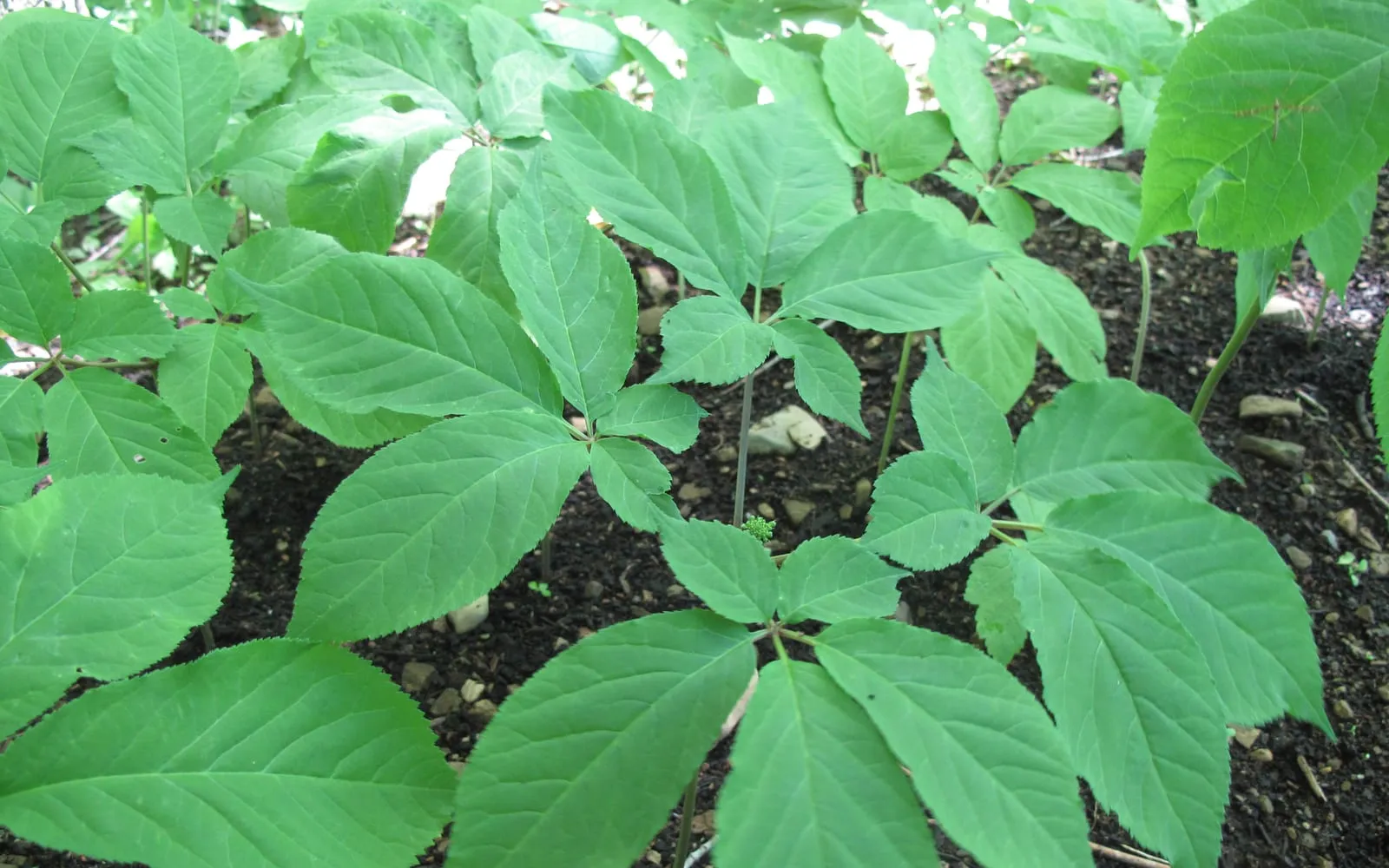
The plant grows as a single stem topped by a whorl of compound leaves, each with five leaflets, which is where five-fingers comes from. The two lower leaflets on each leaf are noticeably smaller than the three above, and the leaflets are stalked and toothed, with a drawn-out tip.
Age is read from the number of leaves in the whorl. One leaf in the first season, two in the second or third, three in a mature plant, four in an old one. The single flower stalk rises from the centre of the whorl in June and carries a small umbel of greenish-white flowers that a walker would not notice.
The berries are what people see. From August they ripen to a bright scarlet in a cluster of six to twenty, each holding two seeds, held above the leaves at a height that makes them obvious on a shaded forest floor. The root below is pale tan, ringed with fine wrinkles, and forks into two or three legs as it ages.
Where it is from
The native range is the eastern North American deciduous forest, from Quebec and Ontario south to Georgia and Louisiana, west to the Mississippi. The plant grows on cool north- and east-facing slopes under sugar maple, tulip poplar, basswood and oak, in soil with a deep leaf litter and a high calcium content.
It is a plant of intact forest. Ginseng does not colonise a clearing or a young plantation, which is why land clearance and logging have cost it as much habitat as digging has cost it plants. Populations that survive are usually on steep ground nobody could farm.
Harvest is regulated across its range. Nineteen American states permit a licensed wild harvest with a defined season, minimum plant age and a requirement to plant the seeds from any plant dug, and export needs a CITES permit. The rules exist because the species was on a clear path to commercial extinction.
How it grows
The plant emerges in late April, unfolds over two or three weeks, flowers in June, ripens fruit in August and September, and dies back to the ground by October. That is the whole visible year, and root growth happens within it.
Below ground the root contracts each autumn, pulling the crown a little deeper and leaving a scar where the stem was. Counting those scars on the neck of a lifted root gives its age, which is how harvest rules that specify a minimum of five years are enforced.
Seed behaves as Asian ginseng’s does. A fresh seed carries an immature embryo, needs a warm period and then a cold one, and germinates in the second spring after the berry ripened. Seed that dries out at any stage is dead, which is why growers move it straight from the fruit into damp sand.
Through the seasons
Sow stratified seed in September or October, 2 cm deep, 15 cm apart, into a shaded bed with leaf mould worked in. Cover with a few centimetres of leaf litter to mimic what would fall on it in a wood.
Nothing shows the following spring in most cases. Seedlings appear the spring after that, as a single three-leaflet stalk a few centimetres high, and they need protecting from slugs from the day they emerge.
From then the work is annual and light. Renew the leaf litter each autumn, hand weed rather than hoe, and leave the plants alone. Lift in the autumn of the fifth year at the earliest, after the top has died down, using a fork well away from the crown.
Care difficulty
Nothing here is technically hard. The plant is hardy, needs no feeding and has no pruning. The difficulty is that a bed takes seven years to reach a harvest and any one of those years can take it out.
Choose the site with that in mind. Deep shade, a slope or raised bed for drainage, and somewhere you will not want to dig for a decade. A bed under a mature deciduous tree on a north-facing bank is close to ideal, and a spot that puddles in February will kill every plant in it one winter.
Growers in North America distinguish wild-simulated from woods-cultivated plantings. Wild-simulated means scattering seed into forest litter and doing nothing else, which loses most of the seed and produces the gnarled roots the market pays most for. Woods-cultivated means prepared beds, which gives more plants and a smoother root.
Watering
A properly made woodland bed rarely needs watering in Britain. The leaf mould layer holds moisture and the shade keeps evaporation low, which between them cover most summers.
In a drought, water at the base in the evening, enough to wet the top 15 cm, and avoid wetting the foliage. Wet leaves in still warm air are how Alternaria gets started, and a plant that loses its leaves in July makes no root that year.
Winter drainage is the more important half of the water question. Standing water for a fortnight in February kills roots that have survived every summer since they germinated.
Warning signs, diseases and pests
Slugs first. One stem carries the whole plant, so a slug that fells a seedling removes a year and often the plant. Sharp grit around the crowns, a night patrol in wet weather and beer traps at the bed edge all help.
Alternaria panax is the disease that ends a wet summer. It shows as brown lesions with yellow margins on the leaflets, spreads fast in humidity, and defoliates the plant. Spacing, air movement and clearing dead tops in autumn reduce it. Botrytis takes hold on any damaged tissue in a still damp bed.
Larger animals matter more here than with most garden plants. Deer browse the tops and are the main reason wild plants fail to set seed. Voles tunnel to the roots in winter under mulch. And where the plant is known to be growing, digging by people is a real risk, which is why growers in America keep quiet about their beds.
Growing environment
Deep shade under deciduous trees, at roughly a fifth to a quarter of full daylight. Evergreen shade is too dark and too dry at the root; conifer needles also acidify the soil past what the plant wants.
Soil should be deep, crumbly and rich in leaf mould, slightly acid at pH 5.5 to 6.5, and well supplied with calcium, which is why the plant favours ground under maple and lime. Free drainage is not negotiable.
A cold winter is part of the plant’s requirement rather than a hazard to protect it from. It needs several months below 5 deg C to break dormancy properly, so northern and upland temperate gardens suit it better than mild coastal ones.
Feeding
Leaf mould laid on top each autumn, and nothing else. This is a plant adapted to a forest floor where nutrients arrive as slowly rotting leaves.
Manufactured fertiliser produces soft growth that fungal disease exploits, and concentrated salts damage the fine feeder roots. Growers who want a heavier crop use a deeper leaf litter rather than a feed.
Where the underlying soil is sandy or poor, improve it with composted leaves and bark before planting. There is no chance to correct it later without disturbing roots that need seven undisturbed years.
Troubleshooting
How is it different from Asian ginseng? A separate species with a different balance of ginsenosides and, in Chinese practice, an opposite character. Panax ginseng is treated as warming and Panax quinquefolius as cooling. The plants look similar, and American ginseng usually has stalked, more sharply toothed leaflets.
Is it protected? Yes. The species is on CITES Appendix II, so international trade needs a permit, and wild harvest in the United States is regulated by state with licences, seasons and a minimum age. None of that restricts growing your own plants in a garden.
How long before a harvest? Five years minimum from seedling, and seven for a root of any size. Add eighteen months if you start from seed rather than from bought roots.
Why has nothing come up from my seed? Stratification is probably still under way. Fresh seed needs a warm period followed by a cold one and usually appears in the second spring. Seed that dried out before sowing will never germinate.
Can I grow it under conifers? Poorly. The shade is too dense in winter, the soil is dry at the root and the needle litter acidifies the ground past what the plant wants. Deciduous shade is what it evolved under.
What does wild-simulated mean? Seed scattered into forest litter with no bed preparation, so the plants grow as slowly and as gnarled as wild ones. Buyers pay more for that shape. Yields per seed are much lower than in a prepared bed.
Something has eaten the whole plant. Deer if the stem is bitten off cleanly at height, slugs if the damage is at ground level in wet weather, voles if the plant vanishes in winter and the root has gone with it.