
Outdoor plant
Goldenseal
Hydrastis canadensis
Also known as Orangeroot, Yellow puccoon, Yellowroot
How to grow Hydrastis canadensis in a shaded bed. The yellow rhizome that named it, why wild digging put it on CITES Appendix II, and dividing rather than sowing.
At a glance
- Difficulty
- Difficult
- Water
- Rarely, in a bed that holds leaf mould
- Light
- Deep shade under deciduous trees
- Temperature
- Fully hardy, and it needs a cold dormancy
- Hardiness
- USDA 3-7, RHS H7, hardy to -30 C
- Type
- Herbaceous perennial from a yellow rhizome
- Height
- 20-40 cm
- Native to
- the deciduous forests of eastern North America, from Ontario to Arkansas
Deep woodland shade of 70 to 80 per cent, rich moist leaf-litter soil and a cold winter are all required, and four or five years pass before a root is worth lifting. It is listed on CITES Appendix II, and wild populations across the eastern United States have been stripped by digging, so buy cultivated stock.
Hardiness zones describe winter cold alone. Summer heat, humidity, rainfall and the length of the growing season decide as much, so treat the range as the outer limit rather than as a recommendation.
Toxic if eaten
- Do not eat
- The rhizome and the berries
- Harm from
- Eating it
- Affects
- People, cats and dogs
Goldenseal contains berberine and hydrastine, two isoquinoline alkaloids, and the yellow colour of the rhizome comes from the berberine. NC State Extension lists Hydrastis canadensis as poisonous, with the roots and the fruit named as the toxic parts, and records nausea, vomiting and mouth ulceration among the effects of eating them. The raspberry-like fruit is the risk in a garden, since it looks edible and sits at knee height in late summer. The plant does not appear on the RHS list of potentially harmful garden plants, which reflects how seldom it is grown in British gardens rather than a finding of safety, and the ASPCA does not list it. Berberine is documented as unsuitable during pregnancy and in newborns, where it can displace bilirubin, and that caution appears consistently across pharmacological references. None of this makes the plant unsafe to grow. It makes the fruit something to know about before planting it where small children play.
Sources: NC State Extension, Hydrastis canadensis, LiverTox, Berberine, RHS potentially harmful garden plants, ASPCA toxic and non-toxic plants, NHS on herbal medicines
About
Break a goldenseal rhizome and the broken face is chrome yellow, bright enough that Cherokee and Iroquois people used it as a dye for cloth and skin as well as a medicine. That yellow is berberine, an alkaloid the plant shares with barberry and Oregon grape, and it is the reason the species has been dug out of the Appalachian woods for two hundred years.
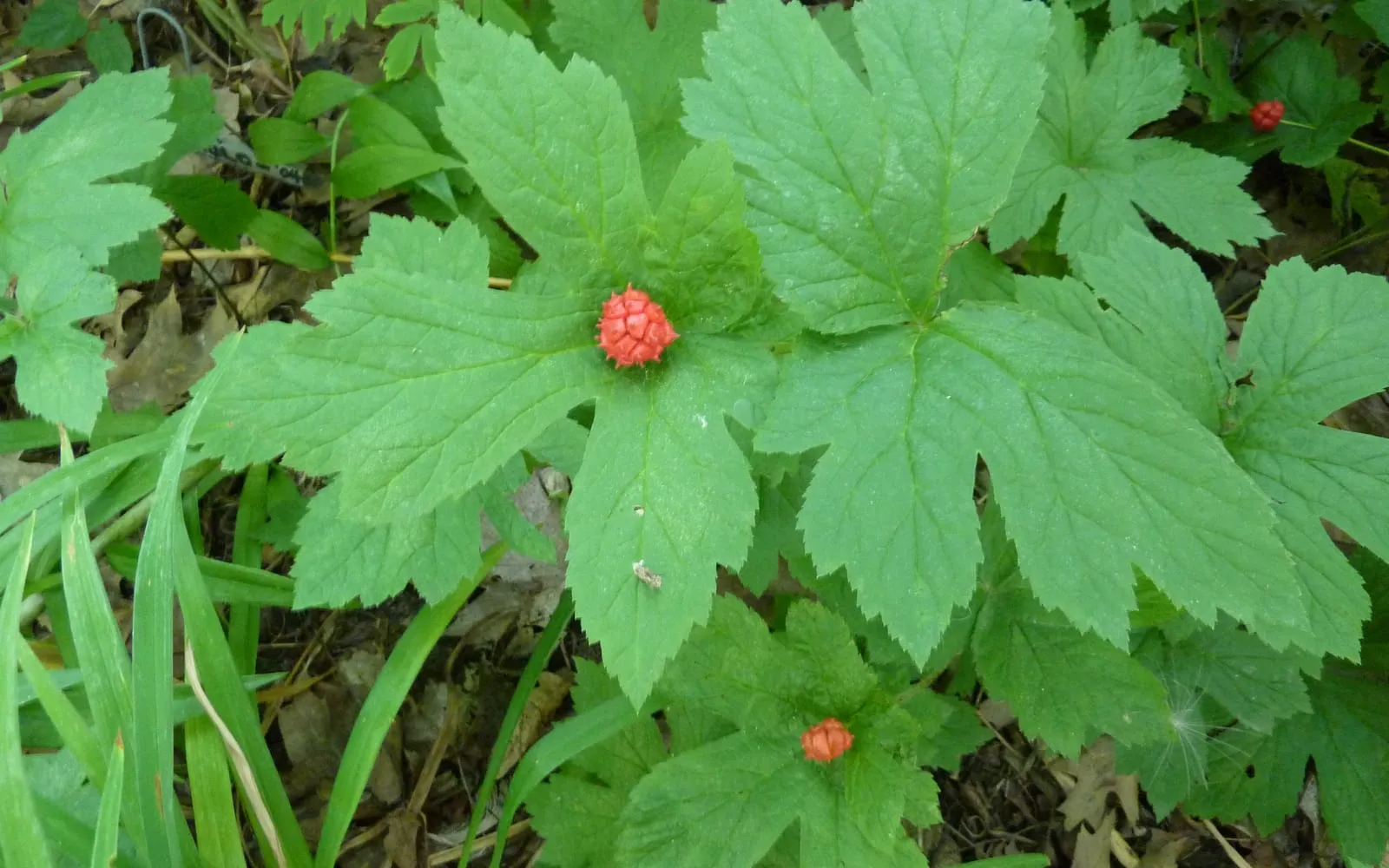
The plant itself is unassuming. Two lobed leaves on a hairy stem, no more than knee high, spreading slowly into a patch by rhizome. It flowers for a few days in April with no petals at all, then carries a single fruit that looks like a small red raspberry through August.
Wild harvest put goldenseal onto CITES Appendix II in 1997, alongside American ginseng. It is one of the most heavily traded North American medicinal plants and one of the most depleted, and United Plant Savers has listed it as at risk since the organisation was founded. Growing it from cultivated stock is the direct answer to that, which is the strongest argument for having it in a garden.
Appearance and character
A flowering stem carries two leaves, one larger than the other, each palmately lobed into five to seven toothed sections and wrinkled like a crumpled sheet. Non-flowering plants carry a single leaf on its own stalk, so a patch looks like two different plants growing together.
The flower opens in April at the top of the stem, and it has no petals. What you see is a brush of white stamens around a cluster of green pistils, lasting less than a week. Most people who grow goldenseal miss it.
The fruit is what the plant is recognised by. From July a single scarlet head of fused fleshy carpels sits above the leaves, looking like a raspberry that has been left on the plant too long. It holds ten to thirty hard black seeds. The rhizome below is knotty, twisted and bright yellow inside, with fine fibrous roots along its length.
Where it is from
The native range covers the eastern North American hardwood forest, from southern Ontario and Vermont west to Minnesota and south to Arkansas and Georgia, with the densest populations historically in the Ohio valley and the southern Appalachians.
Its habitat is rich, moist, shaded woodland with deep leaf litter, often on north-facing slopes and often alongside black cohosh, bloodroot and American ginseng. The plant needs the soil calcium and the leaf fall that a maple, beech and basswood canopy supplies.
Wild populations have fallen sharply. Habitat loss removed much of the forest, and commercial digging removed the plants from what remained, since the whole plant has to be lifted to take the rhizome. The species is now listed as threatened or endangered in a number of states and its export is controlled.
How it grows
Growth is a short spring burst followed by a long wait. Shoots emerge in April, expand, flower almost at once, and hold their leaves until September. The rhizome puts on most of its weight in late summer, after flowering.
Spread is by rhizome rather than by seed in practice. A clump extends a few centimetres a year, budding new crowns along the way, so an established patch thickens slowly outward. Seed germinates poorly and slowly, needing a warm period then a cold one, and most growers propagate by division for that reason.
A rhizome division reaches harvestable size in three to five years, which makes goldenseal quicker than either ginseng. Growers lift in autumn, take the older central rhizome and replant the young growing tips, which turns a harvest into a propagation round.
Through the seasons
Plant rhizome pieces in autumn, each with a visible bud, 5 cm deep and 20 cm apart, in a shaded bed with leaf mould worked in. Autumn planting lets the roots settle before the spring push.
Shoots come through in April and flower within days. Through summer the work is keeping slugs off, keeping the bed hand-weeded and leaving the leaf litter in place. The fruit ripens red in July and August and can be left on the plant.
The top dies down in September. Mulch with fresh leaf mould in October, which feeds the bed and protects the crowns. Lift and divide in autumn once a clump is three or four years old, replanting the growing ends.
Care difficulty
The plant is not fussy so much as specific. Give it shade, leaf mould and drainage and it grows steadily with no intervention. Give it sun, or soil that holds winter water, and it declines and disappears.
Sourcing is the first difficulty and the one worth taking seriously. Buy rhizomes from a nursery that propagates its own stock rather than from a supplier that cannot say where the material came from, because wild-dug goldenseal is still sold and buying it is the trade this plant needs least.
After that the work is small. A goldenseal bed asks for one autumn mulching and some slug vigilance in April, and gives back a slowly widening patch.
Watering
A shaded bed under a leaf mould mulch usually needs no watering in a cool summer. The plant wants soil that stays evenly moist, and in our climate shade plus mulch delivers that without a hose.
Water in a genuine drought, at the base, enough to wet the top 15 cm. The foliage is prone to fungal blotching if it stays wet, so water the ground and not the leaves.
Winter wet is the greater danger. The rhizome sits shallow and rots in soil that stays saturated, so drainage matters more than any summer watering.
Warning signs, diseases and pests
Slugs take the emerging shoots in April, and a shoot lost then is a plant lost for the season. Grit around the crowns and a patrol on damp evenings deal with most of it.
Fungal problems arrive in still damp weather. Botrytis grows on crowded or damaged foliage as a grey fuzz, and Alternaria leaf blight produces brown lesions with yellow margins. Spacing plants, thinning any overhead cover that blocks air movement and clearing dead tops in autumn all reduce both.
Rhizome rot is the disease that kills a bed. It follows waterlogging, and by the time the foliage yellows early the rhizome is soft. Voles are the other underground problem, tunnelling under mulch and eating rhizomes through the winter.
Growing environment
Deep deciduous shade, about a fifth to a quarter of full daylight. Under a lime, maple or beech is the natural analogue, and the north side of a wall with overhanging shrubs works too.
Soil should be deep, crumbly and rich in leaf mould, with a pH near neutral at 6.0 to 7.0, and drainage that stops water standing. Goldenseal is a calcium lover, so a soil that suits hellebores suits it.
It needs a cold dormancy, which temperate winters supply. The plant is hardy to around minus 30 deg C, and it is heat rather than cold that limits it at the southern end of its native range.
Feeding
Leaf mould in autumn is the whole feeding programme. A 5 cm layer over the bed feeds the plants, keeps the soil cool and protects the rhizomes.
Manufactured fertiliser is unnecessary and risky. The fine roots are sensitive to salts, and soft growth from nitrogen is what botrytis and Alternaria settle on first.
Where the underlying soil is acid, a scattering of ground limestone before planting brings the pH towards neutral and suits the plant better than any feed would.
Troubleshooting
Why is goldenseal so expensive? Because most of it was dug from the wild for two centuries and the wild populations ran down. It is listed on CITES Appendix II, it takes three to five years from a division to a harvestable rhizome, and demand is high enough that cultivated supply has never caught up.
Can I grow it from seed? With difficulty. Seed needs a warm period then a cold one, germinates erratically over two springs and must never dry out. Division of a rhizome in autumn is faster and far more reliable.
How do I know a supplier is not selling wild-dug rhizome? Ask where the stock was propagated. A nursery that raises its own will say so. Prices that undercut the market usually indicate wild material.
Is the berry edible? No. NC State Extension lists both the fruit and the roots as poisonous, causing nausea, vomiting and mouth irritation. The fruit looks like a raspberry and sits at knee height, so tell children to leave it alone before you plant one.
Why has my patch stopped spreading? Usually too much light or too little moisture. Goldenseal spreads by rhizome only when the top growth is healthy through the summer, and a plant scorching in June makes no new buds.
When do I harvest? In autumn from the fourth year, after the top dies down. Lift the clump, cut off the older knotty central rhizome and replant the young growing tips at once so the bed continues.
Something ate the rhizomes over winter. Voles, almost certainly. They work under a mulch layer where a cat or an owl cannot reach them. Pull the mulch back from the crowns in late autumn if voles are a known problem in your garden.