
Edible
White Yam
Dioscorea rotundata
Also known as Guinea yam, White Guinea yam, Isu, Puna yam
How to grow white yam, Dioscorea rotundata. The staple of the West African yam belt, why pounded yam behaves the way it does, and the two-harvest trick growers use on one plant.
At a glance
- Difficulty
- Moderate
- Water
- Twice a week in growth, stopping as the vine dies back
- Light
- Full sun
- Temperature
- 25-30 deg C, and nothing below 15
- Humidity
- High through the growing season, drier as it matures
- Hardiness
- USDA 10-12, RHS H1b, hardy to 8 C
- Type
- Tender perennial climber grown from a tuber
- Height
- 8-12 m in the tropics, 3 m under glass in a short season
- Native to
- West Africa
- Best month
- April in the Northern Hemisphere, October in the Southern Hemisphere
The preferred yam of West Africa and the most demanding of the group, wanting 7 to 10 months of steady warmth, deep friable soil and a distinct dry season to trigger dormancy. Nothing below 15 deg C. Tubers sprout as soon as the rains return, so storage barns are built for air rather than for cold.
Hardiness zones describe winter cold alone. Summer heat, humidity, rainfall and the length of the growing season decide as much, so treat the range as the outer limit rather than as a recommendation.
Every month named in this guide is for the temperate Northern Hemisphere. If you garden in the Southern Hemisphere, shift each one by six months, so April becomes October. Closer to the equator the wet and dry seasons matter more than the calendar, and the shift stops being a useful guide.
Skin irritant
- Safe to eat
- The cooked tuber
- Do not eat
- Raw tuber, which irritates the mouth, and the sap, which itches on the hands
- Harm from
- Eating it and handling it
- Affects
- People
White yam is the staple food of tens of millions of people in West Africa and is safe once cooked. Raw tuber contains calcium oxalate and saponins that irritate the mouth and throat, and peeling a quantity by hand leaves the skin itching, which is why it is peeled under water or with gloves. Cooking removes the problem and yam is never eaten raw. Wild Dioscorea species in the same region contain dioscorine and are seriously poisonous without days of leaching, so foraged yams of unknown identity are not food. Neither the RHS nor the ASPCA lists Dioscorea rotundata, and cooked yam does no harm to cats or dogs in small amounts.
Sources: RHS potentially harmful garden plants, ASPCA toxic and non-toxic plants
About
White yam is the single most important yam in the world. West Africa grows something over ninety per cent of the global crop and Nigeria alone accounts for most of that, in a band running from Cote d’Ivoire through Ghana, Togo, Benin and Nigeria into Cameroon that everyone involved calls the yam belt.
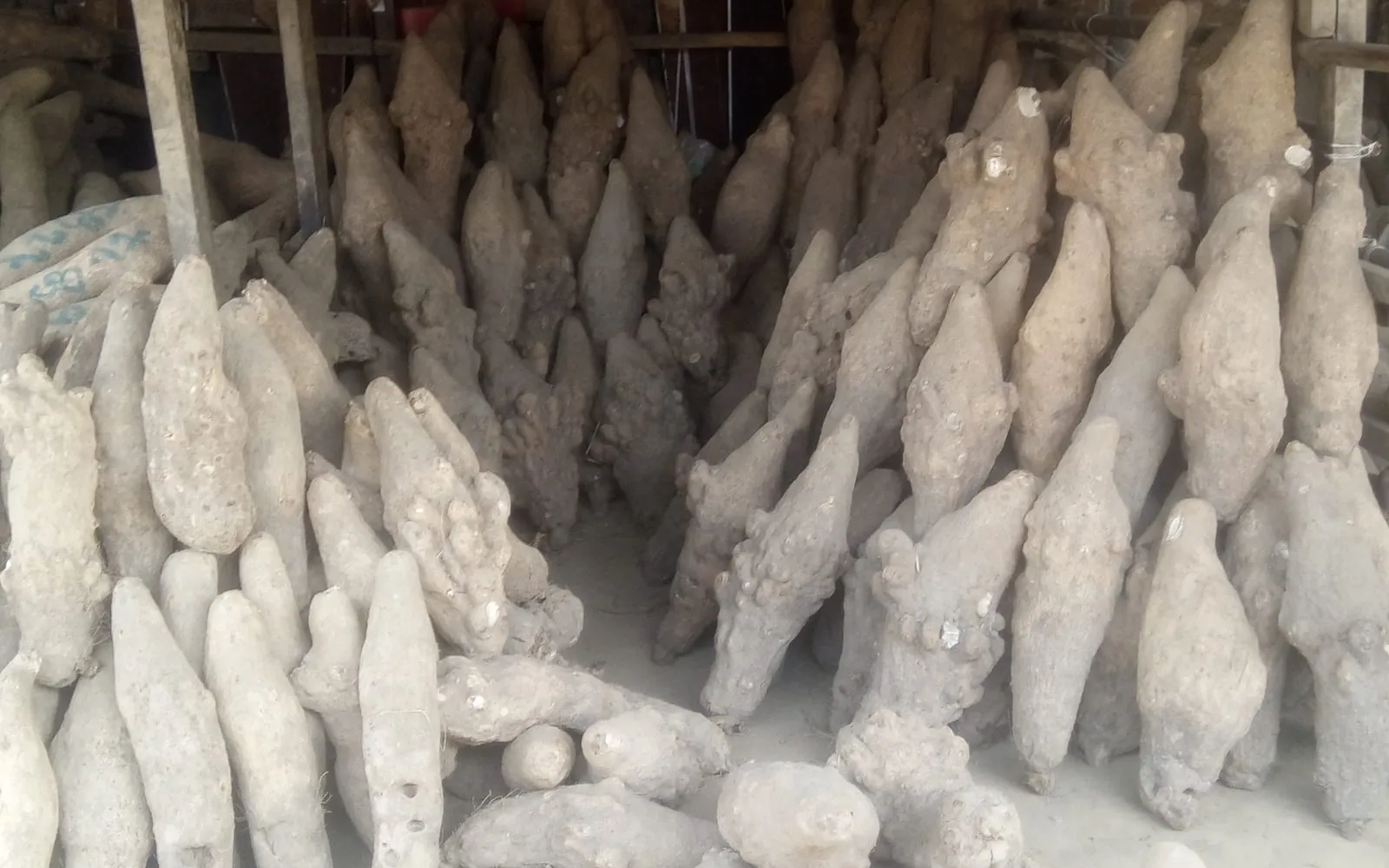
The tuber is a long brown cylinder, often a metre or more, with rough scaly skin and firm white flesh that cooks dry and floury rather than sweet or waxy. Boiled and pounded it makes iyan, the smooth elastic dough eaten with soup, and the texture depends on that dryness. A waxy yam will not pound.
Yam carries more cultural weight in West Africa than any other crop. New yam festivals mark the start of the harvest in Igbo, Yoruba, Akan and other communities, and nobody eats the new crop before them. Yam barns, built as open racks so the tubers can breathe, are a mark of a household’s standing.
Appearance and character
A twining perennial climber reaching 8 to 12 m in the tropics, grown from a tuber and dying back each year.
The stem is round in cross-section, unlike the square winged stem of greater yam, and it twines anticlockwise. Young stems near the base often carry short sharp spines.
Leaves are heart-shaped, 5 to 15 cm, arranged alternately on the stem in most cultivars, with the parallel veins running from base to tip.
Flowers are small, greenish and produced on separate male and female plants, though most cultivated stock rarely flowers.
Aerial bulbils are absent or rare, which separates it from greater yam at a glance.
The tuber is long, cylindrical and often over a metre, growing straight down into loose soil. Skin is thin, brown and scaly; flesh is white and firm.
Cooked flesh is dry and floury, holding together under a pestle, which is what makes it the pounding yam.
Where it is from
Dioscorea rotundata was domesticated in West Africa, and genetic work points to the wild forest species Dioscorea praehensilis and Dioscorea abyssinica as its parents, with the Niger river basin as the likely place it happened.
Cultivation is several thousand years old and predates the arrival of any crop from outside the continent. It is one of the few staple crops domesticated entirely in Africa.
Yam farming shaped the settlement pattern of the forest margin. The crop supports dense populations, stores for months without processing, and provided the agricultural base for the Igbo, Yoruba, Akan and Nupe societies.
Enslaved West Africans carried it to the Caribbean, where it is still grown in Jamaica, Barbados and Puerto Rico under the name white yam or Guinea yam.
It reaches African and Caribbean grocers worldwide, mostly from Ghana and Nigeria, sold whole or in cut sections.
How it grows
Plant a whole small tuber, a cut head, or a piece of a large tuber carrying at least one bud. The head end sprouts most reliably.
Dry or ash-dust the cut surface for a day before planting so it seals.
Plant in March or April, 10 cm deep, in a deep container or greenhouse border at 25 deg C.
Depth is everything. This species grows a long straight tuber and needs 60 cm or more of loose stone-free soil, or it forks and stays small.
West African growers plant on mounds or ridges for the same reason, and a raised bed under glass does the same job.
Give a tall support for the vine to twine around, and let it climb rather than sprawl.
Water steadily and keep the greenhouse warm and humid through summer.
Feed monthly, switching to high potash from August.
Stop watering when the vine yellows in autumn and harvest once it has died back fully.
Cure the lifted tuber for a week in warmth, then store it dry, dark and airy at about 15 deg C.
Through the seasons
March and April are for planting the tuber piece under heat.
May is the waiting month, since sprouting takes four to eight weeks.
June and July are vine growth, which happens fast once it starts.
August is when the tuber begins to bulk in earnest.
September is peak tuber growth, and the month the greenhouse heat is still earning its keep.
October brings yellowing foliage, which means stop watering.
November is harvest, once the vine is entirely dead.
Winter is storage on an airy rack in the dark at around 15 deg C.
Care difficulty
Moderate under glass and impossible outdoors in a cool climate.
The heat requirement runs from March to November, which is a long time to keep a greenhouse warm.
Sprouting is slow, and six weeks with nothing showing is normal rather than a failure.
Soil depth decides tuber quality more than anything else you do.
Lifting is delicate work, since a broken tuber will not keep.
The plant itself is untroubled once it is warm and growing.
Watering
Water twice a week once the shoot is growing.
Increase through August and September as the tuber bulks.
Keep humidity high in the growing months.
Water at the root, avoiding the crown.
Reduce from October and stop once the leaves yellow.
Keep the stored tuber dry, since damp in store is what rots it.
Warning signs, diseases and pests
Dark sunken lesions on leaves and stems are anthracnose.
No shoot after eight weeks usually means the piece rotted in cold wet compost.
Early yellowing in August means cold, drought or both.
A short forked tuber has hit a stone or the base of the pot.
Fine speckling with webbing is red spider mite.
Sticky leaves with black growth mean aphids.
A soft brown patch on a stored tuber began as a bruise, and careful lifting prevents it.
Sprouting in store from January is normal and is the signal to plant.
Growing environment
A heated greenhouse or conservatory. Outdoors is not an option outside the tropics.
Full sun.
Minimum 15 deg C, with 25 to 30 deg C for growth.
High humidity through summer.
At least 60 cm of loose, deep, stone-free soil or compost, ideally in a raised bed or a mound.
A tall support for twining.
A dark airy store at 15 deg C afterwards.
Feeding
Work compost deeply into the bed before planting, since surface feeding does little for a tuber growing a metre down.
Feed a balanced liquid feed monthly once the vine is up.
Switch to high potash in August.
Avoid heavy nitrogen, which lengthens the vine and shortens the tuber.
Mulch to keep the soil warm and moist.
Stop feeding as the foliage yellows.
Troubleshooting
How is this different from greater yam? The stem. White yam has a round stem, often spiny at the base, and twines anticlockwise. Greater yam has a four-winged square stem and twines clockwise. White yam also rarely produces aerial bulbils.
Why does it make better pounded yam? The flesh is dry and floury rather than waxy or watery, so it holds together under a pestle and takes on the smooth elastic texture iyan needs.
Can I eat it raw? No. Raw yam irritates the mouth and gut. It is always boiled, roasted or fried.
My tuber came out short and forked. It hit something. Yam needs 60 cm or more of loose stone-free soil, which is why West African farmers plant on mounds.
What is the two-harvest method? In West Africa growers lift the top part of the tuber during the season and leave the head in the ground to regrow a second tuber. It works where the season is long enough, which a cool climate never is.
How long does a yam keep? Four to six months on an airy rack in the dark at around 15 deg C, provided it was cured and never bruised. Do not refrigerate it.
Why is it a festival crop? Yam supports dense settlement, stores without processing and is difficult to grow well, so a good yam harvest was a measure of a household. New yam festivals across the yam belt mark the point at which the new crop may be eaten.
Can I use a supermarket yam as planting material? Sometimes. A firm tuber with an intact head end that has started to sprout in store is worth trying, and one that has been chilled probably will not grow.
White Yam problem guides
Not sure what is wrong? See the common vegetable pests guide.