
Edible
White Mulberry
Morus alba
Also known as Silkworm mulberry, Common white mulberry
How to grow white mulberry, Morus alba. The silkworm tree, why the fruit disappoints after black mulberry, and the fastest movement in the plant kingdom.
At a glance
- Difficulty
- Easy
- Water
- Weekly for the first two summers, rarely after that
- Light
- Full sun to light shade
- Temperature
- Hardy to about -25 deg C, hardier than black mulberry
- Hardiness
- USDA 4-9, RHS H6, hardy to -30 C
- Type
- Deciduous tree, long-lived
- Height
- 10-15 m
- Native to
- Northern China
- Best month
- August in the Northern Hemisphere, February in the Southern Hemisphere
Hardier, faster and blander than black mulberry, which is why it was planted for silkworms rather than for its fruit. It is invasive across much of North America, where it hybridises with the native red mulberry and is displacing it genetically as well as by shading. Check the local status before planting.
Hardiness zones describe winter cold alone. Summer heat, humidity, rainfall and the length of the growing season decide as much, so treat the range as the outer limit rather than as a recommendation.
Every month named in this guide is for the temperate Northern Hemisphere. If you garden in the Southern Hemisphere, shift each one by six months, so August becomes February. Closer to the equator the wet and dry seasons matter more than the calendar, and the shift stops being a useful guide.
Skin irritant
- Safe to eat
- The ripe fruit
- Do not eat
- The unripe fruit and the milky sap
- Harm from
- Eating it and handling it
- Affects
- People
The ripe fruit is food. As with black mulberry the milky sap and the unripe fruit contain irritant compounds, so a quantity of unripe berries causes stomach upset and the sap can irritate skin and eyes. Wash your hands after pruning. Neither the RHS nor the ASPCA lists Morus alba as harmful and the ASPCA does not record it as toxic to cats or dogs. Two points are specific to this species rather than the genus. The pollen is a significant allergen, and male white mulberry trees release it explosively in large quantities, so fruitless male clones sold as street trees are a poor choice for anyone with hay fever. And the leaves are the sole food of the domesticated silkworm, which means the foliage is extensively studied and understood to be safe to handle.
Sources: RHS potentially harmful garden plants, ASPCA toxic and non-toxic plants
About
White mulberry is the tree that made silk possible and the tree that disappoints anyone who plants it expecting black mulberry fruit. The berries are sweet and watery with very little acidity, closer to a bland fig than to the sharp complex fruit of Morus nigra.
Grow it for what it is rather than what it is not. It fruits young, crops heavily, tolerates cold, drought and poor ground, and it will feed silkworms if that is why you want it.
The species also performs the fastest movement known in the plant kingdom. The stamens are held under tension in the bud and release at over half the speed of sound, flinging pollen clear of the flower. The consequence for a gardener is prosaic, since that pollen is a serious hay fever trigger.
It is hardier and faster than black mulberry and lives nearly as long.
Appearance and character
A deciduous tree to 10 or 15 m, upright when young and spreading with age, more open and less gnarled than black mulberry.
Bark is grey-brown and finely fissured, paler and smoother than the orange rugged bark of Morus nigra.
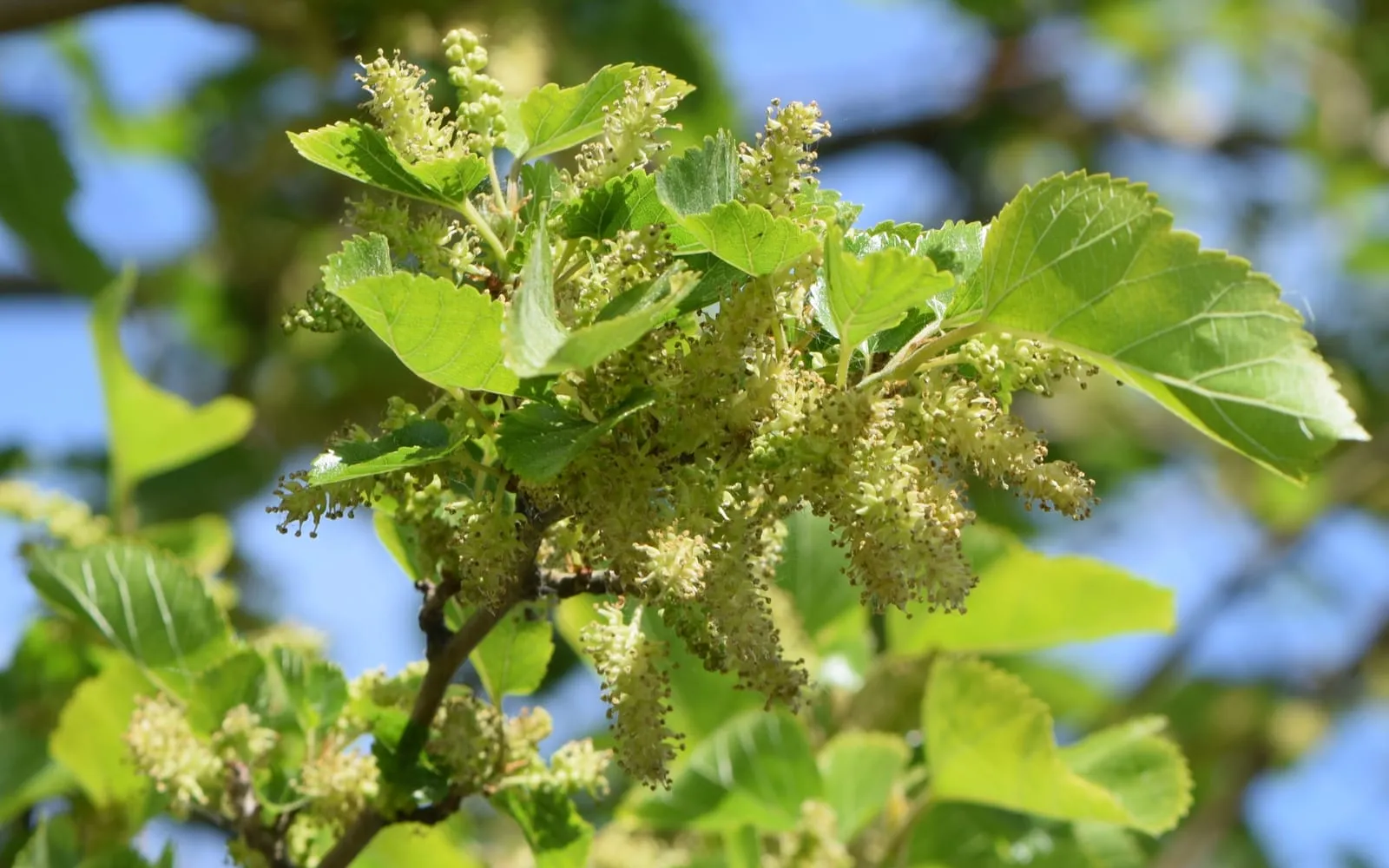
Leaves are the identifying feature and they refuse to settle on one shape. A single tree carries unlobed heart-shaped leaves alongside deeply two or three lobed ones, often on the same shoot. They are glossy, thin and smooth rather than rough.
Fruit is 1 to 2.5 cm, ripening white, pink, red or deep purple depending on the variety, and even the dark forms taste mild.
Flowers are green catkins, and trees may be male, female or both. Male clones are sold as fruitless street trees.
Autumn colour is a clear yellow.
Where it is from
White mulberry is native to northern China, where it has been cultivated for at least five thousand years for silk production.
Sericulture depends on it entirely. The domesticated silkworm, Bombyx mori, will eat the leaves of this species and nothing else, and the moth no longer exists in the wild.
The tree travelled west along the trade routes that silk itself opened, reaching the Mediterranean by the twelfth century and Britain by the sixteenth.
James I’s attempt to found an English silk industry in 1608 failed partly because the trees planted were black mulberry, which silkworms will not eat.
It has naturalised widely in North America, where it hybridises with the native red mulberry and is treated as invasive.
How it grows
Buy a named fruiting variety if you want fruit, since many nursery trees are fruitless male selections grown for street planting.
Plant in autumn or spring, in sun or light shade. White mulberry accepts almost any soil including dry, poor and alkaline ground.
Space at 8 to 10 m for a full-sized tree.
Stake for two years and keep grass off the base.
Prune between late November and early February and at no other time. Like black mulberry it bleeds heavily from cuts made when the sap is moving.
Keep pruning light. Remove dead, crossing and crowded wood.
Expect fruit from the third or fourth year, which is much sooner than black mulberry.
Harvest in August by shaking the branches over a sheet. Ripe fruit falls freely.
For silkworms, pick young leaves from the current season’s growth and use them fresh.
Through the seasons
Winter is the pruning and planting window, and the only safe time to cut.
Spring brings leaf and the explosive pollen release. Trees come into leaf earlier than black mulberry, usually in April.
Summer swells the crop. Water a young tree in drought.
August is the harvest. Fruit ripens over several weeks rather than all at once.
Autumn turns the leaves yellow. Expect seedlings next spring wherever birds have perched.
Care difficulty
Easy, and easier than black mulberry.
It tolerates cold to about -25 deg C, drought, poor soil and alkalinity, and it fruits within a few years of planting.
The same pruning rule applies. Cut only in full dormancy or the tree bleeds.
Two nuisances come with it. The pollen is a strong allergen, and the fruit is spread everywhere by birds, so seedlings appear across the garden and in neighbouring ones.
Choosing the right tree at the nursery is the other difficulty. A fruitless male clone looks identical to a fruiting female until the year it does not fruit.
Watering
Water weekly through the first two summers after planting.
An established white mulberry is notably drought tolerant and rarely needs watering in a temperate climate.
Water in a severe drought if a young tree is carrying fruit.
Mulch every second late winter with compost over the root spread.
The species tolerates dry ground far better than wet, so avoid a position that waterlogs.
Warning signs, diseases and pests
Sap bleeding from a cut means the tree was pruned outside dormancy. Confine pruning to December and January.
Bacterial canker sinks and darkens patches of bark with gum at the margin. Remove affected wood in dry summer weather.
Coral spot raises pink pustules on dead wood and enters through wounds. Cut back into clean wood.
Powdery mildew whitens the leaves in late summer and does no real harm this late in the season.
Birds take the fruit and then sow it. Seedlings appearing across the garden are the predictable result.
Fruit with no flavour is the species behaving normally rather than a fault. White mulberry is mild by nature.
No fruit at all on a mature tree usually means a male clone.
Growing environment
Full sun for the best crop, and it accepts light shade.
Almost any soil suits it. White mulberry grows on sand, chalk, clay and poor dry ground where black mulberry would struggle.
It tolerates alkaline conditions well.
It withstands wind, urban pollution and coastal exposure, which is why it is planted as a street tree.
Give it space at 8 to 10 m, and keep it away from paving where the darker fruiting forms will stain.
Avoid planting near a seating area if anyone in the household has hay fever, since the pollen release is heavy and abrupt.
Feeding
White mulberry needs almost nothing on ordinary ground.
Mulch every second year in late winter with compost over the root spread.
Feed a young tree with a balanced spring feed for its first two years to help it establish.
Avoid nitrogen-rich feeds on an established tree, which produce soft growth that canker enters.
On very poor sand, sulphate of potash at 20 g per square metre in February improves fruiting.
Troubleshooting
The fruit tastes of nothing much. That is white mulberry behaving normally, sweet and low in acid by nature. Plant Morus nigra for the sharp complex flavour.
The tree has never fruited. Probably a fruitless male clone sold as a street tree. Buy a named fruiting variety.
Sap is running from a pruning cut. Pruned outside dormancy. Leave it to seal and prune in December or January in future.
Seedlings are coming up all over the garden. Birds eating the fruit. Hoe them off while small.
The leaves are all different shapes. Normal. White mulberry carries lobed and unlobed leaves on the same tree, often on the same shoot.
Hay fever gets much worse near the tree in spring. The pollen release is heavy and explosive. There is no fix beyond distance.
Can I feed the leaves to silkworms? Yes, and this is the only mulberry they will eat. Use young fresh leaves from the current season’s growth.
Is it hardier than black mulberry? Yes, by about 10 deg C, and it also comes into leaf earlier.
White Mulberry problem guides
Not sure what is wrong? See the common vegetable pests guide.