
Edible
Black Mulberry
Morus nigra
Also known as Mulberry, Common mulberry
How to grow black mulberry, Morus nigra. Why it is never sold in shops, pruning only when fully dormant to stop it bleeding, and the long wait for the first crop.
At a glance
- Difficulty
- Easy
- Water
- Weekly for the first three summers, rarely after that
- Light
- Full sun
- Temperature
- Hardy to about -15 deg C once established. Young growth is frost-tender
- Hardiness
- USDA 7-10, RHS H5, hardy to -15 C
- Type
- Deciduous tree, very long-lived
- Height
- 8-12 m, and as wide
- Native to
- Western Asia, Northern Iran
- Best month
- August in the Northern Hemisphere, February in the Southern Hemisphere
Black mulberry is the tenderest of the mulberries and the slowest, taking eight to ten years to fruit and then living for centuries. It leafs out late enough to miss spring frost. Warm summers deepen the flavour, and in cool ones the fruit stays sharp.
Hardiness zones describe winter cold alone. Summer heat, humidity, rainfall and the length of the growing season decide as much, so treat the range as the outer limit rather than as a recommendation.
Every month named in this guide is for the temperate Northern Hemisphere. If you garden in the Southern Hemisphere, shift each one by six months, so August becomes February. Closer to the equator the wet and dry seasons matter more than the calendar, and the shift stops being a useful guide.
Skin irritant
- Safe to eat
- The ripe fruit
- Do not eat
- The unripe fruit and the milky sap
- Harm from
- Eating it and handling it
- Affects
- People
The ripe fruit is food and has been eaten for millennia. Two minor cautions apply and neither is serious. Unripe fruit and the milky white sap that leaks from cut stems and leaves contain irritant compounds, so eating a quantity of unripe berries causes stomach upset, and the sap can irritate skin on contact and eyes if transferred by a hand. Wash after pruning. Neither the RHS nor the ASPCA lists Morus nigra as a harmful plant, and the ASPCA does not record it as toxic to cats or dogs; a dog eating windfall ripe fruit is not a concern beyond the loose stomach any quantity of fruit produces. The practical warning about a mulberry has nothing to do with poisoning. The juice stains skin, clothes and paving a deep purple-red that does not wash out, so do not plant one over a patio, a path or anywhere cars park.
Sources: RHS potentially harmful garden plants, ASPCA toxic and non-toxic plants
About
You cannot buy a decent mulberry. The ripe fruit collapses at a touch and bleeds purple juice within minutes of picking, so it cannot be boxed, stacked or transported, and no supermarket has ever found a way round it. Growing your own is the only way to eat one properly.
The flavour repays it. A ripe black mulberry is deeper and more complicated than a blackberry, sharp and sweet at once, closer to a loganberry crossed with red wine.
Two things about the tree matter more than anything else. It bleeds sap from any cut made while the sap is moving, which means pruning happens in the depths of winter or not at all. And it is slow to start, taking five or six years to crop from a young grafted tree, then going on to fruit for three hundred more.
The stains are the other thing to know before planting. Ripe fruit drops, and what it drops onto stays purple.
Appearance and character
A broad, low-branched deciduous tree with a gnarled trunk and a spreading crown, 8 to 12 m at maturity and often as wide as it is high. Old trees lean heavily and prop themselves on their own limbs.
Bark is orange-brown and rugged, deeply fissured on an old trunk.
Leaves are large, rough to the touch, heart-shaped with a blunt tip and a coarsely toothed edge, dull dark green above. They come very late, often not until the end of May.
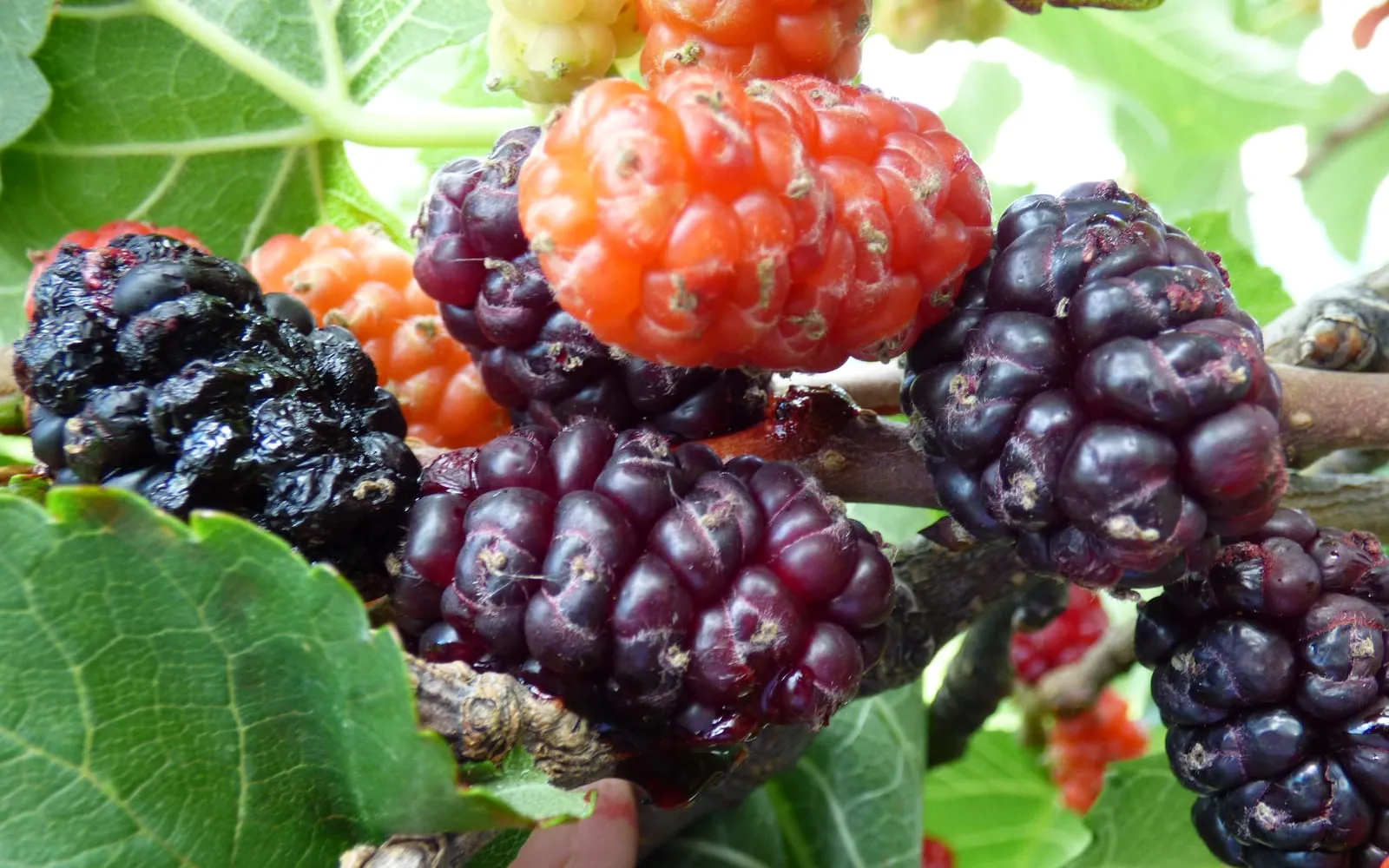
Fruit is a cluster of tiny fruits fused into one body, 2 to 3 cm long, ripening through green to red to a deep purple-black. Ripe fruit falls at the lightest touch.
Flowers are inconspicuous green catkins in spring, and the tree is self-fertile, so one is enough.
Autumn colour is a clear buttery yellow, and it holds late.
Where it is from
Black mulberry comes from western Asia, probably northern Iran and the southern Caucasus, and has been cultivated so long that its wild origin is uncertain.
The Romans grew it and brought it west. It has been in Britain since at least the sixteenth century and probably far earlier.
James I is the reason there are so many old mulberries in England. In 1608 he ordered thousands of trees planted to start an English silk industry, and the scheme failed because silkworms eat white mulberry, not black. The trees survived the plan and many are still standing.
Mulberries live a very long time. Trees at Charlton House, Syon Park and half the Oxford and Cambridge colleges are four centuries old and still fruiting.
The tree has never been a commercial crop anywhere, for the same reason it is not in the shops.
How it grows
Buy a container-grown, grafted or rooted-cutting tree from a fruit nursery. Seedlings take decades to fruit and may be poor.
Plant in autumn or spring in full sun, sheltered, in deep rich soil that holds moisture without waterlogging.
Choose the position carefully and permanently. Mulberry roots are brittle and the tree resents being moved, so a mistake is expensive.
Keep it well away from paths, patios, seating and parking. Dropped fruit stains everything beneath the canopy for six weeks a year.
Stake for three years and keep the base clear of grass.
Prune only between late November and early February, when the tree is fully dormant. A cut made at any other time bleeds sap heavily and the wound is slow to close.
Keep pruning minimal in any case. Remove dead, damaged and crossing wood and let the tree find its own shape.
Expect the first fruit in about five years and a serious crop from ten.
Harvest in August by spreading a sheet under the tree and shaking the branches gently. Ripe fruit falls; unripe fruit stays on.
Through the seasons
Winter is the only safe pruning window, between late November and early February. It is also the time to plant and to mulch.
Spring is a waiting game. Mulberry comes into leaf later than almost any other tree, often not until late May, and a bare mulberry in April is normal rather than dead.
Summer swells the fruit. Water a young tree weekly in a drought and net if birds are a problem, though a mature tree crops far beyond what they can take.
August is the harvest, running into early September. Lay a sheet and shake.
Autumn turns the leaves clear yellow. Rake fallen fruit off paving before it stains.
Care difficulty
Easy, once the two rules are respected.
Prune in full dormancy only. Sap bleeding from a summer cut weakens the tree and opens it to coral spot and bacterial canker, and it is the commonest way people damage a mulberry.
Plant it somewhere permanent and away from hard surfaces. The roots hate disturbance and the fruit stains.
Beyond that the tree is hardy, self-fertile, undemanding about feeding and almost free of pests.
Patience is the real cost. Five or six years to the first fruit is a long time in a small garden, and there is no way to hurry it.
Late frosts can catch the young growth in a cold spring, and an established tree shrugs this off.
Watering
Water weekly through the first three summers, 20 to 30 litres as a single slow soak rather than a daily splash.
An established mulberry is deep-rooted and rarely needs watering in a temperate climate.
Water in a long drought while the tree is carrying fruit, since drought stress gives small dry berries and can cause early fruit drop.
Mulch each late winter with 8 cm of compost over the root spread, kept clear of the trunk.
Do not plant on ground that sits wet over winter. Mulberry tolerates drought far better than waterlogging.
Warning signs, diseases and pests
Bleeding sap from a cut is the signal that you pruned outside dormancy. It rarely kills a tree and it does weaken it. Wait for full dormancy next time.
Coral spot shows as raised coral-pink pustules on dead wood and enters through wounds. Cut back into clean live wood and burn the prunings.
Bacterial canker sinks and darkens patches of bark, often with gum oozing from the edge, and kills the branch beyond. Remove affected limbs in dry weather in summer, which is the one exception to the winter pruning rule.
Birds take ripe fruit, though a mature tree produces more than they can manage.
Root rot follows waterlogging and is the main way a young mulberry dies.
Fruit that drops green usually means drought.
Leaves appearing very late is normal for the species and not a symptom.
Growing environment
Full sun. Fruit will not sweeten properly in shade.
Deep, rich, moisture-retentive soil that drains freely is ideal. Mulberry is not fussy about pH and grows on anything from sand to clay provided winter drainage is good.
Shelter from cold spring winds protects the late young growth.
Give it room. A mature black mulberry is 10 m across and cannot be kept small without constant cutting, which is the one thing the tree does not tolerate.
Keep it away from paving, paths, patios, washing lines and parking. This is the single most common regret with a mulberry.
A lawn is a good position, since fallen fruit disappears into grass and the tree makes a fine specimen.
Feeding
Mulberry needs very little. On reasonable ground an annual mulch is enough.
Mulch in late winter with well-rotted compost or manure over the root spread, kept off the trunk.
Add sulphate of potash at 20 g per square metre in February on light or poor ground, which helps fruiting and firms the wood.
Avoid high-nitrogen feeding. It produces soft growth that frost damages and canker enters.
A young tree benefits from a balanced spring feed in its first two or three years while it establishes.
Troubleshooting
Sap is pouring out of a cut branch. The tree was pruned while the sap was moving. Leave the wound alone to seal itself and confine future pruning to December and January.
The tree is still bare in May. Normal. Black mulberry is among the last trees into leaf and often waits until the end of May.
It has been in six years and has never fruited. Likely still too young, especially from seed. A grafted tree fruits in about five years, a seedling can take fifteen.
The fruit is small and dry. Drought while the fruit was swelling. Water and mulch a young tree in a dry summer.
Purple stains all over the patio. The fruit is doing what mulberry fruit does. Nothing removes it reliably, which is why the tree wants a lawn.
Pink pustules on dead twigs. Coral spot. Cut back into clean wood and burn what you remove.
When is the fruit ripe? When it falls into your hand at the lightest touch and is fully black. Red fruit is not ready and tastes sharp.
Do I need two trees? No. Black mulberry is self-fertile.
Black Mulberry problem guides
Not sure what is wrong? See the common vegetable pests guide.