
Edible
Goji berry
Lycium barbarum
Also known as Wolfberry, Chinese boxthorn, Matrimony vine, Gou qi zi
How to grow goji berry, Lycium barbarum. A hardy sprawling shrub that fruits in its third year, needs no coddling, and takes some training to keep tidy.
At a glance
- Difficulty
- Easy
- Water
- First summer weekly, then in drought only
- Light
- Full sun
- Temperature
- Fully hardy to -25 deg C
- Hardiness
- USDA 5-9, RHS H6, hardy to -30 C
- Type
- Deciduous shrub, long-lived, suckering
- Height
- 2-3 m trained, sprawling to 3 m wide when loose
- Native to
- China, Tibet, Mongolia
- Best month
- August, September and October in the Northern Hemisphere, February, March and April in the Southern Hemisphere
Cold, drought, salt and poor alkaline soil are all taken without complaint, and the fruit sweetens only where summers are hot and dry. In a cool damp summer the crop is small and sharp. Boxthorns are declared weeds in parts of Australia and New Zealand, so check the local rules before planting one.
Hardiness zones describe winter cold alone. Summer heat, humidity, rainfall and the length of the growing season decide as much, so treat the range as the outer limit rather than as a recommendation.
Every month named in this guide is for the temperate Northern Hemisphere. If you garden in the Southern Hemisphere, shift each one by six months, so August becomes February. Closer to the equator the wet and dry seasons matter more than the calendar, and the shift stops being a useful guide.
Edible, with limits
- Safe to eat
- The ripe fruit, and the young leaves cooked
- Harm from
- Eating it
- Affects
- People
The ripe fruit is food, sold dried in every health-food shop, and the young leaves are cooked as a vegetable across southern China. The caution is a drug interaction rather than a poisoning. Case reports link goji fruit and juice to a raised INR in people taking warfarin, so anyone on that medication should ask a pharmacist before eating it regularly. Lycium belongs to the nightshade family alongside tomato and potato, and as in those crops the fruit is the part that is eaten while the root bark and the unripe fruit are not. Neither the RHS nor the ASPCA lists the genus among plants harmful to people or pets, and no poisoning of cats or dogs is recorded from the berries.
Sources: RHS potentially harmful garden plants, ASPCA toxic and non-toxic plants
About
Goji arrived in garden centres on the back of a health-food boom and got a reputation for being difficult, which it does not deserve. The plant is hardy to -25 deg C, grows on poor soil, and needs no protection anywhere in its hardiness range.
What it does need is patience and a framework. Nothing much happens for two years, then the plant fruits and keeps fruiting from August into October.
The habit is the awkward part. Stems are long, thin and arching, and left alone the plant becomes a sprawling tangle across whatever is next to it. Tied to wires or a post it makes a manageable upright shrub.
Fresh berries are milder than the dried ones people know, sweet with a slightly bitter tomato-like note behind them. They dry well on a rack in an airing cupboard.
Appearance and character
A deciduous shrub with long slender arching stems, grey-green and slightly angular, sometimes carrying small spines on older wood.
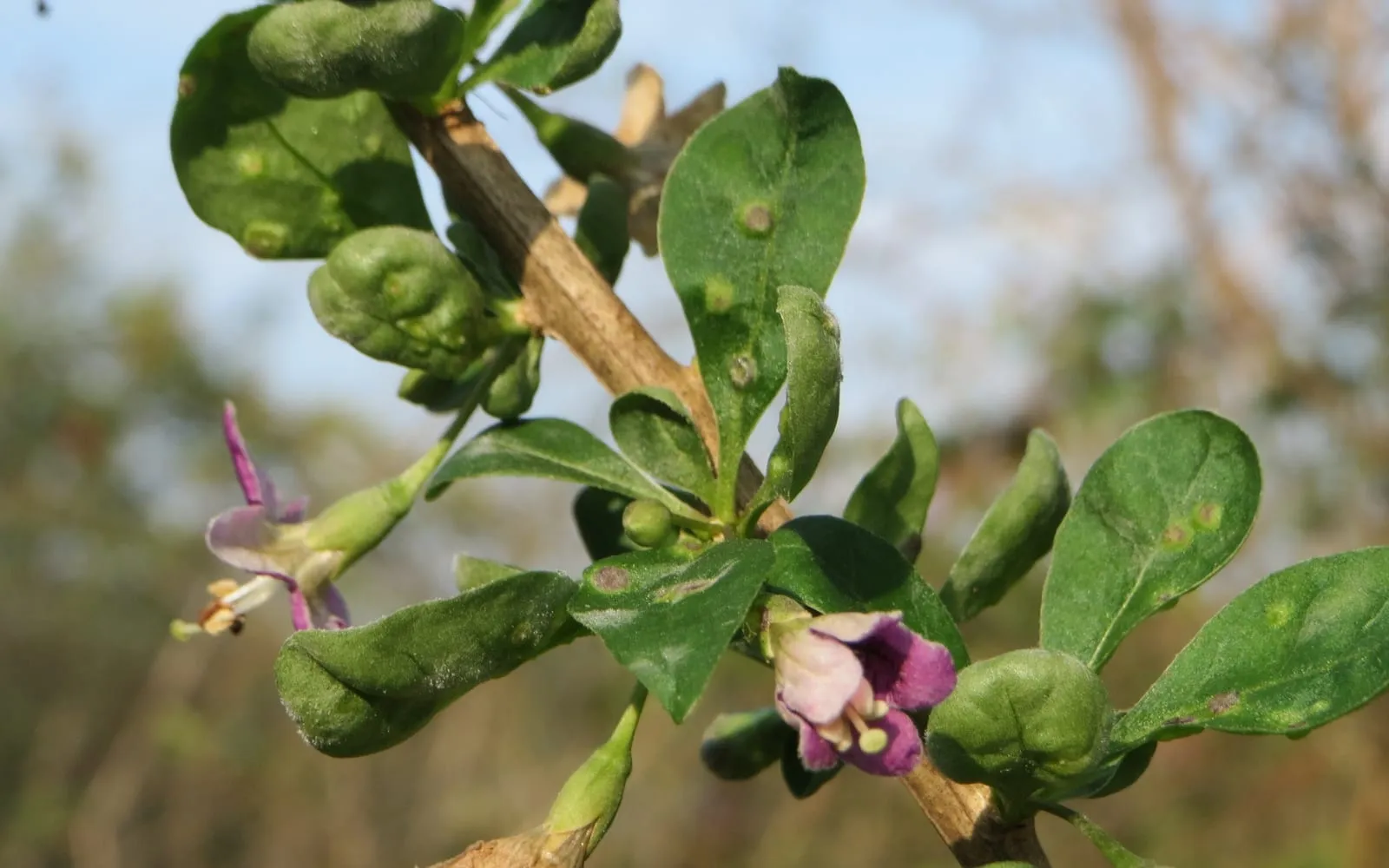
Leaves are narrow and lance-shaped, 3 to 8 cm, grey-green, borne in clusters along the stem.
Flowers open from June through to September, small and star-shaped, 1 cm across, purple fading to brownish with a paler throat and protruding stamens. The nightshade family resemblance is obvious in the flower.
Fruit is a bright orange-red oval berry 1 to 2 cm long, hanging on a thin stalk, ripening from August onwards. Flowering and fruiting overlap, so the plant carries both at once through late summer.
The root system suckers, sending up new shoots at a distance from the crown.
Where it is from
Lycium barbarum comes from northern China and Mongolia, where it grows on dry stony ground, riverbanks and scrub in a continental climate of hot summers and hard winters.
Cultivation is centred on Ningxia in north-central China, where the crop is grown in irrigated fields on alkaline soil and the region’s name is used as a mark of quality.
The berry has been in Chinese medicine for well over two thousand years, listed in the earliest surviving materia medica, and the leaves are cooked as a vegetable in the south.
It reached Britain in the eighteenth century and was planted in hedges long before anyone in Europe ate the fruit. Old naturalised plants survive on the Suffolk and Essex coast.
The English name wolfberry is a mistranslation. The Chinese gou qi zi has nothing to do with wolves, and the association came from a confusion with a similar-sounding word.
How it grows
Buy a container-grown plant of a named variety. Seedlings vary a great deal in fruit quality and take longer to crop.
Plant in autumn or spring in full sun, in well-drained soil. Slightly alkaline ground suits it, which is unusual among soft fruit and useful on chalk.
Give it support. A post and two horizontal wires, or a fan against a sunny wall, turns a sprawling plant into a productive one.
Cut the plant back to about 60 cm after planting to force branching from low down.
Tie in the strongest stems as they grow and shorten side shoots to about 15 cm in winter, since fruit forms on the current season’s growth from those spurs.
Expect a first crop in year two or three, building substantially by year five.
Through the seasons
Spring growth is late and can look worryingly slow. The plant leafs out in April and May and then extends quickly.
Flowering begins in June and continues into September, so the plant is in flower and in fruit at the same time for months.
August through October is the harvest. Pick when the berries are fully coloured and come away with a light pull, and go over the plant every few days.
Handle them gently. The skin bruises and the fruit oxidises to a dark stain where handled, which is why commercial pickers shake them onto sheets.
Dry the surplus on a rack somewhere warm and airy, or freeze it.
Prune in late winter, shortening side shoots and removing a proportion of the oldest stems at the base.
Care difficulty
Easy. It is hardy, drought-tolerant, undemanding about soil, and free of serious pests and diseases outside its native range.
The two things people get wrong are impatience and support. A plant that has not fruited by its second summer is normal rather than failing.
Training takes twenty minutes a year and transforms the plant from a sprawl into something you can pick from.
Mildew turns up in a still humid spot and is a siting issue rather than a disease problem.
The suckering habit needs watching in a small garden, though it is nothing like as vigorous as sea buckthorn.
Watering
Water weekly through the first summer while the roots establish.
After that, water only in drought. The plant comes from dry country and its roots go deep.
Fruit set improves with steady moisture in July and August, so a soaking during a long dry spell is worthwhile once the plant is cropping.
Overwatering is the more common error. Roots sitting wet, particularly on clay in winter, will rot.
A container plant needs regular watering all season and a pot of at least 45 cm with free-draining compost and plenty of grit.
Warning signs, diseases and pests
White powdery film across the leaves in late summer. Powdery mildew, which follows still air and dry roots. Thin the growth to improve airflow and mulch the root run.
Sticky curled shoot tips. Aphids. Ladybirds usually handle them, or rub them off.
Fine pale mottling on leaves with webbing underneath. Spider mite, most likely on a hot dry wall. Mist the foliage and improve air movement.
Whole plant yellowing and wilting on wet ground. Root rot. Improve drainage or move the plant, since it will not recover in saturated soil.
Berries disappearing as they colour. Birds. Net if the crop matters, since a plant in full production is worth protecting.
Shoots appearing a metre from the plant. Suckers. Slice them off with a spade in spring.
Growing environment
Full sun. The plant tolerates part shade and fruits poorly in it.
Free drainage is the requirement that matters most. Sandy, stony or chalky soil all suit it, and heavy clay is the one to improve or avoid.
pH from 6.5 to 8 is ideal, which makes goji one of the few fruits that prefers alkaline ground.
Shelter is helpful for the long stems, which whip about in wind and snap where they are not tied in.
It grows well in a large container, which also solves the suckering, though the crop will be smaller than from a plant in the ground.
Feeding
Little is needed. A balanced general fertiliser in spring covers a plant on poor ground.
Avoid high-nitrogen feeds, which produce long soft whippy stems and less fruit on a plant already inclined to sprawl.
Mulch with compost in spring, kept clear of the stems, which helps more with moisture than with nutrition.
On very poor sand a second light feed in June supports the long flowering period.
A container plant needs a balanced liquid feed fortnightly from May to August, since it cannot forage.
Troubleshooting
No fruit in the first two years. Normal. Goji takes two to three years to begin cropping and longer to reach full production.
Plant sprawling across everything nearby. Its natural habit. Put in posts and wires and tie the main stems in.
Flowers dropping without setting. Often heat and drought stress. Water through dry spells while it is flowering.
Berries bitter. Picked underripe, or a poor-quality seedling. Wait for full colour, and buy a named variety next time.
Leaves dropping in midsummer. Drought or waterlogging, which look similar. Check whether the soil is dry a spade’s depth down before deciding which.
Fruit staining dark where handled. Normal oxidation from bruising. Pick into a shallow tray rather than a deep tub.
Goji berry problem guides
Not sure what is wrong? See the common vegetable pests guide.