
Outdoor plant
White Jute
Corchorus capsularis
Also known as Jute, Pat, Bengal jute, Round-pod jute
How to grow white jute, Corchorus capsularis. The fibre that built Dundee and Bengal, how retting turns a stem into thread, and the round pod that names the species.
At a glance
- Difficulty
- Moderate
- Water
- Two or three times a week, and it tolerates standing water
- Light
- Full sun
- Temperature
- 24-32 deg C, and it stops below 15
- Humidity
- High. It is a monsoon crop
- Hardiness
- USDA 10-12, RHS H1b, hardy to 8 C
- Type
- Tender annual
- Height
- 2-4 m
- Native to
- South Asia, India, Bangladesh
- Best month
- May in the Northern Hemisphere, November in the Southern Hemisphere
A monsoon crop, wanting 24 to 32 deg C with heavy rain and then a dry spell for retting, which is why the fibre industry sits in Bangladesh and West Bengal and nowhere else at scale. Nothing below 15 deg C. It tolerates flooding better than almost any crop.
Hardiness zones describe winter cold alone. Summer heat, humidity, rainfall and the length of the growing season decide as much, so treat the range as the outer limit rather than as a recommendation.
Every month named in this guide is for the temperate Northern Hemisphere. If you garden in the Southern Hemisphere, shift each one by six months, so May becomes November. Closer to the equator the wet and dry seasons matter more than the calendar, and the shift stops being a useful guide.
Harmful if eaten
- Do not eat
- The seeds, which contain cardiac glycosides, and the bitter leaves
- Harm from
- Eating it
- Affects
- People, cats and dogs
White jute is a fibre crop rather than a food, and the distinction matters because its close relative tossa jute is eaten daily across Egypt and West Africa. The leaves of Corchorus capsularis are bitter and are eaten only in a few places and only after long cooking, which is why the leaf trade uses the other species. Seeds of both carry cardiac glycosides of the corchoroside group, which act on the heart in the way digitalis does, and seed in animal feed has caused livestock poisoning. Treat the seed as poisonous and keep it away from children and animals. Neither the RHS nor the ASPCA lists the species by name. Retting water is foul and should be kept away from ponds and watercourses.
Sources: RHS potentially harmful garden plants, ASPCA toxic and non-toxic plants
About
White jute is the fibre crop, and it built two cities. Bengal grew it and Dundee spun it, and by the late nineteenth century a Scottish town on the Tay was processing Bengali stems into sacking for the whole British Empire. Bangladesh and India still supply almost all the world’s jute.
The fibre is bast, the long cells in the inner bark of the stem. Freeing it means retting, standing cut stems in slow water for one to three weeks until bacteria have rotted the soft tissue away, then beating and stripping the fibre out by hand. It is filthy work and it is how the whole crop is processed.
Botanically it is the round-podded jute, which is what capsularis records. Its sibling, tossa jute, makes a long slim pod and softer stronger fibre, and its leaves are the molokhia of Egyptian cooking. White jute leaves are bitter and almost nobody eats them.
As a garden plant outside the tropics it is a curiosity rather than a crop. A polytunnel will grow a 3 m stem in a season, which is enough to try retting a bundle and find out what the work involves.
Appearance and character
A tall annual, 2 to 4 m, with a slender green or red-tinged stem. Grown close, as it is in the field, it runs straight up without branching, which is what the fibre needs.
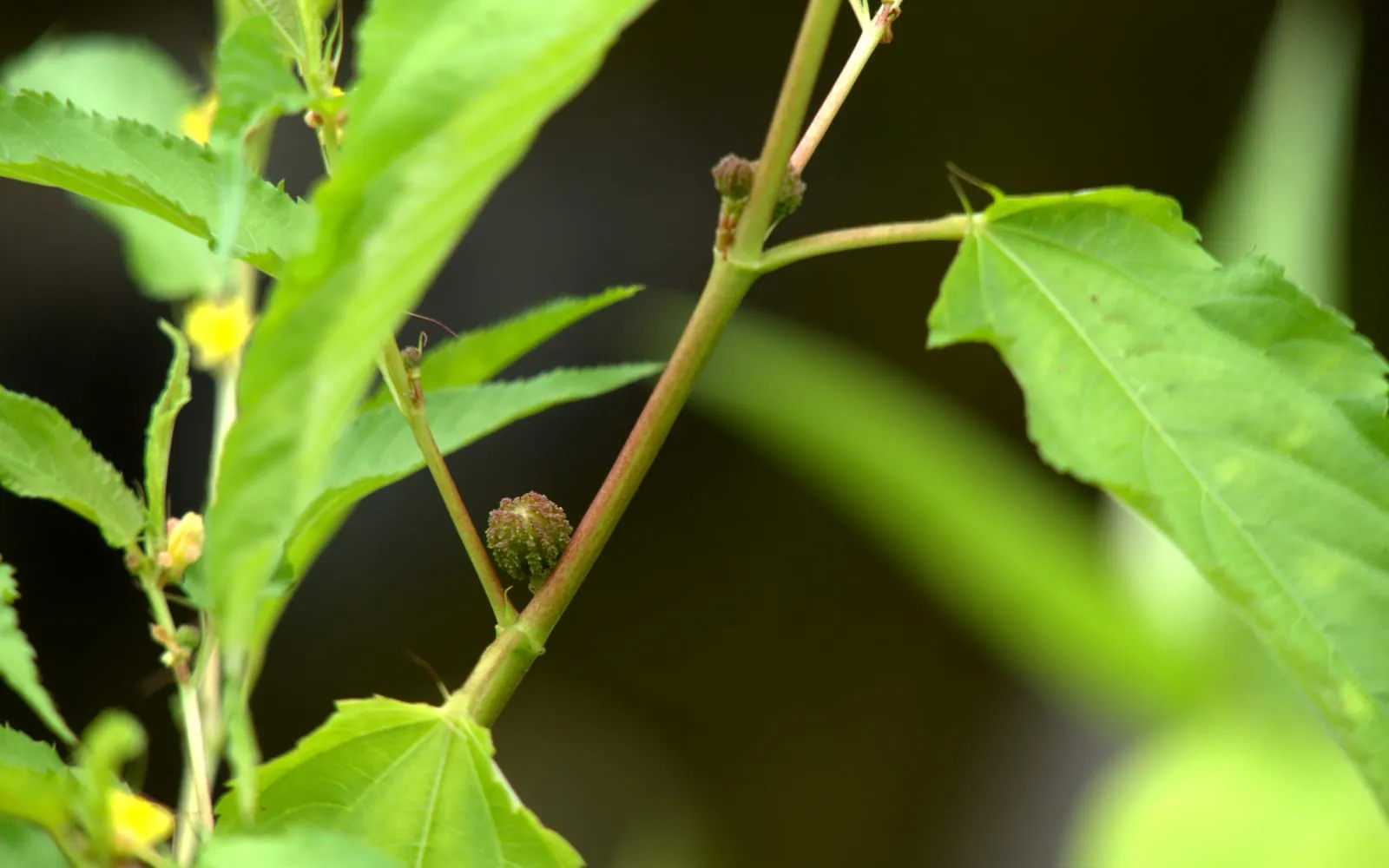
Leaves are oval to lance-shaped, 5 to 12 cm, finely toothed, with two thread-like tails at the base of the blade in the same way as tossa jute.
Leaf taste separates the two species faster than any other test. White jute leaves are noticeably bitter; tossa jute leaves are mild.
Flowers are small, yellow and five-petalled, about 1 cm, borne singly or in pairs.
The pod is the name. A short rounded capsule about 1 cm across, wrinkled and almost spherical, splitting into five valves. Tossa jute’s is a slim cylinder several centimetres long.
Seeds are tiny, angular and brown.
The stem in cross-section shows a thin woody core surrounded by a ring of bark where the fibre lies, and that ring is what retting frees.
Where it is from
Corchorus capsularis is native to South Asia, most likely the Indo-Burma region, and it has been grown in Bengal for weaving and cordage for a very long time.
Bengali households wove jute for domestic use for centuries before it became a commodity.
The East India Company and Dundee’s flax spinners changed that in the 1830s, when Dundee mills discovered that jute could be spun on flax machinery if it was softened with whale oil. Dundee had whale oil in quantity from its own fleet, and the industry followed.
Calcutta mills grew from the 1850s and eventually overtook Dundee. Jute sacking carried grain, sugar, coffee and cotton around the world and sandbagged the trenches of the First World War.
Synthetic fibre took most of that trade after the 1960s. Bangladesh and India still produce almost all of the world crop, and jute is finding a second market as a biodegradable alternative to plastic geotextiles and packaging.
How it grows
Sow in May at 22 to 25 deg C, 5 mm deep, into a greenhouse or polytunnel border.
Sow thickly and thin only lightly. Close spacing at 5 to 10 cm is what forces the plants to run up unbranched, and a plant given room branches and gives short useless fibre.
Give full sun, heat and humidity. It is a monsoon crop and enjoys conditions that would rot most things here.
Water generously and never let it dry out.
Feed a nitrogen-rich feed fortnightly, since the crop is stem length.
Harvest at flowering or just after, cutting the stems at ground level. Later cutting gives more fibre and coarser fibre, and the trade cuts at early pod.
Strip the leaves off and tie the stems into bundles.
Ret the bundles in slow-moving or standing water for one to three weeks, weighted under the surface, checking every few days until the bark slips off under a thumb.
Strip the fibre from the woody core by hand under water, wash it, and hang it to dry.
Dispose of the retting water away from ponds and watercourses, since it is strongly deoxygenating.
Through the seasons
May is for sowing thickly under cover.
June is upright growth, and the plants gain height quickly.
July is the fastest growth period, and the point at which close spacing has already decided whether the stems are straight.
August brings flowering, which is the harvest signal.
Late August is cutting and bundling.
September is retting, which takes one to three weeks depending on the water temperature.
October is stripping, washing and drying the fibre.
Winter is nothing, other than saving seed and keeping it away from animals.
Care difficulty
Moderate, and the difficulty is retting rather than growing.
The plant grows fast and easily given warmth, water and humidity.
Close sowing is the single technique that decides whether the fibre is usable.
Retting is smelly, slow and easy to get wrong in either direction, since under- retted stems will not strip and over-retted fibre falls apart.
The water afterwards is a disposal problem rather than something to tip into a pond.
Anyone growing this outside the tropics is growing it to understand it rather than to make sacking.
Watering
Water two or three times a week and never let it dry out.
Increase in hot weather, since the plant is used to a monsoon.
It tolerates standing water at the root better than any other plant in this wave except taro.
Water at the root, though the foliage is untroubled by wet.
Keep humidity high in the tunnel.
Reduce only when the plants are approaching harvest.
Warning signs, diseases and pests
Plants branching rather than running up mean they were sown or thinned too far apart.
Seedlings collapsing at soil level are damping off from cold wet compost.
Grazed seedlings are slugs.
Brown lesions at the stem base spreading upwards are stem rot, which is the main disease of the crop in Bengal.
Curled tips with sticky residue are aphids.
Fine speckling with webbing is red spider mite in dry air, which also signals the tunnel is too dry for the plant.
Fibre that will not separate from the core means the retting is not finished.
Fibre that breaks into short weak pieces means the retting went too far.
Growing environment
A polytunnel or greenhouse where summers are cool. Outdoors it will grow in a hot summer and stay short.
Full sun.
Minimum 15 deg C, with 24 to 32 deg C for growth.
High humidity.
Rich moisture-retentive loam.
Close spacing of 5 to 10 cm.
A tank, butt or trench of still water for retting, sited where the spent water can be disposed of away from any watercourse.
Feeding
Dig in compost or rotted manure before sowing.
Feed a nitrogen-rich liquid feed fortnightly through growth, since stem length is the crop.
Avoid high potash, which brings on flowering and shortens the stems.
Mulch to hold moisture.
Stop feeding once flowering starts, which is the harvest signal.
Nothing is needed after cutting.
Troubleshooting
What is the difference between white jute and tossa jute? The pod and the leaf. White jute has a short round capsule and bitter leaves; tossa jute has a long slim pod, milder leaves that are eaten as molokhia, and softer stronger fibre.
Can I eat the leaves? They are bitter and are eaten only in a few places after long cooking. Grow tossa jute instead if leaves are what you want.
What is retting? Standing the cut stems in water for one to three weeks so that bacteria rot away the soft tissue holding the bast fibre to the woody core. It is how flax and hemp are processed too.
How do I know when retting is done? When the bark slips off a test stem under thumb pressure and the fibre pulls away in long strands. Check every few days from day seven.
The fibre broke into short pieces. Over-retted. Bacteria had begun on the fibre itself. Check earlier next time.
Can I pour the retting water on the garden? No. It is strongly deoxygenating and will kill a pond, so put it on rough ground well away from any watercourse.
What does close spacing do? A crowded plant runs straight up without branching, which is what gives long usable fibre. A plant with room branches and produces short fibre.
Why did Dundee spin Bengali jute? Dundee’s flax machinery could handle jute once the fibre was softened with whale oil, and the town’s whaling fleet supplied the oil. The industry followed the coincidence.
Is jute the same as hessian? Hessian, or burlap, is the woven cloth made from jute fibre. Same plant, further down the process.