
Outdoor plant
Eastern Redbud
Cercis canadensis
How to grow eastern redbud, Cercis canadensis. Why flowers grow straight out of the bark and sometimes the trunk, eating the spring blossom, and why a taproot makes the tree impossible to move once it is past its first few years.
At a glance
- Difficulty
- Easy
- Water
- Regularly while young, then only during extended drought
- Light
- Full sun for the densest flowering; tolerates light to moderate shade
- Temperature
- Fully hardy across most of its native range
- Hardiness
- USDA 4-9, RHS H6, hardy to -30 C
- Type
- Deciduous tree, often short-trunked and broad-crowned
- Height
- 6-9 m
- Native to
- eastern North America
Native as far north as southern Ontario and as far south as central Florida, so the zone range alone understates how adaptable this species is. What it will not take is wet feet in winter combined with heavy clay, a common cause of decline that has nothing to do with cold. In the hottest part of its southern range, some afternoon shade keeps the leaves from scorching through a long, humid summer, the one concession a tree this tolerant of cold needs from a warm-climate gardener.
Hardiness zones describe winter cold alone. Summer heat, humidity, rainfall and the length of the growing season decide as much, so treat the range as the outer limit rather than as a recommendation.
Not known to be toxic
- Safe to eat
- The spring flowers and young unripe pods, eaten raw or pickled
Eastern redbud is not listed by the RHS among potentially harmful garden plants and does not appear on the ASPCA's toxic plant index for cats, dogs or horses. It is, if anything, notable for the opposite reputation. The magenta spring flowers are a well-documented wild edible across its native range, eaten raw in salads, battered and fried, or pickled much like a caper, and the young flat pods can be eaten while still tender. No part of the tree carries a recorded toxin, and it is planted around homes, schools and parks throughout North America without any safety caveat attached to it.
Sources: RHS potentially harmful garden plants, ASPCA toxic and non-toxic plants
About
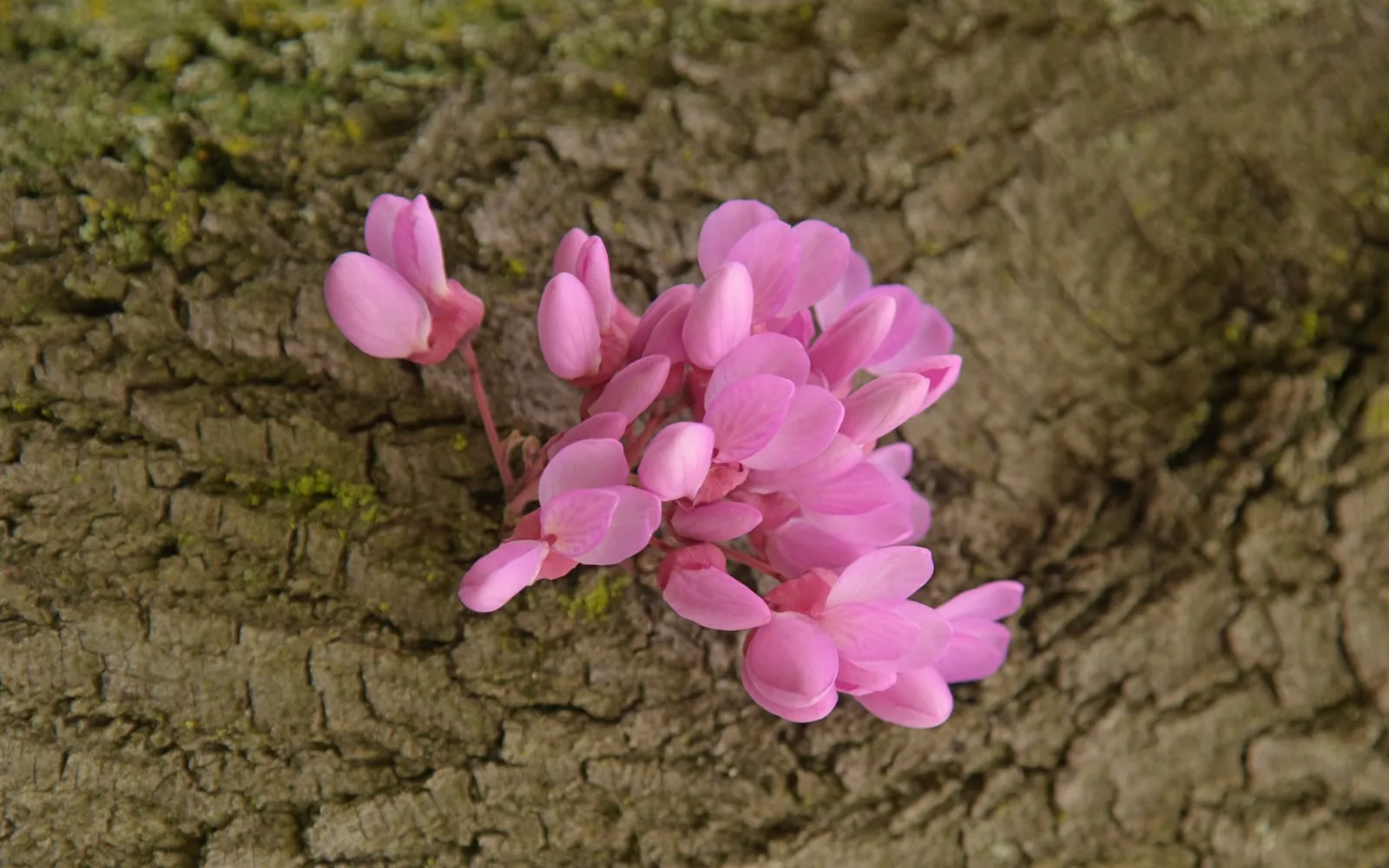
Eastern redbud flowers before almost anything else in a North American spring, and it does so in a way few other trees do. Small magenta-pink flowers stud the bare branches directly, clustered so densely along the twigs, older stems and sometimes the trunk itself that the wood seems to have flowered rather than the leaves.
That habit, called cauliflory, is unusual in a temperate tree and gives a mature specimen in full bloom a startling, almost artificial look against a still-bare late-winter landscape. Leaves follow shortly after the flowers fade, broad and heart-shaped, and stay through summer into a modest but pleasant yellow autumn display.
It is a small, understorey tree by nature rather than a canopy giant, usually broader than it is tall, and fits comfortably into a garden that has no room for anything larger.
Appearance and character
Flowers open in early to mid spring, small, pea-shaped and magenta to rosy-pink, packed along the bark of two-year and older wood before the leaves emerge, sometimes appearing directly on the trunk of an older tree.
Leaves are broad, heart-shaped and glossy, 8 to 13 cm across, opening bronze-tinted on some forms before settling to mid green through summer and turning clear yellow in autumn.
Flat seed pods 5 to 10 cm long follow the flowers, green at first and ripening to brown, often persisting on the bare branches well into winter after the leaves have dropped.
Bark on a mature trunk is dark grey-brown, developing shallow furrows and scaly plates with age, and the trunk itself is often short, dividing low into several wide-spreading limbs rather than rising as a single clear stem.
Named cultivars widen the range considerably. ‘Forest Pansy’ carries deep purple foliage through summer, while ‘Alba’ and several other selections flower white rather than the species’ usual pink.
Where it is from
Cercis canadensis grows wild from southern Ontario and the eastern Great Lakes south through the eastern and central United States into northern Mexico, most often as an understorey tree at the edge of deciduous woodland, along streams, and on limestone bluffs and rocky slopes.
That broad native range, spanning cold Canadian winters and hot, humid southern summers, is a large part of why the species adapts to such a wide range of garden conditions. Populations from the northern end of the range tend to be hardier and more cold-tolerant than southern seed sources, which check when buying a young tree for a cold climate.
It has been grown as an ornamental in North American gardens since the colonial period and remains one of the most widely planted native flowering trees across its range, valued for a spring display that needs no pruning or training to achieve.
How it grows
Plant in well-drained soil of almost any type. Eastern redbud is notably unfussy about soil pH and tolerates acid, neutral and alkaline ground equally well, though it will not tolerate soil that stays waterlogged through winter.
Choose a position in full sun for the most profuse flowering, though the species also performs well in light to moderate shade, particularly useful under the high canopy of larger trees where a smaller understorey specimen is wanted.
Water regularly through the first two growing seasons while a young tree establishes its root system, then reduce watering as it settles in. An established tree tolerates moderate drought well, drawing on roots that reach wider than many trees of similar size.
Prune while young to establish a strong branch structure if a single clear trunk is wanted, since the species naturally tends towards multiple low stems. Beyond that early shaping, little routine pruning is needed; remove only dead, damaged or crossing wood, ideally after flowering.
Avoid moving an established tree. Like many members of the pea family, it develops a taproot early in life that makes transplanting difficult once the tree is past its first couple of seasons.
Through the seasons
Early spring brings the main flowering display on bare wood, ahead of or alongside the first leaves, the tree’s headline moment of the year.
Late spring into summer is leaf expansion and steady growth, with flat green seed pods developing along the branches.
Autumn turns the foliage a clear yellow before it drops, while the brown seed pods often remain on the branches well into winter.
Winter is dormant. The bare branch structure and, on an older tree, lingering pods are the main interest through the coldest months.
Care difficulty
Easy, and one of the most forgiving flowering trees available for a small garden. It needs little beyond reasonable drainage and a sunny to lightly shaded position, and it tolerates a wide range of soil types.
The two things that do trouble it, verticillium wilt and canker, are opportunistic rather than routine, generally taking hold on a tree already stressed by poor drainage, drought or mechanical damage rather than appearing on a healthy specimen grown in reasonable conditions.
Watering
Water deeply and regularly through the first two growing seasons after planting, allowing the soil to dry slightly between waterings rather than keeping it constantly wet.
Once established, an eastern redbud tolerates moderate drought well and needs supplementary watering only during an extended dry spell. Good drainage matters more than watering frequency, and this is a species that copes with dry soil far better than roots sitting in winter wet.
Warning signs, diseases and pests
Verticillium wilt shows as sudden wilting and browning in one branch or section of the crown while the rest of the tree looks healthy, sometimes with discoloured streaking visible under the bark of the affected limb. There is no cure once a tree is infected; prune out affected wood promptly and keep the tree well watered, since stress makes an infected tree far more likely to decline further.
Bacterial canker produces sunken, cracked or oozing patches on the bark of stems and branches, occasionally girdling and killing a limb beyond the canker. Prune out affected wood well below the visible damage, cleaning tools between cuts, and avoid wounding the bark during routine maintenance, since the bacteria typically enter through damage.
Leaf spot causes small brown or tan spots to develop across the foliage in humid weather, cosmetic rather than seriously damaging on an otherwise healthy tree. Clearing fallen leaves in autumn reduces the source of reinfection the following year.
Scale insects occasionally colonise stems and twigs, appearing as small brown or grey bumps that sap the plant’s vigour gradually. A light infestation usually responds to a horticultural oil treatment applied while the tree is dormant.
Growing environment
Full sun brings the densest flowering, though eastern redbud also performs well in light to moderate shade, making it one of the more versatile small flowering trees for a mixed garden.
Well-drained soil of almost any pH suits it, from acid woodland soil to alkaline ground over limestone, provided winter waterlogging is not an issue. In the hottest, most humid part of its native range, some afternoon shade helps prevent leaf scorch through a long summer.
Allow room for a broad, spreading crown rather than a tall narrow one. A mature tree is often as wide as it is high, and planting too close to a wall or path crowds its natural shape.
Feeding
Little to no supplementary feeding is needed on a tree growing in reasonable garden soil. A balanced feed applied in spring benefits a young establishing tree, but an established specimen thrives without routine fertiliser.
A yearly mulch of well-rotted organic matter around the root zone, kept clear of the trunk, supplies most of what the tree needs and helps retain soil moisture through the establishment years.
Avoid heavy nitrogen feeding, which pushes soft, fast growth at the expense of flowering and leaves the tree more vulnerable to the canker and wilt problems that trouble a stressed specimen more than a steadily growing one.
Troubleshooting
Why are the flowers growing straight out of the bark and the trunk? This is normal for the species, a habit called cauliflory. Flower buds form directly on older wood, including the trunk of a mature tree, rather than only on the previous year’s new growth the way many flowering trees bloom.
One branch has wilted suddenly while the rest of the tree looks fine. Likely verticillium wilt or bacterial canker, both of which tend to affect a single limb rather than the whole crown at once. Prune out the affected wood and watch the rest of the tree, since neither disease has a chemical cure.
Can I eat the flowers? Yes. Eastern redbud flowers are a well-documented wild edible across their native range, eaten raw in salads or pickled, with a mild, faintly sour flavour. Only eat plant material you can positively identify and that has not been treated with garden chemicals.
Why won’t my tree grow a single straight trunk? Left unpruned, the species naturally develops multiple low stems rather than one clear trunk. If a single-trunk form is wanted, prune to establish that shape while the tree is young, since correcting it later is much harder.
My established tree failed after I tried to move it. Eastern redbud develops a taproot early and transplants poorly once past its first couple of seasons. Choose a permanent position at planting time rather than expecting to relocate the tree later.