
Outdoor plant
Milk Vetch
Astragalus membranaceus
Also known as Huang qi, Mongolian milkvetch, Astragalus
How to grow Astragalus membranaceus, the huang qi of Chinese medicine. A hardy pea-family perennial for a sunny border, the four-year root, and the locoweeds it is not.
At a glance
- Difficulty
- Moderate
- Water
- Occasionally in the first summer, rarely after that
- Light
- Full sun
- Temperature
- Fully hardy, to about minus 25 deg C
- Hardiness
- USDA 3-8, RHS H7, hardy to -25 C
- Type
- Hardy herbaceous perennial from a deep taproot
- Height
- 40-90 cm
- Native to
- northern China, Mongolia, the Russian Far East
- Best month
- April in the Northern Hemisphere, October in the Southern Hemisphere
Four to five years pass before the taproot is worth lifting, and it wants deep sandy soil to make one, so a shallow or stony bed gives nothing. Cold does not trouble it. Seed has a hard coat and needs scarifying or a hot-water soak before it will germinate.
Hardiness zones describe winter cold alone. Summer heat, humidity, rainfall and the length of the growing season decide as much, so treat the range as the outer limit rather than as a recommendation.
Every month named in this guide is for the temperate Northern Hemisphere. If you garden in the Southern Hemisphere, shift each one by six months, so April becomes October. Closer to the equator the wet and dry seasons matter more than the calendar, and the shift stops being a useful guide.
Not known to be toxic
Astragalus membranaceus root is eaten. It goes into soups and stocks across northern China, where it is simmered as a slice of woody root and lifted out before serving, and it is sold in the West as a food supplement. The species does not appear on the RHS list of potentially harmful garden plants, and the ASPCA does not list it among plants toxic to dogs, cats or horses. The caution attaches to the genus rather than to this plant. Astragalus is one of the largest genera of flowering plants, with around three thousand species, and it includes the North American locoweeds that poison grazing livestock through swainsonine, along with species that accumulate selenium from the soil to concentrations lethal to sheep and cattle. None of that chemistry is present in Astragalus membranaceus, and the point of saying so is that a search for the genus name returns veterinary warnings about a different set of plants. Anyone taking the root alongside prescribed medication should mention it to their GP, as the NHS advises for herbal products generally.
Sources: RHS potentially harmful garden plants, ASPCA toxic and non-toxic plants, NHS on herbal medicines
About
Astragalus membranaceus is a pea-family perennial from the grasslands of northern China and Mongolia, and its root is one of the most used items in the Chinese pharmacopoeia under the name huang qi. The root is harvested at four years, sliced into pale tongue-shaped pieces, and dropped into soup as often as it is taken as a medicine.
Above ground the plant is unremarkable and rather pretty in a loose way. Pinnate leaves of many small leaflets, sprawling stems that lean on their neighbours, and short spikes of pale yellow pea flowers through the summer. It sits happily in a sunny border and asks for nothing.
This is one of the easiest plants in the collection. Fully hardy, grown from seed, needing sun and sharp drainage and no feeding at all, and reaching a liftable root in three or four years. The one caveat is the taproot, which wants depth. On thin soil over clay the plant grows and the root stays stunted.
Appearance and character
The leaves are pinnate, 5 to 10 cm long, with twelve to eighteen pairs of small oval leaflets and a terminal one, giving the whole plant the light feathery look of a vetch. The stems are slender and sprawl outward rather than standing, so a mature clump covers more ground than its height suggests.
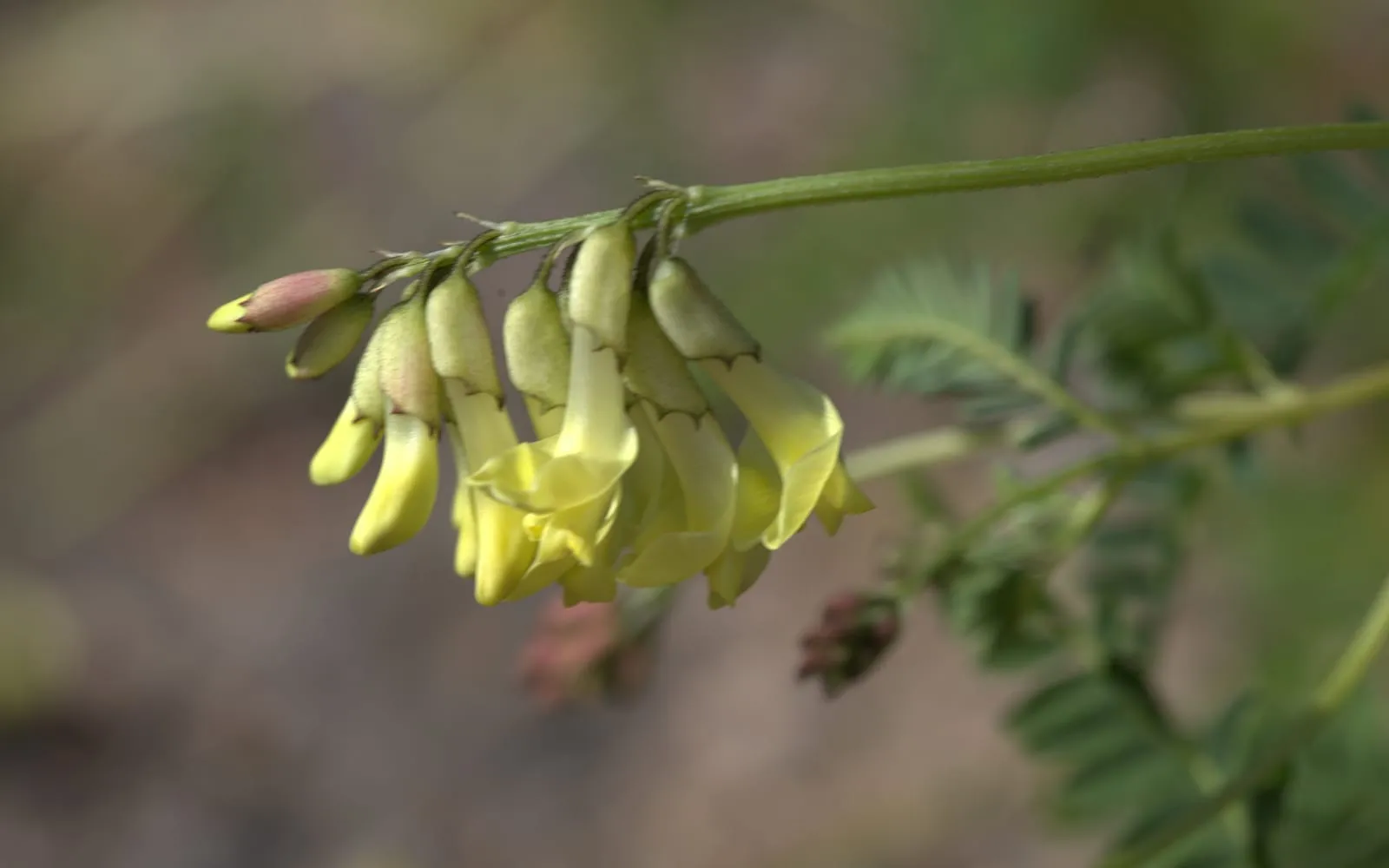
Flowers appear in June and July as short one-sided racemes rising from the leaf axils. They are pale yellow, sometimes almost cream, and about 2 cm long, with the standard, wings and keel of a typical pea flower. They are followed by inflated papery pods that rattle when dry.
The root is the point of the plant. It runs straight down, pale yellowish and fibrous, reaching 30 to 50 cm in good soil by the fourth year with few side branches. Cut across, it shows a radiating pattern that graders in China use to judge quality.
Where it is from
The plant is native to northern China, Mongolia, Korea and the Russian Far East, where it grows on dry sunny grassland, forest margins and stony slopes. These are places with hard cold winters, hot dry summers and thin free-draining soil, which is a good description of what it wants in a garden.
Commercial production is centred on Shanxi, Inner Mongolia and Gansu. Wild harvest has thinned populations in parts of that range, and the great majority of the root in trade now comes from cultivated fields on a four-year rotation.
The botanical name is unsettled. Many authorities treat the plant as Astragalus mongholicus, with membranaceus as a variety or a synonym, and both names appear on packets and in the literature. The app records it as Astragalus membranaceus, which is the name most suppliers use.
How it grows
Seed has a hard coat and needs help. Scarify it by rubbing between sheets of sandpaper, or soak it overnight in warm water, then sow in spring at 18 to 20 deg C. Untreated seed germinates erratically over months.
The first year builds a taproot and little else, and a first-summer plant is a low tuft 20 cm across that looks like nothing. Growth accelerates in the second year, flowering usually begins in the second or third, and the root thickens steadily until the fourth autumn, which is when growers lift it.
Like most legumes it fixes nitrogen through root nodules, so it feeds itself and improves the ground it sits in. That is also why feeding it is counterproductive: a plant given nitrogen stops fixing its own and puts on soft top growth instead of root.
Through the seasons
Sow in April, either in deep pots to plant out in early summer or direct into the bed. Direct sowing suits the taproot better, and plants that are moved late often fork.
Growth runs through spring and summer, with flowering in June and July and pods ripening in August. The top dies back to the ground with the first hard frosts and the plant reappears in April.
Lift the root in autumn of the third or fourth year, once the top has died down. Dig a trench alongside rather than levering from directly above, since the root is brittle and the bottom third is easy to leave in the ground. Wash, slice lengthways and dry until brittle.
Care difficulty
Easy to keep alive, moderately fiddly to bring to a good root. The plant tolerates cold, drought and poor soil, and it dies in wet ground, which in a wet climate is the failure mode to plan against.
Soil depth is the second constraint. A taproot that meets clay or a stone layer at 20 cm forks, and a forked root gives less usable material. Raised beds or deeply dug sandy soil earn their keep.
The plant sprawls, which surprises people who expected an upright herb. Give it 60 cm of space or let it lean on the shrubs nearby, and do not stake it.
Watering
Water new sowings and first-year plants through dry spells to keep them growing. After the first summer the taproot finds its own water and the plant needs almost nothing in a temperate climate.
Where watering does harm is in heavy soil in autumn and winter. Astragalus rots in cold wet ground, and no amount of summer care compensates for a bed that stays saturated in January.
A plant in a container needs more attention, since a pot dries faster and holds water at the base. Use a deep pot, a gritty mix, and let it dry between waterings.
Warning signs, diseases and pests
Slugs take seedlings, which is the main early loss. Once the plant is established almost nothing troubles it.
Aphids gather on the flowering shoots in early summer and rarely reach numbers that matter on a plant this vigorous. Pea and bean weevil notches the leaf margins with neat semicircular bites, which looks alarming and costs the plant nothing.
Root rot is the disease to watch, and it shows above ground as a plant that yellows from the base and collapses. Powdery mildew coats the leaves with white bloom in a dry summer, particularly on plants in a rain shadow, and improved airflow and a mulch to hold soil moisture both reduce it.
Growing environment
Full sun. The plant comes from open grassland and it thins and sprawls in shade without ever building a decent root.
Soil should be sandy or gritty, deep, and free-draining, with a pH from 6.5 to 8.0. It tolerates poor ground well and prefers it to anything enriched. Work grit into heavy soil, or grow it in a raised bed.
Hardiness is not a concern. The plant comes through Mongolian winters, and a maritime one is milder than anything it evolved with. What it will not tolerate is those winters spent in wet soil.
Feeding
None. The plant fixes its own nitrogen through root nodules and grows well on ground that would disappoint a vegetable.
Feeding it produces a large soft plant with a poor root, which inverts the reason for growing it. Nitrogen also suppresses nodulation, so a fed plant does less for the soil around it.
If the soil is very acid, lime it before sowing. That is a pH correction rather than a feed, and it is the only soil intervention the plant benefits from.
Troubleshooting
Is this the same as the locoweeds that poison livestock? No. Locoweeds are other members of the same very large genus, mostly North American, that contain swainsonine or accumulate selenium. Astragalus membranaceus contains neither and its root is eaten in soup across northern China.
How long before I can lift a root? Three years at a minimum and four for a root worth drying. The plant builds slowly in year one and puts on most of its root weight in years three and four.
My plant has flopped everywhere. That is its habit. The stems are slender and sprawling, and it leans on neighbouring plants in the wild. Staking it usually snaps the stems; giving it room works better.
Should I sow direct or in pots? Direct if you can protect the seedlings from slugs, because the taproot resents being moved. If sowing in pots, use deep ones and plant out young.
Why is my seed not germinating? The seed coat is hard and impermeable. Scarify with sandpaper or soak overnight in warm water before sowing, and expect poor results from untreated seed.
Is it Astragalus membranaceus or mongholicus? Both names are in use for the same plant, and many authorities now prefer mongholicus. Seed and dried root are sold under either. The app records membranaceus, which is what this guide follows.
Can I grow it in a pot? For two or three years in a deep container, yes. The taproot will eventually hit the bottom and the plant will stall, so a bed is better if you want a full-sized root.