
Outdoor plant
Culver's Root
Veronicastrum virginicum
Also known as Culver's Physic, Blackroot, Bowman's Root
How to grow Culver's root, Veronicastrum virginicum, an upright border plant with white flower spires above tiers of whorled leaves and a purgative root.
At a glance
- Difficulty
- Moderate
- Water
- In dry spells; keep the soil from drying out
- Light
- Full sun to partial shade
- Temperature
- Very hardy, cut to the ground by frost and returning each spring
- Hardiness
- USDA 3-8, RHS H7, hardy to -34 C
- Type
- Upright herbaceous perennial
- Height
- Up to 1.8 m
- Native to
- Eastern North America
Fully hardy, dying back each winter and returning from the crown in spring. It comes from prairies and moist meadows and needs soil that holds moisture through summer, so it grows tallest and stands best where the ground never bakes dry. A parched, poor soil gives a shorter, weaker plant that may need support. It has no special heat or chill needs within its range.
Hardiness zones describe winter cold alone. Summer heat, humidity, rainfall and the length of the growing season decide as much, so treat the range as the outer limit rather than as a recommendation.
Harmful if eaten
- Do not eat
- The root, especially fresh
- Harm from
- Eating it
- Affects
- People
The flowers and foliage are not considered a hazard, and the ASPCA does not list the plant as toxic to pets. The root is a different matter. It has a long history in North American herbal medicine as a strong purgative, sold dried as Culver's physic or blackroot, and the fresh root is a powerful emetic that causes vomiting and cramping if eaten. This is a plant to enjoy in the border instead of to dig up and taste, and the root should not be eaten. Ordinary handling and deadheading pose no problem.
Sources: RHS potentially harmful garden plants, ASPCA toxic and non-toxic plants
About
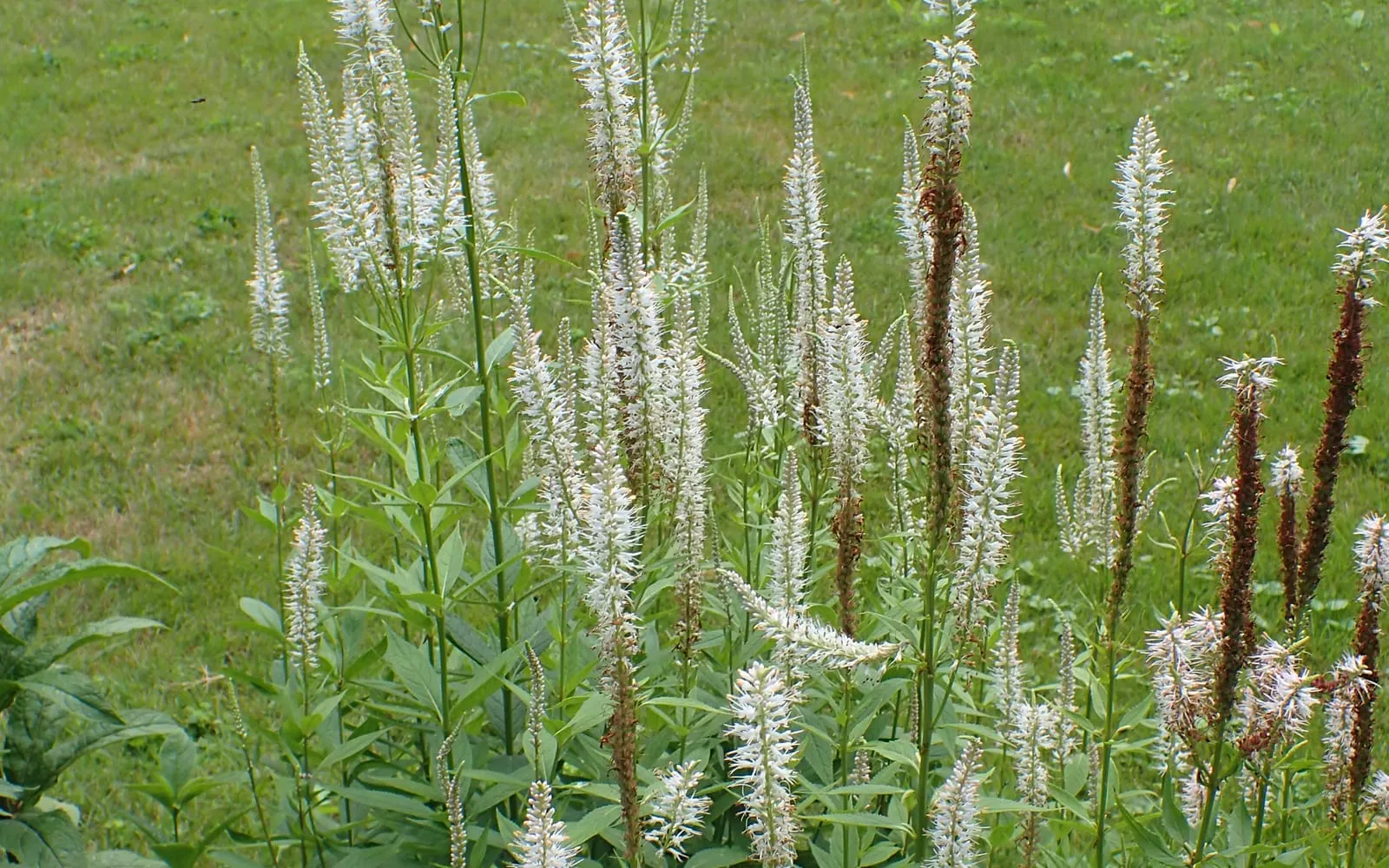
Culver’s root is grown for height and upright flower spikes. In midsummer it sends up slim, tapering spires of tiny white flowers, sometimes pale lilac, held well above tiers of narrow leaves arranged in neat whorls around the stem. The pale spires rise to head height and give a border the upright accent that rounded, mounding perennials cannot.
It is a prairie and wet-meadow plant from eastern North America, sturdy and self-supporting, and once settled it is one of the easier tall perennials to grow well. The stems stand without staking in an open, sunny spot on soil that does not dry out.
The name comes from an old medicinal use rather than a person’s garden. The root was a purgative medicine known as Culver’s physic. That history is mainly a warning not to dig it up and eat it.
Appearance and character
Each flower spire is a slender, tapering raceme up to fifteen or twenty centimetres long, densely set with small tubular flowers, usually white and occasionally soft lilac or pink in named forms, opening from the base upwards in midsummer and lasting several weeks.
The leaves give the plant much of its structure. They are narrow, lance-shaped and finely toothed, carried in whorls of three to seven around the stem at regular intervals, which gives the plant its tiered look even before it flowers.
The habit is tall and columnar, a clump of strong, straight stems reaching between one and nearly two metres, standing upright without support on a good soil in reasonable light.
Named selections are worth seeking out. ‘Fascination’ has thicker lilac spires that sometimes kink, ‘Album’ is a clean white, and ‘Erica’ and ‘Pink Glow’ extend the colour range.
Where it is from
Veronicastrum virginicum is native to eastern and central North America, growing in prairies, moist meadows, damp open woods and the edges of marshes. It is a plant of sunny to lightly shaded ground that stays moist through the growing season.
In a garden, it needs sun and soil that does not dry out. Given both, it grows tall and stands upright. On thin, dry ground it is shorter and floppier, and it flowers less well.
How it grows
Plant in spring or autumn in fertile, moisture-retentive but well-drained soil, in full sun or the lightest shade. Full sun on a soil that stays moist gives the tallest, sturdiest, most upright plants.
Improve the ground with organic matter before planting on lighter soils, and mulch afterwards. Summer moisture keeps the stems standing and the plant vigorous.
Leave it undisturbed to build into a strong clump; it is not invasive and spreads only slowly. It rarely needs staking in a suitable spot, and cutting the stems back by a third in late spring, if you want a shorter plant, is an alternative to supporting a very tall one.
Cut the faded stems down in late winter, or leave them standing over winter for the seed heads and the structure, and divide congested clumps in spring every few years to keep them healthy.
Through the seasons
Spring brings the whorled shoots pushing up, growing fast once the weather warms. Divide or mulch now.
Early to midsummer the stems reach full height and the flower spires open, drawing bees and other pollinators.
Late summer the flowers fade to slim seed spikes, which stay attractive and can be left for winter structure.
Autumn and winter the plant dies back. Cut it down before spring, or leave the stems standing for the frost and the birds.
Care difficulty
Moderate, and easy once matched to the site. On moist, fertile soil in sun it is strong, healthy, long-lived and self-supporting, with few pests and no real fuss. Difficulty usually appears on dry or poor ground, where it grows short, leans and mildews. Give it sun and steady moisture and it is one of the most dependable tall perennials for the back of a border.
Watering
Water in dry spells to keep the soil from drying out, especially through the main growth and flowering period in early summer. The plant needs steady moisture to reach full height and hold its stems upright, and it suffers on ground that bakes hard.
An established clump on naturally moist soil needs little extra water, while one on a lighter, free-draining soil benefits from regular watering and a good mulch through summer.
Warning signs, diseases and pests
Powdery mildew is the main disease, coating the leaves white in a dry season or where the air is still and the planting crowded. On this plant it usually signals dry roots, so improving moisture and air movement helps more than spraying.
Leaning or flopping stems point to dry soil, poor ground or too much shade rather than to any disease. A plant in full sun on moist, fertile soil stands up by itself; correct the conditions rather than only adding stakes.
Beyond those issues it is a healthy, trouble-free plant, largely ignored by the pests that trouble softer perennials.
Growing environment
Full sun gives the best results, producing the tallest, straightest, most free-flowering plants, provided the soil stays moist. It tolerates light shade, where it grows a little taller and laxer and may lean towards the light.
The soil should be fertile and moisture-retentive yet well-drained. Prairie and meadow origins mean it likes ground that holds water through summer, and it is happiest where the soil never dries out completely, though it dislikes standing waterlogged in winter.
Give it room at the back of a border, where its height and vertical spires show well behind rounded, front-of-border plants. It suits a prairie-style or naturalistic planting and combines well with grasses and other tall perennials. For a shorter native perennial on similar moist ground, see turtlehead.
Feeding
Feed lightly. A spring mulch of garden compost or well-rotted manure supplies most of what it needs on an average soil, while it also conserves the moisture the plant relies on.
On a poor, thin soil, a single dressing of a balanced general fertiliser in spring supports strong, tall growth. Avoid overfeeding, which produces soft stems that lean and are more prone to mildew, without improving the flowers.
Troubleshooting
The stems are leaning and flopping. Usually dry or poor soil, or too much shade. This plant stands upright on moist, fertile ground in good light. Improve the soil and moisture, move it to more sun, or cut it back by a third in late spring for a shorter, sturdier plant.
The leaves are coated white. Powdery mildew, which on Culver’s root generally means the roots are too dry. Water and mulch, and thin crowded planting to improve air flow.
Is it invasive? No. It forms a slowly expanding clump and stays where it is put, unlike some vigorous prairie perennials. It is easy to keep in bounds and simple to divide.
Is any part poisonous? The root only, and only if eaten. It was used as a strong purgative medicine and the fresh root causes vomiting, so do not dig it up to taste. The flowers and foliage are not a hazard and it is fine to grow and handle.
When and how do I divide it? In spring, as growth begins, every three or four years if the clump gets congested. Lift it, split the crown into good-sized pieces each with roots and shoots, and replant into improved soil.