
Outdoor plant
Tree Rhododendron
Rhododendron arboreum
Also known as Rhododendron, Himalayan Tree Rhododendron
How to grow tree rhododendron, Rhododendron arboreum. Why seed provenance determines how much frost a plant can take, the felted leaf underside that identifies it, and why its nectar can turn into a dangerous "mad honey".
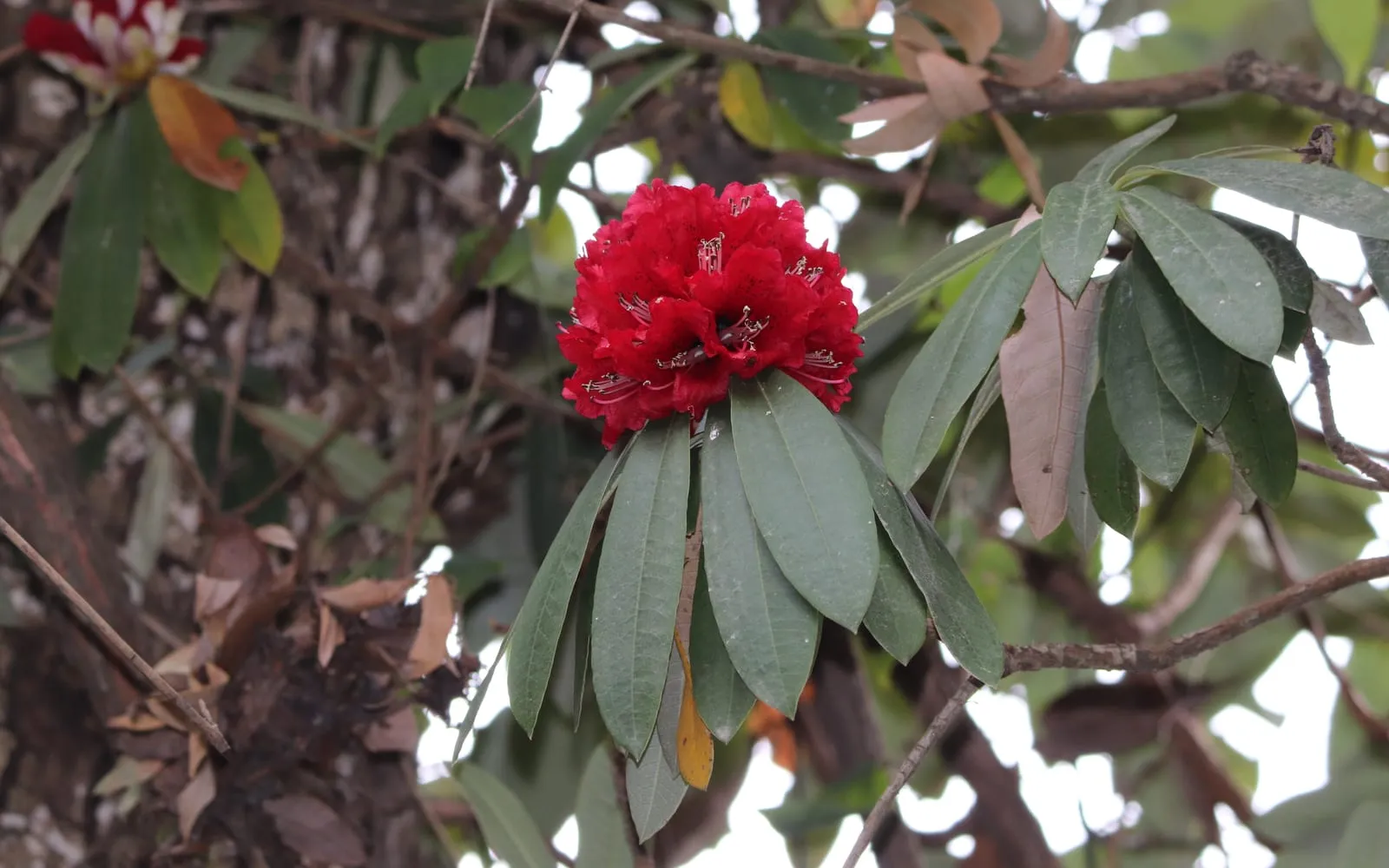
At a glance
- Difficulty
- Moderate
- Water
- Regularly through the growing season, never letting the root zone dry out
- Light
- Light shade, especially from hot afternoon sun, or full sun in a cool, humid climate
- Temperature
- Moderately hardy; young growth and the earliest flowers are frost-tender
- Hardiness
- USDA 8-9, RHS H3, hardy to -10 C
- Type
- Evergreen tree, grown as a large shrub outside its native forest
- Height
- 12-18 m in Himalayan forest, commonly 3-6 m in cultivation
- Native to
- the Himalaya
The zone number leaves out two things that affect whether this species thrives. Rhododendron arboreum needs real humidity through the growing season, the legacy of a monsoon climate, and a dry-aired garden with the right winter minimum on paper still disappoints it. Provenance also matters more here than in most hardy shrubs: seed collected from high-altitude Himalayan populations produces noticeably hardier plants than seed from low-elevation forest, so two plants sold under the same name can differ considerably in what winter they will take.
Hardiness zones describe winter cold alone. Summer heat, humidity, rainfall and the length of the growing season decide as much, so treat the range as the outer limit rather than as a recommendation.
Poisonous if eaten
- Safe to eat
- The petals, traditionally made into a sherbet in small, carefully prepared quantities in parts of Nepal
- Do not eat
- Every part in quantity, including the nectar and any honey made from it, and the raw flowers most of all
- Harm from
- Eating it
- Affects
- People, cats, dogs and horses
Every part of Rhododendron arboreum contains grayanotoxins, which bind to sodium channels in nerve and muscle cells. Eating leaves or a significant quantity of flowers causes drooling, vomiting, abdominal pain, an irregular and slowed heartbeat, low blood pressure, weakness and, in a severe case, collapse. The ASPCA lists rhododendron as toxic to cats, dogs and horses, and the RHS lists it among plants harmful if eaten. In parts of Nepal, where this is the national flower, the petals are traditionally made into a tart sherbet in small, carefully judged quantities, a preparation that does not eliminate the risk of eating the raw flower in excess. Honey made from its nectar carries the toxin too, and Himalayan honey hunters who harvest from wild Apis laboriosa colonies nesting on cliffs during the flowering season produce a reddish "mad honey" deliberately sought in small doses for a mild intoxicating effect, a practice that still occasionally poisons tourists who eat more than the traditional dose. Livestock browsing the foliage when other grazing is short are the most common real poisoning incident anywhere this genus is grown. Wear gloves when pruning or clearing cut material, and never leave foliage where livestock can reach it.
Sources: ASPCA (Rhododendron), RHS potentially harmful garden plants
About
In much of the Himalaya, this is a forest tree in its own right, forming entire belts of woodland at middle elevations that turn deep red across whole hillsides for a few weeks each spring. Rhododendron arboreum is Nepal’s national flower, and the sight of a mountainside in bloom draws trekkers to the Annapurna and Langtang regions every year at flowering time.
Grown in a garden outside that native forest, it behaves more like a large, handsome evergreen shrub than the tree it becomes at home, producing trusses of bell-shaped flowers, typically a deep blood-red in the wild type, earlier in the year than almost anything else flowering around it.
It needs acid soil, real humidity and, in most gardens, some shelter from the hardest frost, conditions that narrow where it can be grown well without ruling it out nearly as widely as its scale might suggest.
Appearance and character
Leaves are leathery, dark glossy green above, and carry a dense felted layer on the underside, called an indumentum, ranging from silvery-white to rusty brown depending on the population. That felted underside is one of the more reliable ways to tell this species apart from other tree-form rhododendrons at a glance.
Flowers open from late winter into spring in bell-shaped trusses of fifteen to twenty individual blooms, most commonly a deep, saturated red in the type species, though populations and named varieties across its wide range also flower pink or white. They open unusually early for a large-flowered rhododendron, often before much else in the garden has started.
Bark is smooth and cinnamon-brown when young, flaking and peeling in patches with age on a mature trunk, an attractive feature in its own right once the tree or large shrub has some size to it.
In its native forest a single trunk or several stems rise to a rounded crown well above head height; in most gardens outside that range, it is grown and pruned as a large, broad shrub rather than allowed to develop tree form.
Where it is from
Rhododendron arboreum grows across the Himalaya, from Nepal, Bhutan and northeastern India through parts of Myanmar and southwestern China, with outlying populations in the hill forests of Sri Lanka, typically at middle to fairly high elevations where monsoon rainfall keeps the air consistently humid.
It reached British gardens through Joseph Dalton Hooker’s Himalayan expeditions of the late 1840s, when seed collected in Sikkim transformed what a British woodland garden could contain and set off decades of further rhododendron collecting across the region. Large estate gardens in mild, high-rainfall parts of Britain and Ireland still grow specimens descended from those original introductions.
Unlike some of its relatives, Rhododendron arboreum has not become a naturalised woodland weed anywhere it has been planted. It lacks the combination of extreme cold tolerance and dense understorey growth that has let other rhododendron species escape cultivation and dominate woodland elsewhere.
How it grows
Plant in acid, moist, humus-rich soil, worked with plenty of well-rotted organic matter before planting, in a position sheltered from the harshest winter wind and from strong, drying afternoon sun.
Provenance matters a great deal when buying. A plant grown from seed collected at high altitude in the Himalaya tolerates considerably more cold than one grown from lowland forest seed, so where a nursery can tell you the origin of its stock, it ask.
Mulch generously each spring with an acidic organic material such as composted bark or pine needles, both to feed the shallow, fibrous roots this species shares with the rest of its genus and to keep the root zone consistently moist through summer.
Little routine pruning is needed. Where shaping is wanted, do it immediately after flowering, since next year’s flower buds form on the current season’s growth soon afterward.
Through the seasons
Late winter into early spring brings the flush of large bell-shaped flowers, opening earlier than most other rhododendrons and vulnerable to a late frost while they do.
Spring, once flowering finishes, is the time for any shaping and for mulching the root zone with fresh acidic organic matter.
Summer is steady growth, with consistent moisture at the root the main requirement through any dry spell.
Autumn is a reasonable planting season in a mild climate, giving roots time to settle before the following winter’s test.
Care difficulty
Moderate, and the difficulty sits almost entirely in the soil and site rather than in ongoing labour. Acid soil is non-negotiable, humidity through the growing season matters more than the label on a plant tag suggests, and a young plant needs real shelter from hard frost until it has some size and age behind it.
Once well sited, an established plant needs comparatively little. An annual mulch, occasional watering in drought and a light shaping prune after flowering, if needed, cover most of what it needs.
Watering
Water regularly through the growing season, never letting the root zone dry out completely, since the shallow, fibrous roots typical of this genus have little reserve to draw on.
A deep, thorough soak that reaches well down works better than frequent light watering, and a generous mulch does a great deal to hold that moisture through a dry summer.
Warning signs, diseases and pests
Vine weevil grubs feed on the roots of young or container-grown plants, causing sudden wilting in a plant that lifts out of its pot with few or no roots left. Adult weevils notch the leaf edges at night, a visible but largely cosmetic warning sign that should prompt a check for more serious grub damage below ground.
Powdery mildew coats leaves in a pale film during a dry, still summer, more disfiguring than seriously damaging on an established plant. Improving airflow around the plant helps reduce it.
Phytophthora root rot follows waterlogged or poorly drained soil, showing as wilting, yellowing foliage and dieback despite consistently wet ground. There is no reliable cure once established; improve drainage before replanting rather than treating an affected specimen.
Frost damage browns or blackens the earliest flower buds and open blooms, the commonest cause of a disappointing display on this early-flowering species. There is no fixing damage already done, only choosing a sheltered site and covering vulnerable buds with fleece when a hard frost is forecast during flowering.
Growing environment
Light shade suits it best in a hot or dry climate, particularly shelter from strong afternoon sun, while full sun is manageable in a cooler, consistently humid one.
Acid soil is essential, and this species will not grow on chalk or limestone at all. A raised bed or large container filled with ericaceous compost is the practical answer for a garden on the wrong soil.
Real humidity through the growing season matters as much as the winter minimum temperature, so a sheltered, damper microclimate outperforms an exposed dry one even where both share the same nominal hardiness rating.
Shelter from the coldest winter wind and from a hard, still frost during the early flowering period both meaningfully improve results in a marginal climate.
Feeding
Feed with an ericaceous fertiliser formulated for acid-loving plants once in early spring, following the product’s guidance for a woodland shrub.
An annual mulch of composted bark, leaf mould or pine needles around the root zone supplies much of the ongoing fertility this species needs beyond that single spring feed.
Avoid lime-containing feeds or mulches entirely. Even a small dose of lime can push the soil pH high enough to trigger the yellowing that signals an acid-loving plant struggling on the wrong ground.
Troubleshooting
Why did my plant’s leaves turn yellow between the veins? Almost always lime-induced chlorosis, from alkaline soil, tap water or a non-ericaceous feed. Switch to ericaceous fertiliser and rainwater where possible, and consider growing it in a container of ericaceous compost if the garden soil is not acid.
The flower buds went brown before opening. Frost, most likely, given how early this species flowers. There is no recovery for that year’s buds; cover vulnerable growth with fleece on forecast frosty nights in future springs.
Can I grow it on chalky soil? No, not in open ground. Grow it in a large container of ericaceous compost instead, watered with rainwater rather than hard tap water where possible.
Is it dangerous to grow around animals? Yes. Every part contains grayanotoxins, and livestock browsing the foliage is the most common real poisoning incident. Never let cut material fall where grazing animals can reach it.
Why is my plant so much smaller than the huge trees I saw in photos of the Himalaya? Climate and cultivation, not a different plant. In its native forest this species reaches real tree size over a long lifespan in ideal humid conditions; in most gardens outside that range it is grown and pruned as a large shrub and rarely approaches the same scale.