
Outdoor plant
Spring Crocus
Crocus vernus
Also known as Dutch crocus, Giant crocus, Crocus
How to plant and naturalise spring crocuses. Planting depth, why the leaves must stay, why sparrows shred the yellow ones, and how to tell them from the dangerous autumn crocus.
At a glance
- Difficulty
- Easy
- Water
- Rain is enough once planted
- Light
- Full sun to light shade. Flowers open only in sun
- Temperature
- Fully hardy. Needs a cold winter to flower well
- Hardiness
- USDA 3-8, RHS H6, hardy to -30 C
- Type
- Cormous perennial
- Height
- 10-15 cm
- Native to
- The mountains of central and southern Europe
- Best month
- February in the Northern Hemisphere, August in the Southern Hemisphere
Cold is a requirement rather than a hazard. Several weeks below about 5 C are needed before the flower will open, so in zone 9 and warmer the corms have to be pre-chilled and treated as annuals. The other half of the cycle is a warm dry summer rest, which is why crocuses in a lawn need the grass left uncut until the leaves yellow and why they sulk in ground that stays wet all year.
Hardiness zones describe winter cold alone. Summer heat, humidity, rainfall and the length of the growing season decide as much, so treat the range as the outer limit rather than as a recommendation.
Every month named in this guide is for the temperate Northern Hemisphere. If you garden in the Southern Hemisphere, shift each one by six months, so February becomes August. Closer to the equator the wet and dry seasons matter more than the calendar, and the shift stops being a useful guide.
Harmful if eaten
- Do not eat
- Corms and flowers
- Harm from
- Eating it
- Affects
- People, cats and dogs
The spring crocus is a minor problem. Eating corms or flowers causes vomiting and stomach upset, and Crocus does not appear at all on the RHS list of potentially harmful garden plants. The plant to know about is the one it gets confused with. Autumn crocus, Colchicum autumnale, is not a crocus and belongs to a different family entirely, and the ASPCA lists it as toxic to cats, dogs and horses through colchicine, with bloody vomiting, shock, multi-organ damage and bone marrow suppression. The RHS puts Colchicum in category B, toxic if eaten. Telling them apart is straightforward: a spring crocus flowers in late winter alongside its narrow white-striped leaves, whilst Colchicum throws up bare pink flowers on naked stems in September and October with no leaves at all. If you cannot place which you have and something has been eaten, treat it as the dangerous one and ring a doctor or vet.
Sources: ASPCA (Autumn crocus, Colchicum autumnale), RHS potentially harmful garden plants
About
Crocuses are the cheapest reliable pleasure in a temperate garden. A bag of a hundred corms costs very little, goes in the ground in October in an afternoon, and comes back every February for decades, spreading as it goes.
Crocus vernus is the large-flowered species behind the Dutch crocuses sold in garden centres, the fat purple, white and striped ones. It naturalises in grass better than almost anything else, which is what makes it worth planting properly rather than dotting about.
Autumn crocus is a different plant from a different family, and it is dangerous in a way that the spring crocus is not.
Appearance and character
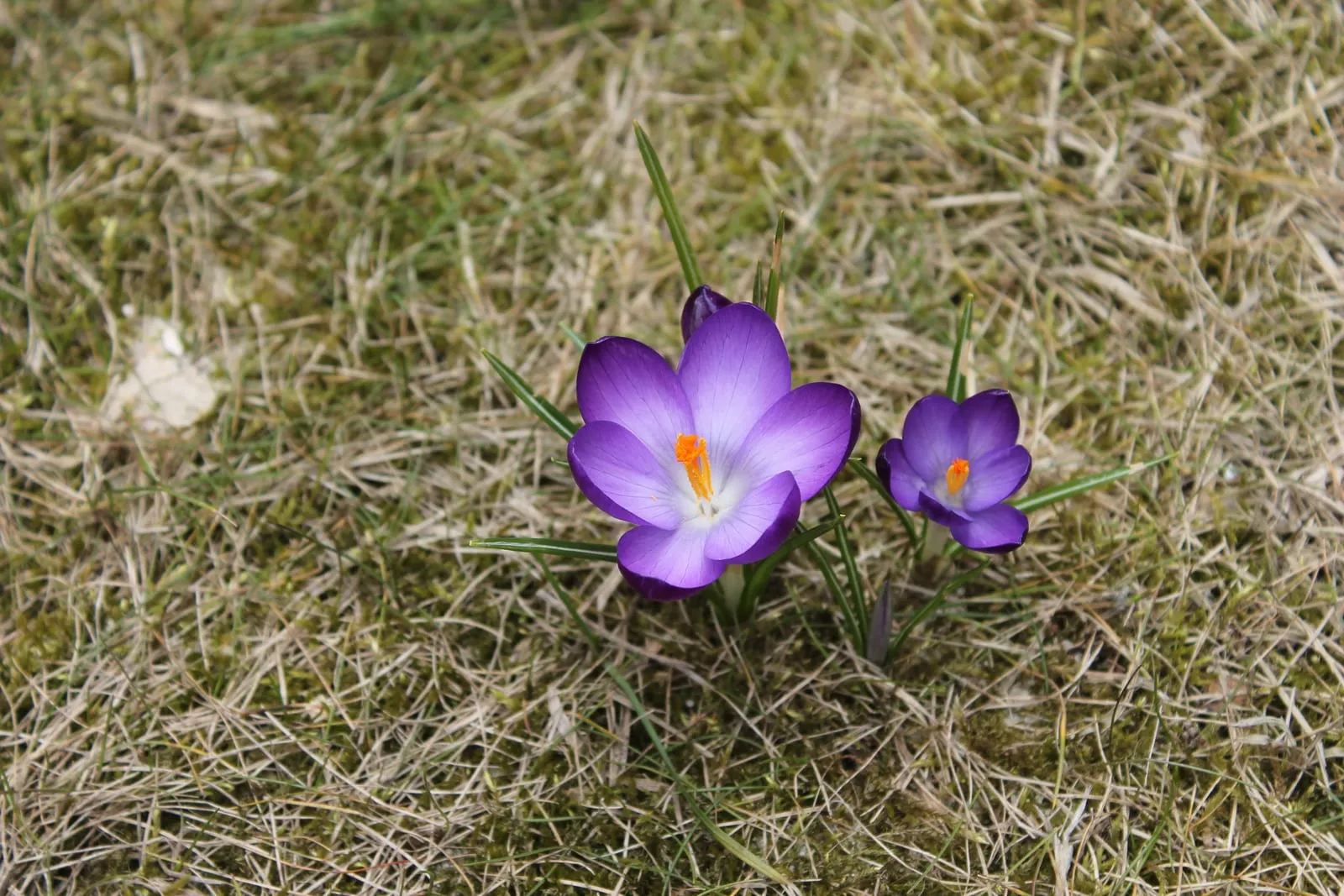
A goblet of six segments on a very short stem, opening from a papery sheath at ground level, in purple, white, lilac or striped. The leaves are narrow, dark green, and carry a distinct white stripe down the centre, which is a reliable way to identify a crocus out of flower.
The flowers open in sunshine and close in dull weather and at night, and they do it by growing: the inner surface of the segments grows faster than the outer when the temperature rises, which levers the flower open. Watch a clump on a morning when the sun comes out and you can see it happen over half an hour.
What sits underground is a corm rather than a bulb. A bulb is a compressed bud in layers, like an onion. A corm is a solid swollen stem base, and it works differently: the old corm is used up entirely each year and a new one forms on top of it, which is why crocuses slowly rise through the soil and why depth matters at planting.
Where it is from
The mountains of central and southern Europe, in alpine meadows and open woodland from the Pyrenees through the Alps to the Balkans.
An alpine meadow is wet in spring as the snow goes, and dry through summer. That is the pattern a crocus is built for, and it explains the two rules of growing them. They need free drainage and a dry summer dormancy, and they need a proper cold winter to flower well, which anywhere below zone 9 supplies without effort.
How it grows
A cormous perennial. Each corm produces flowers and leaves, then exhausts itself building a replacement corm above the old one, along with small cormlets around the edge that become next year’s new plants.
Everything the new corm contains has to be manufactured by the leaves in the six to eight weeks after flowering. Cut or mow the leaves early and the new corm is undersized, so it either flowers poorly next year or not at all.
The clump thickens over years as cormlets mature, and seed drops around it too, which is how a small planting becomes a drift.
Through the seasons
Autumn is planting. Get corms in from September to November, 8 to 10 cm deep and about 5 cm apart. Plant them in generous drifts rather than in a line, and scatter a handful and plant where they fall if you want a natural look.
Winter brings the first shoots through, often before Christmas in the south.
Late winter is flowering, from February into March.
Spring is the critical stretch. Leave every leaf alone for at least six weeks after the last flower fades, and preferably until they yellow and flop.
Summer is dormancy. Crocuses want to be dry now. Do not water the area, and avoid planting them where a summer border gets irrigated.
Care difficulty
Easy, with one rule that catches people who plant them in a lawn. Do not mow until the leaves have died down.
Six weeks after flowering is the minimum, and that means no cutting until at least mid-May in a temperate climate. A lawn full of crocuses that stopped flowering after two years was almost certainly mown in April.
Watering
Water them in once after autumn planting, and after that leave them to the weather. Winter and spring rainfall is exactly what they want.
Do not water them in summer. Corms sitting in warm wet soil during dormancy rot, which is the main reason crocuses vanish from mixed borders that get watered through July.
Container-grown crocuses are the exception at both ends. Keep the compost just moist through winter and spring, and then stop entirely once the foliage yellows and move the pot somewhere dry.
Warning signs, diseases and pests
House sparrows shred crocus flowers, tearing the petals apart and leaving them in pieces on the ground without eating anything. They go for yellow flowers far more than any other colour, sometimes attacking the buds before the colour is even visible. If sparrows are a problem where you are, plant purple and white and leave the yellows out, or run fine netting or black cotton over the clumps while they are in bud.
Squirrels and mice dig up newly planted corms, mostly in the first autumn before roots anchor them. Planting through a layer of chicken wire laid just under the surface stops them, and a handful of grit in each planting hole helps too.
Corm rot follows summer wet or heavy soil, and shows as clumps that fail to appear. There is nothing to treat; move them somewhere better drained.
Grey squirrels aside, crocuses have very few problems.
Growing environment
Full sun to light shade. They flower before deciduous trees leaf up, so a spot under a tree that is shaded in summer works perfectly well. What they cannot do is open their flowers in shade, so a permanently dark corner gives you closed buds and little else.
Fully hardy to about -30 deg C, and they need the cold. Several weeks below about 10 deg C is part of what triggers proper flowering.
Free-draining soil matters more than fertility. They grow happily in poor thin soil, in gravel, in a rock garden, and in grass. Heavy clay that stays wet in summer is the one thing to avoid, and adding grit to the planting hole helps.
Depth is the detail people get wrong. Plant 8 to 10 cm deep. Shallow-planted corms produce lots of small cormlets and few flowers, and they are easier for animals to find.
Feeding
In reasonable garden soil, no feeding at all. Crocuses are adapted to thin mountain soils and do not want richness.
In containers, or on poor sand, a light scatter of balanced granular feed as the leaves push through is enough. A low-nitrogen or high-potassium feed after flowering supports the new corm if a naturalised planting is looking tired.
Do not feed with anything high in nitrogen, which produces lush leaves at the expense of the corm.
Troubleshooting
Flowered the first year, then never again. The leaves were cut or mown too early. Leave them for six weeks minimum after flowering, and preferably until they yellow.
Leaves come up but no flowers. Corms are congested, planted too shallowly, or undersized from an early mow. Lift and replant at 8 to 10 cm in autumn.
Flowers torn to shreds overnight. House sparrows, and they favour yellow. Switch to purple and white, or net the clumps in bud.
Corms disappear entirely. Squirrels and mice, or summer rot in wet soil. Use wire mesh at planting, and choose a drier spot.
Flowers never open. Too much shade. Crocuses open in direct sun and stay shut without it.
Is this the poisonous one? If it is flowering now, in late winter, with narrow white-striped leaves alongside the flower, it is a spring crocus. Bare pink flowers with no leaves in September or October are Colchicum, which is a serious poison.