
Outdoor plant
Flame Azalea
Rhododendron calendulaceum
How to grow flame azalea, Rhododendron calendulaceum. Why every part, including the nectar and the honey made from it, carries a toxin severe enough to need medical care, and why hot, humid summers trouble this mountain species more than winter cold does.
At a glance
- Difficulty
- Easy
- Water
- Regularly while establishing, then during dry spells
- Light
- Light shade to full sun with cool, moist roots
- Temperature
- Fully hardy; dislikes hot, humid summers at low elevation
- Hardiness
- USDA 5-7, RHS H5, hardy to -15 C
- Type
- Deciduous shrub, living several decades
- Height
- 2-4.5 m
- Native to
- the eastern United States
A mountain species adapted to cool, moist summers as much as to cold winters, and it struggles in a hot, humid lowland climate even where the winter cold itself sits comfortably within its rating. Grown well outside its native Appalachian range, give it shade from the hottest part of the day and soil that never bakes dry: conditions closer to a woodland edge than an open, sun-baked border.
Hardiness zones describe winter cold alone. Summer heat, humidity, rainfall and the length of the growing season decide as much, so treat the range as the outer limit rather than as a recommendation.
Poisonous if eaten
- Do not eat
- Every part, including the flowers and nectar, and honey made from them
- Harm from
- Eating it
- Affects
- People, cats, dogs and horses
Rhododendrons and azaleas contain grayanotoxins, and every part carries them: leaves, flowers, nectar, and the honey bees make from it. Drying does not neutralise the toxin, so fallen leaves and clippings stay dangerous. Eating a leaf or two causes a burning mouth, drooling, repeated vomiting, stomach pain and weakness within a few hours; a larger amount slows the heart, drops blood pressure and brings staggering, collapse and occasionally fits. Recovery is the normal outcome with treatment, but a slow or irregular pulse needs monitoring in hospital rather than at home, so this is not one to wait out. Sheep, goats and cattle are the serious agricultural cases, poisoned in winter when an evergreen relative is the only green thing in reach, and horses are affected too; flame azalea is deciduous and offers less winter temptation than an evergreen rhododendron, but the plant is no less toxic while in leaf. Dogs are poisoned by chewing prunings left on the ground. Honey made where rhododendrons and azaleas dominate the local forage, sometimes sold as mad honey, produces the same picture in anyone who eats it by the spoonful. Grow it freely and treat the clippings as the risk: bag them rather than leaving heaps by a fence, and keep grazing animals away from a hedge or shrubbery of it.
Sources: RHS potentially harmful garden plants, ASPCA (Rhododendron, Rhododendron spp)
About
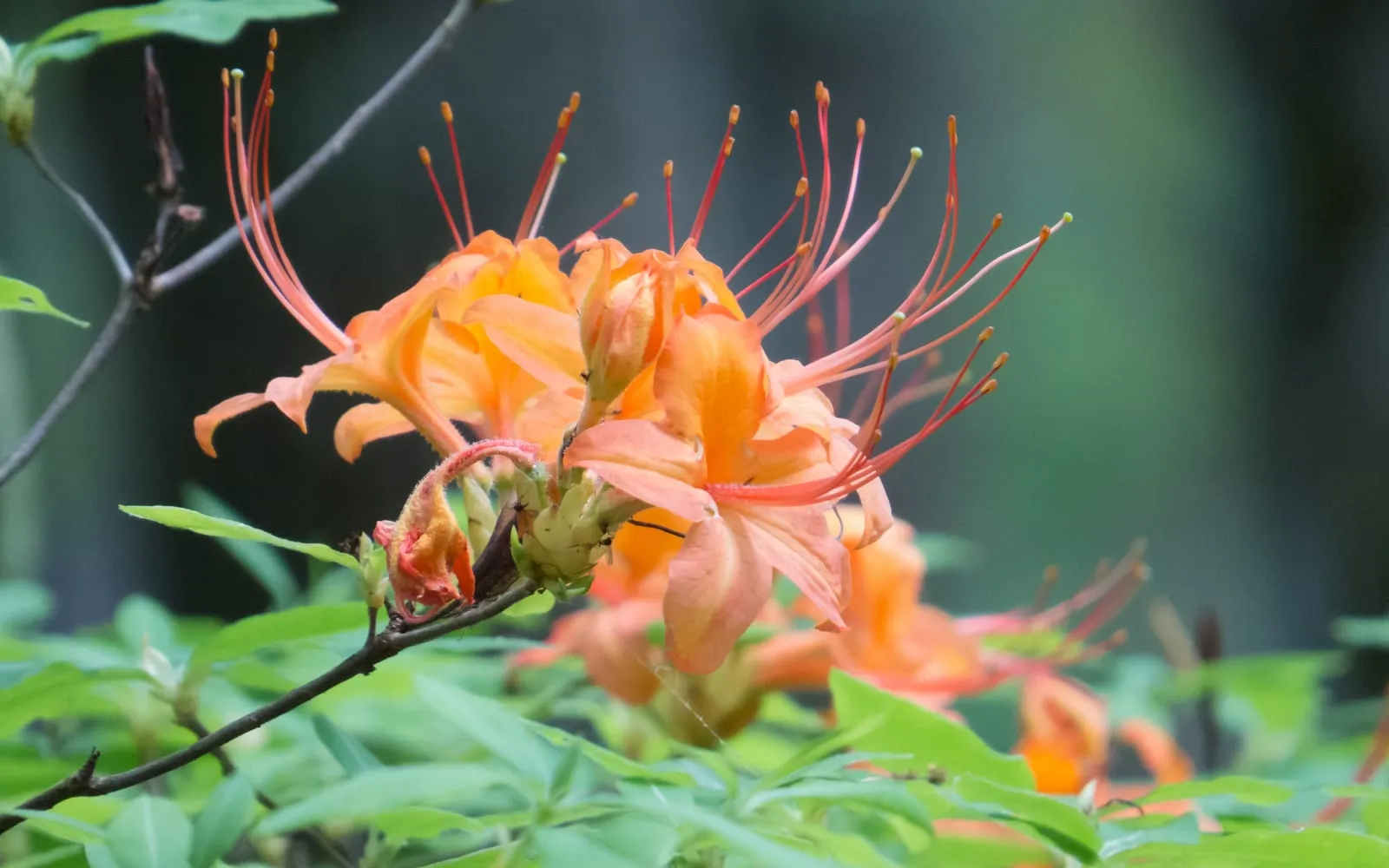
Flame azalea is a deciduous rhododendron with late spring flowers in yellow, orange and red. It comes from the Appalachian region of the eastern United States, where it grows in cool, moist mountain conditions.
It needs acidic soil, steady moisture and roots that do not bake dry. Winter cold is rarely the limiting factor; hot, humid lowland summers are usually harder on the plant. Every part is toxic, including the nectar and honey made from it, so clippings and grazing access need care.
Appearance and character
Leaves are broadly elliptic, 5 to 12 cm, hairy on both surfaces, mid-green through summer and turning yellow to orange in autumn before falling, a second colour display distinct from the spring flowers.
Flowers open in trusses of five to seven blooms in a broad, funnel shape, 4 to 5 cm across, in colours ranging from clear yellow through orange to a deep, saturated red, with prominent stamens extending well beyond the petals. Unlike many rhododendrons, the flowers carry no scent, which is one of the features botanists use to separate this species from its similarly coloured, fragrant relatives.
Growth is upright and can reach 2 to 4.5 m over time in good conditions, though it is often smaller in cultivation, forming an open, multi-stemmed shrub rather than a dense, rounded one.
Where it is from
Rhododendron calendulaceum is native to the eastern United States, concentrated in the southern Appalachian Mountains, where it grows on mountain slopes and in open woodland at elevations that keep summer temperatures moderate even at a latitude where the lowlands run hot and humid.
That elevation is the detail most important to a gardener growing it outside its native range. Cold hardiness and heat tolerance are separate traits that do not always travel together, and this species holds one without the other. Grown at low elevation in a hot, humid summer, it struggles regardless of how comfortably the winter temperature sits within its stated range.
How it grows
Plant in acidic, humus-rich, moist but well-drained soil, amending with ericaceous compost or well-rotted leaf mould if the native soil runs alkaline, since it will not tolerate lime the way many garden shrubs do.
Choose a position with light shade, particularly from the hottest part of the afternoon sun, and cool, moist root conditions; a woodland-edge setting under high, open tree canopy suits it better than an open, sun- baked border in most climates.
Mulch generously with an acidic material such as pine bark or leaf mould, both to conserve moisture around the shallow, fibrous roots and to help maintain the soil acidity the plant needs.
Prune only lightly, if at all, immediately after flowering, removing dead or crossing wood. It flowers on the previous year’s growth, so any hard pruning is best done straight after the blooms fade rather than in winter or early spring, which would remove the coming display.
Through the seasons
Spring brings the main flowering display, opening on bare or barely leafing stems in shades of orange, yellow and red.
Summer brings full leaf growth. Water during dry spells, since the shallow roots dry out faster than the plant’s size suggests, and any light pruning is best done as flowering finishes.
Autumn brings a second colour display as the leaves turn yellow to orange before falling.
Winter is dormant. The bare, deciduous stems are fully hardy and need no protection in a suitable climate.
Care difficulty
Easy within the right conditions, and considerably harder outside them. Given acidic soil, reliable moisture and protection from the hottest summer sun, it is an undemanding, long-lived shrub that needs little beyond an annual mulch and occasional light pruning. Planted in alkaline soil, a hot exposed position, or a climate with proper heat and humidity in summer, it struggles regardless of how well everything else is managed, since those are conditions the species has no real tolerance for.
Watering
Water regularly through the first two growing seasons while the shallow, fibrous root system establishes, and continue watering during any dry spell once mature, since those roots sit close to the surface and dry out faster than a plant of this size would suggest.
A deep soak less often serves it better than frequent light watering, and a good mulch layer reduces how often supplementary watering is needed by keeping the root zone cool and moist between waterings.
Warning signs, diseases and pests
Lace bug causes a fine, pale, stippled mottling across the upper leaf surface, with small dark specks of excrement visible on the underside. It is worse in hot, dry, sunny positions, so improving shade and soil moisture reduces the problem alongside any direct treatment.
Azalea gall shows as pale green to white, fleshy, swollen distortions on leaves or flower buds, caused by a fungal infection. Remove and destroy affected growth as soon as it appears, before the galls mature and release spores.
Root rot develops in poorly drained soil, showing as wilting and dieback despite damp conditions, since the roots responsible for water uptake have failed. Improve drainage before replanting in the same spot, since the fungus persists in wet soil.
Chlorosis, a yellowing of the leaf between still-green veins, signals alkaline soil rather than a pest, since the plant cannot take up iron properly at a high pH. Treat with an ericaceous feed and consider whether the site’s soil is suitable long term.
Growing environment
Light shade suits it best in most climates, particularly shade from strong afternoon sun; it tolerates more sun in a cooler, more humid climate than in a hot one.
Acidic soil is essential, ideally pH 5 to 6, and it performs poorly on neutral to alkaline ground regardless of other conditions being right.
Cool, consistently moist but well-drained soil matters as much as soil acidity. It dislikes both waterlogging and drought, a narrower tolerance than many garden shrubs.
Shelter from strong wind protects the flowers, which are relatively delicate for the size of the truss, and from the coldest, driest winter winds, which can damage stem tips in an otherwise hardy plant.
Feeding
Apply an ericaceous, rhododendron-formulated feed once in early spring, following the product’s guidance, which supplies both general nutrition and the acidifying effect that helps counter naturally borderline soil.
A mulch of pine bark, pine needles or leaf mould applied at the same time supports soil acidity over the longer term more effectively than feeding alone.
Avoid feeding with anything containing lime or with a general garden fertiliser not formulated for acid-loving plants, both of which push the soil away from the pH range the plant needs.
Troubleshooting
The leaves are yellow between green veins. Chlorosis from alkaline soil, almost certainly. Treat with an ericaceous feed as a short-term fix and consider whether the site suits a lime-hating plant over the long term, since this tends to recur without a soil change.
It flowered poorly or not at all this year. Check whether it was pruned in winter or early spring; since flower buds form on the previous year’s growth, pruning at the wrong time removes them. Also consider whether summer heat has been a problem, since a stressed plant flowers less freely the following year.
The leaves are stippled and pale looking. Lace bug, most likely, particularly if the plant is in a hot, sunny, exposed position. Check the leaf undersides for small dark specks, and consider whether more shade or better soil moisture would help alongside direct treatment.
Can I grow it in a hot, humid climate? With real difficulty. This is a mountain species that dislikes hot, humid summers regardless of winter hardiness, so gardeners in such climates often do better with a different rhododendron bred for heat tolerance rather than persisting with this species outside its comfort range.
Is it safe to plant where livestock graze nearby? Only with a secure barrier. Every part is toxic to grazing animals, and sheep, goats and cattle are poisoned by browsing on rhododendrons and azaleas, particularly when little else is available to eat.