
Houseplant
Ti plant
Cordyline fruticosa
Also known as Good luck plant, Hawaiian ti, Cabbage palm
How to care for Cordyline fruticosa. The red-leaved Pacific plant carried across an ocean by canoe, why fluoride in tap water browns the tips, and how much light the colour needs.
At a glance
- Difficulty
- Moderate
- Water
- When the top third of the compost has dried
- Light
- Bright indirect light for strong colour, and it tolerates moderate shade in green forms
- Temperature
- 18-27 deg C, and never below 12 deg C
- Humidity
- High. Dry air is the usual cause of brown tips
- Hardiness
- USDA 10-12, RHS H1b, hardy to 12 C
- Type
- Evergreen perennial shrub, long-lived
- Height
- 1-3 m
- Native to
- Southeast Asia, The Pacific Islands
Humid tropical forest margins across Southeast Asia and the Pacific, in warm, wet, sheltered conditions with no cold season and high year-round humidity. It has no frost tolerance and is damaged below about 12 deg C, so outdoors it needs a warm humid frost-free climate where it is widely grown as a hedge and border plant. Humidity is the condition it misses indoors, and a dry heated room produces brown tips no amount of watering will fix.
Hardiness zones describe winter cold alone. Summer heat, humidity, rainfall and the length of the growing season decide as much, so treat the range as the outer limit rather than as a recommendation.
Harmful if eaten
- Do not eat
- The leaves
- Harm from
- Eating it
- Affects
- People, cats and dogs
Cordyline fruticosa contains saponins, and the ASPCA lists it as toxic to cats and dogs. An animal that chews the leaves may vomit, drool or develop diarrhoea, and cats sometimes show dilated pupils as well. The effects are unpleasant rather than dangerous and usually resolve without treatment, though a small cat that has eaten a quantity is worth a call to a vet. There is no irritant sap and no risk from handling. The leaves have a long history of practical and ceremonial use across the Pacific, wrapped around food for cooking in an earth oven, made into skirts and used in ritual, and the rhizome is baked and eaten in some traditions after long cooking, which breaks the saponins down.
Sources: ASPCA (Ti-Plant, Cordyline terminalis), NC State Extension, Cordyline fruticosa
About
The ti plant is one of the few houseplants with a documented history of being carried deliberately across an ocean. Polynesian voyagers took it with them through the Pacific as a canoe plant, valued for food, for wrapping and cooking, for clothing and for ceremony, and its distribution across the islands maps the routes those voyages took.
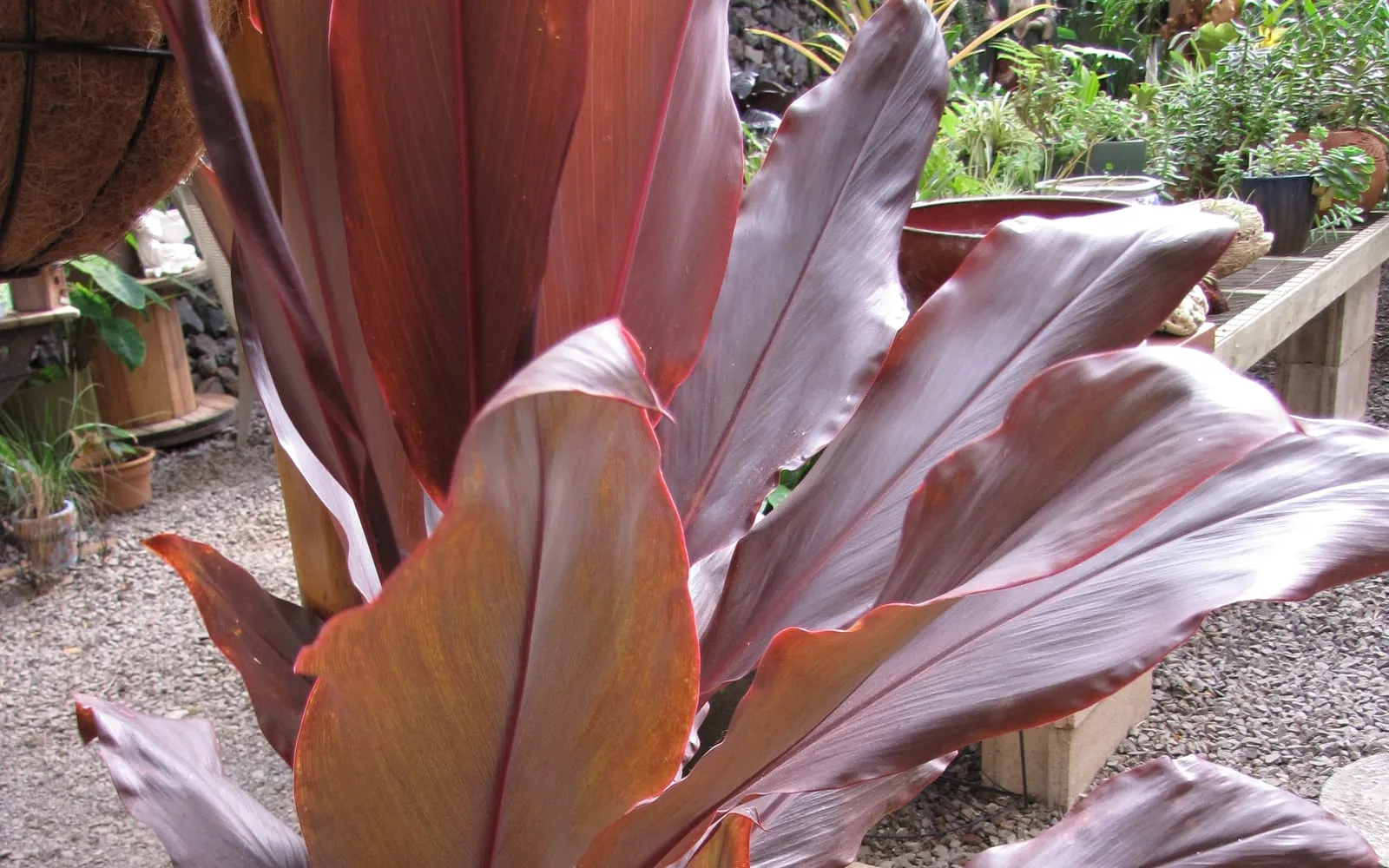
Indoors it is grown for the leaf colour, which in the modern cultivars runs through pink, crimson, magenta and near-black, often striped or edged in a second shade. Almost all of that colour is anthocyanin sitting over the chlorophyll, and it costs the plant something to make, which is why a ti plant in a dim corner fades steadily towards plain green.
Its reputation for difficulty comes down to two things, and both are about water. It wants high humidity, and it is unusually sensitive to fluoride in tap water. A plant with brown-tipped leaves in a dry room is showing both problems at once.
Appearance and character
An upright evergreen shrub with slender woody canes carrying a terminal tuft of long strap-shaped leaves, losing its lower leaves and going bare-caned with age.
Leaves are lance-shaped to broadly strap-like, 30 to 60 cm long, arching, and held in a spiral around the growing point. Colour depends entirely on cultivar.
‘Red Sister’ is deep magenta and pink. ‘Rubra’ is dark red-purple. ‘Kiwi’ is green striped in cream with pink margins. Plain green forms exist and are the most shade-tolerant.
Growth is moderate, reaching one to three metres indoors over years, and the plant becomes top-heavy as the cane lengthens.
New growth emerges at the top of each cane in the strongest colour, which fades and greens as the leaf ages and as light drops.
Flowering indoors is uncommon, producing branched sprays of small fragrant white to pinkish flowers followed by red berries in warm climates.
Cane sections root readily, which is how the plant is propagated commercially and why it travelled well by canoe.
Where it is from
Southeast Asia and Papua New Guinea originally, then spread by human movement across Melanesia, Polynesia and into Hawaii and New Zealand.
The plant’s Pacific range is cultural rather than natural. Voyagers carried rhizome pieces in canoes, and the species now grows across islands it could not have reached on its own. In Hawaii it remains bound up with ceremony and with protection, planted around houses, and the leaves are used in hula skirts and to wrap food for cooking in an imu.
Its natural habitat is humid forest margin, which explains the indoor requirements. High constant humidity, warmth, shelter from wind and bright but filtered light are the conditions it evolved in, and dry heated air is the exact opposite.
The genus Cordyline contains around fifteen species, and Cordyline australis, the New Zealand cabbage tree, is the hardy one grown outdoors in cool climates. The two are often confused and their care has almost nothing in common.
How it grows
Give it bright indirect light for strong colour. Green and lightly marked forms tolerate moderate shade, and the deep reds and pinks fade without good light.
Keep it out of harsh direct sun, which scorches the leaves.
Water with rainwater, filtered or distilled water. This is the single most effective change for a plant with brown tips, since fluoride in tap water is the usual cause.
Water when the top third of the compost has dried, thoroughly, and drain completely.
Raise the humidity as high as you can manage. A bathroom, a humidifier or a gravel tray all help, and grouping plants together helps more than misting.
Keep it above 12 deg C and ideally between 18 and 27 deg C.
Feed monthly at half strength through the growing season, and avoid superphosphate fertilisers, which carry fluoride.
Cut a leggy cane back in spring to any height. It resprouts from below the cut, and the removed section can be cut into pieces and rooted.
Repot every two or three years in spring into a heavy pot, since a tall cane is top-heavy.
Through the seasons
Spring restarts growth and is the time to cut back leggy canes, repot and take cuttings.
Summer is the main growing season. Water when the top third dries, feed monthly, and keep the humidity up.
Autumn slows it. Reduce watering, stop feeding from October, and move it nearer the light as colour depends on it.
Winter is the difficult season. Dry heated air browns the tips, so keep the plant off radiator shelves, maintain humidity and water sparingly with rainwater.
Care difficulty
Moderate, and the difficulty is specific rather than general.
Fluoride sensitivity is the defining problem. Tap water in many supply areas carries enough fluoride to brown the leaf tips of this genus, and no adjustment to watering frequency fixes it. Switching to rainwater or filtered water does.
Dry air is the second, producing the same brown tips by a different route.
Colour loss follows low light and is the usual disappointment with the red cultivars.
Legginess is inevitable as the cane extends and the lower leaves drop, and hard pruning in spring is the remedy.
Watering
Water when the top third of the compost has dried, roughly weekly in summer and every two weeks in winter.
Use rainwater, filtered or distilled water rather than tap water wherever possible.
Water thoroughly until it drains, then empty the saucer.
Flush the compost through with clean water two or three times a year to clear accumulated salts and fluoride.
Underwatering shows as drooping and then browning leaf tips and edges.
Overwatering shows as yellowing lower leaves and a soft cane base.
Warning signs, diseases and pests
Brown dry tips on most leaves are fluoride from tap water, dry air, or salts from feeding. Switch to rainwater, raise the humidity and flush the pot.
Colour fading towards green means insufficient light. Move it brighter, out of harsh sun.
Yellow lower leaves dropping one at a time as the cane extends is normal ageing.
Fine pale stippling with webbing is red spider mite, which thrives in the dry air this plant already dislikes.
White cottony fluff in the leaf bases along the cane is mealybug.
Small brown discs on the leaf undersides are scale insects, with sticky honeydew below.
Scorched pale patches are sun damage.
A bare cane with foliage only at the top is age. Cut it back in spring and root the removed section.
Growing environment
Bright indirect light for the coloured cultivars, and moderate shade for green forms.
Never harsh direct sun.
Warm, 18 to 27 deg C, with 12 deg C as the floor.
High humidity, which is the condition most often missing indoors.
Free-draining peat-free houseplant compost in a heavy pot with drainage holes.
Rainwater or filtered water rather than tap water.
Outdoors it grows in warm humid frost-free climates, USDA 10 and warmer, where it is a common hedge and border plant.
Avoid radiators, dry rooms, fluoridated tap water and superphosphate feeds.
Feeding
Feed monthly from spring to early autumn with a balanced liquid houseplant fertiliser at half strength.
Avoid superphosphate-based fertilisers, which contain fluoride and worsen the tip browning.
Stop feeding from mid-autumn to early spring.
Repot every two or three years in spring into a heavy pot one size up.
Flush the compost with clean water regularly to clear salts and fluoride.
Troubleshooting
The leaf tips are brown on every leaf. Fluoride in tap water is the most likely cause, with dry air second. Switch to rainwater or filtered water, raise the humidity and flush the compost through.
The red has faded to green. Not enough light. The colour is anthocyanin pigment sitting over the chlorophyll and it costs the plant energy, so it fades in shade. Move it brighter, out of harsh sun.
Is this the same as a cabbage tree? No. Cordyline australis is the hardy New Zealand species grown outdoors in cool climates. This is the tropical one and it needs warmth and humidity.
Is it safe with pets? It contains saponins and the ASPCA lists it as toxic to cats and dogs, causing vomiting and drooling rather than anything worse.
The cane is bare with leaves only on top. Normal ageing. Cut the cane back to any height in spring and it will resprout, and the removed section can be cut up and rooted.
Can I use tap water if I let it stand? Standing water overnight removes some chlorine but not fluoride, which is the compound causing the trouble. Rainwater or filtered water is the reliable answer.
How do I propagate it? Cut the cane into 5 to 8 cm sections, lay or stand them in damp compost, and they will sprout from the dormant buds. This is how the plant was carried across the Pacific.
Why is it called a good luck plant? The green forms have long been planted around houses in Hawaii and across Polynesia for protection, and the association travelled with the plant into the houseplant trade.
Ti plant problem guides
Not sure what is wrong? See the common houseplant pests guide.