
Houseplant
Sweetheart Hoya
Hoya kerrii
Also known as Valentine Hoya
How to grow sweetheart hoya, Hoya kerrii. Why a single heart-shaped leaf sold as a gift can never grow into a vine unless it was cut with a stem node, and why letting the mix dry out fully matters more than any feeding schedule.
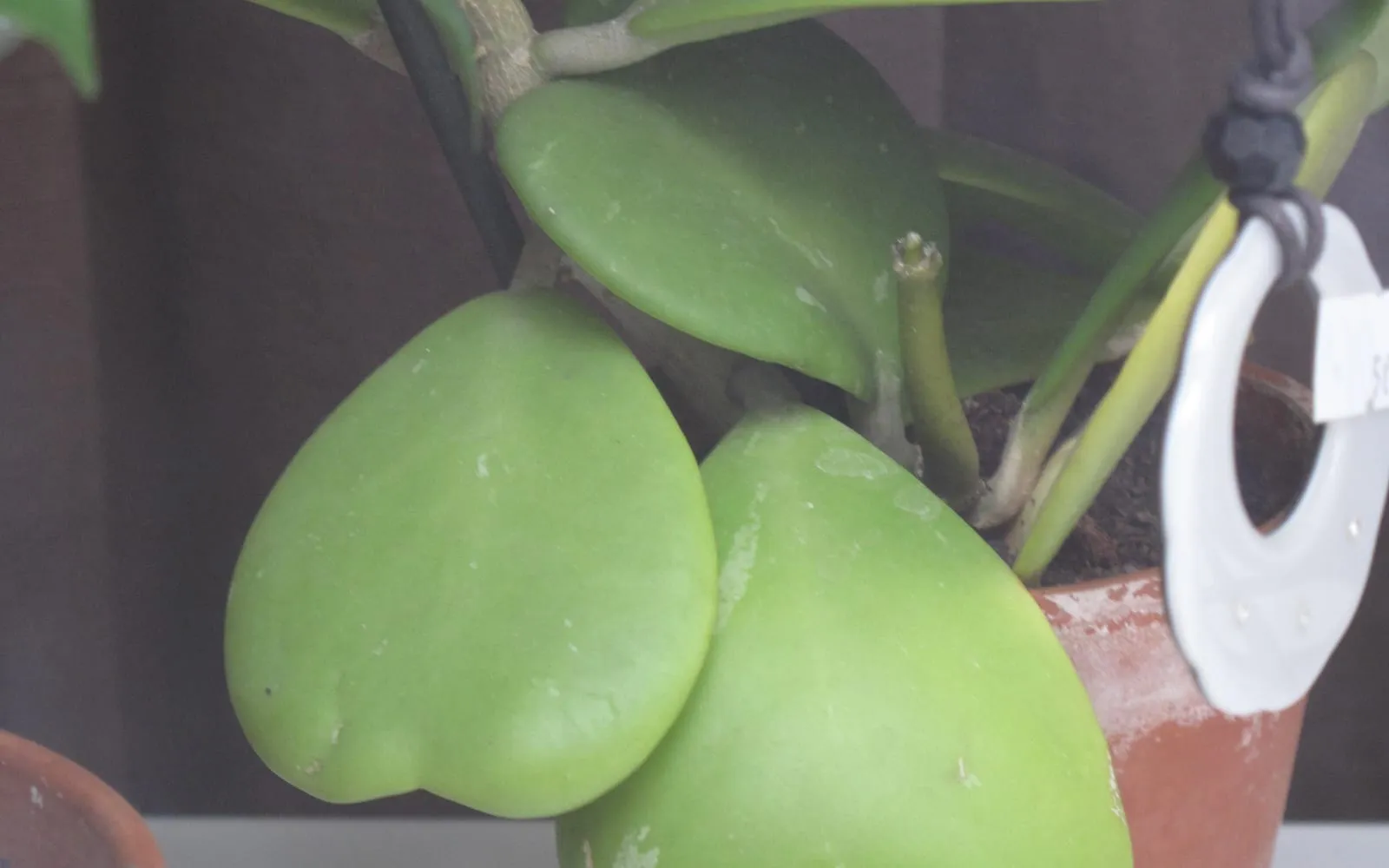
At a glance
- Difficulty
- Moderate
- Water
- Only once the mix has dried out completely, which may be every two to three weeks
- Light
- Bright light with some direct morning or evening sun
- Temperature
- Above 10 deg C
- Humidity
- Average room humidity; no need to raise it artificially
- Hardiness
- USDA 10b-12, RHS H1b, hardy to 10 C
- Type
- Evergreen succulent climbing vine
- Height
- 2-4 m trained; a single-leaf plant may stay one leaf for years
- Native to
- Southeast Asia
A tropical epiphyte that grows on trees and rock faces through Southeast Asia, taking the wet-dry rhythm of a monsoon climate rather than constant damp. It reads as needy in a temperate house only because its dry season expects real dryness at the roots, not because the plant itself is delicate. It has no frost tolerance at all.
Hardiness zones describe winter cold alone. Summer heat, humidity, rainfall and the length of the growing season decide as much, so treat the range as the outer limit rather than as a recommendation.
Not known to be toxic
Hoya carries no toxic compounds and appears on no reputable list of harmful plants. A cat or dog that chews a leaf may vomit afterwards from the sheer fibre and thickness of it rather than from any poison, the same as with any tough plant material eaten in quantity, and a child who bites into one gets nothing worse than a mouthful of waxy leaf. The flowers exude a sticky nectar that some pets find interesting to lick; it is sugar rather than toxin and causes no harm beyond mild stickiness. This is a genus you can grow without factoring pets or small children into the decision at all.
Sources: RHS potentially harmful garden plants, ASPCA toxic and non-toxic plants
About
Sweetheart hoya is often sold as a single rooted heart-shaped leaf. A leaf cutting without a node can stay alive for years but will not grow into a vine. If you want a plant that climbs and flowers, buy one with a visible stem node or an existing vine.
A true vine forms thick, waxy, succulent leaves and can eventually produce clusters of small fragrant flowers. It needs bright light, a free-draining mix and roots that dry fully between waterings.
Appearance and character
Leaves are thick, fleshy and heart-shaped, 6 to 10 cm long, with a firm, almost rubbery feel that comes from storing water the way a succulent does rather than the thin tissue of most houseplant foliage. New leaves emerge in pairs along a twining stem.
Left to climb, a mature plant produces rounded clusters, or umbels, of small star-shaped flowers, pale cream to yellow with a red-centred waxy corona at the middle of each bloom, which beads with nectar and carries a sweet scent, strongest in the evening. Flowering takes a mature vine of some years rather than the young single-leaf plants sold as gifts.
Growth is slow by houseplant standards, one of the trade-offs for a leaf this thick and durable, and a Hoya kerrii can sit contentedly in the same small pot for a long time before it needs moving up.
Where it is from
Hoya kerrii grows through Southeast Asia as an epiphyte, rooting into bark crevices and rock faces rather than soil, and climbing by aerial roots that grip onto whatever surface it meets. Its native range runs through a monsoon climate with a real dry season, during which an epiphytic plant with almost no soil around its roots dries out completely between rains.
That background explains the two things people most often get wrong with it indoors: it needs strong light, closer to what it gets clinging high on a tree trunk than what most houseplants tolerate, and its roots should dry out fully and often between waterings rather than staying lightly moist.
How it grows
Plant it in a chunky, fast-draining mix, similar to what suits an orchid or a cactus: bark, perlite and a cactus or succulent compost in roughly equal parts. Ordinary houseplant compost holds too much water around succulent-textured roots that expect to dry out.
Give it something to climb early, a small trellis or moss pole, since a plant trained upward from the start develops the twining growth habit that eventually flowers, where one left to sprawl in a hanging pot may go on putting out leaves for years without flowering.
Repot only when it is clearly rootbound, perhaps every two to three years, since it dislikes root disturbance and grows slowly enough that frequent repotting offers no benefit.
Propagate stem cuttings that include at least one leaf node in water or damp perlite; a single leaf without a node roots readily but, as above, goes nowhere from there.
Through the seasons
Spring brings the start of active growth. Resume feeding and check whether the plant needs repotting.
Summer is the main growing season and, on a mature vine, the most likely time for flowers to open.
Autumn slows growth. Reduce feeding towards the end of the season.
Winter is a rest. Water more sparingly than in summer, since the plant uses far less at lower light and temperature, and stop feeding until spring.
Care difficulty
Moderate, and the difficulty sits entirely in the watering rather than in anything else. Overwatering is by far the commonest way to lose one, because the succulent leaves and stems store enough water that the plant gives no early warning; by the time it looks unwell, the roots have often rotted already. Underwatering, by contrast, it tolerates for weeks. Light is the other factor. A plant kept too dim survives but rarely climbs or flowers, sitting as a static, healthy-looking rosette of leaves indefinitely.
Watering
Let the mix dry out completely before watering again, checking with a finger a couple of inches down rather than by the calendar, since the interval shifts with light, temperature and pot size. In a bright, warm room in summer that might mean every two weeks; in a cooler room in winter it can stretch to a month or more.
When you do water, do it thoroughly, until water runs from the drainage holes, then let the pot drain fully and do not water again until it has dried out. A “little and often” approach is the wrong instinct for this plant and the most common route to root rot.
Warning signs, diseases and pests
Mealybug shows as small white, cottony tufts tucked into leaf joints and along new growth. Wipe them away with a damp cloth or treat with horticultural soap.
Scale insects appear as small, flat, brownish bumps on the stems, sapping the plant. Treat the same way as mealybug.
Spider mite thrives in hot, dry indoor air and shows as fine speckling on the leaves with faint webbing in bad cases. Raising humidity slightly and wiping leaves down helps prevent it.
Root rot follows overwatering, and shows as a plant that looks increasingly unwell despite a damp pot, since the roots that should be taking up water and holding the plant upright have already failed. Unpot it, cut away soft brown roots, let the remainder dry, and repot into fresh mix, watering only once it has dried out again.
Growing environment
Bright light suits it best, including an hour or two of gentle direct sun in the morning or evening; a plant kept too far from a window grows slowly and rarely flowers.
Average room temperature is fine year round, provided it never drops close to 10 deg C, below which growth stalls and cold damage becomes a real risk.
Ordinary room humidity is adequate. This is one succulent-leaved houseplant that does not need a pebble tray or a bathroom spot to thrive.
Give it a support to climb from an early stage, since a plant trained upward develops differently from one left to trail, and training later is harder once growth has set a sprawling habit.
Feeding
Feed with a balanced liquid houseplant feed, diluted to around half strength, or a fertiliser formulated for cacti and succulents, monthly through spring and summer.
Stop feeding entirely from autumn through winter, when the plant is using very little and unused fertiliser only builds up as salts in a mix that is already drying out between waterings.
Troubleshooting
My heart-shaped leaf has not grown anything new in two years. It is very likely a leaf cutting taken without a node, in which case it physically cannot produce a new stem or leaf. It will stay healthy as a single leaf indefinitely; nothing you do will change that, and the only way to get a growing vine is to start a new plant from a cutting that includes a node.
The leaves are shrivelling. Underwatering, and an easy fix: the thick leaves store water and shrink visibly once that reserve runs low. Water thoroughly and they should plump back up within a few days.
It has never flowered. Most likely age, light, or both. A vine needs some years of growth before it flowers at all, and needs strong light throughout that time to do so once mature. A young single-leaf plant will not flower regardless of care.
The stems have gone soft and dark at the base. Root rot from overwatering. Check the roots, remove any that are soft and brown, and repot into fresh, dry mix, then adjust your watering interval.
Can I keep it as a hanging plant instead of training it up? Yes, though it flowers less freely trailing than climbing, since in the wild it flowers on the sections attached to a support rather than on loose hanging growth.
Sweetheart Hoya problem guides
Not sure what is wrong? See the common houseplant pests guide.