
Edible
American Prickly-Ash
Zanthoxylum americanum
Also known as Toothache Tree, Northern Prickly-Ash
How to grow American prickly-ash, Zanthoxylum americanum. Why chewing the bark numbs a toothache, its close kinship with Sichuan pepper, and why gardeners usually leave giant swallowtail caterpillars to strip a few leaves undisturbed.
At a glance
- Difficulty
- Moderate
- Water
- Regular water while establishing; tolerates normal rainfall once mature
- Light
- Full sun to part shade; tolerates woodland understorey conditions
- Temperature
- Fully hardy; a cold winter causes it no trouble
- Hardiness
- USDA 3-7, RHS H7, hardy to -35 C
- Type
- Deciduous suckering shrub or small tree
- Height
- 3-8 m
- Native to
- eastern North America
A cold-continental understorey shrub of eastern hardwood forest, hardy through severe winters and unbothered by a short growing season, since it tolerates shade and cold better than heat and humidity. It grows less vigorously in a hot, humid subtropical climate than in the cooler, harder-wintered part of its range where it is most at home.
Hardiness zones describe winter cold alone. Summer heat, humidity, rainfall and the length of the growing season decide as much, so treat the range as the outer limit rather than as a recommendation.
Skin irritant
- Safe to eat
- The dried, ground fruit husk, used sparingly as a spice
- Do not eat
- The bark, and the crushed leaf or fresh sap in strong sunlight
- Harm from
- Eating it and handling it
- Affects
- People
American prickly-ash carries a long history of use as a folk remedy rather than as a food crop, and that history is a caution as much as a recommendation. Chewing the aromatic bark produces a strong, numbing tingle on the tongue and gums, which is exactly why Indigenous peoples and early settlers reached for it as a toothache remedy, and the same active compounds that cause the numbness can bring on nausea or vomiting if the bark or a large dose is swallowed rather than chewed and spat out. The fruit husks, dried and ground, are used sparingly as a spice related in flavour and numbing effect to Sichuan pepper, a closer relative than the true pepper it is sometimes compared with, and are safe in the small quantities a spice is used in. Neither the RHS harmful plants index nor the ASPCA toxic and non-toxic plants list carries a specific entry for this species. Like several relatives in the citrus family, its foliage and sap have some potential to cause a sun-triggered skin reaction where crushed plant material contacts skin left in strong sunlight, so wash exposed skin after heavy pruning or handling rather than assuming none of the family's photosensitising traits carried over to this species.
Sources: RHS potentially harmful garden plants, ASPCA toxic and non-toxic plants
About
American prickly-ash is a thicket-forming understorey shrub from eastern North American forests, grown for aromatic bark and fruit long used in folk medicine and as a spice rather than for ornamental appeal. Paired thorns guard every leaf node along its stems, and small, easily missed greenish-yellow flowers open on bare wood in early spring, well before the leaves. It suckers from the base and spreads gradually into a dense, spiny thicket if left unmanaged, a habit useful for wildlife cover and frustrating for anyone wanting a single tidy specimen.
Appearance and character
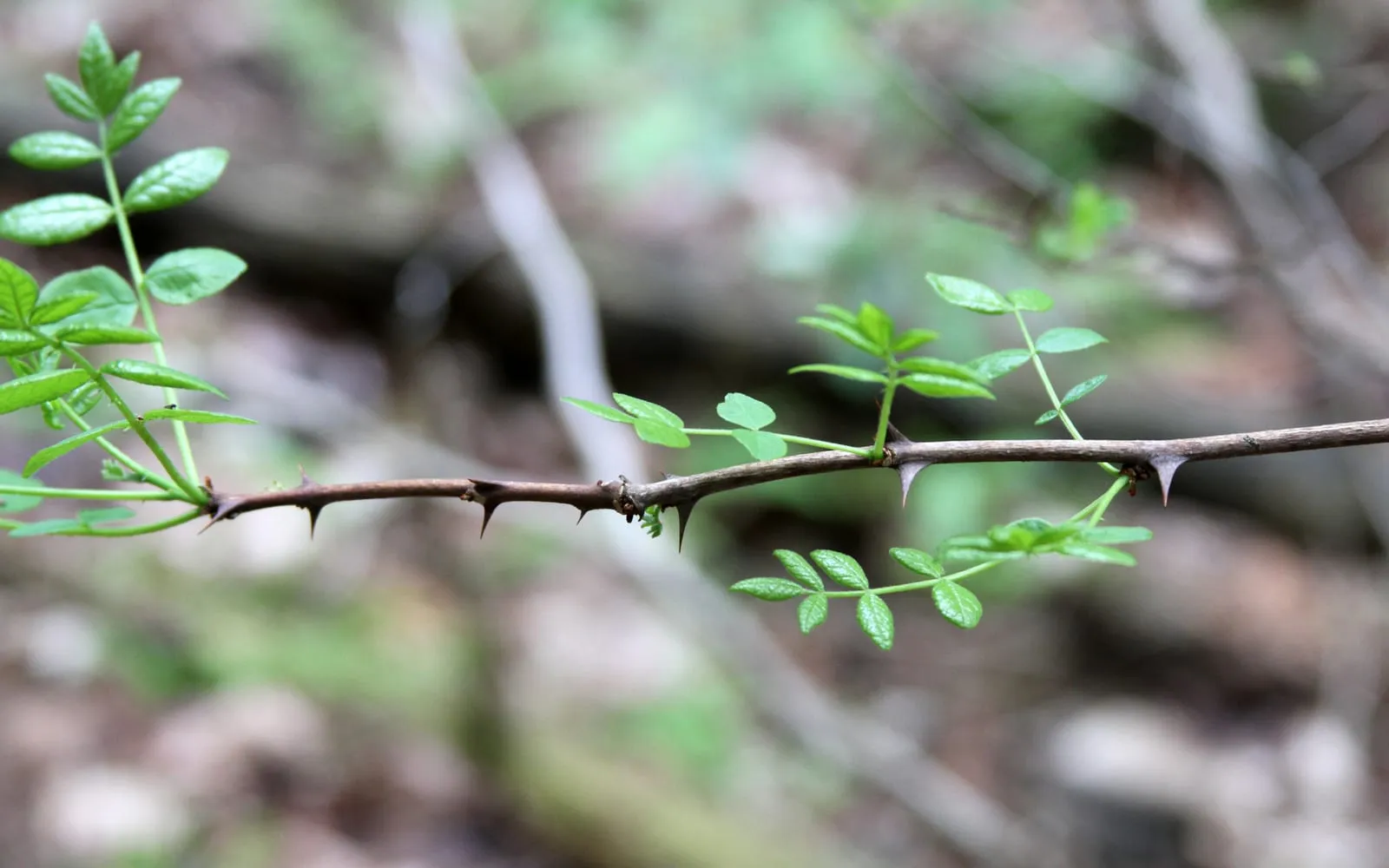
Stems carry stout, paired thorns at each leaf node, sharp enough to catch clothing readily and dense enough on older wood to make the plant a genuine barrier where it forms a thicket. Leaves are pinnately compound, aromatic when crushed, with five to eleven leaflets along a central stalk. Flowers appear in small clusters directly on the previous year’s wood before the leaves emerge, greenish-yellow and easy to overlook, and the plant is dioecious, meaning individual shrubs carry either male or female flowers rather than both. Fruit follows on female plants only, small reddish-brown capsules that split open in late summer to reveal a single shiny black seed, aromatic and numbing on the tongue in the same way as the bark.
Where it is from
Zanthoxylum americanum is native to eastern and central North America, from the Great Lakes and southern Canada south through the eastern United States, typically found in the understorey of hardwood forest, along woodland edges and on rocky or gravelly slopes. Indigenous peoples across its range chewed the bark to numb toothache and sore gums long before European settlement, a use that gave the plant its common name and that early settlers adopted readily once they learned it. It is closely related to the Sichuan pepper of Chinese cuisine, sharing the same characteristic numbing sensation from related compounds in the fruit husk, though American prickly-ash has never been cultivated as a commercial spice crop on anything like the same scale.
How it grows
Plant in any reasonably drained soil, moist woodland loam or drier, rockier ground alike; it tolerates a wide range of conditions and grows well in part shade as an understorey planting or in full sun with slightly denser growth. Because it suckers from the roots, decide early whether a thicket or a smaller number of stems is wanted, and remove unwanted suckers each year at ground level if a tidier shape is the goal. Since it is dioecious, a female plant needs a male growing nearby to set fruit, so buy or propagate more than one specimen if fruit for spice is the aim rather than foliage alone. Handle the plant with care during any pruning or thinning work, since the paired thorns at every node catch skin and clothing on contact.
Through the seasons
Spring brings the small flowers on bare wood before the leaves open, an early and easily missed event best watched for closely.
Summer is leaf growth and, on a pollinated female plant, fruit development through the season.
Autumn brings the fruit to maturity, splitting to release the aromatic black seed, and is a suitable time to plant new stock.
Winter is full dormancy, and the plant needs its share of cold to stay healthy through the following growing season.
Care difficulty
Moderate. The plant itself is tough and cold-hardy, tolerating a wide range of soil and light conditions with little routine attention once established. The difficulty comes from two sources instead: managing the thorns during any hands-on work, and controlling the suckering habit if a single specimen rather than a thicket is wanted. Neither is technically demanding, but both call for a bit more care than an unarmed, non-suckering shrub would need.
Watering
Water regularly through the first two growing seasons while roots establish, then expect the plant to manage on typical rainfall in most climates within its native range. It tolerates both moist woodland soil and drier, rockier ground reasonably well once mature, and rarely needs supplemental watering beyond an unusually prolonged dry spell.
Warning signs, diseases and pests
Giant swallowtail caterpillars feed on the foliage, sometimes stripping a branch bare, and are useful to recognise before reaching for control: they are the larval stage of one of the largest butterflies in North America, and this plant is one of its principal host species. Most gardeners choose to tolerate the feeding damage in exchange for the butterflies it supports, though a heavily infested young plant can be protected by moving a few caterpillars to an older, more established shrub if growth needs protecting.
Scale insects form small, flat bumps along the woody stems, sapping vigour gradually if left unchecked; horticultural oil applied while the insects are active controls most infestations.
Aphids cluster on soft new shoots in spring, distorting growth and fouling the leaves below with honeydew; a strong jet of water or an insecticidal soap usually clears a light infestation.
Leaf spot marks the foliage with brown patches during a wet summer, rarely serious on an established plant; clearing fallen leaves in autumn reduces the fungus carrying over to reinfect the following season.
Growing environment
Part shade suits it well as an understorey planting, close to its native woodland habitat, while full sun produces slightly denser, more compact growth. Soil is rarely the limiting factor, since it tolerates moist woodland loam, drier rocky ground and average garden soil alike, provided drainage is reasonable. Good spacing from paths and seating areas is worth planning for given the thorns, particularly once suckers begin spreading the thicket outward from the original planting.
Feeding
Little supplementary feeding is needed beyond a spring mulch of leaf litter or compost, which also mimics the woodland floor conditions it grows in naturally. A mature plant in reasonable soil rarely benefits from additional fertiliser, and heavy feeding offers little advantage over the plant’s own tolerance for average ground.
Troubleshooting
My plant has never produced any fruit. This species is dioecious, so a female plant needs a male growing nearby to set fruit; a single plant of unknown sex, common where seedlings were not identified before planting, may be the wrong sex for fruiting on its own regardless of how well it is grown otherwise.
Caterpillars have stripped several branches bare. Giant swallowtail larvae are the likely cause, and many gardeners choose to leave them, since this plant is one of the species that supports the butterfly through its larval stage. A young plant under heavy pressure can be protected by moving some caterpillars to an older shrub with more foliage to spare.
The thorns keep catching my clothing and skin during routine maintenance. That is normal for this species. Wear thick, close-fitting sleeves for any pruning or thinning work, and site the plant away from paths and seating areas where brushing past it is likely.
Is chewing the bark for a toothache safe? In the small quantities historically used, chewed briefly and spat out rather than swallowed, it has a long record of traditional use. Swallowing bark or using it in quantity is a different matter and can cause nausea or vomiting, so treat it as a folk remedy with real effects rather than a casual home treatment.
How far will the thicket spread if I leave it unmanaged? Root suckers extend gradually outward from the original planting over years rather than suddenly, so a thicket left entirely alone can eventually cover a significant area. Removing unwanted suckers at ground level each year is the straightforward way to keep it within bounds.
American Prickly-Ash problem guides
Not sure what is wrong? See the common vegetable pests guide.