
Edible
Sugar Apple
Annona squamosa
Also known as Sweetsop, Custard apple, Sitaphal, Noi-na
How to grow sugar apple, Annona squamosa. The fruit that breaks into segments in your hands, the quickest Annona to crop, and why the seed powder must be kept away from eyes.
At a glance
- Difficulty
- Moderate
- Water
- Twice a week in growth, nearly dry in winter
- Light
- Full sun
- Temperature
- Minimum 8 deg C. Tolerates a very light frost when dormant
- Humidity
- Moderate
- Hardiness
- USDA 10-11, RHS H1b, hardy to 5 C
- Type
- Tender deciduous or semi-deciduous shrub or small tree
- Height
- 3-8 m in the open, 1.5 m in a pot
- Native to
- the Caribbean, Central America
- Best month
- June, July and September in the Northern Hemisphere, December, January and March in the Southern Hemisphere
Seasonally dry tropical America. It sheds its leaves in a dry or cool spell and flowers as it releafs. Like the cherimoya it is protogynous, so hand pollination transforms the crop.
Hardiness zones describe winter cold alone. Summer heat, humidity, rainfall and the length of the growing season decide as much, so treat the range as the outer limit rather than as a recommendation.
Every month named in this guide is for the temperate Northern Hemisphere. If you garden in the Southern Hemisphere, shift each one by six months, so June becomes December. Closer to the equator the wet and dry seasons matter more than the calendar, and the shift stops being a useful guide.
Toxic if eaten
- Safe to eat
- The white flesh around each seed
- Do not eat
- The seeds, leaves and bark
- Harm from
- Eating it and sap in the eyes
- Affects
- People
The flesh is food and is eaten across the tropics. The seeds are a recognised hazard. Powdered Annona squamosa seed has been used for centuries as an insecticide and as a treatment for head lice, and its use on the scalp is a documented cause of severe chemical keratoconjunctivitis and lasting corneal damage when the powder or paste reaches an eye. Hospital series from India describe exactly this. Never crush the seeds, never blend the fruit whole, and keep any seed preparation away from the face. Swallowing an intact seed does no harm because it passes through. The leaves and bark contain the same acetogenins that underlie the warnings about the Annona family more generally, discussed in the soursop guide, and leaf preparations are best avoided.
Sources: EFSA Journal risk assessment of Annona muricata in food supplements, RHS potentially harmful garden plants
About
A ripe sugar apple comes apart in the hands. The knobbly green skin splits along the seams between segments, each segment lifts out with a black seed inside, and you eat it off the seed. No knife is involved and no plate survives the process.
The flavour is where the name comes from. Sweet, floral and custard-like, with almost no acidity, and sweeter than any other Annona.
For a temperate grower it is the second most practical Annona after cherimoya. The plant is small, semi-deciduous, tolerates poor and limy soil, needs only to be kept above 8 deg C, and fruits within three years from seed.
Appearance and character
An open spreading shrub or small tree, 3 to 8 m in the open, branching low and easily kept to a metre and a half in a pot.
The plant is deciduous or semi-deciduous, dropping its leaves in a dry or cool season.
Leaves are alternate, oblong to lance-shaped, 5 to 17 cm, dull pale green, thin, and aromatic when crushed.
Flowers hang singly or in twos and threes on the young wood, greenish yellow, about 2.5 cm, with three fleshy outer petals that never open wide.
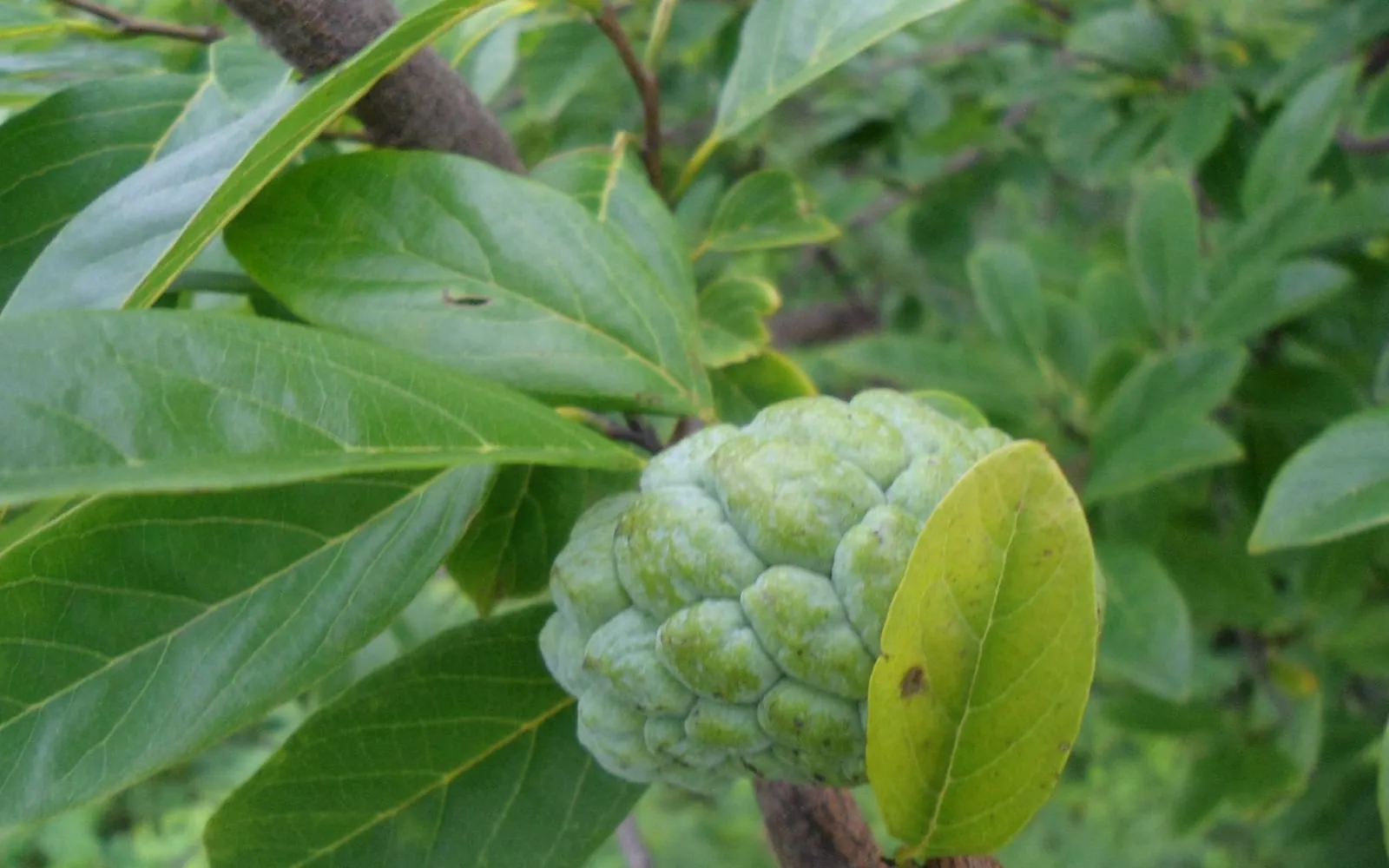
Fruit is round to heart-shaped, 6 to 10 cm, and the surface identifies it at a glance. A mass of rounded knobs, each one a separate carpel, sits behind pale seams under a grey-green bloom.
Ripe fruit softens and the seams open, which is what makes it break apart.
Flesh is white, sweet, granular and custard-like, in segments, with one glossy black seed in most of them.
The fruit does not travel, which is why it rarely reaches temperate markets fresh.
Where it is from
Sugar apple is native to the Caribbean and Central America, and it was one of the first American fruits the Spanish and Portuguese carried across the world.
It reached India and South East Asia in the sixteenth century and naturalised so thoroughly that it is often assumed to be Asian. Sitaphal in India, noi-na in Thailand and srikaya in Indonesia are all this fruit.
India is now the largest producer, and it is grown throughout the drier tropics because it tolerates poor soil and a marked dry season better than most fruit trees.
It is naturalised and locally weedy in parts of Africa, Asia and the Pacific.
Temperate markets see it very rarely fresh, since it is soft, splits open on ripening and keeps for only a few days.
How it grows
Sow seed from a ripe fruit. It keeps for months and germinates at 20 to 25 deg C, taking three to eight weeks, which is slower than the other Annonas.
Nick the hard seed coat or soak the seed for three days to speed things up.
Grow in full sun in free-draining compost. This species tolerates poor and limy ground better than any other Annona.
Keep it above 8 deg C in winter and let it go dormant, dropping its leaves and staying nearly dry.
Water twice a week in growth.
Feed monthly from April to September.
Hand-pollinate for a decent crop, collecting pollen from male-phase flowers in the afternoon and applying it to female-phase flowers the next morning.
Prune in late winter while the plant is bare, to keep it open and compact.
Expect fruit in three years from seed, which is quicker than most.
Through the seasons
Winter is dormancy. Hold at 8 to 12 deg C, keep the compost nearly dry, and feed nothing. The plant drops its leaves.
Late winter is the pruning window while the plant is bare.
Spring brings new leaves, and flowers follow on the young wood.
Early summer is the main flowering and hand pollination period.
Midsummer is fruit swell, which takes three to four months.
Early autumn is harvest, and ripe fruit splits along its seams.
Late autumn is when to stop feeding and dry the plant off for dormancy.
Care difficulty
Moderate, and the second most practical Annona for a cool climate after cherimoya.
Cold tolerance is adequate. It needs to be held above 8 deg C, and it takes a very light frost when leafless.
The dormancy is useful rather than a burden, since a cool dry winter is easier to provide than a heated humid one.
Soil is undemanding, and it grows on limy ground where other Annonas will not.
Fruiting comes in three years from seed, which is fast.
Hand pollination is needed for a full crop, as with all Annonas.
The fruit splits on ripening and keeps for days rather than weeks, so it is a crop to eat rather than store.
Watering
Water twice a week through the growing season.
Reduce sharply from autumn and keep the plant nearly dry through dormancy.
Drain fully. Wet compost in a cool winter is the main cause of loss.
Water steadily during fruit swell, since irregular watering splits the fruit prematurely and spoils it.
Tap water is acceptable, including in a hard water area.
Keep humidity moderate.
Resume watering as the new leaves expand.
Warning signs, diseases and pests
Flowers dropping without setting means no pollination.
Fruit growing lopsided is partial pollination, and it is more obvious on this species because the segments are visible from outside.
Fruit splitting before it is ripe is irregular watering.
White waxy fluff between the fruit segments is mealybug, which is difficult to reach and spoils the crop.
Brown limpets on the stems are scale.
Leaf fall in autumn is the normal dormancy rather than a problem.
Wilting in damp compost through winter is root rot.
Blackened new shoots in spring are late frost damage.
Very slow germination is normal for this species. Nick or soak the seed.
Growing environment
A frost-free greenhouse or conservatory, standing outdoors for the summer.
Winter at 8 to 12 deg C, dry, with the plant leafless.
Summer at 20 to 30 deg C.
Full sun.
Moderate humidity.
Free-draining compost of moderate fertility, tolerant of lime.
pH from 6.0 to 8.0, which is the widest tolerance of any fruit in this collection.
A pot of 35 to 45 cm for a fruiting plant.
Feeding
Feed monthly from April to September with a balanced liquid feed.
Move to a high-potash feed as fruit swells.
Stop feeding at the end of September so the wood ripens before dormancy.
Give nothing through winter.
Repot or top-dress in late winter while the plant is bare.
Avoid heavy nitrogen.
Add magnesium if older leaves yellow between the veins during growth.
Troubleshooting
How do I eat one? With your hands. A ripe fruit splits along the seams between segments, each segment lifts out with a seed inside, and you eat the flesh off the seed.
Is it the same as a custard apple? The name is used loosely across countries. Sugar apple is Annona squamosa, cherimoya is A. cherimola, and both get called custard apple somewhere.
Why is my seed taking so long? Sugar apple seed is slow, taking three to eight weeks. Nicking the hard coat or soaking for three days speeds it up.
Why do the flowers fall without setting? No pollination. Hand-pollinate with pollen collected from male-phase flowers the previous afternoon.
The fruit is lopsided. Partial pollination. On this species you can see which segments were fertilised, because only those swell.
The fruit split before it was ripe. Irregular watering during swell. Keep the compost evenly damp from setting to harvest.
Can I use the seeds for head lice? No. Powdered Annona seed has been used that way for centuries and hospital series in India record severe corneal damage and lasting eye injury when the powder reaches an eye. Do not put it near a face.
It lost all its leaves in autumn. Normal. Sugar apple is deciduous or semi-deciduous and goes dormant in a cool or dry season.
Sugar Apple problem guides
Not sure what is wrong? See the common vegetable pests guide.