
Edible
Star Apple
Chrysophyllum cainito
Also known as Caimito, Golden leaf tree, Cainito
How to grow star apple, Chrysophyllum cainito. The purple fruit that shows a star when cut across, the golden leaf undersides that name the genus, and the rind you must not eat.
At a glance
- Difficulty
- Moderate
- Water
- Weekly in growth, sparingly in winter
- Light
- Full sun
- Temperature
- Minimum 8 deg C. Damaged by frost
- Humidity
- Moderate to high
- Hardiness
- USDA 10-11, RHS H1b, hardy to 5 C
- Type
- Tender evergreen tree
- Height
- 8-30 m in the open, 1.5-2 m in a pot
- Native to
- the Greater Antilles, Central America
- Best month
- May and June in the Northern Hemisphere, November and December in the Southern Hemisphere
Lowland Caribbean and Central America. The leaves are golden beneath and green above, which is the tree's distinguishing feature at a distance. It naturalises readily in the wet tropics.
Hardiness zones describe winter cold alone. Summer heat, humidity, rainfall and the length of the growing season decide as much, so treat the range as the outer limit rather than as a recommendation.
Every month named in this guide is for the temperate Northern Hemisphere. If you garden in the Southern Hemisphere, shift each one by six months, so May becomes November. Closer to the equator the wet and dry seasons matter more than the calendar, and the shift stops being a useful guide.
Edible, with limits
- Safe to eat
- The soft white pulp and the segments around the seeds
- Do not eat
- The rind and the latex in it, which are bitter and sticky
- Harm from
- Eating it
- Affects
- People
The pulp of a ripe star apple is food. The rind is not. It carries a thick sticky latex that is bitter, coats the mouth and glues the lips together, and the standard advice across the Caribbean is to eat the fruit with a spoon and go nowhere near the skin or the white layer immediately beneath it. Unripe fruit is worse in the same way. Neither is dangerous in the toxicological sense, and neither is pleasant. The seeds are hard and inedible and are spat out. Nothing in the plant is listed by the ASPCA as harmful to cats or dogs, though the latex would give either an unpleasant time.
Sources: RHS potentially harmful garden plants, ASPCA toxic and non-toxic plants
About
Cut a star apple across the middle and the seed cavities form a clean eight-pointed star in the flesh. Cut it lengthways and you see nothing of the kind, which is why the fruit is always halved around its equator.
The tree names itself twice over. Chrysophyllum means golden leaf, and the underside of every leaf is covered in fine golden-brown hairs that flash when the wind turns them, which makes the tree recognisable from a distance.
Eating one has a rule attached. The rind carries a thick bitter latex that glues the mouth shut, so the fruit is halved and spooned out and the skin is left alone. Jamaica pairs the pulp with orange and calls the dish matrimony.
Appearance and character
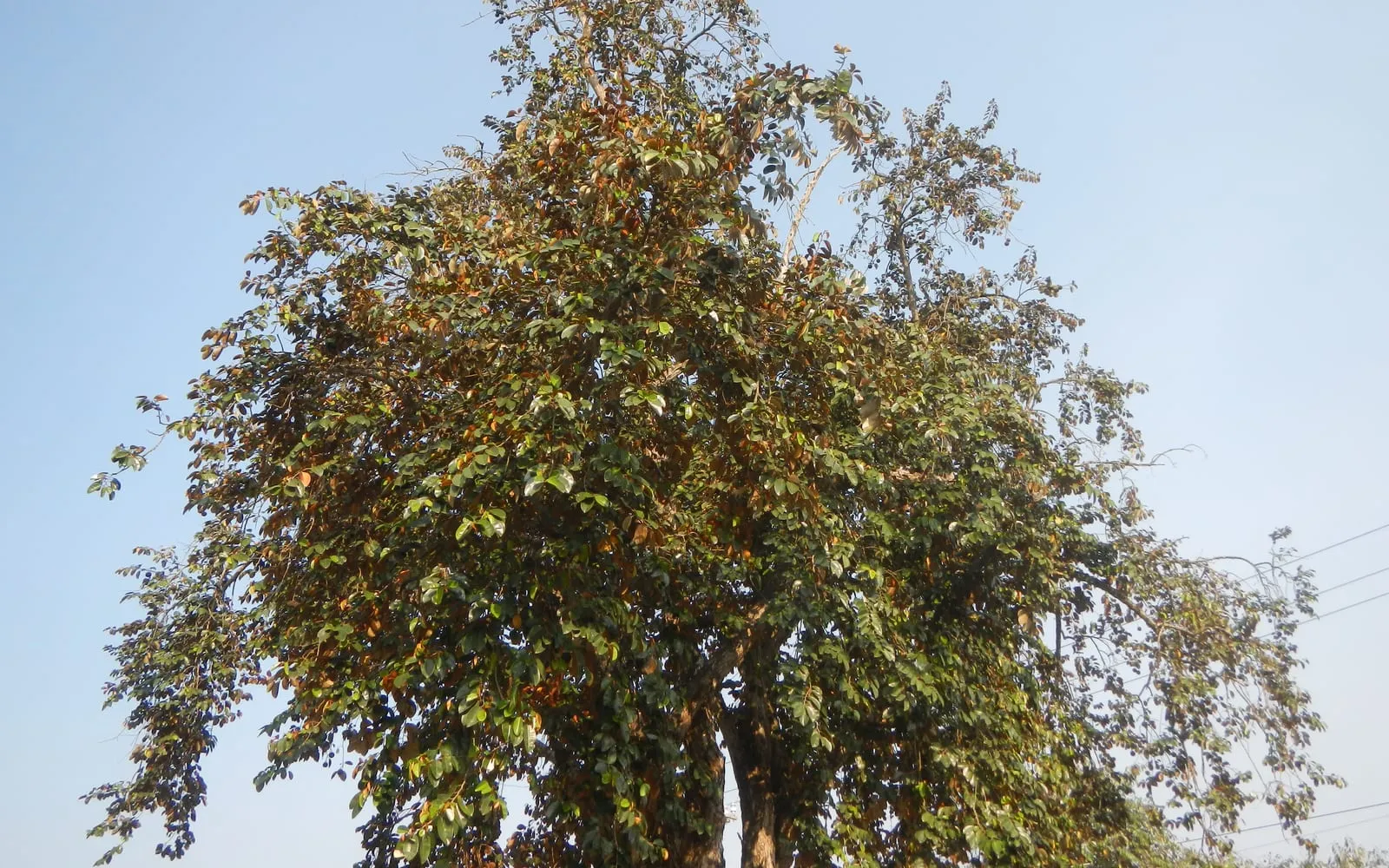
An upright evergreen tree with a dense rounded crown and drooping branch tips, 8 to 30 m in the open.
Leaves are the identifying feature. Alternate, oval, 5 to 15 cm, glossy dark green above and covered beneath in dense silky golden-brown hairs, so a moving tree flickers green and gold.
All parts bleed a sticky white latex when cut.
Flowers are tiny, purplish white to yellow-white, clustered in the leaf axils, and faintly fragrant.
Fruit is round, 5 to 10 cm, with a smooth glossy skin that is deep purple in the common form and pale green in the other.
The rind is thick, leathery and full of latex.
Inside, a layer of white pulp surrounds six to eleven flat brown seeds set in translucent segments arranged in a star.
Ripeness is judged by a dulling of the gloss and a slight softening. Fruit picked too early never ripens properly and stays hard and bitter.
Where it is from
Star apple is native to the Greater Antilles and the lowlands of Central America, and it was in cultivation across the Caribbean before European contact.
The Spanish spread it early through their possessions, and it reached South East Asia by way of the Philippines.
Vietnam took to it more than anywhere else outside its homeland. The Mekong delta grows it commercially as vu sua, and Vietnamese star apples are exported across Asia.
Jamaica uses it in matrimony, where the pulp is mixed with orange segments and a little sugar or condensed milk, and the dish is a national fixture.
It is naturalised and locally weedy in parts of Florida, Hawaii and the Pacific.
Temperate markets see it rarely, in Caribbean and Vietnamese groceries, because the fruit bruises and does not travel well.
How it grows
Sow seed from a ripe fruit. It germinates at 22 to 28 deg C in three to six weeks and keeps for a few weeks only.
Buy a grafted plant if fruit is the aim, since seedlings take five to ten years and vary.
Grow in deep free-draining compost of moderate fertility.
Give full sun and a minimum of 8 deg C.
Water weekly in growth and sparingly in winter.
Keep humidity moderate to high.
Feed monthly from April to September.
Prune lightly to control size. The tree is naturally dense and needs little shaping.
Expect fruit on a grafted plant in three to five years under warm glass, taking four to six months from flower to ripe fruit.
Pick when the gloss dulls and the fruit softens slightly, and never earlier.
Through the seasons
Winter is a cool rest above 8 deg C, watered sparingly and unfed.
Spring brings the growth flush and flowering. Repot and start feeding.
Early summer is fruit set.
Midsummer is fruit swell, which is slow.
Autumn is harvest for spring-set fruit.
Late autumn is when to stop feeding and reduce watering for the winter rest.
Care difficulty
Moderate, and much like sapodilla in what it asks.
Minimum 8 deg C is the floor, and frost damages young wood.
Soil is undemanding provided it drains.
Growth is slow, though not as slow as sapodilla.
Fruit comes in three to five years on a grafted plant under warm glass.
Picking at the right moment is the skill. A star apple picked early never ripens, staying hard and bitter, and there is no way to rescue it.
Humidity matters more than for sapodilla, and dry heated air brings spider mite and leaf drop.
Watering
Water weekly in growth, giving a thorough soak.
Reduce in winter, keeping the compost barely damp.
Drain fully.
Water steadily through fruit swell.
Keep humidity moderate to high with grouping or a damp gravel tray.
Tap water is acceptable.
Mulch the pot surface in summer.
Warning signs, diseases and pests
Fruit that stays hard and bitter was picked too early. It cannot be ripened afterwards.
A mouth coated in sticky bitterness means the rind or the layer under it was eaten. Spoon the pulp out and leave the skin.
Brown limpets on the stems and leaf undersides are scale, which the hairy undersides make hard to spot.
White fluff in the leaf axils is mealybug.
Fine webbing on the leaves is spider mite in dry air.
Wilting in damp compost is root rot.
Leaf drop after a cold night is chill damage.
Fruit dropping small is irregular watering or too heavy a set.
Growing environment
A frost-free glasshouse or conservatory, with the pot stood outside through a warm summer.
A floor of 8 deg C, and 22 to 30 deg C for growth and fruit.
Full sun, which is also what makes the golden underside of the leaves worth having. Site it where moving air turns the canopy and the whole tree flashes bronze.
Moderate to high humidity.
Deep compost of moderate fertility that drains freely, pH 5.5 to 7.5.
A pot of 40 cm or more before it will carry a crop.
Shelter from cold wind, which browns the leaf margins before it does any deeper harm.
Feeding
A balanced liquid feed monthly while the tree is growing.
High potash from the point the fruit begins to fill.
Nothing from October onwards, and nothing over winter.
A top-dress or a repot every second spring, since this is a slower feeder than most of the tropical fruit here.
Magnesium where the older leaves yellow between green veins.
Go easy on nitrogen. A star apple fed hard makes a magnificent canopy of gold-backed leaves and very little else, which is a pleasant enough failure but a failure all the same.
Troubleshooting
Why cut it across rather than lengthways? The seed cavities form an eight-pointed star only in cross-section. Cut lengthways there is no star at all.
Can I eat the skin? No. The rind and the white layer immediately under it carry a thick bitter latex that glues the mouth shut. Halve the fruit and spoon out the pulp.
My fruit never ripened. It was picked too early. Star apple does not ripen properly off the tree if taken green, and it stays hard and bitter.
How do I know when to pick? The glossy skin dulls and the fruit softens slightly. Wait for both.
Why are the leaves gold underneath? Dense silky hairs. Chrysophyllum means golden leaf, and the flicker of green and gold in a breeze is how the tree is recognised at a distance.
What is matrimony? A Jamaican dish of star apple pulp mixed with orange segments and a little sugar or condensed milk.
Purple or green, which is better? The purple form is the common one and the green form is milder and often sweeter. Both are good.
How long until it fruits? Three to five years on a grafted plant under warm glass, five to ten from seed.
Star Apple problem guides
Not sure what is wrong? See the common vegetable pests guide.