
Edible
Cherimoya
Annona cherimola
Also known as Custard apple, Chirimoya, Anona
How to grow cherimoya, Annona cherimola. Warm days, cool winter rest, hand pollination, fruit ripening and seed safety.
At a glance
- Difficulty
- Moderate
- Water
- Twice a week in growth, almost dry in winter dormancy
- Light
- Full sun
- Temperature
- Takes a light frost when dormant. Needs a cool winter rest
- Humidity
- Moderate
- Hardiness
- USDA 9-11, RHS H1c, hardy to 0 C
- Type
- Tender deciduous or semi-deciduous tree
- Height
- 5-9 m in the open, 1.5-2 m in a pot
- Native to
- the Andes of Ecuador, Peru
- Best month
- May, June and October in the Northern Hemisphere, November, December and April in the Southern Hemisphere
Andean highlands at 1,500 to 2,500 m, which makes it the coolest-growing annona and the only one that suits a Mediterranean climate. It wants warm days and cool nights and sulks in tropical lowland heat. Flowers open female then male on different days, so hand pollination is what makes the difference between a token crop and a real one.
Hardiness zones describe winter cold alone. Summer heat, humidity, rainfall and the length of the growing season decide as much, so treat the range as the outer limit rather than as a recommendation.
Every month named in this guide is for the temperate Northern Hemisphere. If you garden in the Southern Hemisphere, shift each one by six months, so May becomes November. Closer to the equator the wet and dry seasons matter more than the calendar, and the shift stops being a useful guide.
Toxic if eaten
- Safe to eat
- The white flesh
- Do not eat
- The seeds, the leaves and the bark, which contain annonaceous acetogenins
- Harm from
- Eating it and sap in the eyes
- Affects
- People
The flesh of a cherimoya is food. The seeds are not. Annona seeds contain acetogenins and other compounds that are strongly irritant and toxic, and powdered Annona seed has been used as an insecticide and a treatment for head lice for exactly that reason. Seed material getting into an eye causes severe inflammation and has caused lasting damage, so a fruit should never be blended without removing the seeds first. Swallowing a whole intact seed is harmless, since it passes through; chewing or crushing them is not. The leaves and bark carry the same compounds. Separately, the acetogenins found across the Annonaceae are the subject of a health warning about the family as a whole, discussed under the soursop guide, and the sensible reading is to eat the fruit as a fruit and to avoid preparations made from the seeds, leaves or bark.
Sources: EFSA Journal risk assessment of Annona muricata in food supplements, RHS potentially harmful garden plants
About
Cherimoya has one of the strongest testimonials in fruit. Mark Twain, who ate his way round the world and complained about most of it, called it the most delicious fruit known to men.
The flesh is white, soft and creamy, tasting of banana, pineapple and vanilla together, and it is eaten with a spoon out of the halved fruit.
Growing it is a matter of a single obstacle. The flowers are protogynous, opening as female and then as male hours later, and the small beetle that pollinates them in the Andes lives nowhere else. Everywhere the tree is grown outside its homeland, from Spain to California, the crop is set by hand with a paintbrush.
Appearance and character
A spreading tree with drooping branches, 5 to 9 m in the open, deciduous or semi-deciduous depending on the winter.
Leaves are alternate, oval, 7 to 15 cm, dull green above and velvety with fine hairs beneath, and they smell faintly of green apple when crushed.
Flowers are the odd part. Green-yellow, fleshy, about 2 cm, with three thick outer petals that barely open, hanging singly or in small groups from the older wood.
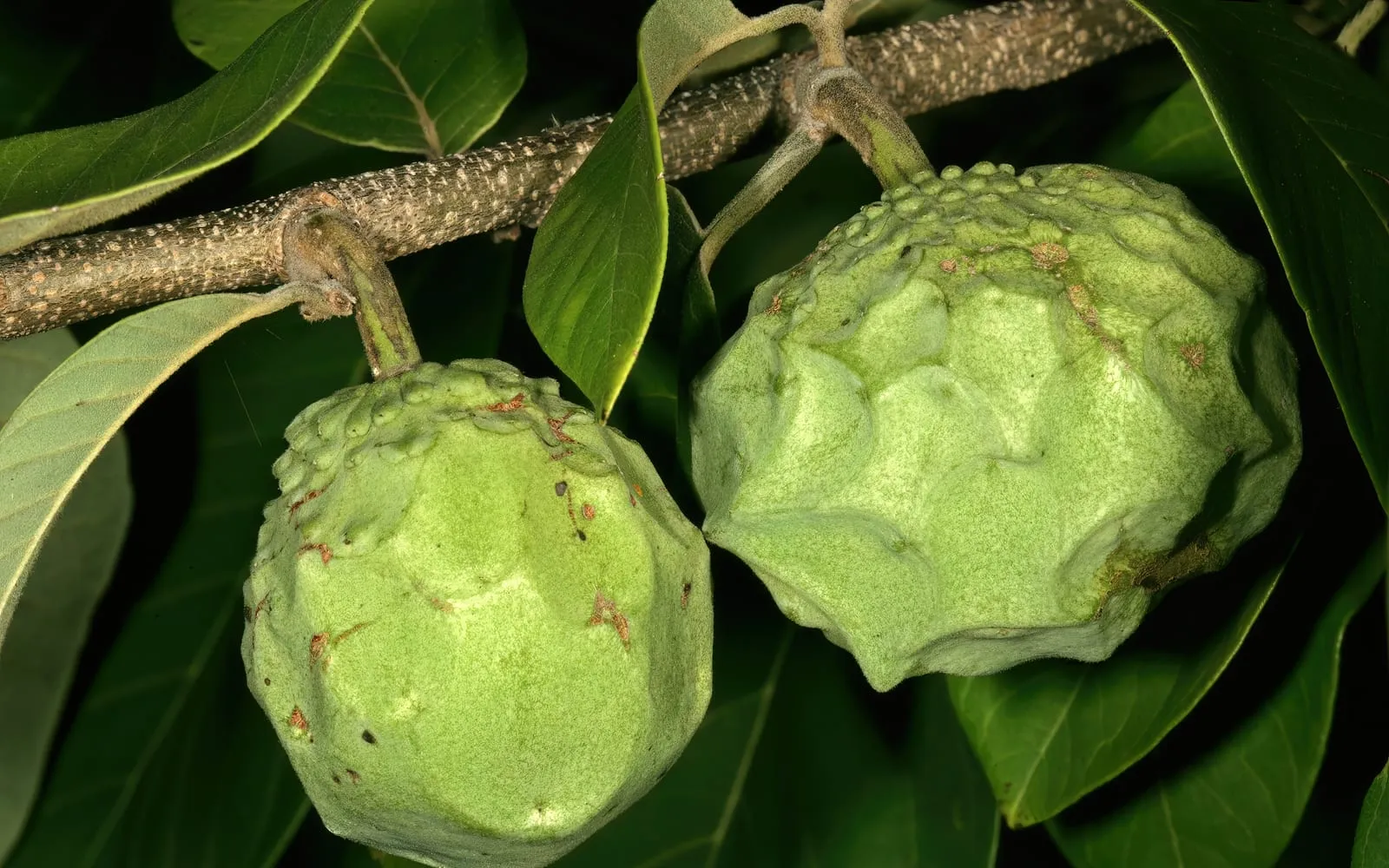
Fruit is heart-shaped to conical, 10 to 20 cm, weighing 150 g to over a kilogram, with a green skin patterned in overlapping scale-like markings, each one a fingerprint-shaped depression.
Skin thickness and the pattern vary by cultivar, and the smoother-skinned types are generally the better fruit.
Flesh is white, soft, custard-like and studded with large glossy black seeds that separate cleanly.
Ripeness is judged by a slight give under the thumb, as with an avocado. Fruit is picked firm and softens over three to five days.
Where it is from
Cherimoya comes from the inter-Andean valleys of southern Ecuador and northern Peru, at 1,300 to 2,600 m, where the climate is subtropical highland rather than tropical: warm days, cool nights and a dry season.
That altitude explains its behaviour. Cherimoya is the most cold-tolerant of the Annonas, needs a cool winter rest and takes a light frost when dormant, which sets it apart from soursop and sugar apple.
Pre-Columbian cultivation is well attested. Cherimoya fruits are moulded on Moche pottery from coastal Peru, and the plant was grown throughout the Andes before European contact.
The Spanish carried it to the Mediterranean, and southern Spain became the largest producer in the world, with the Costa Tropical around Almunecar and Motril growing most of it under hand pollination.
Chile, Peru, Portugal, California and New Zealand grow it commercially in a smaller way. Temperate markets see Spanish cherimoya in autumn and winter in larger greengrocers.
How it grows
Sow seed from a ripe fruit, which keeps for months and germinates readily at 20 to 25 deg C, taking three to six weeks.
Buy a grafted plant if fruit matters. Seedlings take four to six years and give variable fruit.
Grow in full sun in free-draining compost of moderate fertility.
Give a cool winter rest at 5 to 12 deg C with the compost nearly dry. Cherimoya is deciduous or semi-deciduous and wants a dormant period.
Water twice a week in growth and almost not at all in dormancy.
Feed monthly from April to September.
Hand-pollinate. This is the step that decides whether you get fruit. Collect pollen in the late afternoon from flowers in the male phase, when the petals have opened and the anthers are shedding cream powder, keep it in a closed container overnight in the fridge, and brush it into flowers in the female phase the next morning, when the petals have parted slightly and the stigmas are white and sticky.
Expect a grafted plant to fruit in two or three years, and expect the crop to be proportional to the hand pollination.
Prune in late winter while dormant to keep the plant open and within bounds.
Through the seasons
Winter is dormancy. Hold the plant cool at 5 to 12 deg C, keep the compost nearly dry, and feed nothing. Leaves may fall entirely.
Late winter is the pruning window while the plant is bare.
Spring brings new leaves, and flowering begins as the leaves expand.
Early summer is the hand pollination season, and it runs for several weeks as flowers open in sequence.
Midsummer is fruit swell.
Autumn is harvest. Fruit is picked firm and ripens indoors over three to five days.
Late autumn is when to stop feeding and start drying the plant off for dormancy.
Care difficulty
Moderate, and the most achievable Annona for a temperate grower.
Cold tolerance is the reason. Cherimoya takes a light frost when dormant and needs only a frost-free winter rest rather than heat.
The winter rest is a requirement rather than a convenience. Without a cool dry dormancy the plant grows poorly and flowers badly.
Hand pollination is the real work. Without it a tree outside the tropics sets almost nothing, and with it a pot plant can carry a useful crop.
Timing the pollination takes a little practice, since the two flower phases have to be recognised and the pollen collected the afternoon before.
Fruit comes in two or three years from a grafted plant.
Fruit is picked firm and ripened indoors, so there is no need for the last weeks of heat that most tropical fruit demands.
Watering
Water twice a week through the growing season, keeping the compost evenly damp.
Reduce sharply from late autumn and keep the plant nearly dry through dormancy.
Drain fully. Wet compost in a cool winter rots the roots, which is the usual way a cherimoya is lost.
Water steadily during fruit swell, since irregular watering splits the fruit.
Use tap water, as this species is not particularly sensitive to hardness.
Keep humidity moderate.
Resume normal watering as the new leaves expand in spring.
Warning signs, diseases and pests
Flowers dropping without setting is the standard cherimoya complaint and means no pollination. Hand-pollinate.
Fruit that sets on one side only, growing lopsided, means partial pollination.
Fruit splitting on the tree is irregular watering.
White waxy fluff in the leaf axils and around the fruit stalk is mealybug, which this species attracts.
Brown limpets on the stems are scale.
Leaf fall in autumn is normal. Cherimoya is deciduous or semi-deciduous.
Wilting with damp compost in winter is root rot from a wet dormancy.
Blackened new growth in spring is late frost damage.
Small hard fruit usually means the plant carried too many for its size.
Growing environment
A frost-free greenhouse or conservatory, standing outdoors for the summer.
Winter at 5 to 12 deg C, dry, for a proper dormancy.
Summer at 20 to 28 deg C.
Full sun.
Moderate humidity.
Free-draining compost of moderate fertility.
pH from 6.0 to 7.5, which is a wider tolerance than most fruit here.
A pot of 40 cm or more for a fruiting plant, and shelter from spring frost once growth starts.
Feeding
Feed monthly from April to September with a balanced liquid feed.
Switch to a high-potash feed as fruit swells.
Stop feeding by the end of September so the wood ripens before dormancy.
Give nothing through winter.
Repot or top-dress in late winter while the plant is bare.
Avoid heavy nitrogen, which produces leaf at the expense of flower.
Add magnesium if older leaves yellow between the veins.
Troubleshooting
Why do I have to pollinate it by hand? The flowers open as female first and as male hours later, so a flower cannot pollinate itself, and the small beetle that does the job in the Andes does not live outside its range. Every cherimoya crop from Spain to California is set by hand.
How do I hand-pollinate? In the late afternoon find flowers in the male phase, with the petals open and cream pollen shedding, and collect the pollen with a small brush into a closed pot. Keep it in the fridge overnight. Next morning brush it into flowers in the female phase, whose petals have parted slightly and whose stigmas are white and sticky.
The fruit grew lopsided. Partial pollination. Only some of the carpels were fertilised, so only part of the fruit developed.
Do I need a cool winter? Yes. Cherimoya is deciduous or semi-deciduous and needs a cool dry dormancy at 5 to 12 deg C. Kept warm all winter it grows and flowers badly.
Can I eat the seeds? No. Annona seeds contain acetogenins and are strongly irritant. Swallowing an intact one whole is harmless because it passes through, but never crush or blend them, and never let seed material get near an eye.
How do I know when it is ripe? It gives slightly under a thumb, like an avocado. Fruit is picked firm and softens indoors over three to five days.
Is it the same as a custard apple? The name is used loosely. Cherimoya is Annona cherimola, sugar apple is A. squamosa, and the two are sold under the same English name in different countries.
It dropped all its leaves in autumn. Normal. It is a deciduous or semi-deciduous tree.
Cherimoya problem guides
Not sure what is wrong? See the common vegetable pests guide.