
Edible
Stuffing Cucumber
Cyclanthera pedata
Also known as Caigua, Slipper gourd, Achocha, Korila, Lady's slipper
How to grow caigua, Cyclanthera pedata. The hollow fruit that comes ready to stuff, the gourd that will crop outdoors in a cool summer, and the seeds shaped like tiny turtles.
At a glance
- Difficulty
- Easy
- Water
- Twice a week outdoors, more in a dry spell
- Light
- Full sun, and it tolerates light shade better than most cucurbits
- Temperature
- 15-25 deg C suits it, and it keeps going in cool weather
- Humidity
- Moderate
- Hardiness
- USDA 9-11, RHS H2, hardy to 0 C
- Type
- Tender annual climber
- Height
- 3-5 m in a season
- Native to
- the Andes, Peru, Bolivia
- Best month
- April, May and September in the Northern Hemisphere, October, November and March in the Southern Hemisphere
Cool conditions suit it better than they suit any other cucurbit in this group, and it keeps cropping in weather that stops cucumbers, which follows from an Andean origin. It is short-day for flowering, so it sets late in the season at high latitude and needs the frost to hold off.
Hardiness zones describe winter cold alone. Summer heat, humidity, rainfall and the length of the growing season decide as much, so treat the range as the outer limit rather than as a recommendation.
Every month named in this guide is for the temperate Northern Hemisphere. If you garden in the Southern Hemisphere, shift each one by six months, so April becomes October. Closer to the equator the wet and dry seasons matter more than the calendar, and the shift stops being a useful guide.
Not known to be toxic
- Safe to eat
- The fruit, the seeds when young, and the young shoots
Caigua is food and no part of it is harmful. Neither the RHS nor the ASPCA lists Cyclanthera pedata. The young fruit is eaten raw or cooked, the hollow mature fruit is stuffed, and the shoots are eaten as a green in the Andes. Black mature seeds are usually removed before cooking for texture rather than for safety. Unlike most of its family it does not develop bitter cucurbitacins in cultivation, so the taste test that matters for bottle gourd and loofah is not the same concern here. Cooked fruit in small amounts is harmless to cats and dogs.
Sources: RHS potentially harmful garden plants, ASPCA toxic and non-toxic plants
About
Caigua is the gourd you can grow outdoors in a cool summer and expect a crop from. It comes from the Andes rather than the lowland tropics, so it works in cool summers, keeps cropping into October, and asks for very little.
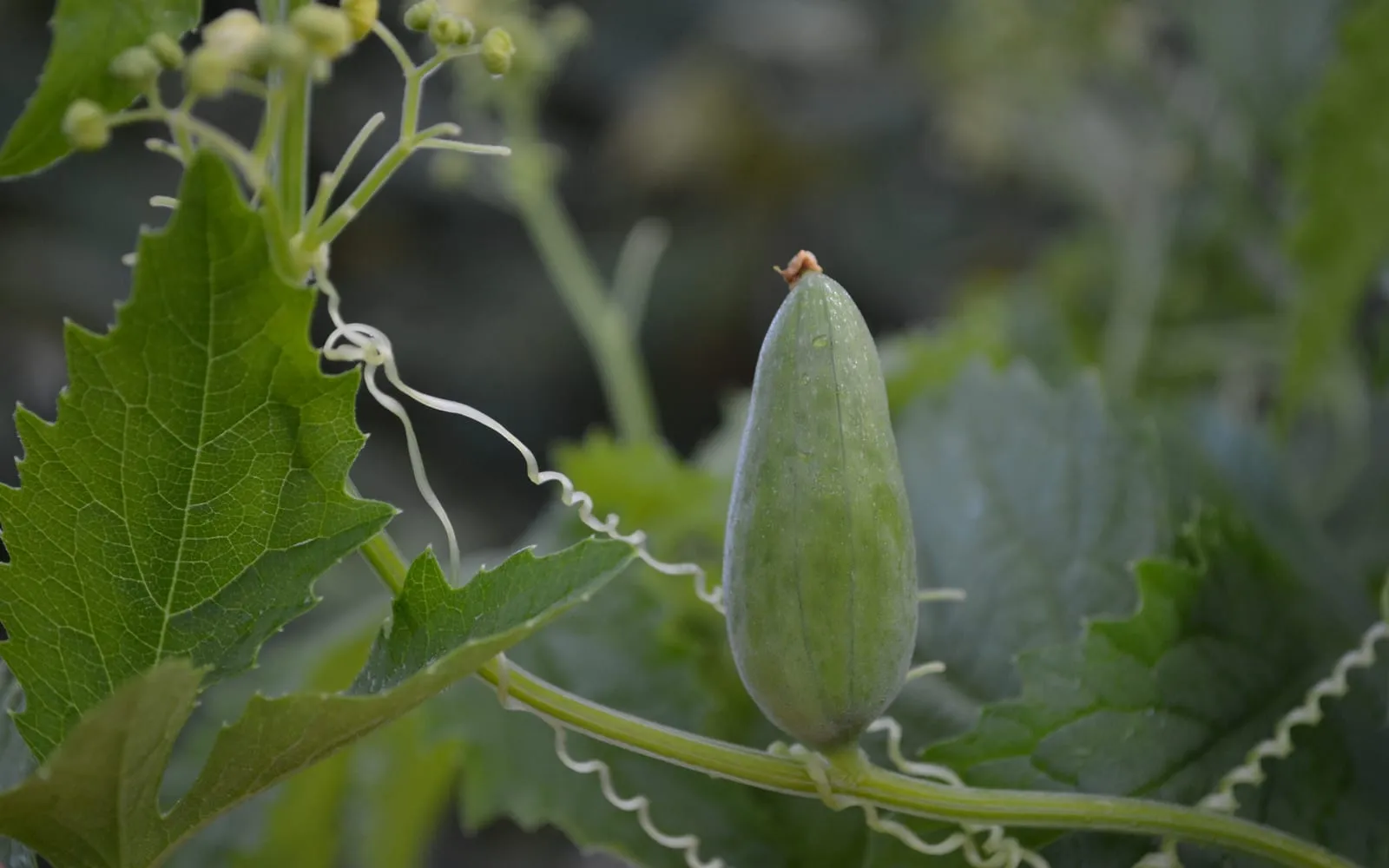
The fruit is hollow. A pale green pod 5 to 15 cm long, slightly curved, with a thin wall and a cavity holding a row of flat black seeds along one side. Pull the seeds out and you have a container, which is what Andean cooks do with it, stuffing it with minced meat, onion and cheese and baking it.
Raw and young it tastes like a mild cucumber with a hint of green pepper. Cooked it softens and picks up whatever it is filled with. The seeds are the oddity, each one flattened, notched and ridged into something that looks convincingly like a small black turtle.
Appearance and character
A slim annual climber reaching 3 to 5 m, far lighter than the tropical gourds and easy to fit on a fence or an obelisk.
The leaves are the identification. Each is divided right to the base into five to seven separate leaflets radiating from one point, each leaflet toothed, so the whole leaf looks like a hand rather than a lobed disc.
Tendrils are branched and fine.
Flowers are tiny and greenish white, only 3 to 5 mm across, easy to miss entirely. Males come in small sprays and females sit singly.
The male flower has a curious trick. Pollen is held under tension and released in a small visible puff, which is where the genus name comes from.
Fruit is pale to mid green, 5 to 15 cm, curved like a slipper or a small banana, smooth on some cultivars and covered in soft harmless spines on others.
Cut it open and the wall is 3 to 5 mm thick around a hollow. Young seeds are white and soft and can be eaten; mature ones are black, hard and are scooped out.
Where it is from
Caigua is an Andean crop, from Peru, Bolivia, Ecuador and Colombia, grown between about 1,000 and 2,000 m where nights are cool.
It is one of the oldest cultivated plants in South America. Depictions appear on Moche ceramics from northern Peru, and seeds turn up in coastal archaeological sites thousands of years old. No wild population of the cultivated form is known.
Spanish colonisation pushed it to the margins along with quinoa, oca and several other Andean crops, and it survived in highland kitchen gardens.
It travelled to Asia with migration and is now grown in Nepal and northern India as korila, where it is common in hill markets. European seed catalogues began listing it in the 1990s, and it has become a minor favourite on northern European allotments for the reason that it works.
How it grows
Sow in April at 18 to 20 deg C, two seeds to a pot, 2 cm deep. Germination is quick and reliable, which no other gourd here can claim.
Pot on once and harden off.
Plant out after the last frost, 60 cm apart, against a fence, netting, an obelisk or through a hedge.
Full sun is best and light shade is tolerated, which is unusual in this family.
Water and feed moderately. Overfeeding gives a curtain of foliage and less fruit.
No pinching is required, though taking out the leader at 2 m brings the crop lower down where you can reach it.
No hand pollination is needed outdoors. Under glass, a gentle shake of the plant does the job.
Harvest from August at 5 to 10 cm for eating raw, or leave fruit to 15 cm for stuffing.
Pick every few days. The plant crops heavily and keeps going until the first hard frost.
Save seed easily from a fruit left to yellow on the vine, and expect self-sown seedlings the following spring wherever fruit fell.
Through the seasons
April is for sowing indoors in gentle warmth.
May is potting on and hardening off.
Late May or early June is planting out after the last frost.
June and July are for climbing growth, with the first flowers appearing in July.
August brings the first pickings.
September is the heaviest cropping month, when most tender vegetables are finishing.
October carries on until the first hard frost kills the vine.
Winter is nothing, other than clearing the dead growth and letting the seed that fell come up next year.
Care difficulty
Easy, and the easiest crop in this group by a wide margin.
Germination is quick and reliable at ordinary spring temperatures.
It grows and fruits outdoors in a cool summer without cover.
Cool nights do not stop it, which is what separates it from every other gourd here.
It self-seeds freely, so one year’s sowing often supplies the next.
Slugs on the young plant are the only serious risk.
Watering
Water twice a week from planting out.
Increase in a dry spell, since a checked plant sheds small fruit.
Water at the root.
Mulch to hold moisture and to keep slugs off at the same time.
It tolerates a cool wet summer better than any other cucurbit here.
Reduce watering in October as growth slows.
Warning signs, diseases and pests
A young plant grazed to the stem overnight is slug damage, and it is the main loss.
Curled shoot tips with sticky residue are aphids.
White powder on the leaves in September is powdery mildew, which arrives late and does little harm on this species.
Plenty of leaf and no fruit means too much nitrogen or too much shade.
Fruit that yellows on the vine has been left too long, and it is still fine for seed.
Seedlings appearing everywhere the following April are volunteers rather than a problem, and they transplant well when small.
Growing environment
An open sunny spot outdoors, or a fence, trellis or obelisk to climb.
Full sun, though light shade is tolerated.
Ordinary garden soil with compost dug in.
Temperatures of 15 to 25 deg C, which a cool summer supplies.
Shelter from strong wind.
Support of 2 to 3 m.
Nothing under cover is needed in a summer that stays around 15 to 25 deg C, which is what makes it worth growing where other cucurbits want glass.
Feeding
Dig in garden compost before planting.
Feed a general liquid feed fortnightly through summer.
Do not overfeed with nitrogen, since the plant will happily make foliage instead of fruit.
A high-potash feed from August encourages a heavier late crop.
Mulch in June.
Stop feeding at the end of September.
Troubleshooting
What does it taste like? Raw and young, mild cucumber with a green pepper edge. Cooked, it softens and takes on whatever it is stuffed or cooked with.
Do I have to remove the seeds? Only the black mature ones, and only for texture. Young white seeds can be eaten with the fruit.
Why is my fruit hollow? That is the plant. The hollow is the point, and it is why Andean cooks stuff and bake it.
Will it grow outdoors in a cool climate? Yes, across most of one. It is an Andean highland plant and it handles cool nights that stop bitter gourd and snake gourd dead.
It has spines on it. Some cultivars do. They are soft, harmless and rub off under a tap.
Do I need to hand-pollinate? Not outdoors. Under glass, shake the plant occasionally.
Seedlings are coming up everywhere. Caigua self-seeds freely from any fruit that fell. Hoe off what you do not want or move the small ones where you do.
Is achocha the same plant? Yes. Achocha, caigua, korila, slipper gourd and stuffing cucumber are all Cyclanthera pedata.
When should I pick? From 5 cm for raw eating, and around 10 to 15 cm for stuffing. Little and often keeps the plant producing.
Stuffing Cucumber problem guides
Not sure what is wrong? See the common vegetable pests guide.