
Houseplant
Blushing philodendron
Philodendron erubescens
Also known as Red-leaf philodendron, Pink Princess, Red Emerald
How to care for Philodendron erubescens. The red-stemmed climber behind 'Pink Princess' and 'Red Emerald', why it needs a pole to make big leaves, and what the red pigment is for.
At a glance
- Difficulty
- Easy
- Water
- When the top half of the compost has dried
- Light
- Bright indirect light for the coloured cultivars, moderate shade for the plain form
- Temperature
- 18-27 deg C, and never below 13 deg C
- Humidity
- Moderate to high. Leaf size depends on it
- Hardiness
- USDA 10-12, RHS H1b, hardy to 13 C
- Type
- Evergreen perennial climber, long-lived
- Height
- 2-3 m indoors on a pole
- Native to
- Colombia
Wet montane and lowland rainforest in Colombia, growing up tree trunks in warm, consistently humid, shaded conditions with no dry season and no cold. It has no frost tolerance at all and is damaged below about 13 deg C, so outdoors it needs a warm humid frost-free climate. Indoors the limits are humidity and warmth rather than light, and a plant that stalls in winter is usually cold rather than dark.
Hardiness zones describe winter cold alone. Summer heat, humidity, rainfall and the length of the growing season decide as much, so treat the range as the outer limit rather than as a recommendation.
Toxic if eaten
- Do not eat
- Every part, and the sap most of all
- Harm from
- Eating it and handling it
- Affects
- People, cats and dogs
Philodendrons carry needle-shaped calcium oxalate crystals called raphides throughout their tissues. Biting into a leaf or stem drives those crystals into the lining of the mouth and throat, producing immediate burning, drooling, swelling of the lips and tongue and difficulty swallowing. The ASPCA lists Philodendron as toxic to cats and dogs for that reason, and the same applies to people. Serious poisoning is rare because the pain begins instantly and deters a second bite, but swelling that reaches the airway is an emergency in a small animal. The sap also irritates skin, and this species bleeds freely when cut, so wear gloves when pruning or taking cuttings and wash your hands afterwards. Keep it out of reach of a cat that chews foliage.
Sources: ASPCA (Red Princess Philodendron, Philodendron erubescens), RHS potentially harmful garden plants
About
Philodendron erubescens is the species behind a large share of the philodendrons sold under trade names. ‘Red Emerald’, ‘Imperial Red’, ‘Burgundy’ and the much-photographed ‘Pink Princess’ are all cultivars of it, and the price gap between them and the plain green form is entirely about the pigment rather than about the plant.
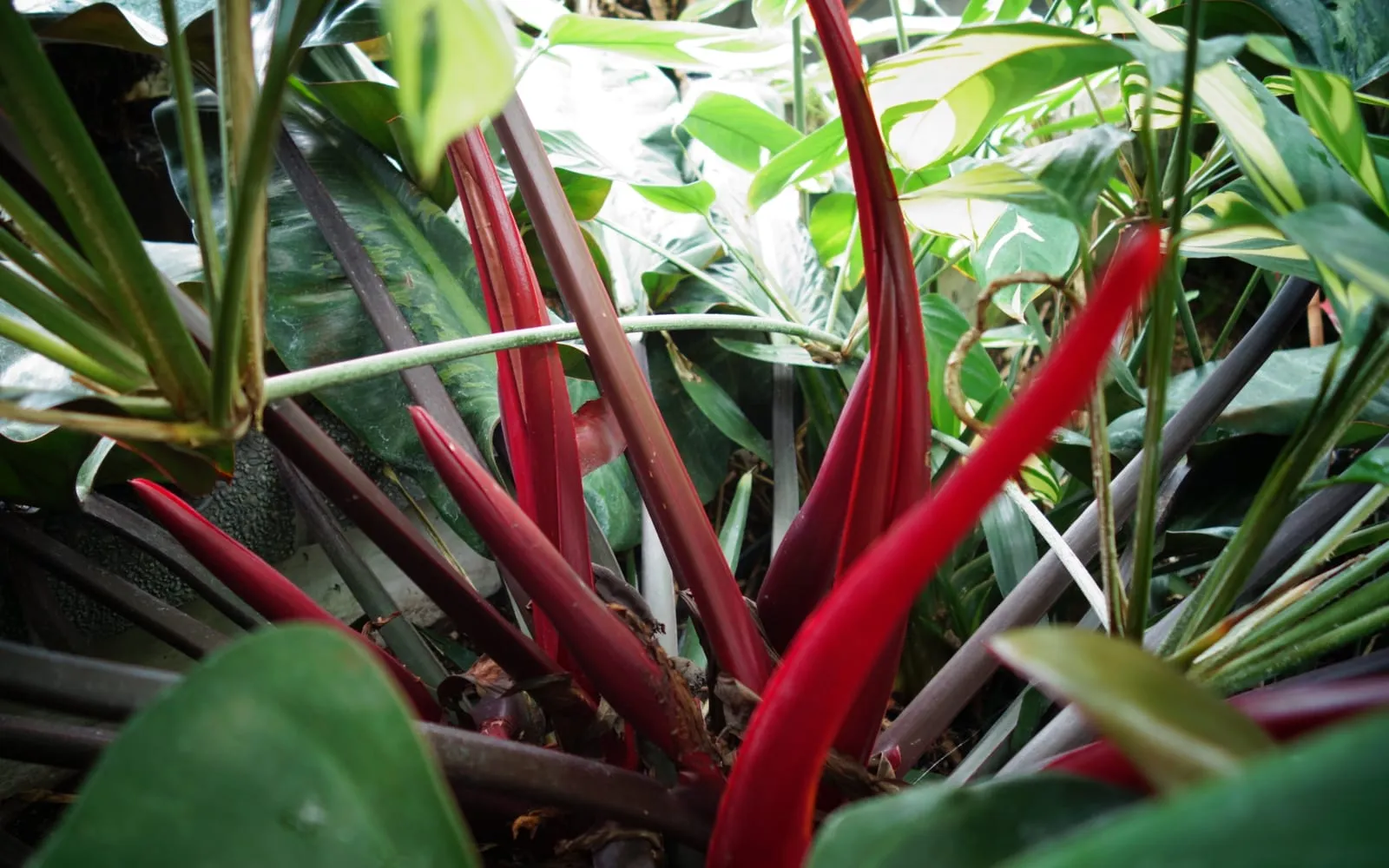
The name means blushing, and it refers to the red-purple flush on the stems, the leaf undersides and the sheaths that protect each new leaf. On the plain species that flush is a wine colour on the petioles and the new growth, and it fades as a leaf hardens off.
It behaves like the other climbing philodendrons. It wants something to climb, it makes markedly bigger leaves once it does, and the difference between a sad-looking specimen and a good one is usually a moss pole rather than anything in the watering can.
Appearance and character
A vigorous climbing vine with a thick green stem washed in red-purple, carrying long petioles and large glossy leaves. The stem produces stout aerial roots at each node, which is how it attaches to a trunk in the wild and to a pole indoors.
The leaves are elongated heart shapes, deep glossy green above with a coppery red-purple underside, reaching 25 to 40 cm long on an established plant on a pole and staying much smaller on a plant left to trail.
New leaves emerge from a deep red-pink sheath called a cataphyll, which dries to a papery brown and falls away. Peeling those off early tears the new leaf, so leave them to drop.
Growth is fast for an aroid given warmth and support, adding a leaf every few weeks in summer.
The cultivars differ mainly in pigment. ‘Red Emerald’ has bright red petioles. ‘Imperial Red’ is a compact non-climbing selection. ‘Pink Princess’ carries irregular pink variegation on dark leaves and is the one that commands high prices and reverts most readily.
Where it is from
The rainforests of Colombia, where it climbs the trunks of forest trees in warm, wet, deeply shaded conditions.
Like most climbing aroids it is a hemiepiphyte. It germinates on the forest floor in low light, finds a trunk and climbs it, producing progressively larger leaves as it rises. Everything about the plant indoors follows from that: it tolerates shade because it starts in shade, and it makes small leaves without support because a plant that has not found a trunk has no reason to invest in large ones.
The red pigmentation on young growth and leaf undersides is anthocyanin, and in forest understorey plants it is generally understood as protection for developing tissue against the brief intense light of sunflecks, alongside a possible role in deterring herbivores.
The genus Philodendron runs to around 500 species across tropical America and is one of the largest in the arum family.
How it grows
Give the plain green form moderate to bright indirect light, and give the variegated cultivars the brightest indirect position you have. Pink variegation carries no chlorophyll and needs more light to break even.
Keep it out of direct sun, which scorches the leaves and bleaches the red.
Give it a moss pole, a bark plank or a coir pole from the start. This is the single change that produces large leaves, and a plant left to trail will never develop the foliage it is sold for.
Keep the pole damp. The aerial roots grip and feed into a moist pole, and a dry one does nothing except hold the plant up.
Water when the top half of the compost has dried, thoroughly, letting it drain away completely.
Keep it above 13 deg C and ideally between 18 and 27 deg C.
Raise the humidity where you can. Leaf size responds directly to it, and above 60 per cent the difference is obvious.
Feed monthly at half strength through spring and summer, and not at all in winter.
Use a chunky mix. Ordinary compost with a third bark and a handful of perlite gives roots the air they need and avoids the wet dense root ball that rots them.
Through the seasons
Spring restarts growth. Resume feeding, repot if the roots have filled the pot, and add or extend the pole before the growing season gets going.
Summer is fast growth in warmth and humidity. Water when the top half dries, feed monthly, and tie new growth to the pole as it extends.
Autumn slows it. Reduce watering, stop feeding from October and move the plant nearer the light.
Winter is the difficult season. Keep it above 13 deg C, water sparingly, and keep it away from cold glass and draughts. Growth stops and should be allowed to.
Care difficulty
Easy in the plain green form and moderate in the variegated ones.
Support is the difference between success and disappointment. Without a pole the plant produces small leaves on a lengthening bare stem, and no amount of feeding changes that.
Cold is the main danger. Below 13 deg C the leaves develop dark patches and drop, and a plant near a freezing window in winter can be lost overnight.
Overwatering in a dense compost is the other. Aroid roots want air, and a peat mix that holds water rots them.
Reversion is the specific problem of ‘Pink Princess’. An all-green shoot grows faster than the variegated ones and takes over within a season or two, and the only response is to cut it out back to variegated tissue.
Watering
Water when the top half of the compost has dried, which in a warm room means roughly weekly in summer and every two to three weeks in winter.
Water thoroughly until it drains from the bottom, then empty the saucer.
Mist or water the moss pole itself when you water the pot, since the aerial roots take up moisture from it.
Use rainwater or filtered water where the tap water is hard, since salts accumulate and brown the leaf margins.
Underwatering shows as drooping petioles and slight curling, and the plant recovers quickly.
Overwatering shows as yellowing lower leaves, a soft stem base and a sour smell. Cut a healthy section of stem with an aerial root and re-root it if the base has gone, since the top usually saves.
Warning signs, diseases and pests
Small leaves with long bare stretches of stem between them means no support and not enough light. Add a pole and move the plant brighter.
Yellow lower leaves, several at once, are overwatering. Check the drainage and open the compost up with bark at the next repot.
Brown crisp edges are dry air or accumulated salts. Raise the humidity and flush the pot through.
Dark, water-soaked patches after a cold night are cold damage and do not recover.
White cottony fluff around the leaf sheaths and aerial roots is mealybug, which hides well on this plant.
Fine pale stippling with webbing is red spider mite in dry heated air.
An all-green shoot on a ‘Pink Princess’ that grows faster than everything else is reversion. Cut it back to a node carrying variegated tissue as soon as you see it, because it will take the plant over otherwise.
Leaves emerging entirely pink with no green on a variegated cultivar cannot photosynthesise and will not survive. Cut back to a node with a mix of both.
Growing environment
Bright indirect light for coloured cultivars, moderate shade for the plain green form.
Never direct sun.
Warm, 18 to 27 deg C, with 13 deg C as a hard floor.
Moderate to high humidity, and leaf size increases noticeably above 60 per cent.
A chunky free-draining mix of compost, orchid bark and perlite in a pot with drainage holes.
A moss or coir pole, kept damp, from the moment the plant goes into its pot.
Outdoors it needs a warm humid frost-free climate in shade, USDA 10 and warmer.
Avoid cold glass, dry heated rooms in winter and dense peat-based compost.
Feeding
Feed monthly from spring to early autumn with a balanced liquid houseplant fertiliser at half the strength on the label.
Stop feeding from mid-autumn to early spring.
Feed variegated cultivars at the same rate rather than more. Extra nitrogen pushes green growth and hastens reversion.
Repot every two years in spring into a chunky mix, moving up one pot size.
Flush the compost with plain water occasionally to clear salts.
Troubleshooting
The new leaves are much smaller than the old ones. The plant has nothing to climb. Add a moss pole and keep it damp, and the leaves will enlarge as the stem rises.
Is this the same as Pink Princess? ‘Pink Princess’ is a variegated cultivar of this species. The care is the same except that it needs brighter light and watching for reversion.
A plain green shoot has appeared on my variegated plant. Reversion. It will outgrow the variegated growth because it has more chlorophyll. Cut it back to a node with variegation as soon as you notice.
Brown papery sheaths are hanging off the stem. Cataphylls, which protect each new leaf and then dry out. Let them fall on their own rather than pulling them, since pulling tears the new leaf.
Is it safe with pets? No. It carries calcium oxalate raphides and the ASPCA lists it as toxic to cats and dogs. Chewing burns the mouth and can swell the airway.
The leaves have dark wet-looking patches. Cold damage, below about 13 deg C. Move the plant somewhere warmer and remove the worst leaves.
Why are the stems red? Anthocyanin pigment, concentrated in young tissue and leaf undersides. In forest understorey plants it is thought to protect developing tissue from sudden bright light.
Can I root a cutting? Yes. Cut a stem section below a node carrying an aerial root, and it will root in damp compost or water within a few weeks. Wear gloves, since the sap irritates skin.
Blushing philodendron problem guides
Not sure what is wrong? See the common houseplant pests guide.