
Houseplant
Lipstick Plant
Aeschynanthus radicans
Also known as Basket Vine
Practical guidance for growing lipstick plant, Aeschynanthus radicans, including tubular red flowers, dark calyxes, trailing stems, bright light, humidity, pruning, and non-toxic houseplant care.
At a glance
- Difficulty
- Moderate
- Water
- When the top few centimetres of mix dry out, roughly weekly in summer
- Light
- Bright light with some direct morning or evening sun to flower well
- Temperature
- 18-27 deg C, never below 12 deg C
- Humidity
- 50% or higher; dry air causes bud drop and leaf loss
- Hardiness
- USDA 10b-12, RHS H1b, hardy to 10 C
- Type
- Evergreen trailing epiphytic subshrub
- Height
- Trails 60-90 cm; individual stems can reach further with support
- Native to
- Southeast Asia
An epiphyte from the humid forests of Southeast Asia, rooting into moss and bark on a tree trunk rather than into soil. Warmth and humidity carry more weight than the zone range, since flowering depends on strong light and a genuine difference between a bright, slightly drier rest period and an actively growing season rather than on any winter chill. It has no frost tolerance and stops growing below about 12 deg C.
Hardiness zones describe winter cold alone. Summer heat, humidity, rainfall and the length of the growing season decide as much, so treat the range as the outer limit rather than as a recommendation.
Not known to be toxic
Aeschynanthus radicans is not listed as toxic by the RHS or the ASPCA, and no reputable poisoning database records a case linked to it. The thick, waxy leaves are unappealing to chew in any quantity, and a pet or child that mouths one is very unlikely to come to any harm beyond mild stomach upset from the fibre itself, the same as with any tough foliage eaten in excess. This is a flowering houseplant that can be grown without weighing pets or small children into the decision.
Sources: RHS potentially harmful garden plants, ASPCA toxic and non-toxic plants
About
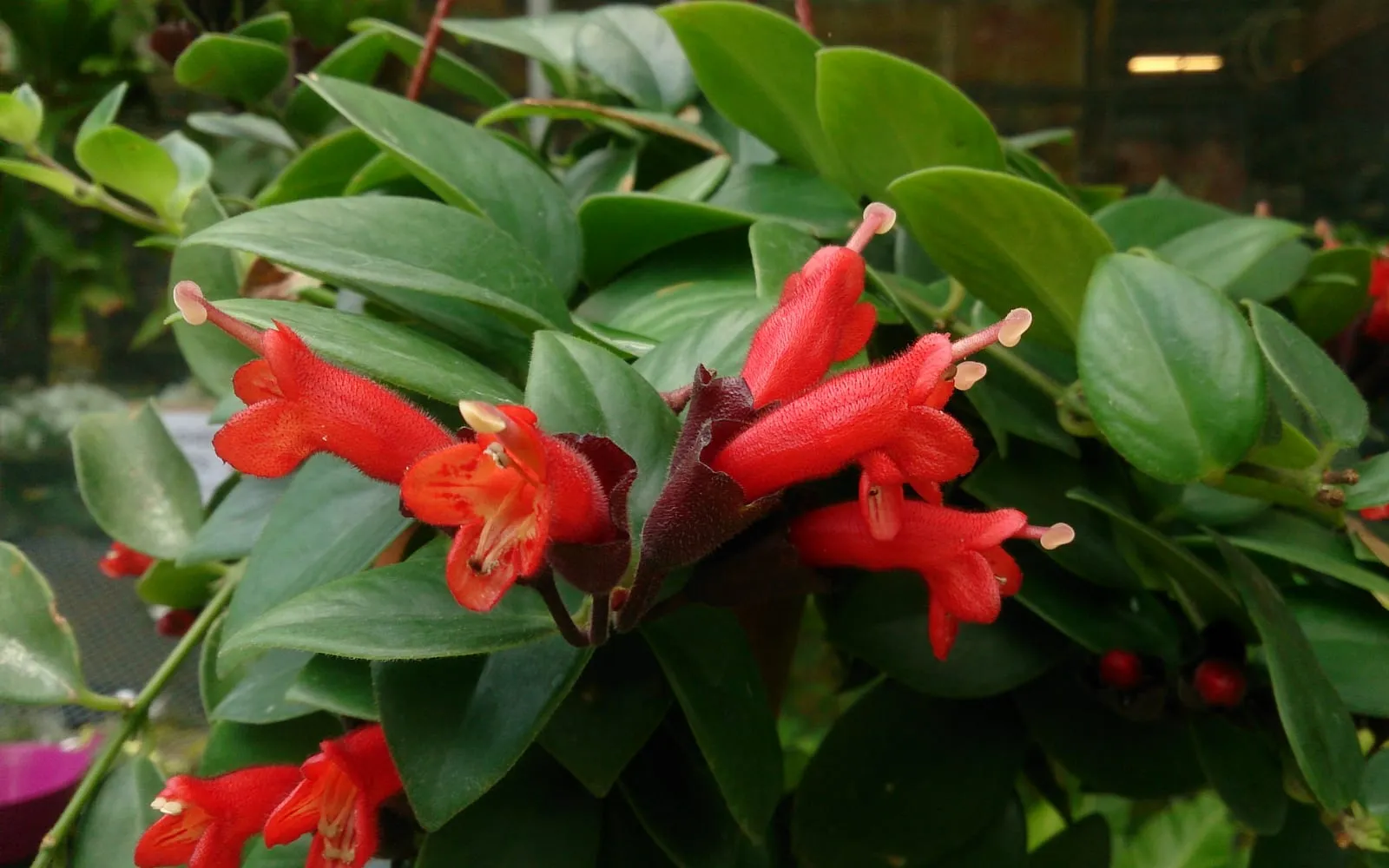
Lipstick plant takes its name from the flower buds, which sit inside a dark maroon tube before the bright red bloom pushes out of the end, much like lipstick emerging from its case. Glossy, dark green leaves cover trailing stems that suit a hanging basket or a high shelf where the growth can spill over the edge.
Flowering depends on light more than on anything else in its care. A plant kept bright enough, with some direct sun, produces flushes of tubular flowers through the warmer months; one kept too dim grows leaves happily but rarely blooms.
Appearance and character
Leaves are thick, waxy and dark green, oval and pointed, 5 to 8 cm long, arranged in pairs along wiry trailing stems that thicken and become semi-woody with age. New growth often carries a faint bronze or reddish tint before settling into its mature colour.
Flowers form in clusters at the leaf axils and stem tips. Each begins as a dark red to near-black calyx shaped like a small tube, from which a brighter scarlet, curved, tubular flower with a yellow-marked throat emerges and opens over several days. A well-grown plant in flower carries dozens of these clusters at once, dotted along every trailing stem.
Stems trail rather than climb without support, lengthening steadily and looking best allowed to hang rather than trained upright.
Where it is from
Aeschynanthus radicans grows through the humid forests of Southeast Asia, rooting as an epiphyte into moss-covered bark and rock faces high in the tree canopy rather than into soil at ground level.
That habitat sets the terms for growing it indoors. Light in the upper canopy is bright and often includes direct sun filtering through gaps in the foliage overhead, far more than the deep interior shade many trailing houseplants tolerate. Humidity stays high year round, and the free-draining pocket of moss and bark debris the roots grow into never holds water for long.
Those two facts explain most of what goes wrong with a lipstick plant kept indoors: too little light stops it flowering, and a heavy, slow-draining compost rots roots built for a mossy ledge rather than a plant pot.
How it grows
Grow it in a free-draining mix built with extra bark or perlite added to ordinary houseplant compost, so water passes through quickly and the roots never sit wet for long.
Give it a bright spot, ideally with an hour or two of gentle direct sun in the morning or evening. A sheer curtain filtering a south-facing window or an unobstructed east or west window both work well.
Pinch out the growing tips of young stems to encourage branching and a fuller basket, since an unpinched plant tends to produce a few long, sparsely leaved trails rather than a dense mound.
Prune lightly after a flowering flush to keep growth compact, and repot every couple of years into a pot only slightly larger than the last, since it flowers best when its roots have some room to fill.
Propagate from stem cuttings a few centimetres long, rooted in water or damp perlite; cuttings taken in spring or summer root fastest.
Through the seasons
Spring restarts active growth. Resume fortnightly feeding, repot if needed, and pinch back leggy stems to encourage branching.
Summer brings the main flowering season, with repeated flushes of flowers on a plant getting enough light. Water more often as growth speeds up.
Autumn slows growth and flowering tapers off. Reduce feeding towards the end of the season.
Winter is a rest at cooler temperatures and lower light. Water more sparingly, keep the plant well away from cold draughts, and hold off feeding until spring.
Care difficulty
Moderate. Keeping it alive is easier than getting it to flower. A lipstick plant tolerates missed waterings and average conditions well enough to survive for years as a healthy trailing foliage plant, but it needs strong light and a proper difference between an actively growing summer and a cooler, slightly drier winter rest to flower freely.
Dry indoor air is the other common stumbling block, causing flower buds to drop before they open and older leaves to shed faster than new ones replace them.
Watering
Water thoroughly once the top few centimetres of mix have dried out, letting the pot drain fully afterwards and never leaving it standing in a saucer of water.
In summer, an actively growing plant in a bright spot may need water roughly once a week; in a cooler winter room, that interval can stretch to every two or three weeks.
Reduce watering slightly once flower buds appear, since a mix kept constantly wet during flowering tends to cause more buds to drop than a mix allowed to dry a little between waterings.
Warning signs, diseases and pests
Mealybug gathers in the leaf axils and among new growth, showing as small white, cottony tufts. Wipe them away with a cotton bud dipped in surgical spirit.
Aphids cluster on soft new shoots and on unopened flower buds, distorting new growth and leaving a sticky residue behind. Rinse them off under a tap or treat with horticultural soap.
Spider mite thrives in hot, dry indoor air, especially near radiators in winter, showing as fine pale speckling on the leaves and faint webbing in bad cases. Raising humidity and wiping the leaves down regularly helps prevent it.
Root rot follows a mix that stays wet for too long, showing as blackened stem bases and leaves that yellow and drop despite damp compost. Unpot the plant, trim away any soft brown roots, and repot into fresh, free-draining mix.
Growing environment
Bright light suits it best, including some direct sun in the morning or evening; a plant kept too far from a window rarely flowers, however healthy its leaves look.
Keep the room between 18 and 27 deg C. Growth stalls and leaf drop increases below about 12 deg C, and the plant has no tolerance for frost at all.
Humidity of 50% or higher keeps flower buds from dropping before they open. A pebble tray, a grouping of plants, or a spot away from heating vents all help in a dry room.
A free-draining mix and a snug pot both encourage flowering over leafy growth, so resist moving it into a much larger container than it needs.
Feeding
Feed fortnightly from spring to late summer with a balanced liquid houseplant feed, diluted to the strength stated on the label.
Reduce feeding as flowering slows in autumn, and stop entirely over winter, when the plant is using very little and any unused fertiliser only builds up as salts in the compost.
A feed slightly higher in phosphorus than nitrogen can encourage a fuller flush of flowers on a plant that already produces plenty of healthy leaves but few blooms.
Troubleshooting
It has plenty of leaves but has never flowered. Almost always too little light. Move it somewhere brighter, ideally with an hour or two of direct morning or evening sun, and be patient through at least one full growing season before judging the result.
Flower buds are forming, then dropping before they open. Low humidity or a sudden change in watering are the usual causes. Raise humidity, water a little more consistently, and avoid moving the plant once buds have started to form.
The stems have gone bare and leggy at the base. Normal on an unpinched, older plant. Cut the stems back by a third after a flowering flush to encourage branching lower down, and take healthy cuttings from the trimmings if you want more plants.
Leaves are yellowing and dropping despite regular watering. Check the roots for rot. If the mix has stayed wet for a long period, unpot the plant, trim away any soft brown roots, and repot into fresh, free-draining mix.
Can I train it to climb instead of trail? Yes, against a small moss pole or trellis, though it will need tying in as it grows since it has no natural means of gripping a support the way a true climber does.
Lipstick Plant problem guides
Not sure what is wrong? See the common houseplant pests guide.