
Houseplant
Dragon Blood Tree
Dracaena draco
Also known as Canary Islands Dragon Tree
How to grow dragon blood tree, Dracaena draco. Why it spends decades as a rosette before branching into its umbrella crown, the red sap once traded as dragon's blood, and why overwatering is the real risk.
At a glance
- Difficulty
- Easy
- Water
- Every two to three weeks in summer, monthly or less in winter
- Light
- Full sun to bright light. Tolerates some direct sun through glass
- Temperature
- 15-30 deg C ideally. Established plants tolerate brief cool spells
- Humidity
- Average room humidity is fine. It does not want raised humidity
- Hardiness
- USDA 9b-11, RHS H2, hardy to -2 C
- Type
- Evergreen succulent tree, living many centuries in the wild
- Height
- 1-2 m indoors over many years; 6-15 m outdoors in its native range
- Native to
- the Canary Islands, Macaronesia
A volcanic island endemic from Macaronesia, where a mild, dry subtropical climate never brings hard frost and rain is scarce for much of the year. Mature, established outdoor specimens on the Canary Islands survive an occasional brief dip near freezing, but a young plant or one grown indoors has far less resilience, and this species is better treated as frost-tender in cultivation. Drought tolerance, not cold tolerance, is what its thick trunk and sparse rosette of leaves are built for.
Hardiness zones describe winter cold alone. Summer heat, humidity, rainfall and the length of the growing season decide as much, so treat the range as the outer limit rather than as a recommendation.
Harmful to cats and dogs if eaten
- Do not eat
- Leaves, and the sap from any cut or damaged tissue
- Harm from
- Eating it
- Affects
- Cats and dogs
The genus Dracaena carries saponins, compounds the ASPCA lists as toxic to cats and dogs, causing vomiting, sometimes with blood, loss of appetite, drooling and dilated pupils in cats specifically. The ASPCA's dedicated entry covers Dracaena fragrans, the corn plant, rather than this species by name, but the saponins responsible sit throughout the genus and the same caution applies here. People are not considered at meaningful risk from this plant; there is no listing of human toxicity on the RHS potentially harmful garden plants index, and the leaves are stiff and unappealing to chew in any case. The red sap the trunk produces when cut is a resin used historically as a dye and varnish rather than a documented toxin, though it is sensible to avoid getting any plant sap in an eye or an open cut.
Sources: ASPCA (Corn Plant, Dracaena fragrans), RHS potentially harmful garden plants
About
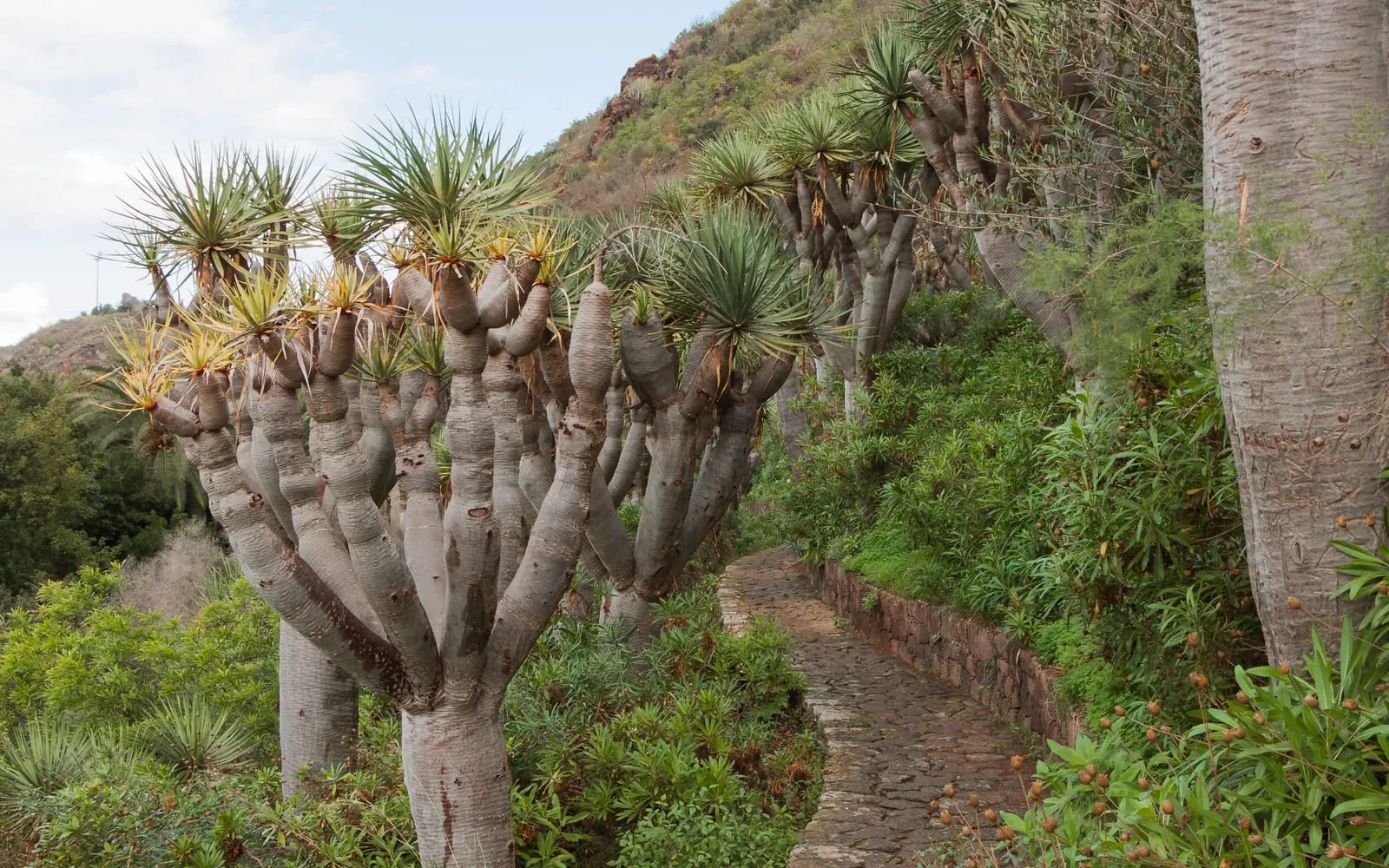
Dragon blood tree grows for decades before it looks anything like the umbrella-crowned tree it eventually becomes, spending its early years as a single rosette of stiff, sword-shaped leaves atop a thickening trunk. Indoors it is grown at this juvenile stage, valued for its sculptural, architectural form and its genuine tolerance of neglect rather than for any resemblance to the ancient wild trees the species is known for.
The name comes from the dark red resin the trunk exudes when cut or damaged, historically traded as dragon’s blood and used as a dye and varnish. A houseplant specimen is unlikely ever to be tapped for it, but the trait is part of what makes the species distinctive among succulent trees.
Appearance and character
Stiff, blue-green, sword-shaped leaves radiate from the growing point in a dense rosette, each leaf 30 to 60 cm long on a mature plant, narrowing to a point and often edged with a fine reddish line.
The trunk is smooth and pale grey when young, thickening slowly over years and eventually developing the rough, fissured bark of an aged specimen. A young plant stays as a single unbranched rosette for a long time; branching, when it eventually happens, is usually triggered by the plant flowering or by damage to the growing tip, and produces the forked, umbrella-like crown the species is famous for in the wild.
Growth is slow at every stage, which is part of the plant’s appeal as a long-term houseplant. A specimen bought as a compact young rosette can be expected to look broadly similar, if larger, for years rather than changing dramatically season to season.
Where it is from
Dracaena draco is native to the Canary Islands and neighbouring parts of Macaronesia, growing on volcanic slopes and cliffs in a mild, subtropical climate with a dry summer and most of the modest rainfall concentrated in winter.
That volcanic, well-drained terrain and dry climate explain the plant’s tolerance for infrequent watering and its dislike of compost that holds moisture for long. Full, strong sun on an exposed island slope is also why a plant grown too dim indoors stretches and loses the tight, upright form of a well-lit specimen.
Wild trees on the islands can live for many centuries, growing extremely slowly and building up the branched crown that gives the oldest specimens their distinctive silhouette, a scale and age no container-grown plant will approach but a useful sense of how unhurried this species is by nature.
How it grows
Pot it in a free-draining cactus or succulent compost, in a container only slightly larger than the root ball, since a young plant’s roots are modest compared with the leaf rosette above them.
Growth is slow in every season, with new leaves emerging from the centre of the rosette a few at a time while the oldest, lowest leaves gradually yellow and are shed. This steady turnover is normal rather than a sign of a problem.
Repot only every few years, when roots have clearly filled the pot, moving up one size at a time. This species resents being disturbed more often than necessary and settles best left alone for long stretches between repots.
Propagation from stem cuttings is possible on an older, branched plant but slow and best left to a grower prepared for a long wait; most indoor specimens are bought as young plants rather than raised from cuttings at home.
Through the seasons
Spring restarts steady growth. Repot only if the roots have clearly filled the pot, and begin monthly feeding.
Summer is the main growing season. Water every two to three weeks as the compost dries, and give the plant its brightest position of the year.
Autumn slows growth further. Reduce feeding towards the end of the season and begin spacing out waterings.
Winter is close to a rest. Water once a month or less, keep the plant away from cold draughts, and stop feeding until spring.
Care difficulty
Easy, and one of the more forgiving succulent trees for an inexperienced grower precisely because its slow growth comes with a wide margin for error on watering.
Overwatering is the one real risk, since the fleshy roots rot readily in compost that stays wet, and a grower coming from leafier houseplants can easily water this species too often out of habit. Underwatering, by contrast, it tolerates for weeks without visible harm, drawing on the moisture stored in its thick leaves and trunk.
Watering
Water thoroughly, then let the compost dry out completely before watering again, roughly every two to three weeks in a warm, bright spot through summer and considerably less often in winter.
Check the compost with a finger before watering rather than following a fixed schedule, since the correct interval shifts with light, temperature and pot size through the year.
A leaf that wrinkles slightly is a sign of a plant using its stored water reserves and is a useful cue to water soon, well before the plant shows any more serious sign of drought stress.
Warning signs, diseases and pests
Scale insects appear as small, flat brown discs on the stiff leaves and along the trunk, sapping the plant and often leaving a faint sticky residue. Wipe them off with a cloth dipped in diluted alcohol or treat with horticultural soap.
Mealybug gathers at the base of the leaf rosette, showing as small white, cottony tufts. Treat the same way as scale.
Spider mite favours hot, dry indoor air and shows as fine pale speckling on the leaves, sometimes with faint webbing in bad cases. Rinsing the foliage periodically helps keep numbers down.
Root rot follows compost that stays wet for too long, showing as a softening trunk base and lower leaves that yellow and collapse rather than ageing off one at a time. Repot into fresh, free-draining mix and cut back watering drastically if it has already taken hold.
Growing environment
Full sun to bright light suits it best, and this is one succulent that tolerates several hours of direct sun through a window without scorching, given a gradual introduction to it if the plant has been grown in shadier conditions previously.
A room between about 15 and 30 deg C suits it well. An established plant tolerates a brief cooler spell without lasting harm, but this species is best treated as having no real frost tolerance in cultivation.
Average room humidity is entirely adequate. This is a dry-climate succulent rather than a tropical foliage plant, and raised humidity offers it no benefit.
A free-draining cactus or succulent compost suits the roots best. Ordinary houseplant compost cut with extra grit or perlite works as an alternative if a dedicated succulent mix is not available.
Feeding
Feed monthly through spring and summer with a balanced liquid houseplant fertiliser at half strength, or a fertiliser formulated for cacti and succulents, which is enough to support this naturally slow grower without pushing soft, uncharacteristic growth.
Stop feeding entirely from autumn through winter, when the plant is using very little and unused fertiliser only accumulates as salts in the compost.
A young plant in fresh compost needs little to no feeding in its first year, since the compost itself supplies most of what a slow grower like this needs.
Troubleshooting
The lower leaves are yellowing and dropping one at a time. Normal ageing rather than a problem, provided it is only the oldest, lowest leaves and the rosette centre stays firm and healthy. The plant sheds older leaves steadily as it grows.
The rosette has stretched and leans towards the window. Not enough light reaching the plant evenly. Move it closer to a bright window and rotate the pot regularly to keep growth even.
The trunk feels soft near the base. Root rot from compost kept too wet, the most serious problem this species faces. Repot into fresh, dry, free-draining mix immediately and cut back watering going forward.
It has not grown at all in over a year. Likely nothing wrong. This species grows slowly under the best conditions and can appear static for long stretches, particularly in a pot that comfortably still fits its root system.
Is it safe to keep with a cat that chews houseplants? Not entirely. Dracaena leaves contain saponins that are toxic to cats and dogs if eaten in quantity, causing vomiting and lethargy. Keep it somewhere a determined chewer cannot reach, or choose a different species if that is not practical.
Dragon Blood Tree problem guides
Not sure what is wrong? See the common houseplant pests guide.