
Houseplant
Lipstick Echeveria
Echeveria agavoides
Also known as Molded Wax Echeveria
How to grow lipstick echeveria, Echeveria agavoides. Why its pointed leaves look closer to a small agave, what strong sun does for the red leaf-tip colour, and why water pooling in the rosette is the fastest way to lose it.
At a glance
- Difficulty
- Easy
- Water
- Every one to two weeks in summer, monthly or less in winter
- Light
- Full direct sun for several hours. Weak light loses the red leaf tips
- Temperature
- 0-32 deg C. Tolerates brief light frost only if kept bone dry
- Humidity
- Dry air. Do not mist or raise humidity
- Hardiness
- USDA 9a-11, RHS H2, hardy to 0 C
- Type
- Evergreen succulent perennial
- Height
- 10-20 cm across
- Native to
- Mexico
A semi-desert species from the high plateaus of central Mexico, where strong sun, sharp drainage and cool nights combine with a dry season that the rosette expects and depends on for its colour. It tolerates a brief light frost if the compost is completely dry, but wet cold kills it quickly, so treat it as frost-tender in cultivation. Below USDA 9 it needs to come indoors or under glass for winter.
Hardiness zones describe winter cold alone. Summer heat, humidity, rainfall and the length of the growing season decide as much, so treat the range as the outer limit rather than as a recommendation.
Not known to be toxic
Echeveria as a genus has no documented toxicity, and this species carries nothing that separates it from that pattern. The ASPCA lists the related Echeveria elegans, sold as hens and chickens, as non-toxic to cats, dogs and horses, and no source treats other Echeveria species differently on toxicological grounds; the genus shares the same basic leaf chemistry throughout. Nor does it appear on the RHS list of potentially harmful garden plants. A pet that bites into the firm, pointed leaves may find the texture unappealing rather than harmful, and there is no reason to keep this plant away from cats, dogs or children on safety grounds.
Sources: ASPCA (Hens and Chickens, Echeveria elegans), RHS potentially harmful garden plants
About
Lipstick echeveria takes its shape from the plant its species name references. Instead of the soft, spoon-shaped, powder-coated leaves typical of many echeverias, this one carries thick, triangular, sharply pointed leaves arranged in a tight star, closer in silhouette to a small agave than to a classic rosette succulent.
The name comes from the red that develops along each leaf tip and margin in strong light, a colour that intensifies with sun and stress in a way that can make a well-grown plant look almost painted at the edges. It is a glossy plant rather than a dusty one, with a smooth, waxy sheen instead of the powdery farina that coats many of its relatives.
Appearance and character
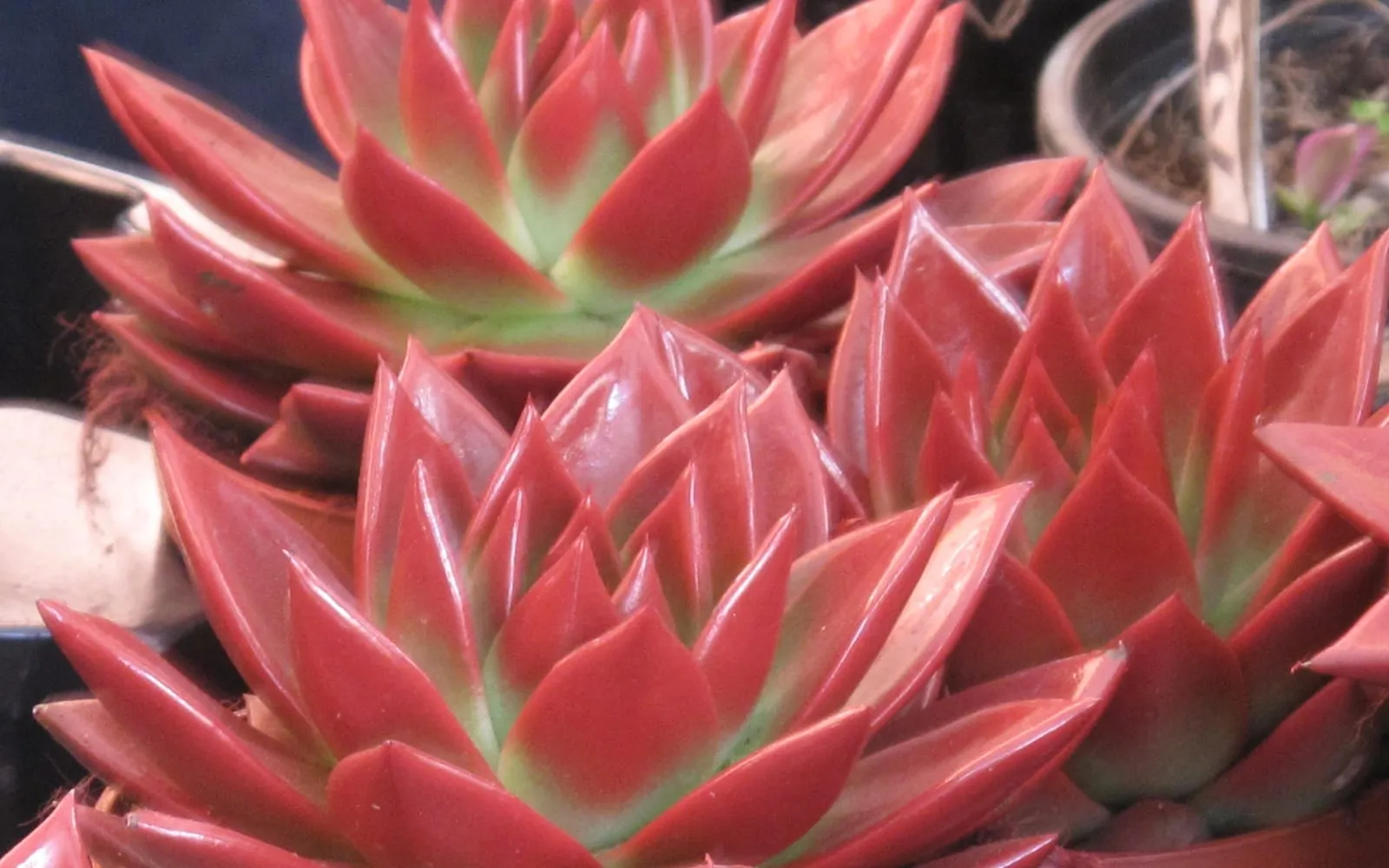
A dense, symmetrical rosette, 10 to 20 cm across, of thick, fleshy leaves that are broadly triangular and taper to a firm, sharp point, smooth and glossy rather than powder-coated across most of the surface.
Leaf colour runs from apple green through blue-green depending on light, with a red to burgundy flush developing along the tips and margins wherever the plant gets strong, direct sun, the trait that gives the plant its common name. A rosette kept in weaker light loses most of this colour and stays a plainer, uniform green.
Offsets form around the base over time, gradually building a small cluster of rosettes rather than staying as a single plant indefinitely. Flowers appear on an arching stem in spring, small and bell-shaped in shades of pink and yellow, held well clear of the foliage.
Where it is from
Echeveria agavoides grows on rocky slopes and outcrops across the high plateaus of central Mexico, in a climate of intense sun, sharp drainage and a marked dry season, at an altitude that brings cool nights even where days run hot.
That combination of strong light and cool nights is what produces the red-tipped colouring the species is grown for, and it is difficult to reproduce fully indoors without a properly bright spot, since the colour fades within weeks on a plant moved somewhere dimmer.
Rocky, mineral soil with almost no organic matter drains within minutes of rain, which is the condition a gritty succulent compost is meant to imitate. Roots adapted to that terrain rot quickly in anything that holds water the way ordinary potting compost does.
How it grows
Pot it in a gritty, sharply drained cactus or succulent compost, in a shallow pot with generous drainage holes, since the root system is modest relative to the rosette above it.
Growth runs through spring and summer and slows close to a stop over winter, particularly if the plant is kept cool and dry through the colder months, which is the correct approach rather than a sign of stress.
Offsets appear around the base of a mature rosette. Detach them once they have a few leaves and some roots of their own, let the cut surface callus for a few days, and pot into the same gritty mix.
Leaf propagation also works, though less reliably than with some softer-leaved echeverias, since the thick, firmly attached leaves of this species can be harder to remove cleanly with the base intact. Twist gently rather than pulling straight out.
Through the seasons
Spring restarts active growth. Repot if needed, remove any offsets ready to pot separately, and give the first feed of the season.
Summer is the main growing period and, given strong light, the season when the red leaf-tip colour is at its most vivid. Water every one to two weeks and move the plant outdoors into full sun where possible.
Autumn slows growth as light and temperature drop. Bring an outdoor plant back in before the weather turns and reduce watering.
Winter is a dry rest. Water sparingly, keep the plant in the brightest spot available, and accept that winter light is rarely enough to sustain full colour until spring returns.
Care difficulty
Easy, and closer in temperament to a true desert succulent than to many houseplant-marketed echeverias, which makes it a forgiving choice for a grower who tends to underwater rather than overwater.
Light is the main lever for how the plant looks rather than whether it survives. A rosette kept too dim stays alive but loses the tight form and red tip colour that make the species distinctive, stretching gradually towards whatever light source it can find.
Watering
Water the compost thoroughly, then let it dry out completely before watering again, roughly every one to two weeks in summer and monthly or less in winter.
Water at the soil line and keep water out of the rosette itself. Water sitting in the tight centre of the plant is the most common way to lose a rosette outright, since it cannot evaporate quickly from between the tightly packed leaves.
Judge by the leaves rather than a fixed schedule. Firm, plump leaves mean the plant needs no water yet; slightly softer or faintly wrinkled lower leaves are the cue to water again.
Warning signs, diseases and pests
Rot from water sitting in the rosette centre is the main risk, turning the growing point soft and dark. There is no fix once it has properly taken hold; healthy offsets or leaves give the best chance of saving something from an affected plant.
Mealybugs wedge between the tightly packed leaves near the centre, showing as small white, cottony specks that are awkward to reach. Apply diluted alcohol with a fine paintbrush rather than flooding the rosette with liquid.
Vine weevil grubs feed on the roots underground and can cause sudden collapse with little warning above soil level. Nematodes applied to the compost are the standard control.
Etiolation, a stretched stem with widely spaced, upward-pointing leaves, is a light problem rather than a disease. It cannot be reversed on the existing growth; move the plant to full sun and expect new growth to come in tighter.
Growing environment
Full direct sun for several hours a day suits it best. A south-facing windowsill or a bright spot outdoors in summer both work well, and this plant needs real sun rather than merely bright light.
Temperatures from around 0 to 32 deg C are tolerated, with brief light frost survived only if the compost is completely dry. Wet cold is a reliable way to lose the plant, so bring it under cover before both combine.
Dry air suits it. Avoid misting and avoid grouping it with humidity-loving plants that need the opposite conditions.
Gritty, sharply drained compost is essential. A dedicated cactus and succulent mix, or an ordinary potting compost cut half and half with grit or perlite, both work.
Feeding
Very little feeding is needed. A cactus and succulent fertiliser at half strength, applied once or twice during the growing season, is enough for a plant this size and this slow-growing.
Stop feeding entirely from autumn through winter, when the plant is using next to nothing.
Over-feeding produces soft, oversized growth that loses the tight, architectural form this species is grown for, so restraint serves the plant better than generosity here.
Troubleshooting
The red leaf tips have faded to plain green. Not enough direct sun. Move the plant somewhere it gets several hours of strong light a day, and the colour should return in the leaves that grow afterwards.
The rosette has stretched with gaps between the leaves. Etiolation from insufficient light. It will not tighten back up on its own; move to full sun and let new growth reset the shape over time.
The centre of the rosette has gone soft and brown. Water sat in the rosette or reached the growing point some other way. Take any healthy offsets now, and water at the soil line only in future.
Leaves feel soft and slightly wrinkled. Underwatering. A thorough soak should plump them back up within a few days.
Can I grow it outdoors year round? Only in a mild, dry-winter climate, roughly USDA zone 9 or warmer. Anywhere colder, grow it in a pot and bring it under cover for winter, since wet cold is far more dangerous to this species than dry cold alone.
Lipstick Echeveria problem guides
Not sure what is wrong? See the common houseplant pests guide.