
Edible
Casabanana
Sicana odorifera
Also known as Cassabanana, Sikana, Melocoton, Musk cucumber, Coroa
How to grow casabanana, Sicana odorifera. Heat, glasshouse growing, scented fruit, deep red skin and pollination for fruiting.
At a glance
- Difficulty
- Difficult
- Water
- Two or three times a week, daily under glass in summer
- Light
- Full sun
- Temperature
- 22-30 deg C, with nothing below 15
- Humidity
- Moderate to high
- Hardiness
- USDA 10-12, RHS H1b, hardy to 8 C
- Type
- Tender perennial climber, grown as an annual where frost comes
- Height
- 15 m or more where it is perennial
- Native to
- tropical South America, Brazil, Peru
- Best month
- April in the Northern Hemisphere, October in the Southern Hemisphere
A perennial vine in the frost-free tropics, running to 15 m and fruiting for years from one planting, and it needs the whole warm season to ripen. Nothing below 15 deg C. Outside the tropics it makes growth and rarely reaches a ripe fruit.
Hardiness zones describe winter cold alone. Summer heat, humidity, rainfall and the length of the growing season decide as much, so treat the range as the outer limit rather than as a recommendation.
Every month named in this guide is for the temperate Northern Hemisphere. If you garden in the Southern Hemisphere, shift each one by six months, so April becomes October. Closer to the equator the wet and dry seasons matter more than the calendar, and the shift stops being a useful guide.
Not known to be toxic
- Safe to eat
- The ripe flesh, and the young fruit cooked as a vegetable
Casabanana is food and no part of it is recorded as harmful. Neither the RHS nor the ASPCA lists Sicana odorifera. Ripe flesh is eaten raw or made into preserves, immature fruit is cooked as a vegetable, and the seeds are discarded for texture rather than for safety. The strong scent that gives the plant its name comes from volatile esters in the skin and is inhaled rather than eaten. As with any cucurbit, discard a fruit that tastes bitter. Cooked flesh in small amounts is harmless to cats and dogs.
Sources: RHS potentially harmful garden plants, ASPCA toxic and non-toxic plants
About
Casabanana is grown across tropical America for its smell as much as for its flesh. A ripe fruit is laid on a shelf or hung in a wardrobe, where it perfumes the room for weeks and keeps moths out of the linen, and it is eaten when the scent finally fades.
The fruit is unlike anything else in the family. Smooth, hard-skinned, 30 to 60 cm long and shaped like a fat cigar, coloured deep maroon, purple-black or orange depending on the cultivar, with a glossy finish that looks polished. The flesh inside is orange to yellow, firm, sweet and melon-like, with a scent somewhere between melon, mango and cantaloupe.
Growing it outside the tropics is a long-odds project. The vine is enormous and the fruit needs several warm months to ripen, so a heated greenhouse and an early start are the minimum. The plant itself is handsome enough to justify the space.
Appearance and character
An extremely vigorous perennial climber, woody at the base with age, reaching 15 m or more in the tropics and filling a large greenhouse in a single season.
Stems are ridged, roughly hairy, and thicken quickly.
Leaves are 10 to 30 cm across, broadly heart-shaped with three to five shallow lobes, rough above and downy beneath, with a faint musky smell when crushed.
Tendrils are strongly branched and grip hard.
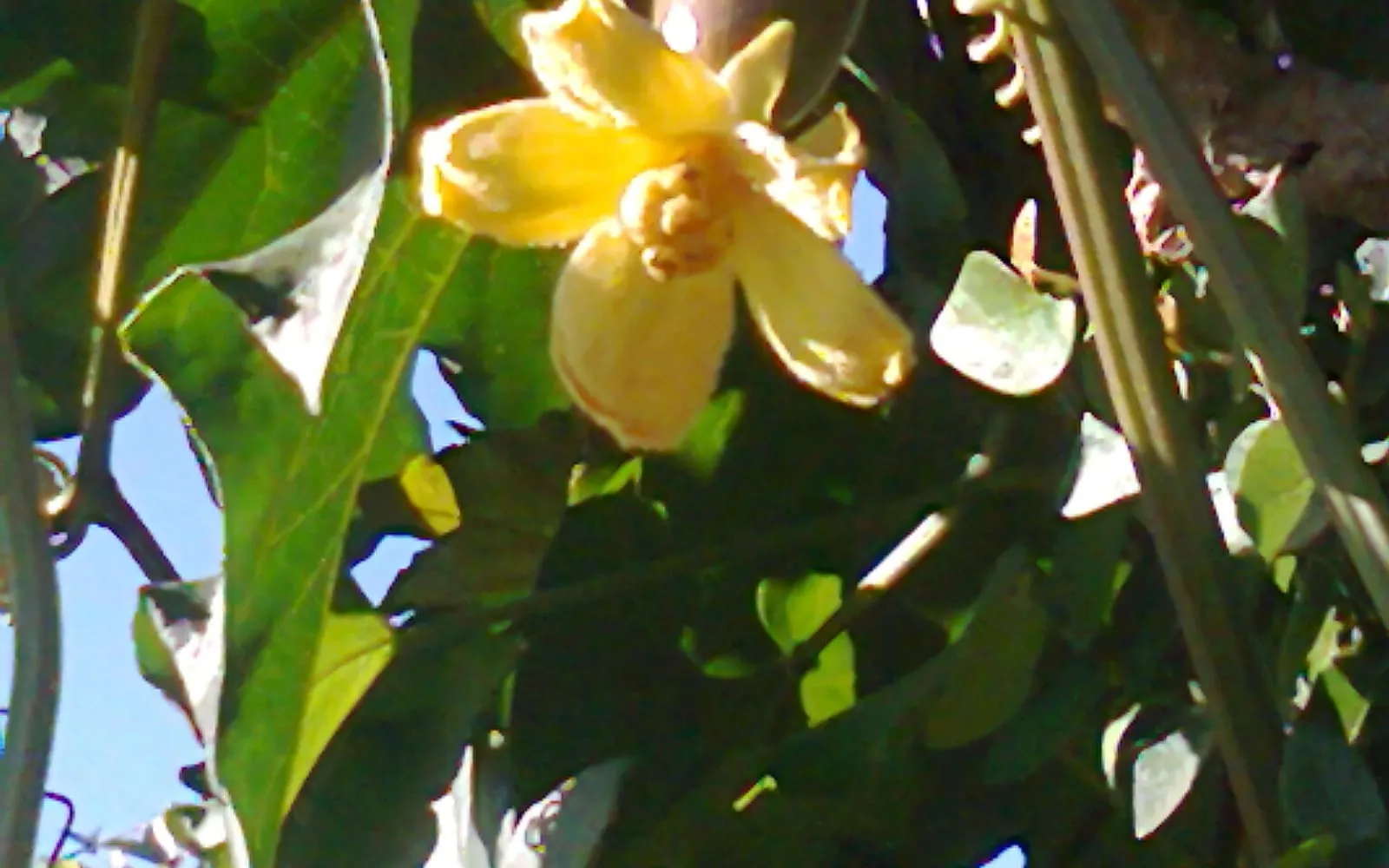
Flowers are pale yellow to cream, bell-shaped and about 3 cm across, with males and females on the same plant. Compared with the fruit they are modest.
The fruit is the reason to grow it. It hangs from a stout stalk, 30 to 60 cm long and 10 to 12 cm thick, hard-skinned and smooth, ripening to deep maroon, violet-black, or orange-red.
The flesh is 3 to 5 cm thick, orange or yellow, firm and sweet, surrounding a central cavity packed with flat cream seeds in a soft pulp.
The scent is what people remember. A ripe fruit is detectable across a room and holds it for weeks.
Where it is from
Casabanana comes from tropical South America, most likely Brazil and Peru, though it has been grown across the region for so long that its wild range is uncertain.
Pre-Columbian cultivation is well attested. Peruvian archaeological sites carry seeds and the fruit appears in Moche art, and it moved north into Central America and the Caribbean before Europeans arrived.
Spanish accounts from the sixteenth century describe it in Central American gardens, used exactly as it is now, hung indoors for its scent.
It stayed a garden plant rather than becoming a commercial crop, and it is grown today in Brazil, Peru, Ecuador, Colombia, Mexico, the Caribbean and parts of the Philippines, mostly on a household scale.
How it grows
Sow in March or early April at 25 deg C. Soak the seed for 24 hours and nick the coat, since germination is slow and uneven otherwise.
Pot on generously. The seedling grows fast and resents a small pot.
Plant into a heated greenhouse or conservatory border in late May. Outdoors in a cool summer it will not fruit.
Give it the largest support you have. A greenhouse roof, a strong pergola, or a set of high wires.
Pinch the leader once it reaches the top, since female flowers come on the laterals.
Hand-pollinate. Brush a stripped male flower into the centre of each female in the morning.
Thin to two or three fruit per plant, since each one is heavy and a vine carrying six will ripen none of them properly.
Sling each fruit in a net once it is 10 cm long.
Expect four to five months from flower to ripe fruit, so the sowing date settles the crop before the plant has done anything.
Harvest when the skin has coloured fully and the fruit smells strongly. It keeps for weeks at room temperature.
Through the seasons
March is the sowing month. Later than that and the fruit will not ripen.
April and May are for growing the young plant on in warmth and potting up once or twice.
Late May is planting into a heated greenhouse border.
June and July are growth, training and pinching, with the first flowers usually in July.
Late July and August are the pollination window and the point to thin the fruit.
September and October are fruit swell and colouring, and the reason the greenhouse heater has to stay on.
November is harvest in a good year, and the fruit will then scent a room until Christmas.
Care difficulty
Difficult outside the tropics, and one of the more demanding plants in the whole collection.
Season length is the limitation, with four to five months needed from flower to ripe fruit.
Heat is needed at both ends, which means a March sowing under a propagator and a heated greenhouse into November.
Space is the second problem, since the vine is enormous and shades everything under it.
Hand pollination and fruit thinning are both required.
As a foliage plant it is easy, and that is the outcome most cool-climate growers get.
Watering
Water two or three times a week from planting out, daily under glass in high summer.
Increase while fruit is swelling.
Soak the root zone deeply rather than watering little and often.
Keep the leaves dry and the greenhouse ventilated.
Mulch heavily.
Reduce watering from October as the fruit colours, which concentrates the flavour and the scent.
Warning signs, diseases and pests
White powder on the leaves from midsummer is powdery mildew.
Fine speckling with webbing is red spider mite, which the warm dry greenhouse encourages.
Sticky leaves with black growth mean aphids or whitefly above them.
Small fruit yellowing and dropping means the female was not pollinated.
Fruit that stops growing at half size usually means the vine is carrying too many, and thinning early prevents it.
A fruit that stays green into November has run out of season.
Wilting in wet compost is root rot from cold roots in spring.
A vine that fills the roof and flowers only male is unpinched and overfed with nitrogen.
Growing environment
A heated greenhouse or a large conservatory. There is no outdoor option outside the tropics.
Full sun.
Minimum 15 deg C, with 22 to 30 deg C for growth, held into November.
Moderate to high humidity with enough ventilation to slow mildew.
Deep rich soil with plenty of organic matter.
A support strong enough for a very heavy vine, plus a sling for each fruit.
Several square metres of roof space.
Feeding
Dig in rotted manure before planting.
Feed a balanced liquid feed fortnightly from planting out.
Switch to a high-potash tomato feed once fruit has set.
Keep feeding through the ripening period, which runs later than for any other plant in the greenhouse.
Stop feeding a fortnight before harvest.
Keep nitrogen moderate after midsummer, since it delays flowering on a plant that has no time to spare.
Troubleshooting
Why would I grow a fruit for its smell? That is what it is grown for across tropical America. A ripe one perfumes a room for weeks and is traditionally kept in a linen cupboard to deter moths, then eaten when the scent goes.
What does it taste like? Sweet, firm and melon-like, with a scent of cantaloupe and mango. Ripe flesh is eaten raw or made into preserves, and young fruit is cooked as a vegetable.
Can I grow it outdoors in a cool climate? No. It needs four or five warm months from flower to ripe fruit, which means a heated greenhouse.
When should I sow? March, under a propagator at 25 deg C, after soaking and nicking the seed. A later sowing gives a magnificent vine and no fruit.
How many fruit should I leave? Two or three per plant. Each is heavy and takes months, and a vine that sets six will ripen none of them.
Mine flowered and set nothing. Under glass there are no pollinators. Brush a male flower into each female by hand in the morning.
The fruit fell off the vine. Weight. Sling every fruit in a net once it reaches about 10 cm.
How long does a ripe one keep? Several weeks at room temperature, and the scent lasts most of that time. Refrigeration is not needed and dulls the smell.
Is it related to melon? Distantly. It is in the gourd family but in its own genus, Sicana, and it will not cross with melons, cucumbers or squashes.
Casabanana problem guides
Not sure what is wrong? See the common vegetable pests guide.