
Outdoor plant
Silk Tassel Bush
Garrya elliptica
Also known as Coast Silktassel
Practical guidance for growing silk tassel bush, Garrya elliptica, including its winter catkins, male and female plants, coastal wind tolerance, pruning timing, and low toxicity.
At a glance
- Difficulty
- Moderate
- Water
- Regular watering while establishing, then drought-tolerant
- Light
- Full sun to part shade; more compact and floriferous in good light
- Temperature
- Hardy to about -10 deg C once established; young plants need shelter
- Hardiness
- USDA 8-10, RHS H4, hardy to -10 C
- Type
- Evergreen shrub or small tree
- Height
- 2.5-4 m
- Native to
- western North America
The zone number understates what makes this shrub useful in practice. Garrya elliptica comes from coastal California and Oregon, where salt spray and constant onshore wind matter more to a plant's survival than winter cold does, and it carries that wind and salt tolerance into cultivation almost anywhere it is grown. A sheltered inland garden within its zone range gives it an easier life than the cold number alone suggests it needs.
Hardiness zones describe winter cold alone. Summer heat, humidity, rainfall and the length of the growing season decide as much, so treat the range as the outer limit rather than as a recommendation.
Not known to be toxic
Garrya elliptica does not appear on the RHS list of potentially harmful garden plants or on the ASPCA's toxic plant database, and no reliable record of poisoning in a person, dog, cat or horse ties back to the species. Every part of the plant is intensely bitter, which makes it naturally unpalatable to grazing animals and to most children who bite into a leaf by accident, well before any toxin would need to act. Some related Garrya species carry diterpene alkaloids that researchers once investigated as a possible substitute for quinine, though nothing about that research points to a genuine poisoning risk from the bitter taste alone. This is a shrub you can plant without factoring pets or small children into the decision.
Sources: RHS potentially harmful garden plants, ASPCA toxic and non-toxic plants
About
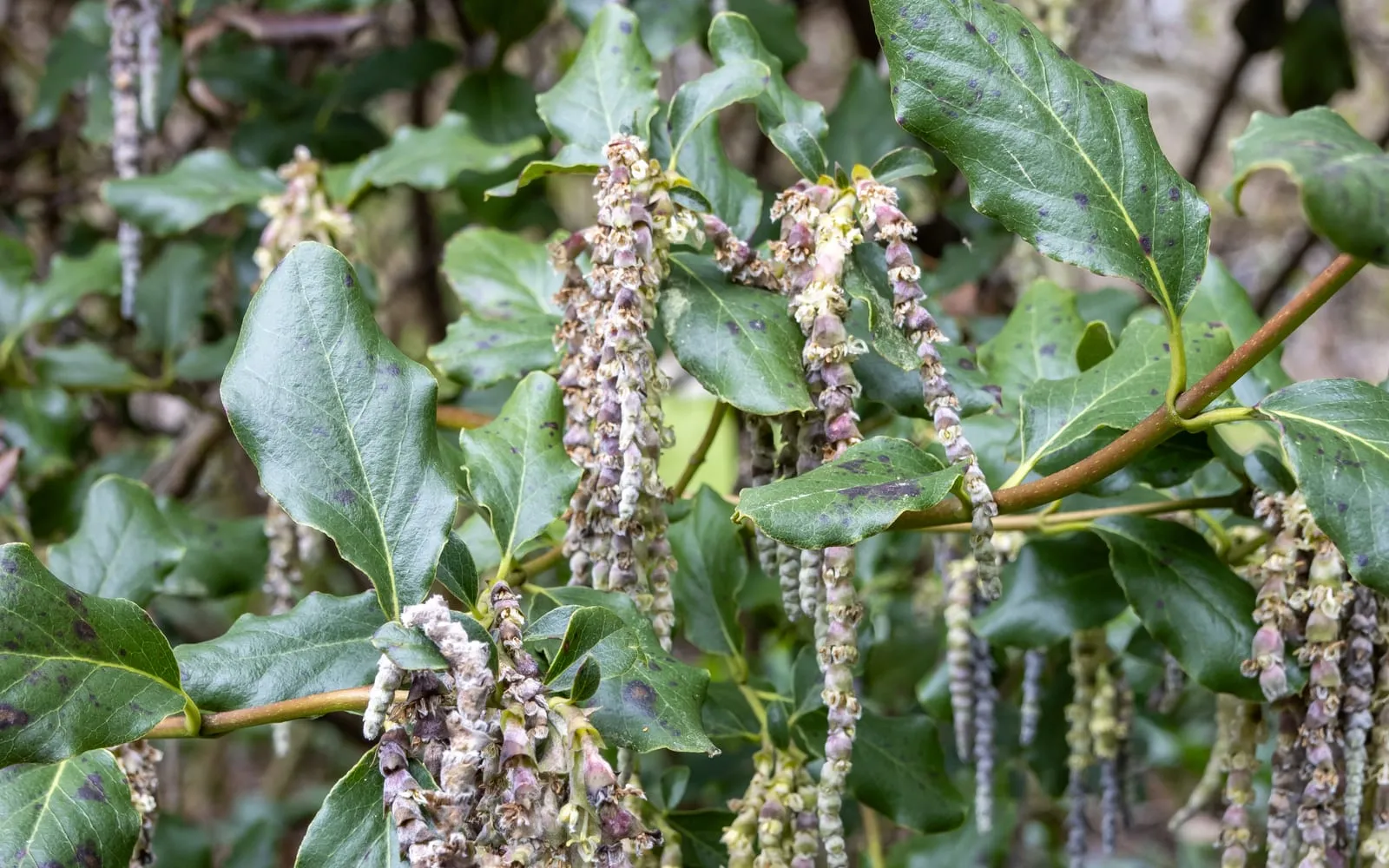
Silk tassel bush earns its place in a winter garden for one feature: long, silvery-grey catkins that hang from the bare stems from midwinter into early spring, moving in the slightest breeze and catching low winter light better than almost anything else flowering at that time of year.
It is also one of the more useful evergreen shrubs for a windswept or coastal site, shrugging off salt spray and constant onshore wind that would scorch or defoliate most broadleaf evergreens. A gardener choosing it mainly for that toughness gets the catkin display as a bonus rather than the other way round.
Appearance and character
Leaves are leathery and wavy-edged, dark grey-green above and covered in a fine grey felt beneath, held densely on stiff, upright stems that give the whole shrub a slightly bristling, architectural texture even without its flowers.
The species is dioecious, meaning male and female flowers grow on separate plants, and the difference matters more here than in most garden shrubs. Male plants carry the long, showy catkins gardeners grow it for, often 15 to 20 cm on the species and considerably longer on selected male cultivars. Female plants carry shorter, less dramatic catkins and follow them with strings of small purple-brown fruit, which some gardeners value in their own right but which nurseries rarely propagate for.
Growth is fast while the plant is young, slowing once it reaches its mature bulk, and left unpruned it thickens into a dense, rounded mass that takes readily to being grown as an informal screen or windbreak.
Where it is from
Garrya elliptica is native to the coastal hills and canyons of California and Oregon, growing in chaparral and open woodland within reach of salt spray from the Pacific. That habitat is what gives the species its defining practical trait: a tolerance of wind and salt that few other broadleaf evergreens can match.
Winters in its native range are mild and wet rather than harshly cold, so the zone range sits on the tender side for a shrub this tough in every other respect. Wind and salt tolerance explain why it is planted as a coastal screen far outside its native range.
How it grows
Plant in well-drained soil in full sun to part shade; it is not fussy about soil type or fertility and grows about as well in poor, sandy ground as in better soil, provided water does not stand around the roots.
Buy a named male cultivar such as ‘James Roof’ if the catkin display is the reason for planting it, since seed-grown plants are unsexed until they flower and roughly half will turn out to be the shorter-catkined female.
Give it shelter from cold wind while young, even though a mature plant tolerates far more exposure than most evergreens; the first year or two in the ground is when it is most vulnerable to a hard frost or a drying gale.
Prune, if needed, immediately after the catkins fade in spring, since flower buds for the following winter form on the current season’s growth soon afterwards. It tolerates fairly hard pruning but looks best allowed to keep something close to its natural shape.
Through the seasons
Winter is the main event, with catkins hanging from every stem from December into February in most climates it is grown in.
Spring is for pruning, done as soon as the catkins have faded and before the next season’s flower buds start to form.
Summer is quiet growth, needing little water once the plant is established beyond an extended dry spell.
Autumn is a good time to plant a new specimen, giving the roots a season to settle before the following winter’s display.
Care difficulty
Moderate, mostly for the first two years. A young Garrya needs shelter from hard frost and drying wind while it establishes a root system that will later tolerate both. Once past that stage, it is close to trouble-free. It tolerates drought, stays largely free of pests, and needs no routine feeding on reasonable soil.
Watering
Water regularly through the first two growing seasons while the roots establish, giving it a moderate soak rather than frequent light watering.
Once established, it copes with real drought and needs no supplementary water in most climates outside an extended dry spell, a trait that follows directly from the dry summers of its native coastal range.
Warning signs, diseases and pests
Leaf spot appears as small dark blotches in prolonged wet, still weather. It is mostly cosmetic on an otherwise healthy shrub and eased by better air circulation around the plant.
Honey fungus occasionally affects an old or stressed specimen, showing as gradual dieback and, eventually, fungal growth at the base near soil level. There is no reliable treatment once it takes hold.
Vine weevil adults sometimes notch the edges of the leaves at night, leaving a ragged, scalloped outline. The damage is cosmetic on an established shrub; a serious infestation of the grubs, which feed on roots, is more of a concern for a plant grown in a container.
Scale insects appear as small, flattened brown bumps along the stems, feeding on sap and leaving a sticky residue that can attract sooty mould. Treat with horticultural oil on a bad infestation.
Growing environment
Full sun to part shade both suit it, though full sun gives a more compact plant and a heavier catkin display than deep shade does.
Well-drained soil is the one real requirement; beyond that it tolerates poor, sandy or chalky ground without difficulty.
Wind and salt tolerance are this shrub’s standout traits, and a coastal or otherwise exposed site that rules out many broadleaf evergreens suits it well once it is past its first couple of seasons.
Feeding
A light application of balanced, general-purpose fertiliser in spring helps a young plant establish on poor soil, though an established Garrya on reasonable ground rarely needs feeding at all.
Avoid heavy feeding, which pushes soft growth more vulnerable to wind and frost damage than the naturally tough growth the plant makes on its own.
Troubleshooting
Mine has never produced the long catkins I see in photographs. It is very likely a female plant, or a seed-grown plant of unknown sex that turned out female. Only male plants, and named male cultivars in particular, carry the long, showy catkins; a female plant’s catkins are shorter and followed by small fruit instead.
The leaves scorched over a hard winter. Cold, drying wind on a young plant is the usual cause, more often than the cold itself. Provide shelter for the first two winters after planting, after which the shrub copes with far harsher conditions on its own.
Can I grow it as a hedge or screen? Yes, and it takes well to being grown as an informal windbreak, particularly in a coastal garden where few other evergreens tolerate the exposure as well.
When should I prune it, and how hard? Straight after the catkins fade in spring, and lightly rather than hard, since next winter’s flower buds form on the growth made soon after that pruning.
Is it worth planting inland, away from the coast? Yes, provided the soil drains well and the site is not a frost pocket. The wind and salt tolerance is a bonus rather than a requirement, and the winter catkin display works just as well away from the sea.