
Outdoor plant
Sweet Olive
Osmanthus fragrans
Also known as Tea Olive, Fragrant Olive
Practical guidance for growing sweet olive, Osmanthus fragrans, including its edible flowers, apricot scent, slow growth, frost tenderness, and non-toxic care.
At a glance
- Difficulty
- Moderate
- Water
- Regular watering while establishing, then moderate
- Light
- Full sun to part shade; shelter from cold wind improves winter survival
- Temperature
- Hardy to about -5 deg C; damaged or killed by a harder frost
- Hardiness
- USDA 8b-10, RHS H3, hardy to -5 C
- Type
- Evergreen shrub or small tree
- Height
- 2.5-4 m
- Native to
- eastern Asia
Sweet olive comes from a climate with mild, frost-light winters and long, warm, humid summers, and cold rather than heat is what limits where it thrives. It survives a light frost with only minor leaf damage but a harder freeze can kill it to the ground or outright, so the zone range matters more here than for many shrubs: outside it, a warm wall and a sheltered corner are not a substitute for the mild winter the species needs.
Hardiness zones describe winter cold alone. Summer heat, humidity, rainfall and the length of the growing season decide as much, so treat the range as the outer limit rather than as a recommendation.
Not known to be toxic
- Safe to eat
- The flowers, used fresh or dried in tea, wine, jam and confectionery
Osmanthus fragrans does not appear on the RHS list of potentially harmful garden plants or on the ASPCA's toxic plant database, and no documented case of poisoning in a person, dog, cat or horse is tied to the species. The flowers are eaten in quantity across the parts of Asia where the plant is grown, steeped for tea, distilled into wine, or used to flavour cakes and preserves, which is about as strong a real-world safety record as a garden plant carries. Cats can find the scent of the flowers overpowering at close range and sneeze or move away from it, which is a matter of a sensitive nose rather than any toxin. This is a shrub you can plant without factoring pets or small children into the decision.
Sources: RHS potentially harmful garden plants, ASPCA toxic and non-toxic plants
About
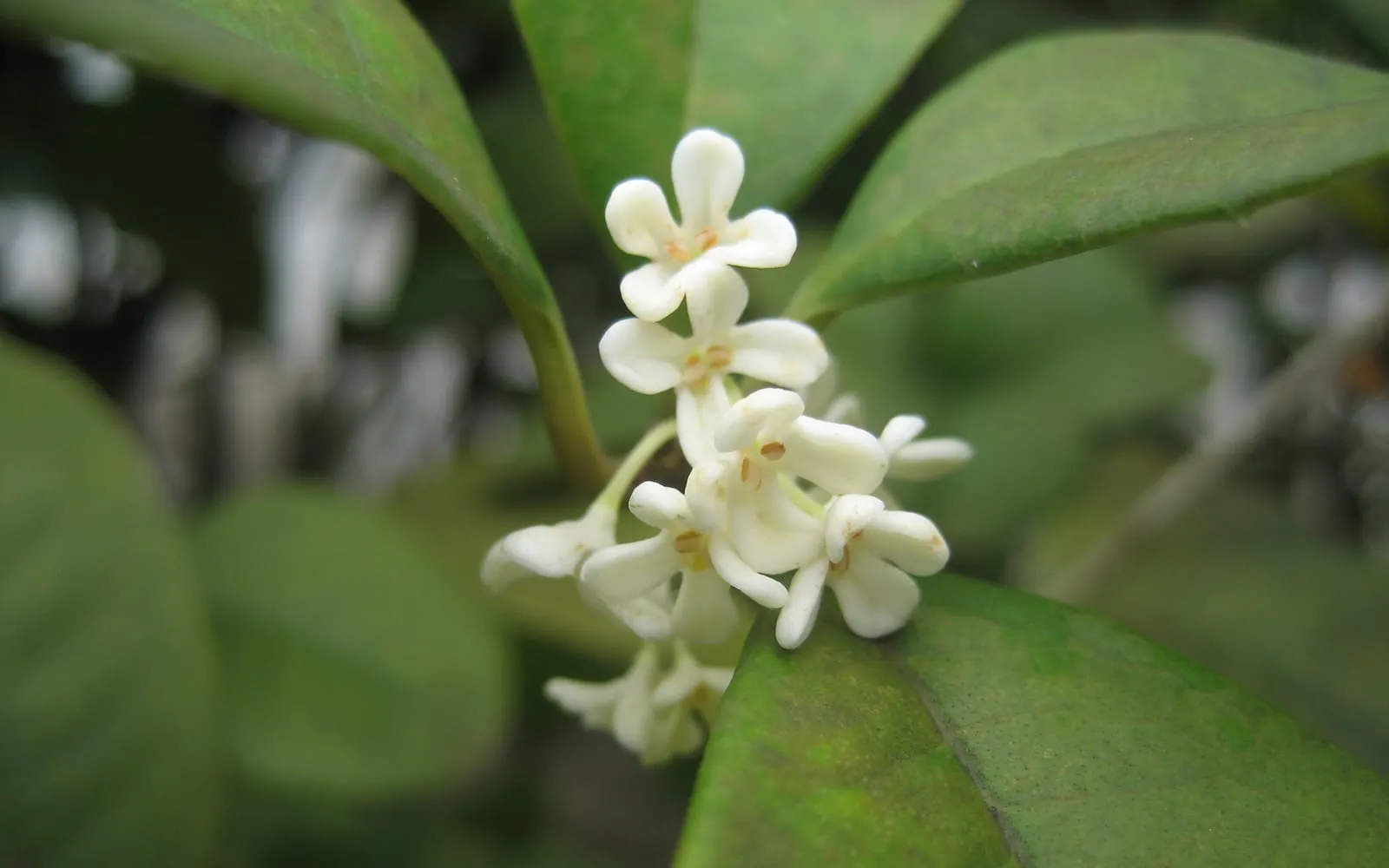
Sweet olive earns its place near a door, a window or a path for one reason: tiny white flowers with a scent close to ripe apricot, carrying much further than their small size would suggest. In a mild climate it can flower more than once a year, and in its native range the fragrance is strong enough to have shaped an entire culture of tea, wine and cakes built around it.
It is a slow grower, taking a decade or more to reach a size that dominates a border, and a properly tender one outside a mild winter climate. Both traits reward patience and a sheltered position more than they reward any particular skill.
Appearance and character
Leaves are opposite, leathery and glossy dark green, elliptic in shape with finely toothed edges on most forms, though some cultivars carry a smoother margin. They are held densely on the stems year round, giving the shrub a solid, formal texture whether or not it is in flower.
Flowers are individually tiny, cream to white, clustered along the leaf axils in such numbers on a mature plant that the whole shrub can appear lightly dusted. The main flush comes in autumn in most climates, though established plants often produce smaller flushes through other seasons, particularly after a spell of cooler weather breaks a warm run.
Growth is slow and dense, and left unpruned the shrub eventually takes on a rounded, almost topiary-like form on its own, which is part of why it is so often grown as a clipped hedge or a specimen near a seating area where its scent can be appreciated up close.
Where it is from
Osmanthus fragrans is native across a broad stretch of eastern Asia, including southern China, the Himalayan foothills and Japan, growing in mild, humid mountain and lowland forest where winters bring little hard frost and summers are long, warm and wet.
In China its flowers have been gathered for tea, wine and confectionery for centuries, and the plant carries strong cultural associations with the Mid-Autumn Festival, when its main flowering season coincides with the festival’s traditional dates. That long culinary history is also the strong evidence of its safety: a plant eaten in quantity for generations across a large population has left no record of poisoning behind it.
How it grows
Plant in fertile, well-drained soil, neutral to slightly acid, in full sun to part shade. Choose the sunniest, most sheltered spot available outside its reliably hardy range, ideally against a warm, south- or west-facing wall that holds heat and blocks cold wind.
Growth is naturally slow, so water and feed a young plant steadily while it establishes. Expect it to take ten years or more to reach a substantial size.
Prune after the main flowering flush if shaping is needed, since flowers form on the current season’s growth and a badly timed hard prune can remove much of a coming display. It tolerates clipping well and is commonly grown as a formal hedge in climates mild enough to suit it.
Through the seasons
Spring is steady new growth, with a light feed helping a young plant along.
Summer brings warmth the plant uses for growth rather than flowers in most climates, though a passing flush of bloom is possible after a cool spell.
Autumn is the main flowering season in most gardens, when the scent is strongest and most reliable.
Winter is the test of the site chosen for it. A hard frost damages or kills unprotected growth, while a plant in a sheltered spot within its hardy range holds its leaves through the season.
Care difficulty
Moderate. Shelter and drainage matter more than ongoing labour. In the right site, sweet olive needs little beyond patience while it grows to flowering size. In a spot too exposed to hard frost, routine care cannot compensate for a winter the plant cannot survive.
Watering
Water regularly through the first two growing seasons while the roots establish, giving a deep soak and letting the soil dry slightly before watering again.
Once established, moderate watering through summer keeps growth steady; allow the soil to dry a little between waterings rather than keeping it constantly wet, since the roots dislike sitting in saturated ground for long.
Warning signs, diseases and pests
Scale insects appear as small, flattened brown bumps on the stems and the undersides of leaves, feeding on sap and leaving a sticky residue behind them. Treat with horticultural oil on anything beyond a light infestation.
Sooty mould, a black fungal growth, follows scale infestation, feeding on the honeydew scale insects leave behind rather than on the plant itself. Treating the scale clears the sooty mould in turn.
Leaf spot shows as small dark blotches during prolonged wet weather, mostly cosmetic and eased by better air circulation and avoiding overhead watering.
Root rot follows poorly drained soil, showing as a general decline and yellowing that does not respond to extra water. Improving drainage before planting is the only reliable prevention.
Growing environment
Full sun to part shade both suit it, though full sun in a climate mild enough for the species produces the densest growth and the heaviest flowering.
Fertile, well-drained soil matters more than any other single factor, and waterlogged ground is one of the few things this otherwise adaptable shrub does not tolerate.
Shelter from cold wind is worth arranging wherever winters bring any real frost, since wind chill does more damage to the foliage than still cold air at the same temperature.
Feeding
Apply a balanced, slow-release fertiliser once or twice during the growing season, following the product’s guidance for a woody evergreen shrub.
A young, establishing plant benefits from steady feeding more than a mature one does, since it is putting that fertility toward the framework it will carry for the rest of its life.
Avoid feeding late in the growing season, since soft new growth produced too close to winter is the most frost-vulnerable part of the plant.
Troubleshooting
Mine has never flowered. Most likely age, since a young plant can take several years to reach flowering size, or too little sun. A plant kept in deep shade grows leaves readily but flowers sparsely or not at all.
The leaves turned brown and dropped after a cold snap. Frost damage, almost certainly, if temperatures fell close to or below the plant’s hardy limit. Established roots often survive even where top growth is killed back, and new shoots can appear from the base the following spring.
Can I grow it in a container? Yes, and a container is a practical way to grow it outside its reliably hardy range, since the whole plant can be moved under cover for winter. Use a large pot with excellent drainage and expect to repot every few years as it grows.
Why is growth so slow compared with other shrubs I have planted? This is how the species grows. It rewards a settled position and steady care over many years rather than fast results, and rushing it with heavy feeding does more harm than good.
Are the flowers really edible? Yes. They are gathered fresh or dried across much of eastern Asia for tea, wine, jam and cake flavouring, and there is no safety concern in using flowers from a plant grown without pesticide treatment.