
Outdoor plant
Climbing Hydrangea
Hydrangea anomala
Practical guidance for growing climbing hydrangea, Hydrangea anomala, including its self-clinging aerial roots, slow establishment, shade tolerance, exfoliating bark, and moderate toxicity.
At a glance
- Difficulty
- Moderate
- Water
- Regular watering while establishing, then only in extended dry spells
- Light
- Part shade to full shade; tolerates more shade than almost any other hydrangea
- Temperature
- Very hardy; tolerates severe winter cold once established
- Hardiness
- USDA 4-8, RHS H7, hardy to -34 C
- Type
- Deciduous woody climber
- Height
- 12 m or more, spreading 4-8 m
- Native to
- eastern Asia
Cold rarely troubles an established plant, and the zone range mostly marks how long a growing season it needs rather than how much frost it survives. What the numbers leave out entirely is time: this vine spends its first two or three years building roots with almost no visible growth above ground, then accelerates sharply once that root system is in place. A gardener judging it against the zone rating alone, in its first seasons, will conclude it has failed when it has not.
Hardiness zones describe winter cold alone. Summer heat, humidity, rainfall and the length of the growing season decide as much, so treat the range as the outer limit rather than as a recommendation.
Toxic if eaten
- Do not eat
- Leaves, flower buds and bark
- Harm from
- Eating it and handling it
- Affects
- People, cats, dogs and horses
Climbing hydrangea carries the same cyanogenic glycosides found across the Hydrangea genus, present in the leaves, flower buds and bark and releasing a small amount of cyanide when the tissue is chewed and digested. The ASPCA lists hydrangea as toxic to dogs, cats and horses, with vomiting, diarrhoea and lethargy the usual result of a dog or horse eating a mouthful, and true cyanide poisoning rare in practice because an animal would need to eat a large amount of bitter-tasting material to reach a dangerous dose. In people, eating plant material causes stomach upset in similar quantities. The more common complaint is a skin one: the sap irritates some people's hands after regular pruning, causing itching or a mild rash, so gloves are sensible for anyone who reacts to it. Because this vine is often trained up a wall within reach of a garden path, cutting back low growth before it flowers keeps the most tempting foliage away from a dog that grazes on garden plants.
Sources: ASPCA (Hydrangea), RHS potentially harmful garden plants
About
Climbing hydrangea is the one hydrangea that climbs, gripping a wall, fence or tree trunk with small aerial roots rather than needing a trellis or ties. Left to its own devices it becomes one of the largest flowering climbers available for a temperate garden, eventually covering a substantial stretch of wall in lacy white flower heads through early summer.
Patience is the price of that scale. A newly planted vine can sit for two or three years with barely any visible growth while its root system develops, a pattern gardeners describe as sleeping, then creeping, then leaping. It does leap once that root system is established, which is easy to forget while waiting through the slow early years.
Appearance and character
Leaves are heart-shaped, glossy dark green and finely toothed, held on reddish stems that climb by producing small, sticky aerial roots wherever they touch a rough surface, in the same manner as ivy rather than by twining or by tendrils.
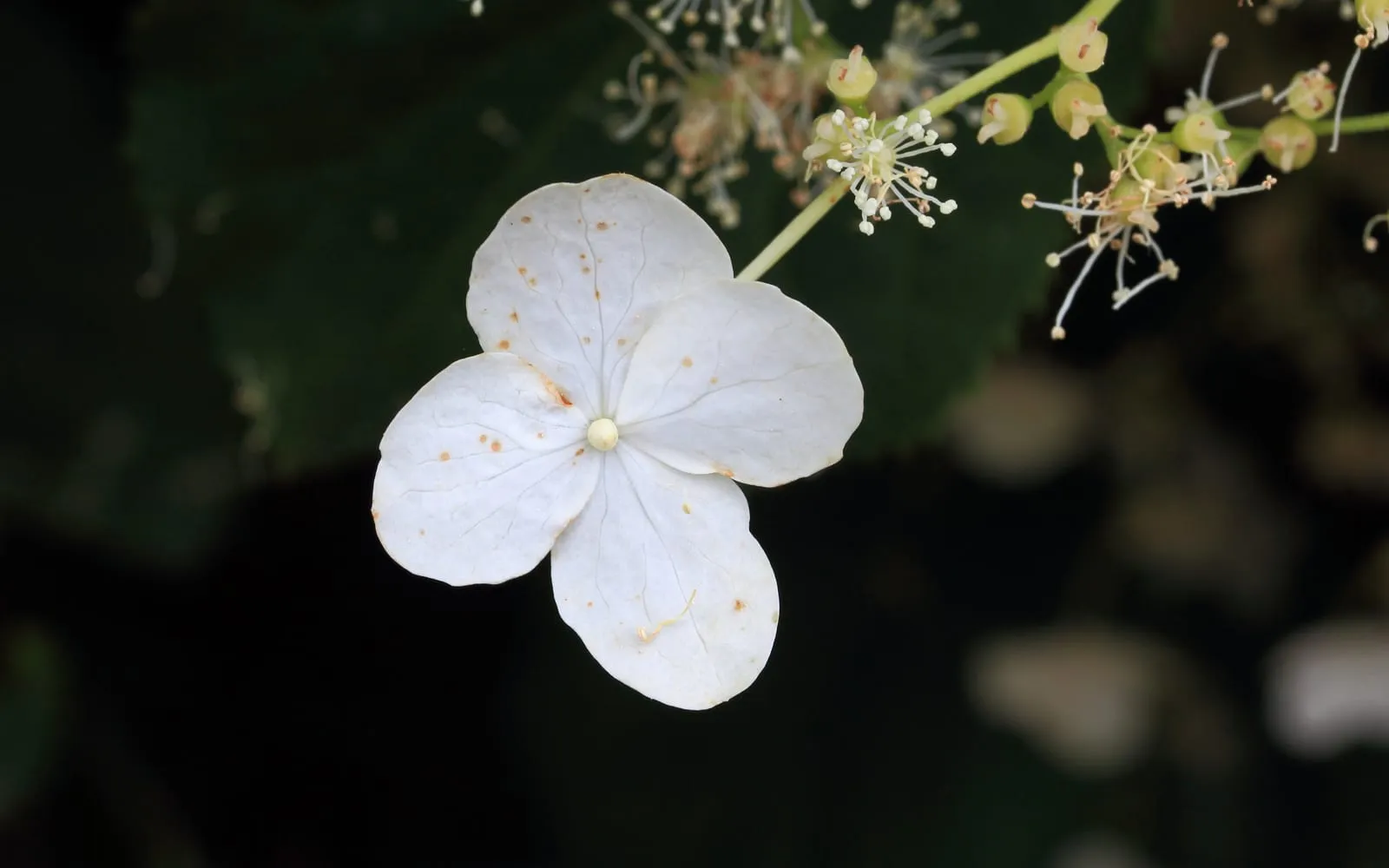
Flowers open in flat, lacecap heads in early summer, a ring of showy white sterile florets surrounding a centre of tiny fertile ones, carrying a light fragrance that most other hydrangeas lack entirely. Unlike a mophead or lacecap hydrangea grown as a shrub, the flower colour here never shifts with soil pH; it opens white and stays white, ageing to a papery tan rather than to blue or pink.
Bark on mature stems peels away in thin, cinnamon-coloured strips, adding a distinct texture to the bare framework once the leaves have dropped, a feature the shrubby hydrangeas do not share to nearly the same degree.
Where it is from
Hydrangea anomala is native to woodland across eastern Asia, from the Himalaya through China to Japan and Korea, climbing into the canopy of mixed forest by clinging to tree bark and rock faces on its way toward the light.
Its forest origin gives it the trait that sets it apart from other garden hydrangeas: real shade tolerance. A species that spends its life reaching upward through a closed canopy performs well on a shaded wall where a shrubby hydrangea would grow leggy and flower poorly.
How it grows
Plant in moist, fertile, humus-rich soil against a wall, fence or sturdy tree, in part shade to full shade. Choose a permanent position with care, since a mature vine grips its support tightly enough that moving it later is rarely practical.
Water and mulch consistently through the first several years while the root system establishes, resisting the urge to feed heavily or dig around the base in an attempt to speed things up. The slow start is normal rather than a sign of a struggling plant, provided the stems stay green and the leaves stay healthy through each of those early seasons.
Give the young growth something to grip in its first year, a length of trellis or a few loosely tied stems against the wall, since the aerial roots need a little help finding their first foothold before they take over the job on their own.
Prune, if needed, immediately after flowering to control size and remove any growth straying from its support. It tolerates hard pruning on mature growth but recovers slowly, so light, regular control suits it better than an occasional drastic cut back.
Through the seasons
Spring brings new growth from the framework built the previous year, almost imperceptible in the plant’s first seasons and increasingly vigorous once established.
Summer is the flowering season, opening in early summer and holding its lacecap heads for several weeks before they begin to fade.
Autumn turns the leaves a soft, buttery yellow before they drop, revealing the exfoliating bark on older stems.
Winter shows the bare structure and the peeling cinnamon bark, and is a reasonable time to plant a new vine, giving the roots a head start before the following growing season.
Care difficulty
Moderate, mainly because establishment is slow. Once established, it is close to self-sufficient, tolerant of shade that would weaken most other flowering climbers and needing only occasional watering and a light annual prune. Give the root system two or three years before judging the plant.
Watering
Water regularly and evenly through the first several growing seasons while the roots establish, giving a deep soak rather than frequent light watering.
Once established, water during any extended dry spell, since the broad leaves show stress through wilting well before the plant is in serious trouble. Consistent soil moisture through the growing season matters more to this vine than to many other established climbers.
Warning signs, diseases and pests
Aphids cluster on soft new growth in spring, distorting shoot tips. Established plants tolerate them; a strong jet of water or natural predators usually clear a light infestation within a few weeks.
Powdery mildew shows as a pale, dusty coating on leaves in still, humid conditions with poor air movement, and is mostly cosmetic on an established vine grown with reasonable spacing from a wall.
Leaf spot appears as small dark blotches during prolonged wet weather, rarely serious enough to need treatment.
Scale insects sometimes settle on older woody stems, feeding on sap and leaving a sticky residue. Treat a heavy infestation with horticultural oil.
Growing environment
Part shade to full shade suits it better than almost any other hydrangea, and a north-facing wall that would disappoint most flowering climbers is a good position for this one.
Moist, fertile, humus-rich soil supports the steady root growth the plant needs through its slow early years, and it dislikes both drought and waterlogging at the roots in roughly equal measure.
A sturdy support is essential given the eventual weight of a mature vine, whether that is masonry, a strong fence, or a large, healthy tree able to carry the load without harm.
Feeding
Apply a balanced, general-purpose fertiliser once a year in spring, which is more useful during the plant’s slow establishment years than once it is mature and largely self-sufficient.
Avoid heavy feeding in an attempt to speed up the early growth, since the plant is building roots rather than top growth during that period and extra fertility above ground does little to change that underlying pace.
Troubleshooting
It has barely grown in three years. Is it dying? Almost certainly not. This is the normal, slow establishment phase, and a healthy plant with green stems and good leaf colour needs more time before it starts climbing in earnest. Consistent watering and patience matter more here than any intervention.
Mine has never flowered. Usually age, since a young vine rarely flowers before it has finished its slow establishment phase and started climbing vigorously, sometimes not for five years or more after planting.
Can I grow it on a shady wall where nothing else has thrived? Yes, and shade tolerance is one of this vine’s strongest selling points among flowering climbers. A wall with little or no direct sun is a realistic option here in a way it is not for most other hydrangeas.
How do I get it to start climbing a bare wall? Tie the young stems in loosely against the surface for the first season, giving the aerial roots a starting point to grip from. Once a few stems have attached, the rest of the plant follows on its own.
Is it safe near a dog that chews low branches? Treat it with the same caution as any hydrangea. It carries the same toxic compounds as the shrubby species, and keeping the lowest, most accessible growth pruned back reduces what a chewing dog can reach.