
Outdoor plant
Pacific Madrone
Arbutus menziesii
Also known as Madrona
How to grow Pacific madrone, Arbutus menziesii. Why summer watering, the instinct behind planting almost any other tree, is what usually kills it, and why the cinnamon bark peels away in curling papery sheets each summer.
At a glance
- Difficulty
- Difficult
- Water
- Sparingly, and not at all once established
- Light
- Full sun
- Temperature
- Hardy to a moderate frost once established; young trees are more tender
- Hardiness
- USDA 7-9, RHS H4, hardy to -12 C
- Type
- Broadleaf evergreen tree, slow to moderate growing
- Height
- 15-25 m
- Native to
- western North America
Native along a Pacific coastline that delivers wet winters and long, reliably dry summers, and that seasonal rhythm matters more to this species than the cold tolerance the zone range describes. Established trees take real winter cold without trouble, but the roots depend on dry summer soil and a fungal partnership that a wetter, more humid climate disrupts. A garden with mild winters but a damp or irrigated summer is a harder home for it than one with colder winters and a reliably dry summer.
Hardiness zones describe winter cold alone. Summer heat, humidity, rainfall and the length of the growing season decide as much, so treat the range as the outer limit rather than as a recommendation.
Not known to be toxic
- Safe to eat
- The ripe autumn berries, edible raw though dry and mealy, or cooked into preserves
Pacific madrone is not listed by the RHS among potentially harmful garden plants and does not appear on the ASPCA's toxic plant index for cats, dogs or horses. The autumn berries were eaten by Indigenous peoples across the tree's range, generally raw in small quantities or dried and cooked, and remain a significant food source for birds including robins, waxwings and band-tailed pigeons that strip a fruiting tree within days. No part of the tree carries a recorded toxin, and the berries, while dry, mealy and mild rather than sweet, present no more of a hazard to a child or a pet than any other tart wild fruit eaten in modest quantity.
Sources: RHS potentially harmful garden plants, ASPCA toxic and non-toxic plants
About
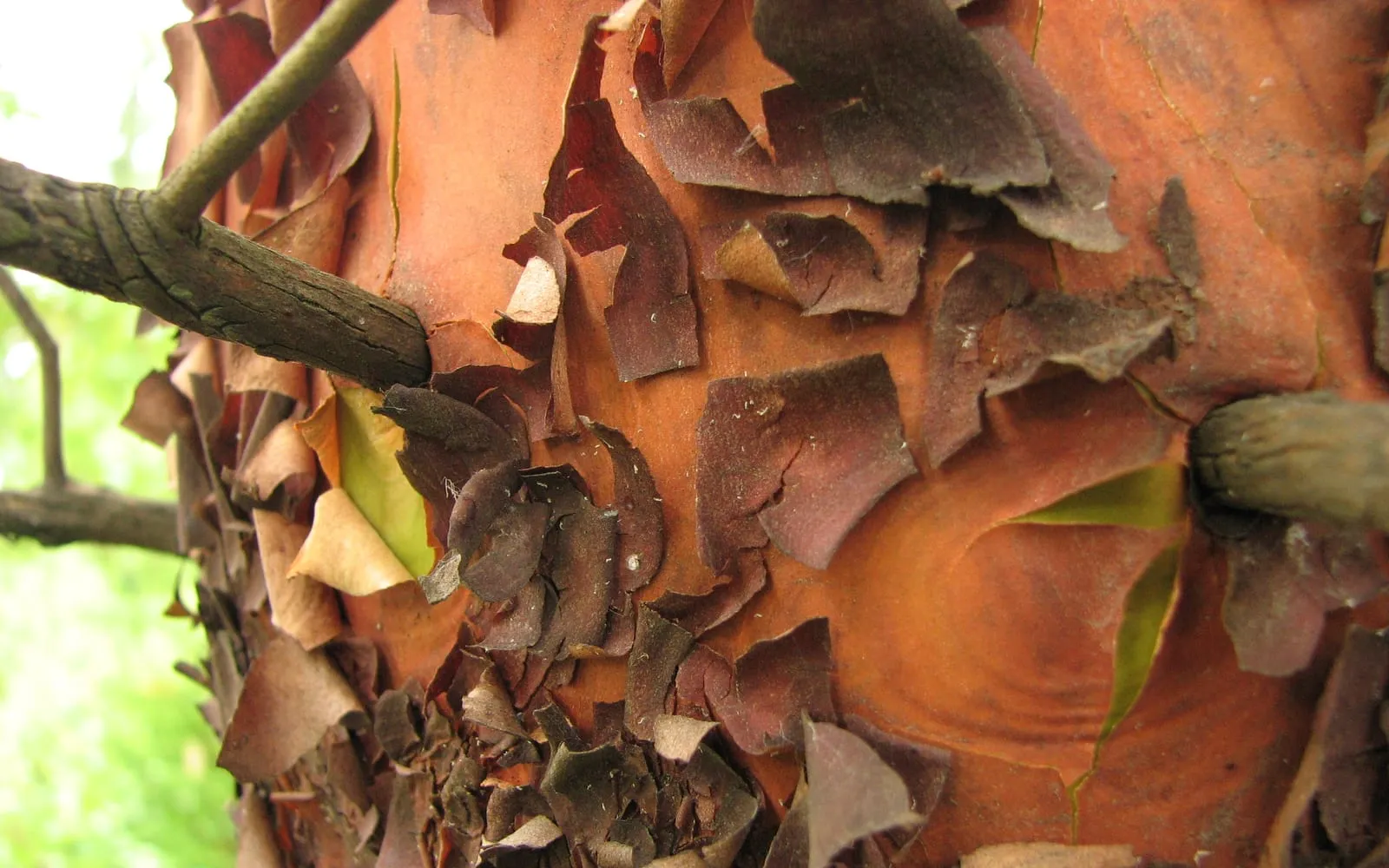
Pacific madrone announces itself through bark before anything else. Smooth, cinnamon-red to terracotta bark peels away in thin, curling sheets through summer, exposing a pale green-grey new layer underneath that darkens and peels again in its turn, so a mature trunk carries several colours at once and never settles into one fixed texture the way most bark does.
It is a difficult tree to bring into cultivation deliberately, so know that before planting one rather than after. Wild seedlings that germinate on their own, on a lean, undisturbed bank, often outperform a nursery-grown specimen planted into prepared garden soil and watered through summer, because the tree’s roots depend on a fungal partnership and a dry season that ordinary garden care disrupts rather than supports.
Where it succeeds, the reward is a sculptural evergreen, often leaning or forking low into several trunks, holding leathery dark green leaves through winter and carrying small white flowers and, later, bright orange-red berries that draw birds from a considerable distance.
Appearance and character
Bark is the tree’s signature. Smooth cinnamon to reddish-orange on younger branches and the upper trunk, curling away in thin papery sheets through the summer to reveal pale green-grey new bark underneath, while the lowest, oldest bark on a mature trunk thickens and roughens into grey-brown plates that no longer peel.
Leaves are broad, oval and leathery, glossy dark green above and paler beneath, 7 to 15 cm long, held on the tree through winter as befits a broadleaf evergreen, though older leaves shed steadily through the year rather than dropping all at once.
Flowers open in spring, small, white and urn-shaped, held in dense upright clusters at the branch tips, closely related in form to the flowers of other members of the heather family.
Berries ripen through autumn from green to bright orange-red, small, round and covered in a fine granular texture, hanging in clusters that strip quickly once local birds discover a fruiting tree.
Growth habit is rarely a single straight trunk. On an open or rocky site the tree commonly leans towards the light or forks low into two or three trunks, a habit shaped by the exposed, competitive ground it most often grows on in the wild.
Where it is from
Arbutus menziesii grows wild along the Pacific coast of North America, from southern British Columbia through Washington, Oregon and California, typically on dry, rocky slopes, coastal bluffs and mixed forest edges within reach of maritime influence rather than far inland.
That native range delivers a sharply seasonal climate, wet mild winters followed by a long, reliably dry summer, and the tree’s roots have adapted closely to it, forming a mycorrhizal partnership with particular soil fungi that support the tree best in the same lean, undisturbed, well-drained ground it evolved on. Moving that relationship into fertile, regularly irrigated garden soil is a large part of why the species has a stronger reputation for dying in cultivation than thriving in it.
Indigenous peoples across its range used the wood, the bark and the berries in various ways, and the tree remains a defining feature of Pacific coastal woodland, standing out through the reddish trunks that mark it apart from the conifers it usually grows among.
How it grows
Plant a young containerised tree, ideally as small as can be sourced, into lean, sharply drained, undisturbed soil in full sun, on a slope or a raised, rocky position rather than a flat, fertile border. Established garden soil, particularly anywhere that has been dug, fertilised or irrigated regularly, is a poor start for this species.
Water sparingly, if at all, even while young. A single season of light supplemental watering to help a newly planted tree root in is reasonable; ongoing summer watering, the instinct for almost every other newly planted tree, is one of the most common ways a Pacific madrone is killed in cultivation, since wet summer soil favours the root-rotting fungi the tree has no natural defence against.
Avoid disturbing the root zone once planted. Digging, cultivating or adding fresh organic mulch close to the trunk disrupts the fungal partnership the roots depend on and is generally best avoided in favour of leaving the ground beneath the tree alone.
Choose the planting site with unusual care, since this is a species that establishes far better from an undisturbed wild seedling or a very young transplant than from a larger nursery specimen moved into prepared soil, and transplanting an established tree essentially never succeeds.
Through the seasons
Spring brings clusters of small white urn-shaped flowers at the branch tips, opening as the previous year’s leaves continue their slow, steady replacement.
Summer is the tree’s natural dry season and the period when it should be left almost entirely alone, with the bark visibly peeling in curling sheets as the season progresses.
Autumn ripens the berries from green through to bright orange-red, drawing birds that typically strip a fruiting tree within days of the fruit colouring fully.
Winter brings the wet season the tree is naturally adapted to, and established roots take the rain without the summer risk that supplemental watering creates the rest of the year.
Care difficulty
Difficult, and unusually so for a tree this widely admired. The underlying biology, a fungal root partnership evolved for lean, undisturbed, summer-dry soil, works against almost every instinct a gardener brings to establishing a young tree.
Success generally comes from doing less rather than more. Choose a properly lean, dry, undisturbed site, water minimally even while establishing, and then leave the tree alone.
Watering
Water sparingly even in a young tree’s first summer, and stop altogether well before the tree reaches maturity. This runs against standard practice for most newly planted trees, but Pacific madrone’s roots decline rapidly in soil kept consistently moist through the warm season, and an established tree in a climate with a wet winter and dry summer needs no supplemental watering at all. Providing it anyway is one of the more reliable ways to trigger root rot.
Warning signs, diseases and pests
Phytophthora root rot is the leading cause of death in cultivated Pacific madrone, favoured directly by summer watering, poor drainage or soil disturbance around the root zone. Affected trees decline gradually, with thinning foliage and dieback in the crown, and there is no reliable cure once the fungus is established; prevention through minimal watering and undisturbed, sharply drained soil is the only real defence.
Leaf spot causes dark blotches to develop on the evergreen foliage in a wet or humid season, more cosmetic than seriously damaging on an otherwise healthy, well-sited tree.
Sunscald and frost cracks can affect the thin bark of a young tree or one newly exposed to direct sun after nearby vegetation is cleared, splitting the bark on the sun-facing side of the trunk. Leaving some surrounding shelter in place during establishment reduces the risk.
Scale insects occasionally settle on stems and leaf undersides, sapping the plant gradually rather than causing sudden decline. A light infestation on an otherwise healthy tree rarely needs treatment.
Growing environment
Full sun suits it best, matching the open, exposed slopes and coastal bluffs it grows on in the wild.
Lean, rocky, sharply drained soil is essential, and fertile, moisture-retentive garden soil, however good it sounds for most other trees, works against this species rather than for it.
Leave the ground beneath an established tree undisturbed rather than underplanting, digging or mulching close to the trunk, since the roots and their fungal partners are sensitive to disruption.
Feeding
None is needed, and fertiliser is actively counterproductive. Pacific madrone evolved on lean, mineral soil with very little available nutrition, and feeding it pushes soft growth while disrupting the fungal root partnership the tree depends on for normal nutrient uptake.
Skip fertiliser at planting time as well as afterwards. A young tree establishes better in very poor soil left alone than in ground that has been enriched to help it along.
Troubleshooting
Why did my newly planted tree die within a year or two? Almost certainly root rot from summer watering or from soil that was too rich or too wet. This species is one of the harder trees to establish deliberately precisely because ordinary good tree care, regular watering and fertile soil, works against its natural adaptation to a lean, dry summer.
The bark is peeling off in curling strips. Is my tree diseased? No, this is entirely normal and one of the species’ most attractive features. Smooth cinnamon-red bark sheds in thin papery sheets through summer, revealing pale green-grey new bark underneath.
Can I eat the berries? Yes, in modest amounts. They were eaten by Indigenous peoples across the tree’s range and remain an important food source for birds, though the flavour is dry and mealy rather than sweet, closer to the strawberry tree’s fruit than to a garden berry.
Is Pacific madrone the same as the strawberry tree in my garden centre? No. Strawberry tree, Arbutus unedo, is a related but different Mediterranean species, with rougher bark and flowers and fruit that appear together in autumn rather than months apart.
My tree is leaning or has split into several trunks instead of one. This is typical of the species rather than a fault, particularly on an open or rocky site where it commonly grows at an angle towards the light or forks low rather than developing a single straight trunk.