
Outdoor plant
Incense Cedar
Calocedrus decurrens
How to grow incense cedar, Calocedrus decurrens. Why it is not a true cedar at all, the tight columnar shape it holds for most of its life, and why its aromatic, decay-resistant timber became the standard wood for pencils.
At a glance
- Difficulty
- Easy
- Water
- Regularly for the first two or three years, then rarely
- Light
- Full sun to light shade
- Temperature
- Fully hardy once established
- Hardiness
- USDA 5-9, RHS H6, hardy to -25 C
- Type
- Evergreen conifer, long lived
- Height
- 25-40 m
- Native to
- western North America
Grows across a wide elevation range in its native mountains, from warm, dry lower slopes to cold, snowy higher ground, which is why it takes a properly cold winter without trouble once established. The zone number does not capture how well it also handles a hot, dry summer, since populations in its southern range experience little rain for months at a time. It is one of relatively few narrow, columnar conifers that tolerates real summer drought once its root system is established, rather than needing consistent moisture the way many upright conifers do.
Hardiness zones describe winter cold alone. Summer heat, humidity, rainfall and the length of the growing season decide as much, so treat the range as the outer limit rather than as a recommendation.
Not known to be toxic
Incense cedar is not listed by the RHS among potentially harmful garden plants and does not appear on the ASPCA's toxic plant index for cats, dogs or horses. No part of the living tree is a recognised poisoning hazard. Its aromatic, straight-grained wood, the source of the strong cedar scent that gives the tree its common name, has been used for pencils, cigar boxes and fence posts for well over a century precisely because it resists insects and decay so well, a property of the timber rather than a sign of any hazard from the standing tree. As with other aromatic conifers, concentrated cedarwood oil products are a separate substance from the living plant and should be kept away from cats specifically.
Sources: RHS potentially harmful garden plants, ASPCA toxic and non-toxic plants
About
Incense cedar is not a true cedar. Despite the common name, it belongs to the cypress family rather than to the true cedars of the genus Cedrus, and the two groups are identified quite differently: where a true cedar carries needles in whorled tufts, incense cedar carries flattened, scale-like sprays closer in look and feel to a Thuja or a false cypress, only larger and more strongly built.
Its outline is just as distinctive. Where most conifers broaden with age into a wide pyramid, incense cedar stays narrow and densely columnar for most of its life, a tall green spire that holds its shape far more consistently than almost any other large conifer, making it useful as a strong vertical accent in a landscape that would otherwise be dominated by broader, rounder trees.
The name comes from the wood itself, which releases a strong, sweet, resinous scent when cut, and that same straight-grained, decay-resistant timber has been the standard material for wooden pencils for well over a century.
Appearance and character
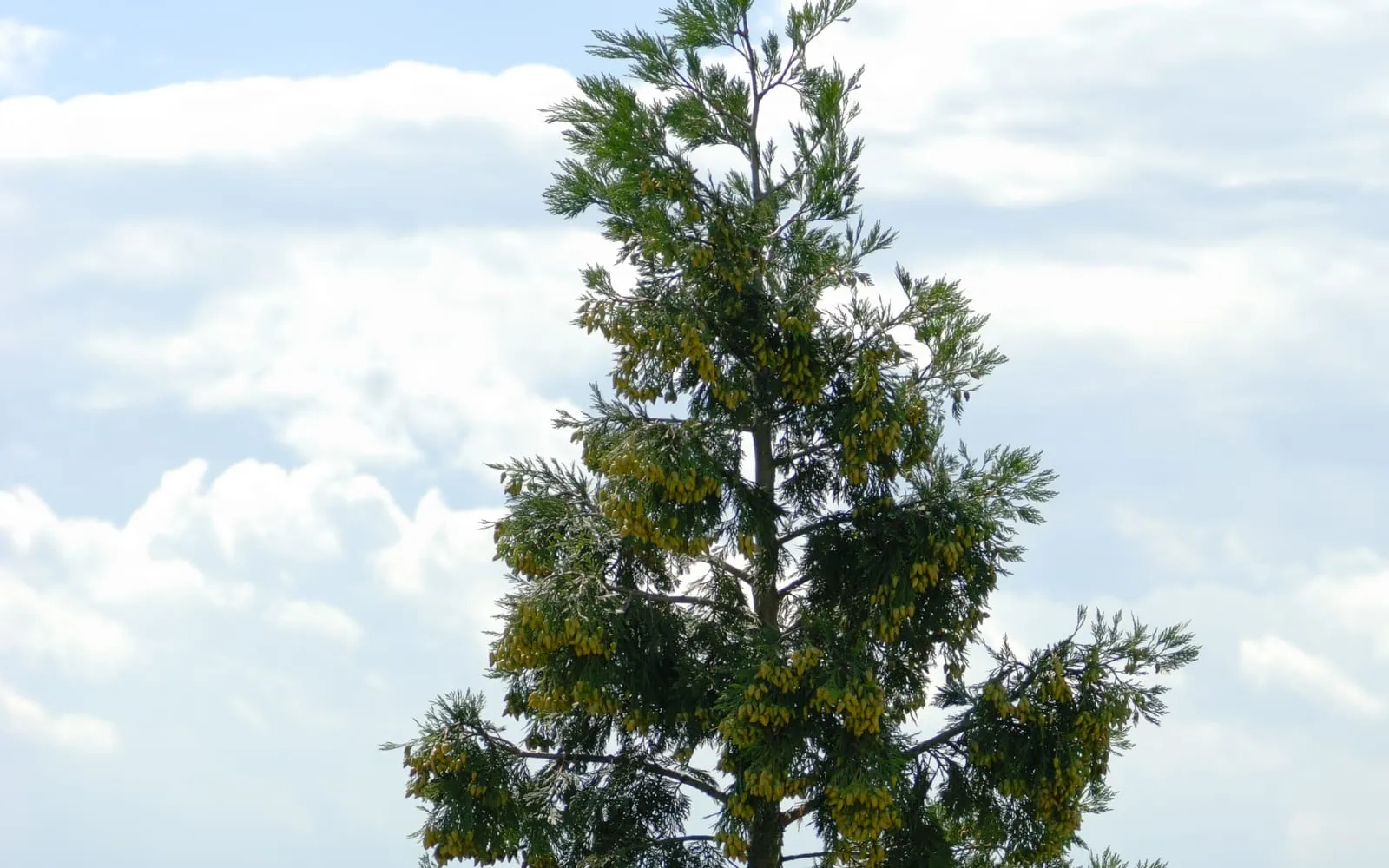
Foliage grows in flattened, fan-like sprays made of small, tightly overlapping scale leaves rather than individual needles, glossy dark green and strongly aromatic when crushed, releasing the resinous scent that gives the tree its name.
The habit is narrowly columnar, a tall, dense spire from a young age that broadens only slightly even on a mature tree several decades old, quite unlike the pyramidal outline most large conifers eventually adopt.
Cones are small, 2 to 3 cm long, an unusual elongated shape that opens into what looks almost like a duck’s bill or a pair of wings when mature, quite different from the barrel-shaped cones of a true cedar and one of the best ways to confirm the identification.
Bark on a young tree is smooth and grey-brown, developing a thick, fibrous, reddish-brown, deeply furrowed texture with age that peels in long vertical strips, a fire-adapted feature that protects the living tissue underneath from all but the most intense burns.
Where it is from
Calocedrus decurrens grows wild across the mountains of western North America, from central Oregon south through California’s Sierra Nevada and Coast Ranges into northern Baja California, typically between 300 and 2,700 metres in elevation, spanning a wide range of climates within that single native range.
That elevational spread explains the tree’s unusual combination of strong drought tolerance and real winter hardiness. Lower-elevation populations experience long, hot, essentially rainless summers, while higher populations take heavy mountain snow, and the species carries adaptations for both extremes rather than being narrowly specialised for one.
It grows naturally alongside giant sequoia, sugar pine and ponderosa pine across much of the Sierra Nevada, standing out from its conifer neighbours through its narrow columnar shape and thick, fire-resistant bark, and its durable, aromatic timber became a major regional industry once the pencil trade adopted it as the standard wood in the late nineteenth century.
How it grows
Plant in well-drained soil of almost any type, in full sun to light shade. Incense cedar tolerates poor, rocky or gravelly ground considerably better than rich, fertile soil, reflecting the lean mountain conditions much of its native range provides.
Water regularly through the first two or three growing seasons while the root system establishes, then reduce watering substantially. An established tree copes well with a hot, dry summer and needs little supplementary watering in most temperate climates.
Growth is moderate, faster than a true cedar of similar eventual size but still measured in decades rather than years to reach anything like full height, and the narrow columnar shape develops from a young age rather than needing to be trained or pruned into it.
Allow the tree its natural upright form rather than attempting to widen or round it through pruning. The tight, narrow spire is the species’ defining feature, and little routine pruning beyond removing dead or damaged wood is needed or beneficial.
Site it with its mature width in mind even though that width stays narrow relative to its height, since a mature specimen still reaches a considerable size and is best kept well clear of buildings and power lines given its eventual height.
Through the seasons
Spring brings a flush of fresh green growth at the tips of the foliage sprays, slightly paler than the older growth before it matures.
Summer tests the tree’s drought tolerance directly, and an established specimen in most native and cultivated ranges copes with a long dry season without difficulty.
Autumn ripens the current year’s small, distinctively shaped cones, which open and shed their seed through the season.
Winter is dormant and, for an established tree, entirely undemanding, taking heavy snow and hard frost without protection.
Care difficulty
Easy, and one of the more forgiving large conifers available once established. It tolerates a wide range of soil types, copes well with summer drought, and needs minimal pruning to maintain its naturally narrow, upright form.
The main demand is space rather than attention. A mature tree reaches a considerable height, and while its narrow shape suits a smaller footprint than many conifers of similar eventual size, it still needs planning for well in advance of planting a young tree that looks modest by comparison.
Watering
Water deeply and regularly through the first two or three growing seasons after planting, encouraging the root system to establish thoroughly before demands on it increase.
Once established, incense cedar tolerates a properly dry summer well, reflecting the long rainless season much of its native range experiences, and needs little to no supplementary watering in an ordinary temperate climate with reasonable annual rainfall.
Good drainage matters more than watering frequency. Heavy, waterlogged ground causes far more problems for this species than dry soil does.
Warning signs, diseases and pests
Scale insects occasionally settle on the foliage sprays and stems, sapping the plant’s vigour gradually rather than causing a fast decline. A horticultural oil treatment on accessible growth usually controls a light infestation.
Honey fungus can attack a stressed or waterlogged tree, showing as gradual dieback in the crown and, eventually, white fungal sheets visible under the bark near the base. There is no reliable cure once it takes hold.
Bracket fungi and wood decay enter through old wounds, storm damage or poorly made pruning cuts on a mature trunk, weakening the wood internally over years without always showing obvious external signs until decay is well advanced. Avoiding unnecessary damage to the bark reduces the entry points these fungi rely on.
Waterlogging is a more common cause of decline than any pest. Roots sitting in heavy winter wet rot regardless of how well the tree otherwise performs, and a poorly drained site should be improved or avoided before planting rather than managed afterwards.
Growing environment
Full sun to light shade both suit it, though the densest, most uniformly columnar growth develops in full sun.
Well-drained soil of almost any type works, including poor, rocky or gravelly ground that would leave many other large conifers struggling, and this tolerance for lean soil is one of the species’ most useful garden qualities.
A properly dry summer poses no problem for an established tree, setting it apart from many narrow, columnar conifers that need consistent moisture to hold their shape and colour.
Allow generous height clearance from overhead wires and, given the species’ considerable eventual height even within a narrow footprint, plan the planting distance from buildings with the mature size in mind rather than the young tree’s modest early stature.
Feeding
None is needed once established, and a mature tree in reasonable garden soil grows well without any routine fertiliser.
A light, general-purpose feed in spring can help a young tree establish more quickly on very poor soil, but an established specimen performs better without heavy feeding, which pushes soft growth at odds with the tree’s naturally tight, disciplined form. A yearly mulch of well-rotted organic matter around the root zone supports a young tree’s establishment better than repeated fertiliser.
Troubleshooting
Is incense cedar a true cedar? No, despite the common name. It belongs to the cypress family rather than the true cedars of the genus Cedrus, and its flattened, scale-like foliage sprays and small, distinctively shaped cones look quite different from a true cedar’s whorled needles and barrel-shaped cones.
Why does my tree smell so strongly when I prune it? That resinous, sweet scent is the source of the common name and comes from compounds in the wood and foliage. It is a normal and, for most people, pleasant characteristic rather than a sign of stress or disease.
My tree has stayed narrow and columnar for years. Is that normal? Yes, this is the species’ defining growth habit. Unlike most large conifers, which broaden into a wide pyramid with age, incense cedar stays densely columnar for most of its life, widening only modestly even once mature.
Can it cope with a hot, dry summer without watering? Yes, once established. It comes from a native range that includes long, hot, essentially rainless summers at lower elevations, and it tolerates drought considerably better than many conifers of similar size.
Is it safe to plant near where children play? Yes, it is not listed as harmful by the RHS or the ASPCA. Concentrated cedarwood oil products made from aromatic conifer timber are a separate substance from the living tree and should be kept away from cats specifically.