
Edible
Shiso
Perilla frutescens
Also known as Perilla, Beefsteak plant, Kkaennip, Zi su
How to grow shiso, Perilla frutescens. The green and red forms, the Korean sesame leaf, sowing it in warmth, and why it is poisonous to grazing cattle.
At a glance
- Difficulty
- Moderate
- Water
- Two or three times a week in summer
- Light
- Full sun to light shade
- Temperature
- Killed by frost. Plant out after the last one
- Hardiness
- USDA 9-11, RHS H2, hardy to 0 C
- Type
- Half-hardy annual
- Height
- 30-100 cm
- Native to
- eastern Asia
- Best month
- June and August in the Northern Hemisphere, December and February in the Southern Hemisphere
Flowering is short-day and triggered by nights drawing in, which is why a plant sown in spring stays leafy until late summer and then runs quickly to seed. Seed needs cold stratification and light to germinate. It self-seeds hard and is listed as an invasive species across the eastern United States, where it poisons cattle that graze it.
Hardiness zones describe winter cold alone. Summer heat, humidity, rainfall and the length of the growing season decide as much, so treat the range as the outer limit rather than as a recommendation.
Every month named in this guide is for the temperate Northern Hemisphere. If you garden in the Southern Hemisphere, shift each one by six months, so June becomes December. Closer to the equator the wet and dry seasons matter more than the calendar, and the shift stops being a useful guide.
Edible, with limits
- Safe to eat
- Leaves, flower spikes and seeds
- Do not eat
- Large quantities of the plant when grazed, particularly in seed
- Harm from
- Eating it
- Affects
- People and horses
Shiso is a food plant eaten daily across east Asia and it is safe in culinary use. The hazard it carries is agricultural and it is a real one. Perilla contains perilla ketone, and cattle and horses grazing large quantities of the plant, particularly when it is flowering and seeding, develop acute respiratory distress syndrome, which is often fatal. It is a recognised cause of livestock loss in the United States, where the plant has naturalised widely and is known as purple mint. The concern is a paddock rather than a kitchen garden, and the amounts involved are far beyond anything a person would eat. For people the plant is not on the RHS list of potentially harmful garden plants, and the ASPCA lists perilla mint as toxic to horses and cattle on exactly the grounds set out above.
Sources: ASPCA toxic and non-toxic plants, RHS potentially harmful garden plants
About
Shiso is one of the defining flavours of Japanese and Korean food and it is still uncommon in Western gardens. The green form is served with sashimi and tempura, and the red form colours and flavours umeboshi, the salted plums, which is what turns them that particular pink.
Korea grows a different variety of the same species and uses it differently. Kkaennip, sold as sesame leaf though it has nothing to do with sesame, is larger, flatter and rounder, and the leaves are eaten as wraps and pickled in soy.
It grows readily in a cool climate from a spring sowing, and the limits are warmth at the start and day length at the end. Shiso flowers as the days shorten, and once it does the leaf goes coarse, which sets the season at roughly June to September.
Appearance and character
An upright bushy annual, 30 cm to 1 m, branching from every pinched tip.
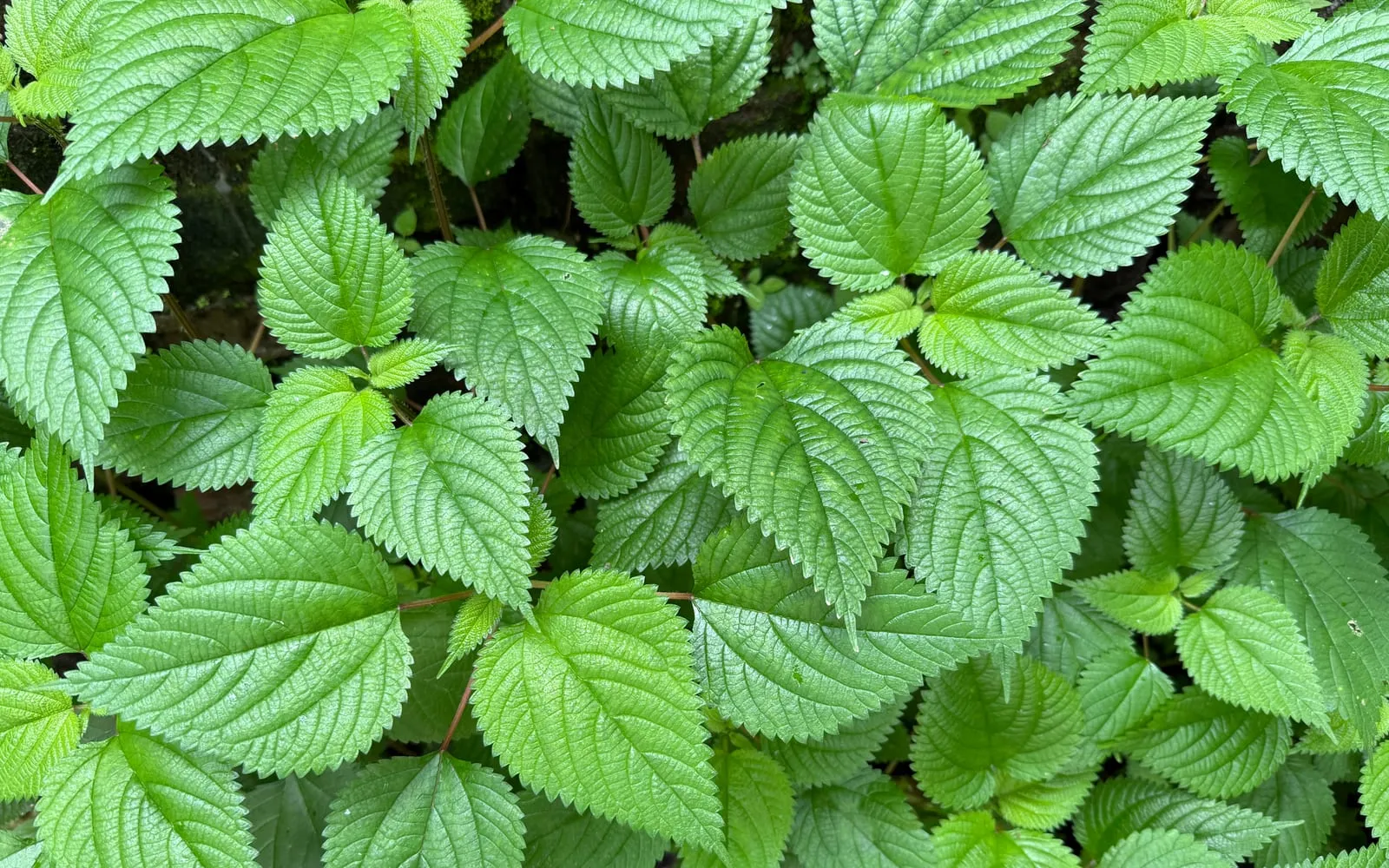
Leaves are broad, oval and pointed, 7 to 12 cm, deeply toothed and often puckered or frilled at the edge.
Colour splits the forms. Green shiso, aojiso, is fresh green on both sides. Red shiso, akajiso, is deep purple-red throughout and is the one used for umeboshi and for the drink shiso juice.
Flowers open in slender one-sided spikes from late summer, small and white or pink, and the immature spikes are eaten as a garnish under the name hojiso.
Stems are square and often purple-flushed.
The scent is distinctive and hard to compare to anything else, with notes of mint, cumin and cinnamon at once. Red shiso is stronger and more medicinal; green shiso is fresher.
Where it is from
Shiso is native to east and south-east Asia, from India through China to Japan and Korea, and it has been cultivated for well over a thousand years.
China grew it first and uses it as zi su, in cooking and in traditional medicine, particularly with fish and shellfish.
Japan developed the culinary distinction between green and red. Aojiso goes with raw fish, in tempura and shredded over rice; akajiso is used to colour and flavour umeboshi and to make a bright red summer drink.
Korea grows a different variety, Perilla frutescens var. frutescens, for its large leaves and for the oil pressed from its seed, which is a staple cooking oil there.
In North America it naturalised widely from ornamental plantings and became a weed, and it is best known there as purple mint and as a cause of cattle poisoning.
How it grows
Sow indoors from March or April at 20 deg C. Surface sow and press the seed in, since it needs light to germinate.
Germination takes one to three weeks and can be uneven. Fresh seed germinates better, and the seed does not keep well.
Prick out into small pots and grow on somewhere bright and frost free.
Plant out after the last frost, at the end of May, spacing at 30 cm, or grow in 20 cm pots.
Choose a position in sun or light shade with moisture-retentive soil. It wilts readily in dry ground.
Pinch the tips from 15 cm to make it branch and to delay flowering.
Pinch out flower spikes as they appear from August, unless you want the hojiso spikes as a garnish or seed for next year.
Harvest whole leaves from the top of the plant, taking the young ones, which are the tender ones.
Expect it to seed itself in a warm garden. Seedlings appear the following May.
Through the seasons
Winter there is nothing. It is killed by frost.
Spring is sowing, from March in warmth, and planting out at the end of May.
Early summer is establishment and the first picking. Pinch hard.
Midsummer is the main harvest, through July and August.
Late summer brings flowering as the days shorten. Pinch the spikes for leaf, or pick them as hojiso, or let some set seed.
Autumn ends it at the first frost. Collect seed before then if you want to sow your own, and expect self-sown seedlings next May.
Care difficulty
Moderate. Shiso grows well in a cool climate given a warm start and damp ground.
Germination is the first hurdle. The seed needs light and warmth, it germinates unevenly, and it does not store well, so buy fresh and sow plenty.
Day length ends the season. Shiso is a short-day plant and it flowers as the nights lengthen from August, after which the leaf goes coarse. Nothing prevents that, and pinching the spikes buys a few weeks.
Slugs find young plants quickly and will clear a newly planted row.
Dry soil makes it wilt and toughens the leaf. Keep it damp.
Beyond that it is straightforward, and in a warm garden it seeds itself and returns without any effort.
Watering
Keep the soil evenly damp. Shiso wilts readily and the leaf quality suffers when it dries out.
Water two or three times a week in summer, more for a pot.
Water in the morning at the base rather than over the leaves.
Mulch around plants in the ground to hold moisture, which reduces the watering considerably.
A container needs watering daily in July. Use a pot of at least 20 cm.
Reduce watering in September as growth slows.
Warning signs, diseases and pests
Slugs take young plants overnight and can destroy a planting. Protect them until established.
Aphids gather on the growing tips. Rub them off.
Whitefly builds up under glass. Use sticky traps and a biological control.
Damping off kills seedlings in cold wet compost. Sow into warm fresh compost.
Wilting in the middle of the day means dry soil. Water and mulch.
Flower spikes from August are the plant responding to shortening days. Pinch them for a few more weeks of leaf.
Coarse tough leaves mean the plant has flowered, or that it has been dry.
Seedlings the following spring mean it seeded. That is usually welcome.
Growing environment
Full sun to light shade. It takes more shade than most herbs and the leaf is softer for a little of it.
Moisture-retentive, fertile, free-draining soil with organic matter worked in.
pH from 5.5 to 7.5.
A vegetable bed, a large pot on a patio or a greenhouse border all suit it. In a greenhouse it grows larger and starts earlier.
Shelter helps. The large soft leaves tear in wind.
It is killed by frost, so the outdoor season runs from the end of May to the first cold night in October.
Feeding
Feed a container plant with a balanced liquid feed every three weeks through summer, since leaf is the crop and a pot runs out.
In good garden soil with compost worked in, no feeding is needed.
Avoid heavy nitrogen, which gives large soft leaves with less scent.
Mulch with compost in the ground rather than feeding, which holds moisture at the same time.
Refresh a container with fresh compost each year.
Troubleshooting
Green or red, which do I want? Green shiso for eating with raw fish, in tempura and shredded over rice. Red shiso for colouring and flavouring umeboshi and for shiso juice. They are used differently and are not interchangeable.
Is it the same as Korean sesame leaf? Same species, different variety. Korean kkaennip is Perilla frutescens var. frutescens, with larger flatter rounder leaves eaten as wraps. It has nothing to do with sesame despite the name.
It flowered in August and the leaves went tough. Shiso is a short-day plant and flowers as the nights lengthen. Pinch the spikes out for a few more weeks and accept the end of the season.
Nothing germinated. The seed needs light and warmth, it germinates unevenly, and it does not store well. Surface sow fresh seed at 20 deg C.
Slugs ate the young plants. They find it fast. Protect new plantings.
Is it dangerous to animals? To grazing cattle and horses, yes. Perilla ketone causes fatal respiratory disease in stock that graze large quantities, especially of flowering and seeding plants. It is not a risk in a kitchen garden.
It came up on its own the next year. Shiso self-seeds readily in a warm garden. Move the seedlings where you want them.
Shiso problem guides
Not sure what is wrong? See the common vegetable pests guide.