
Houseplant
Asparagus fern
Asparagus setaceus
Also known as Lace fern, Common asparagus fern, Asparagus plumosus
How to care for Asparagus setaceus. Light, watering, humidity, toxic berries, its false leaves and its weed risk in warm climates.
At a glance
- Difficulty
- Easy
- Water
- When the top third of the compost has dried
- Light
- Medium to bright indirect light, and it tolerates moderate shade
- Temperature
- 13-24 deg C, and never below 7 deg C
- Humidity
- Moderate. Dry air causes the needle drop it is known for
- Hardiness
- USDA 9-11, RHS H2, hardy to -2 C
- Type
- Evergreen perennial climber growing from a tuberous root system
- Height
- 1-3 m climbing
- Native to
- Southern and eastern Africa
Forest margins and scrub in southern and eastern Africa, in a subtropical climate with warm wet summers, mild dry winters and no hard frost. That seasonally dry origin is why the plant stores water and starch in swollen tuberous roots and survives long neglect. Established plants take a brief -2 deg C, though growth stops well above that. It has escaped and become an environmental weed in Australia, New Zealand, Hawaii, Florida and parts of southern Africa outside its native range.
Hardiness zones describe winter cold alone. Summer heat, humidity, rainfall and the length of the growing season decide as much, so treat the range as the outer limit rather than as a recommendation.
Toxic if eaten
- Do not eat
- The berries most of all, and the sap
- Harm from
- Eating it and handling it
- Affects
- People, cats and dogs
The ASPCA lists Asparagus setaceus as toxic to cats and dogs. The red berries produced by mature plants contain sapogenins and cause vomiting, diarrhoea and abdominal pain if eaten, and they are the most likely part to be swallowed because they are bright and at reachable height on a trailing plant. Repeated contact with the sap causes allergic contact dermatitis in some people, which is well documented among florists who handle the foliage in quantity, so wear gloves when cutting it back. The plant also carries small sharp backward-hooked thorns on older stems that scratch readily. Despite the name it is not related to a fern, and although it sits in the same genus as edible asparagus, this species is not food.
Sources: ASPCA (Asparagus Fern, Asparagus setaceus), RHS potentially harmful garden plants
About
The asparagus fern is not a fern, has no leaves, and is a close relative of the asparagus you eat. Each of those facts changes how the plant is grown.
It is not a fern, so it flowers, sets seed and grows from a tuberous root system rather than a rhizome, and it will not be treated like the ferns it is sold beside. It has no leaves, and what looks like fine feathery foliage is a mass of flattened green stems called cladodes doing the work of leaves. And the swollen tubers on its roots store water and starch, which is why a plant survives being forgotten and why it can burst a plastic pot.
There is one more thing it does that surprises people. The soft feathery plant sold in a shop is juvenile growth. Left alone it becomes a wiry climber several metres long, armed with small backward-hooked thorns, and that adult form is what has made it an invasive weed across several continents.
Appearance and character
An evergreen perennial growing from fleshy tuberous roots, producing arching then climbing stems.
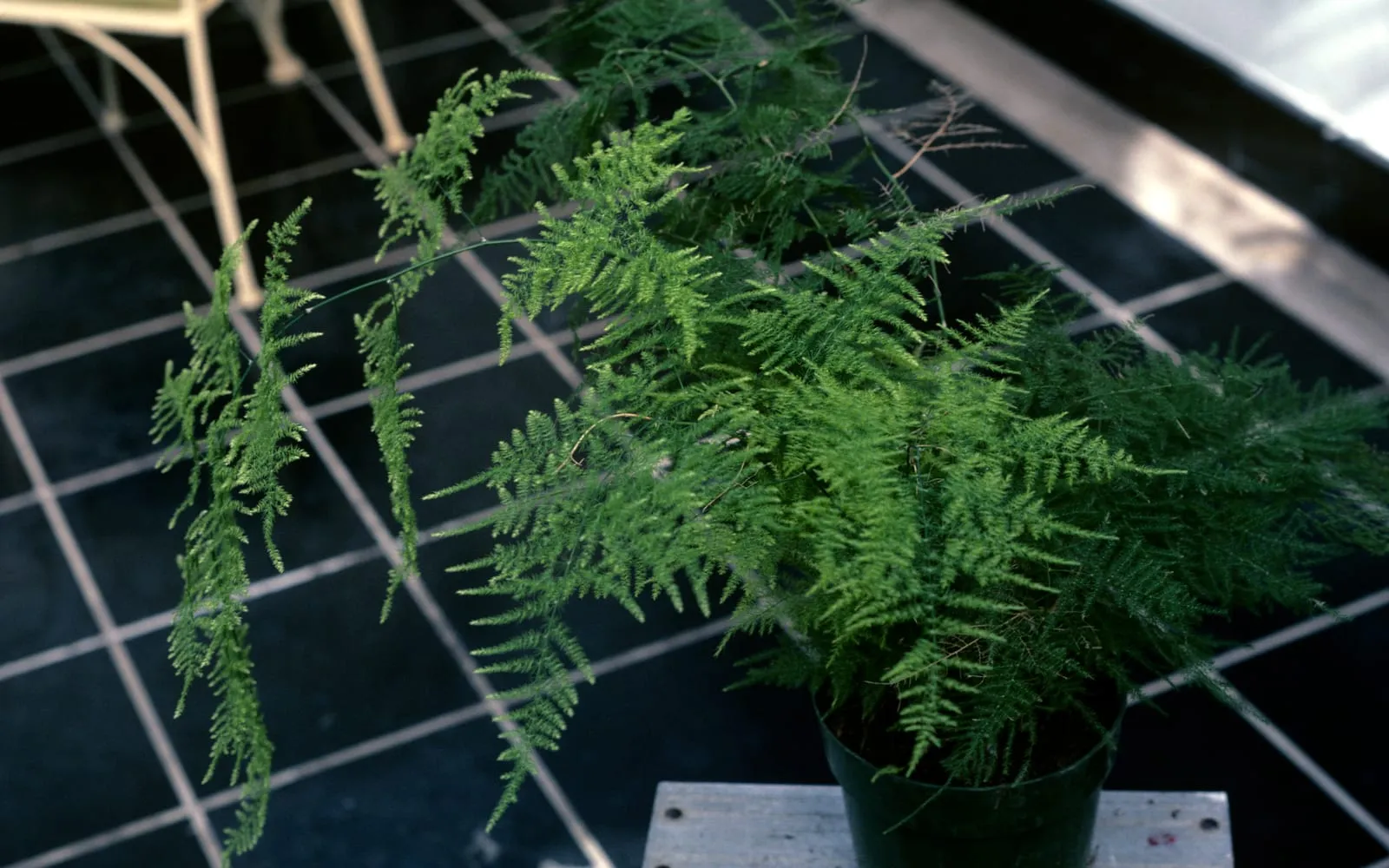
The feathery appearance comes from cladodes, needle-fine flattened stems 4 to 6 mm long, borne in dense clusters along the branches and arranged in flat sprays. True leaves are reduced to tiny brown scales and are easily overlooked.
Young growth is soft, bright green and arching, and this is the state in which the plant is sold.
Older stems lengthen into wiry climbers with small sharp thorns curving backwards, which catch on skin and clothing and are the reason a mature plant is unpleasant to handle.
Small white flowers appear on established plants, followed by round berries that ripen from green to bright red.
Growth is fast in warmth, and a plant fills a hanging basket in a season and then starts sending out climbing shoots.
‘Pyramidalis’ is a stiffer upright form. Asparagus densiflorus, the foxtail and sprengeri ferns, are the other species commonly grown and are coarser in texture.
Where it is from
Southern and eastern Africa, growing at forest margins and in scrub and bushland in a subtropical climate.
The seasonal dry period in that climate explains the tuberous roots. A plant that stores water and starch underground survives a dry season and, indoors, survives a fortnight of neglect that would kill a true fern.
The climbing adult form is an adaptation to scrambling up through scrub towards light, and the backward-hooked thorns are what let it hold on as it climbs.
It has escaped cultivation and become a serious environmental weed in eastern Australia, New Zealand, Hawaii, Florida and elsewhere. Birds eat the berries and spread the seed, the tubers make it very hard to remove once established, and it smothers native ground layer vegetation. Several jurisdictions restrict its sale.
The genus Asparagus contains around three hundred species, including the vegetable Asparagus officinalis.
How it grows
Give it medium to bright indirect light. It tolerates moderate shade at the cost of density.
Keep it out of harsh direct sun, which yellows and scorches the cladodes.
Water when the top third of the compost has dried, thoroughly, and drain completely.
Keep the humidity moderate. Dry heated air causes the needle drop this plant is known for, dropping cladodes in quantity and leaving bare stems.
Keep it above 7 deg C and ideally between 13 and 24 deg C. It tolerates cooler conditions than most tropical houseplants.
Feed monthly at half strength through the growing season.
Cut old, yellowing or over-long stems out at the base rather than trimming them, since a cut stem does not regrow from the wound.
Repot every year or two in spring. The tubers swell and can crack a rigid pot, so check before the pot distorts.
Divide the root mass in spring to propagate, cutting through the tubers with a knife and expecting the divisions to sulk for a season.
Wear gloves when handling older growth, because of the thorns and the sap.
Through the seasons
Spring brings the main flush of new shoots from the base. Resume feeding, and repot or divide now before the growth gets going.
Summer is fast growth. Water when the top third dries, feed monthly, and cut out any climbing shoots you do not want.
Autumn slows it. Reduce watering and stop feeding from October.
Winter brings the worst needle drop, as heating dries the air. Keep the plant away from radiators, maintain some humidity, and water sparingly.
Care difficulty
Easy, and more tolerant of neglect than any true fern.
Needle drop is the defining complaint. Dry air, a move, a draught or a dry root ball all cause the plant to shed cladodes in quantity, leaving bare wiry stems that do not refoliate.
Thorns make an established plant unpleasant to prune without gloves.
Tuberous roots outgrow pots quickly and can crack them.
Invasiveness is a real consideration rather than a footnote. Do not plant it out or compost the trimmings in Australia, New Zealand, Hawaii, Florida or similar climates.
Watering
Water when the top third of the compost has dried, roughly weekly in summer and every two to three weeks in winter.
Water thoroughly until it drains, then empty the saucer.
The tubers buffer the plant against drought, so it tolerates a missed watering far better than a fern would.
Reduce watering in winter, when growth stops and the compost stays wet longer.
Underwatering shows as yellowing and heavy needle drop, and the bare stems will not recover.
Overwatering shows as yellowing from the base, soft tubers and a sour compost smell.
Warning signs, diseases and pests
Needle drop leaving bare wiry stems is the standard problem, caused by dry air, a dry root ball, a draught or a change of position. Cut the bare stems out at the base, since they will not refoliate.
Yellowing of the whole plant is usually overwatering or a root system that has outgrown its pot.
Fine pale stippling with webbing is red spider mite, which thrives in the warm dry air that also causes needle drop.
Small brown discs on the wiry stems are scale insects.
Long thorned shoots climbing away from the plant are the adult growth phase. Cut them out if you want the soft juvenile look.
Red berries on a mature plant are viable seed. Remove them where the plant might escape into a mild garden.
A pot bulging or cracking is the tubers, which need repotting rather than treatment.
Growing environment
Medium to bright indirect light, tolerating moderate shade.
Never harsh direct sun.
Cool to average, 13 to 24 deg C, with 7 deg C as the floor.
Moderate humidity, and dry heated air is the main cause of needle drop.
Free-draining peat-free houseplant compost in a sturdy pot with drainage holes.
A hanging basket or a raised position suits the arching juvenile growth.
Outdoors only where it is not invasive, in shade in USDA 9 and warmer. Check local restrictions first, since sale and planting are controlled in several regions.
Avoid radiators, dry heated rooms and rigid pots that the tubers can crack.
Feeding
Feed monthly from spring to early autumn with a balanced liquid houseplant fertiliser at half strength.
Stop feeding from mid-autumn to early spring.
Repot every year or two in spring, since the tuberous roots fill a pot quickly.
Divide in spring rather than trying to reduce a large root mass in place.
Flush the compost occasionally with plain water to clear accumulated salts.
Troubleshooting
It is dropping needles everywhere. Dry air, a dry root ball, a draught or a recent move. The bare stems will not refoliate, so cut them out at the base, raise the humidity and keep the watering steady.
Is it a fern? No. It has no spores, it flowers and sets berries, and it grows from tuberous roots. It is in the same genus as edible asparagus.
Where are its leaves? It has none to speak of. The feathery green is made of flattened stems called cladodes, and the true leaves are tiny brown scales.
It has grown long thorny stems. That is the adult climbing form. Cut them out at the base if you want the soft juvenile foliage.
Is it safe with pets? No. The ASPCA lists it as toxic to cats and dogs, and the red berries cause vomiting and diarrhoea. The sap also causes dermatitis in some people.
The pot has cracked. The tubers swell and are strong enough to split a rigid pot. Repot into something larger, or divide the root mass.
Can I plant it in the garden? Only where it is not a weed. It is invasive in eastern Australia, New Zealand, Hawaii and Florida among others, spread by birds eating the berries, and sale is restricted in several places.
Are the red berries edible? No. They contain sapogenins and cause stomach upset. Despite the genus, this species is not food.
Asparagus fern problem guides
Not sure what is wrong? See the common houseplant pests guide.