
Outdoor plant
Asian Ginseng
Panax ginseng
Also known as Korean ginseng, Chinese ginseng, Ren shen
How to grow Panax ginseng, the ginseng of Korea and north-east China. The six-year wait for a root, why the seed takes eighteen months to germinate, and how deep the shade has to be.
At a glance
- Difficulty
- Difficult
- Water
- Rarely, once the bed holds moisture
- Light
- Deep shade, around a fifth of full daylight
- Temperature
- Fully hardy, and it needs a cold winter to break dormancy
- Hardiness
- USDA 3-7, RHS H7, hardy to -30 C
- Type
- Long-lived herbaceous perennial from a fleshy root
- Height
- 30-60 cm
- Native to
- the mountain forests of north-east China, the Korean peninsula, the Russian Far East
Effectively extinct in the wild, so every root in trade comes from cultivation, and the plant needs the same deep shade, cold winter and six years of patience as its American relative. Seed needs stratification through a full winter. Replant disease is severe enough that a bed is used once and then rested for a decade.
Hardiness zones describe winter cold alone. Summer heat, humidity, rainfall and the length of the growing season decide as much, so treat the range as the outer limit rather than as a recommendation.
Harmful if eaten
- Do not eat
- The red berries, which are not eaten
- Harm from
- Eating it
- Affects
- People
Ginseng root is a food and a food supplement rather than a poison, and it has been eaten and brewed in Korea and China for two thousand years. The European Medicines Agency maintains a herbal monograph on ginseng radix, which is the dried root of Panax ginseng, and that monograph is the best short reference for what the plant is and how it is regulated in Europe. The plant does not appear on the RHS list of potentially harmful garden plants, and the ASPCA does not list it among plants toxic to dogs, cats or horses. Two cautions rather than warnings. The red berries are not the part anyone uses and children should be told to leave them, since ginsenosides are concentrated in the seed and the fruit flesh has no history of being eaten. And ginseng interacts with prescribed medicines, warfarin among them, so anyone taking a course of it alongside medication should tell their GP. The NHS page on herbal medicines sets out why that matters more with herbal products than people expect.
Sources: European Medicines Agency herbal monograph, ginseng radix, LiverTox, Ginseng, NHS on herbal medicines, RHS potentially harmful garden plants, ASPCA toxic and non-toxic plants
About
A ginseng root sells for what it does because the plant takes six years to make one. Panax ginseng is a woodland perennial that grows a few centimetres a year, puts up one stem each spring, and spends everything it earns on a fleshy root that thickens slowly underground. Dig it at four years and you have something worth a few pounds. Leave it until six and the root is worth several times that.
Wild ginseng from the mountains of Jilin and the Russian Far East is a different economic object again. A large wild root, aged by counting the scars left on its neck by each year’s stem, has sold at auction for figures that would buy a house, and the trade has left the species close to extirpated across most of its original range. What keeps ginseng common is the cultivated crop, grown under shade cloth in Korea and north-east China on a six-year cycle.
The plant is growable in a cool climate in a shaded woodland bed, and a handful of people do it. Nobody does it for money. Six years of slug patrol for a root you could buy dried is a project for someone who wants the plant rather than the harvest, and that is the honest way to approach it.
Appearance and character
A ginseng plant announces its age. A first-year seedling carries three leaflets on one stalk. A second-year plant carries five. From the third year it produces a whorl of two, then three, then four compound leaves at the top of a single stem, each with five leaflets arranged like the fingers of a hand. Growers count prongs, and a four-prong plant is a mature one.
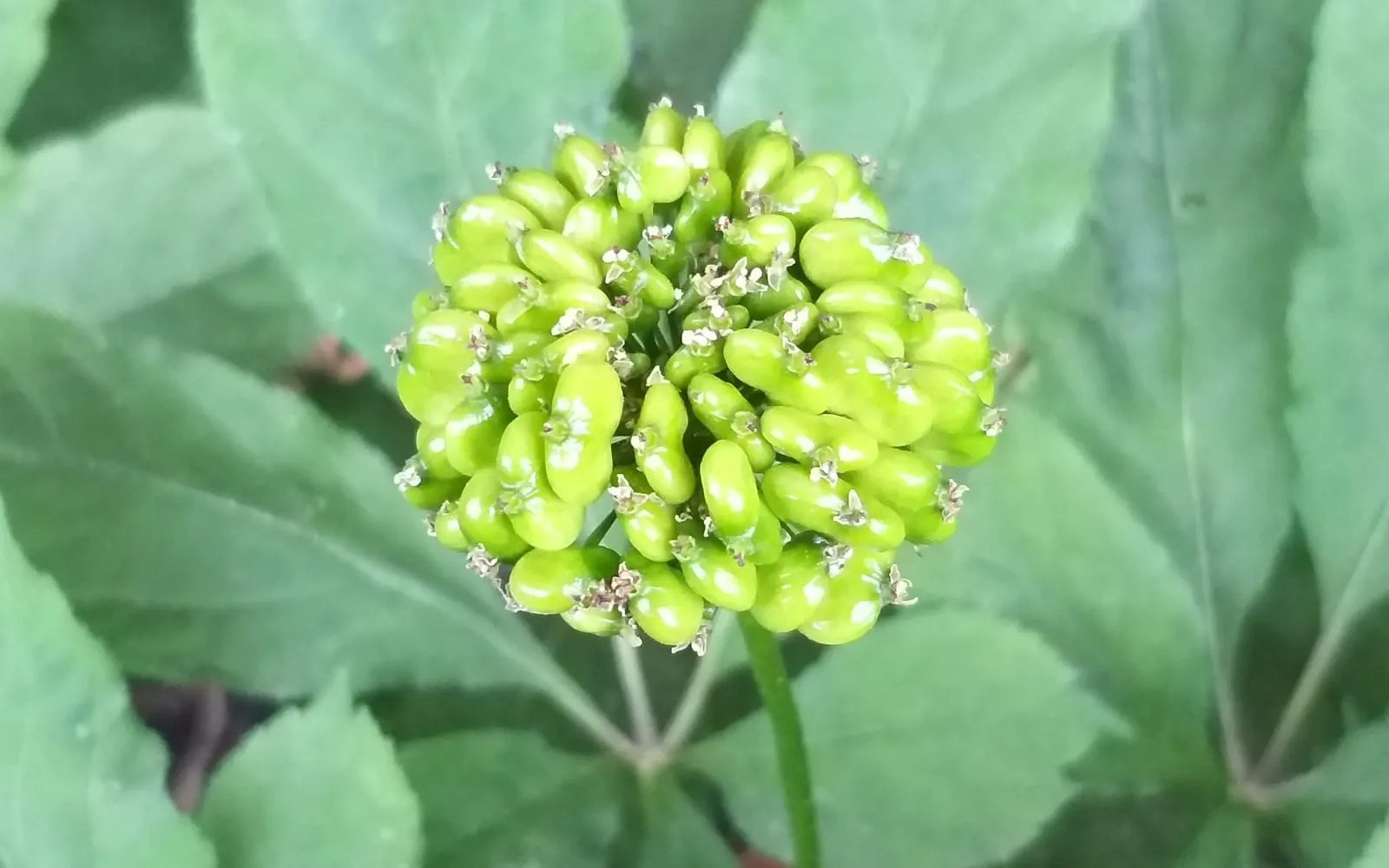
The flowers sit on a single stalk rising from the centre of the whorl, in a tight umbel of twenty or thirty greenish-white flowers so small that most people walking past a bed in June see nothing. What they see in September is the berries, a cluster of flattened scarlet fruits held above the leaves, each holding two seeds.
The root is the reason for the plant’s Chinese name, ren shen, meaning man root. A well-grown root has a thickened main body, two forked legs and a neck carrying the scars of past stems, and the resemblance to a human figure is close enough that it drove the plant’s reputation for centuries. Roots that fork well fetch more than roots that do not.
Where it is from
The native range runs through the mixed broadleaf and Korean pine forests of north-east China, the Korean peninsula and the Primorye region of the Russian Far East. These are cold-winter, humid-summer forests with deep leaf litter, and ginseng grows on shaded slopes among maple and lime rather than under conifers.
Wild populations are now scarce everywhere. The species is assessed as endangered in the wild, protected in China and Russia, and the wild digging that caused the decline continues wherever a root is worth more than a month’s wages. Korea, which no longer has meaningful wild populations, produces most of the world’s cultivated root.
Cultivation is old. Korean records describe deliberate planting from the sixteenth century, and the modern industry in Geumsan and Punggi runs on beds under raised shade structures, rotated onto fresh land because ginseng cannot follow ginseng on the same ground for many years.
How it grows
Everything happens slowly and in one short burst. The stem emerges in April, expands its leaves over three weeks, holds them through the summer, and dies back in September. The root grows through that window and then sits dormant through a long cold winter, which it requires: without several months below 5 deg C the bud does not break the following spring.
Seed is the slow part. A fresh ginseng seed has an immature embryo and needs a warm period followed by a cold one before it will germinate, which in practice means eighteen to twenty-two months from the berry to the seedling. Growers stratify seed in damp sand in a buried box for a year, then sow it, then wait for the following spring.
The root grows in a spiral, contracting each year to pull itself deeper into the soil. That habit is why a mature plant sits several centimetres lower than the seed was sown, and why lifting a six-year root without damaging it takes a fork and patience.
Through the seasons
Sow stratified seed in autumn, 2 cm deep in a shaded bed, and mulch with leaf mould. Nothing appears until the spring after next in most cases, so mark the bed clearly and resist the urge to dig it over.
Growth runs April to September. There is no pruning, no staking and no training to do. The whole of the gardening year is keeping slugs off the single stem, keeping the bed weeded by hand, and topping up the leaf mould.
Berries ripen scarlet in September. Collect them if you want more plants, rub off the flesh at once and start the stratification, since the seed must not dry out. Leave the roots undisturbed for at least five years, and lift in autumn after the top has died down.
Care difficulty
This is the hardest plant in the collection to bring to a harvest, and the difficulty is time rather than technique. Nothing about the growing is complicated. Everything about it is slow, and a single mistake in year five costs five years.
Slugs, drainage and impatience are what end an attempt in a cool climate. One stem per plant means a single slug can remove a whole year. Waterlogging in a wet winter rots roots that have survived every summer since they germinated, and people dig to see how it is doing, which sets the plant back each time.
Buying two- or three-year-old roots instead of seed cuts the wait and costs more. It is the sensible route for anyone who wants a plant in the ground rather than a decade-long propagation exercise.
Watering
A woodland bed with deep leaf mould holds enough moisture in most cool summers to need no watering at all. The plant wants soil that stays evenly damp, never wet, and never bone dry in July.
Water in a genuine drought, at the base, in the evening, enough to wet the top 15 cm. Overhead watering on a still warm evening invites Alternaria and botrytis onto the leaves, and a defoliated plant stops making root for that year.
Ginseng dies in ground that holds winter water, so a raised bed or a slope is worth more to the plant than any watering regime.
Warning signs, diseases and pests
Slugs are the first and worst problem. A single stem carries the whole plant’s photosynthesis, so losing it in May means losing the year. Beer traps, a night patrol in wet weather and a barrier of sharp grit are all worth doing before the stem emerges.
Fungal leaf diseases arrive in wet summers. Alternaria panax shows as brown spots with yellow haloes that run together and take the leaflets off, and botrytis appears as grey fuzz on damaged tissue. Air movement and space between plants prevent both better than anything sprayed.
Below ground the risks are root rot in wet soil and rodents in winter. Voles will work along a row of roots under snow or mulch. Growers in Korea rotate onto fresh land every cycle, since the soil-borne fungi that cause replant failure build up under a ginseng crop and stay for years.
Growing environment
Deep shade, of the sort found under a deciduous canopy in high summer. Around 20 to 25 per cent of full daylight is the target, which is deeper shade than most gardeners think when they say shade. Full sun scorches the leaves within a week.
The soil should be a woodland soil, leafy and crumbly and acid to neutral at pH 5.5 to 6.5. It has to be deep enough for a root to run 20 cm down and it has to drain freely. Heavy clay needs a raised bed rather than an amendment.
Cold winters are a requirement rather than a hazard. The plant needs a sustained period below 5 deg C to break dormancy, so it does better in a cold upland garden than in a mild coastal one.
Feeding
Leaf mould, and nothing else. Ginseng evolved in soil fed by falling leaves, and a fresh 5 cm layer each autumn supplies what the plant needs while protecting the crown through winter.
Manufactured fertiliser does more harm than good. Nitrogen produces soft growth that fungal disease finds easy, and salts damage the fine roots. Growers who feed a ginseng bed usually do it once.
If the bed is on poor sandy ground, work in composted bark or leaf mould before planting rather than feeding afterwards. Get the soil right at the start, because there is no opportunity to correct it for the next six years.
Troubleshooting
How long until I can harvest a root? Five years at the earliest and six for a root worth the wait, counting from the seedling rather than from sowing the seed. Sowing seed adds another eighteen months to that.
Why has my seed not germinated? Because it is probably still working. Fresh ginseng seed has an underdeveloped embryo and needs a warm period then a cold one, which takes eighteen to twenty-two months. Seed that has dried out at any point will never germinate.
Can I grow it in a pot? For the first two or three years, yes, in a deep pot in shade. After that the root wants depth and a cool root run that a container cannot hold through a summer.
How much shade does it need? More than you think. Aim for a fifth to a quarter of full daylight, which is what a beech or lime canopy gives in July. Plants in half shade scorch at the leaf margins and stop growing.
Is it the same plant as American ginseng? No. Panax quinquefolius is a separate species from eastern North America with a different chemistry and a different reputation in Chinese medicine, where it is treated as cooling rather than warming. Siberian ginseng is not a Panax at all.
Is wild ginseng legal to buy? Trade is controlled. The species is protected in China and Russia and international commerce is regulated, so a wild root without documentation is a legal problem as well as a conservation one. Cultivated root carries neither.
My plant has come up with fewer leaves than last year. That happens after a hard year. Defoliation, drought or root damage all make a plant return smaller the following spring, and it can recover over two or three seasons if the root is sound.