
Outdoor plant
Water Forget-Me-Not
Myosotis scorpioides
Also known as True forget-me-not, Marsh scorpion grass
How to grow water forget-me-not, Myosotis scorpioides, a sky-blue-flowered true aquatic for the margin of a pond or slow stream.
At a glance
- Difficulty
- Easy
- Water
- Permanently wet margin, shallow water, or moist soil
- Light
- Full sun to light shade
- Hardiness
- USDA 3-9, RHS H6, hardy to -20 C
- Type
- Hardy marginal perennial
- Height
- 15-30 cm, spreading indefinitely along the margin
- Native to
- Europe, Western Asia, North Africa
Fully hardy across the cool and cold temperate world, tolerating both a hard winter and a summer that never gets particularly hot, provided the roots never dry out. Heat and drought trouble this plant far more than cold does, and a hot, dry summer will check its growth long before a cold winter causes it any harm.
Hardiness zones describe winter cold alone. Summer heat, humidity, rainfall and the length of the growing season decide as much, so treat the range as the outer limit rather than as a recommendation.
Not known to be toxic
Water forget-me-not carries no toxicity listing from the RHS and is not considered a poisonous plant. Like many members of the borage family, it contains trace amounts of pyrrolizidine alkaloids, the compounds that make comfrey unsuitable for regular internal use in quantity, but the levels here are low and there is no record of it causing harm to people, pets or wildlife at a pond edge.
Source: RHS
About
Water forget-me-not carries the same clear sky-blue flowers with a yellow eye as the woodland forget-me-not familiar from spring borders, but it is a distinct plant adapted to life at the water’s edge rather than a garden escape that happens to tolerate damp ground. Loose sprays of flowers open continuously from late spring well into autumn, longer than almost any other marginal on this list, threading through and softening the stiffer, more upright foliage of neighbouring pond plants.
It spreads readily along a wet margin, rooting from stems that trail across mud and shallow water, and is one of the easiest marginals to establish from a handful of small divisions or even self-sown seedlings that appear naturally along a damp edge.
Appearance and character
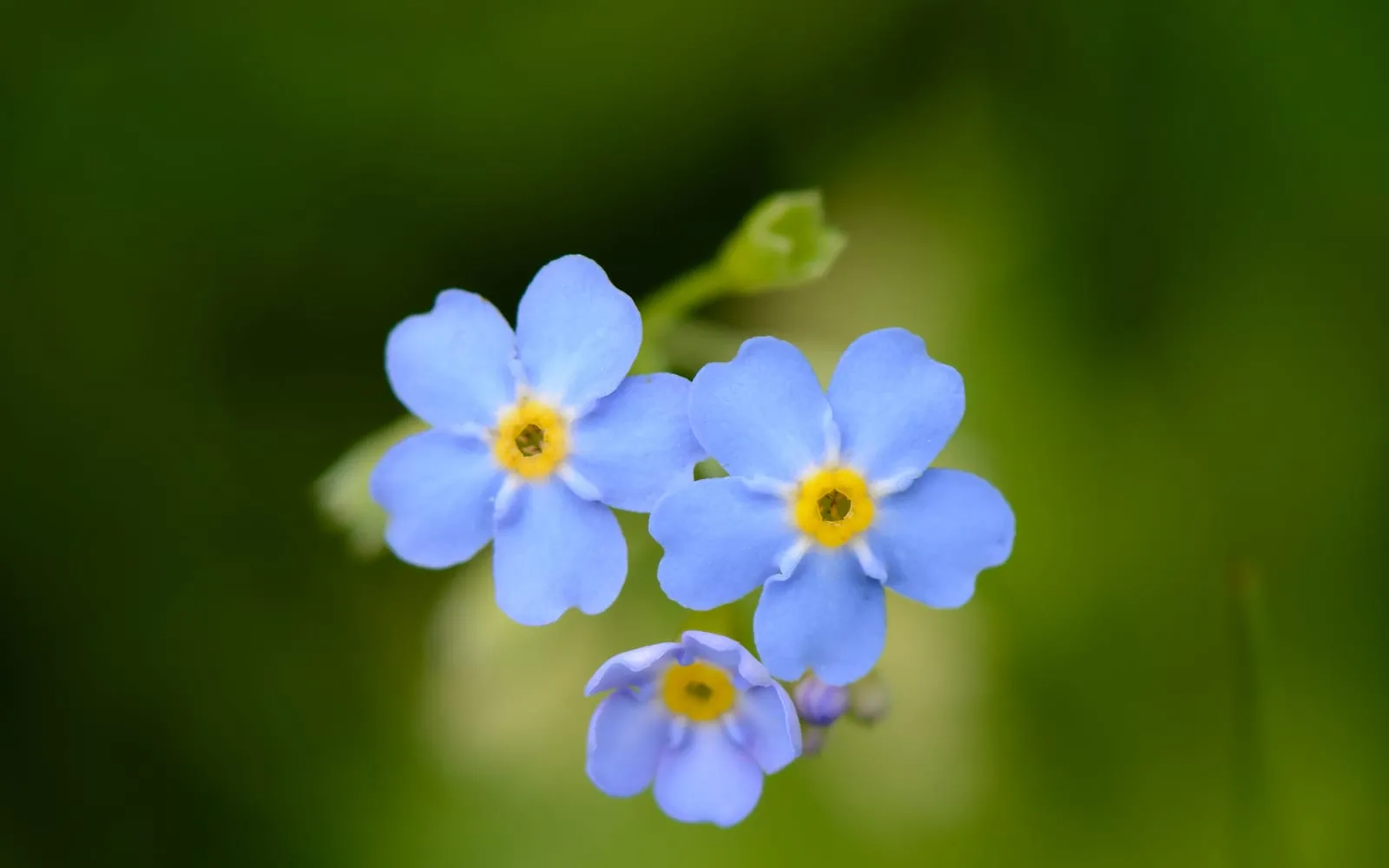
Leaves are narrow, mid-green and slightly hairy, carried on sprawling stems that root wherever a node touches wet mud, giving the plant its low, spreading habit rather than the upright clump form of most other marginals. Flowers open in loose, coiled sprays that famously uncurl as each bloom matures, a growth pattern shared across the wider forget-me-not family and the source of the species name scorpioides, from the Greek for scorpion, describing the way the young flower spike curls over at the tip like a raised tail before straightening out as the blooms open along its length, with five petals in a clear sky-blue around a small yellow centre.
Unlike the biennial woodland forget-me-not grown in borders, this is a true perennial that persists and spreads from the same rootstock year after year, and it flowers over a much longer season, often continuing in flushes from May through into early autumn where conditions stay consistently moist. The two are easy to confuse from a distance, since both carry near-identical sky-blue, yellow-eyed flowers, and the surest way to tell them apart without waiting for winter is habitat: one grows rooted in wet mud or shallow water, the other on ordinary dry border soil.
Where it is from
Water forget-me-not grows naturally across Europe, western Asia and North Africa, at the edges of ponds, ditches, slow streams and wet meadows. It is fully aquatic in a way the name alone does not make obvious, rooting directly in mud that is permanently wet or in shallow standing water rather than merely tolerating occasional dampness the way many so-called moisture-loving border plants do.
Its wide native range across such varied conditions is reflected in a tolerance for both full sun and light shade, and for water that ranges from nutrient-poor to fairly rich, provided it never dries out for any length of time during the growing season.
How it grows
Growth happens through trailing stems that root as they spread, each node capable of forming new roots and shoots where it makes contact with wet mud, letting a single small planting cover a metre or more of margin within two or three seasons. This creeping habit makes it an effective plant for knitting together the transition between open water and drier bank, softening the harder edges of pond liner or coping stones far more convincingly than an upright, clump-forming marginal can.
It also self-seeds readily where conditions suit it, and volunteer seedlings often appear along a damp margin without any deliberate planting, though established colonies spread mostly by rooting stems rather than relying on seed to fill in new ground.
Through the seasons
Spring growth resumes early, among the first marginals to put on fresh leaf, with the first flush of flowers often opening by late April or May.
Summer flowering continues in waves through the season, particularly where the margin stays consistently moist and does not bake dry in a hot spell.
Autumn flowering tapers off gradually rather than stopping abruptly, and stems continue to root and spread until growth slows with falling temperatures.
Winter the plant dies back to a low crown at the waterline, fully hardy through frost, and resumes growth again as soon as temperatures allow the following spring.
Care difficulty
Easy, and one of the more forgiving marginals for a new pond keeper to start with. It establishes quickly from small divisions, tolerates a range of light and water conditions, and needs no special winter protection anywhere within its hardiness range. The only real task is keeping its spread within bounds, since a happy planting will steadily colonise more of the margin than it was originally given.
Watering
Permanently wet ground or shallow water suits it best, and growth checks noticeably if the margin is allowed to dry out during summer, even for a short period. Plant directly into wet marginal mud, or into an aquatic basket with the crown covered by up to about 10 cm of water, positioned where roots can spread freely along the pond edge.
Warning signs, diseases and pests
Slugs and snails graze young leaves and stems, particularly on soft new growth in spring, though an established, spreading planting generally outgrows the damage without lasting harm. Aphids occasionally colonise new shoot tips in a sheltered spot and are usually kept in check by natural predators around a healthy pond.
A planting that flowers poorly or looks pale and thin most often points to the margin drying out at some point during the growing season rather than to disease, and consistent moisture is usually enough to restore normal growth the following year.
Growing environment
Full sun brings the longest flowering season, though light shade is well tolerated and can be an advantage in a hot, exposed spot where the margin is prone to drying quickly. Permanently moist to wet soil or shallow water matches its natural habitat closely, and it is not fussy about nutrient levels, growing about as well in a lean margin as in a rich, well-fed one.
Give it room to spread along the edge of the pond rather than confining it tightly, since its habit of rooting as it trails is most effective, and most attractive, where it can knit together several metres of margin rather than being restricted to a single small clump.
Feeding
An aquatic plant fertiliser tablet pushed into the basket helps a newly planted division establish, but an established, spreading planting usually needs little further feeding, drawing enough from ordinary pond conditions to keep flowering well. A weak feed in spring is worth considering only where growth looks noticeably poor for more than one season running.
Troubleshooting
Flowering has slowed or stopped despite healthy-looking leaves. Check whether the margin has dried out at any point recently. Consistent moisture through the growing season is usually all that is needed to restart flowering.
The plant has spread further than intended along the margin. Expected behaviour from its rooting, trailing stems. Pull up unwanted rooted sections by hand; they lift easily and can be replanted elsewhere or discarded.
Leaves show ragged holes or missing patches. Check for slugs and snails, especially after wet weather. Established plantings usually outgrow light grazing without further treatment.
Seedlings are appearing in unexpected spots around the pond. Normal self-seeding where conditions suit it. Leave welcome seedlings in place or remove unwanted ones while they are still small and easy to pull.
Growth looks pale, sparse and unflowering by midsummer. Usually a sign the margin has been too dry for too long. Improve moisture retention at the site or move the planting closer to permanent water.
Is this the same plant as the forget-me-not grown in spring borders. No. The border forget-me-not, Myosotis sylvatica, is usually grown as a biennial for spring bedding, while this is a true aquatic perennial that flowers over a much longer season at the water’s edge.
The clump in the centre has thinned while the edges keep spreading outward. A natural pattern in an older planting, since the oldest growth at the centre eventually exhausts itself while younger, rooted stems at the margins carry on. Lifting and replanting a few of the vigorous outer sections back into the thinned centre usually restores an even covering.