
Outdoor plant
Sasanqua Camellia
Camellia sasanqua
How to grow sasanqua camellia, Camellia sasanqua. Why flowering in autumn rather than spring means the buds miss the frost risk that comes with Camellia japonica's later season, and spotting petal blight before it browns a flush of open flowers.
At a glance
- Difficulty
- Moderate
- Water
- Regularly while establishing, then during dry spells
- Light
- Full sun to part shade; tolerates more sun than most camellias
- Temperature
- Hardy, though slightly less so than Camellia japonica
- Hardiness
- USDA 7-9, RHS H4, hardy to -12 C
- Type
- Evergreen shrub, living many decades
- Height
- 1.5-5 m
- Native to
- Japan
Slightly less cold-hardy than the better-known Camellia japonica, but it makes up the difference by flowering in autumn and early winter rather than late winter and spring, so there are no swollen flower buds sitting on the plant through the hardest part of the cold season waiting to be caught by a frost. The trade-off is that a hard early freeze can cut a flowering display short rather than merely delaying it.
Hardiness zones describe winter cold alone. Summer heat, humidity, rainfall and the length of the growing season decide as much, so treat the range as the outer limit rather than as a recommendation.
Not known to be toxic
Camellia sasanqua carries no toxin identified as harmful to people or pets, and the ASPCA lists the closely related Camellia japonica as non-toxic to cats and dogs, a rating that applies equally here. This is the ornamental side of a genus whose most famous member, Camellia sinensis, is the tea plant, and the caffeine and other stimulant compounds present in tea leaves are specific to that species rather than shared across the whole genus; the leaves of an ornamental camellia grown for its flowers carry nothing comparable. A pet or child that chews a leaf or flower gets nothing worse than a mouthful of leathery leaf or delicate petal. This is a shrub you can plant without factoring toxicity into the decision at all.
Sources: RHS potentially harmful garden plants, ASPCA (Camellia)
About
Sasanqua camellia flowers in autumn and early winter, earlier than the better-known Camellia japonica. Because the flowers open before the coldest part of the year, they often avoid the late-winter frost damage that affects spring-flowering camellias.
It is slightly less cold-hardy than Camellia japonica, but more tolerant of sun. It still needs acidic soil, steady moisture and shelter from the worst winter exposure.
Appearance and character
Leaves are small to medium, elliptic to narrowly ovate, 3 to 7 cm, glossy dark green with finely toothed edges, noticeably smaller and thinner than the broader, thicker leaves of Camellia japonica, a useful distinguishing feature where the two are planted side by side.
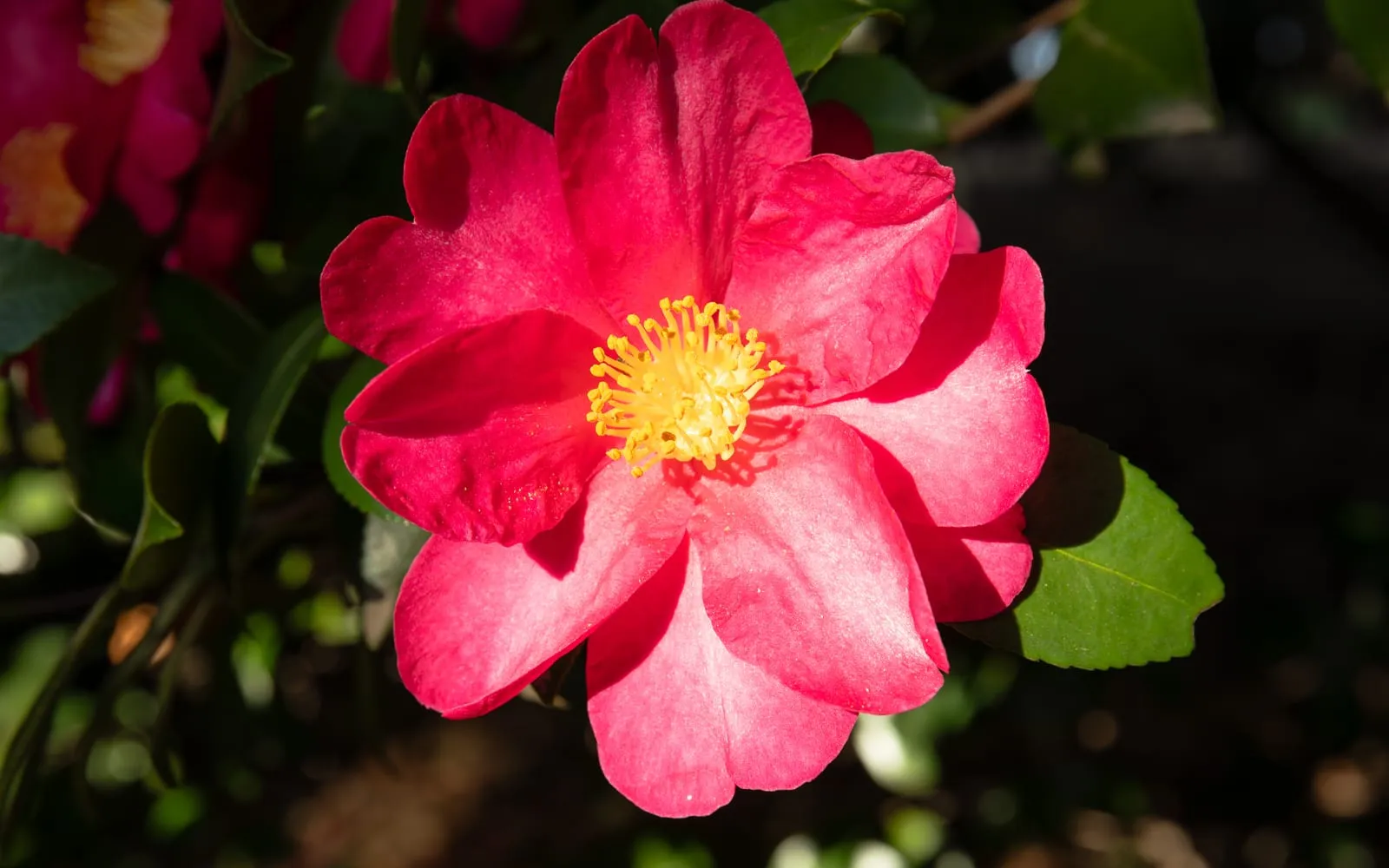
Flowers are single to semi-double, 5 to 7 cm across, white through soft pink, with a looser, more relaxed arrangement of petals than the tightly formal doubles common in Camellia japonica cultivars. Many are lightly fragrant, another point of difference, since japonica flowers are generally scentless.
Growth habit ranges from a dense, upright shrub to a more spreading form depending on cultivar, reaching 1.5 to 5 m at maturity, and it is commonly trained as an informal hedge or espaliered flat against a wall, both uses that take advantage of its greater sun tolerance.
Where it is from
Camellia sasanqua is native to Japan, growing wild in warmer coastal and lowland regions of the southern islands, generally in more open, sunnier conditions than the cooler mountain forests that Camellia japonica favours further north.
That difference in native habitat is the root of most of the practical differences between the two species in cultivation: sasanqua’s greater sun tolerance and slightly reduced cold hardiness both trace back to where in Japan each species evolved.
How it grows
Plant in acidic, humus-rich, well-drained soil, amending with ericaceous compost if the native soil runs alkaline, since it shares the whole genus’s dislike of lime.
Choose a position in full sun to part shade; unlike most camellias, it tolerates considerable direct sun without leaf scorch, though a little shade from the hottest afternoon sun still helps flowers last longer before browning.
Mulch generously with an acidic material such as pine bark or leaf mould to conserve moisture around the shallow root system and help maintain soil acidity.
Prune, if needed, immediately after flowering finishes in winter, since next season’s flower buds form on the following summer’s growth; pruning later in the year risks removing developing buds before they open.
Water well and consistently through the first two years while the root system establishes, since a young camellia that dries out repeatedly in its first seasons often struggles to recover its vigour.
Through the seasons
Autumn and early winter bring the main flowering display, opening earlier than most camellias and generally clear of the frost damage that affects later-flowering species.
Winter is otherwise quiet, since flowering has largely finished before the coldest weather arrives; protect young plants in a hard winter regardless.
Spring brings the flush of new leaf growth that follows flowering.
Summer is the main growing season, on which next autumn’s flower buds depend. Water during dry spells and prune only if needed, since pruning late in summer risks cutting off developing buds.
Care difficulty
Moderate. It needs acidic soil and consistent moisture as non-negotiable requirements, which rules it out on chalky or fast- draining ground without significant soil improvement, but within those conditions it is a reliable, long-lived shrub that needs comparatively little routine attention. Its greater sun tolerance and earlier, more frost-resistant flowering season make it more forgiving than Camellia japonica in most respects.
Watering
Water regularly through the first two growing seasons while the shallow root system establishes, and continue watering during any extended dry spell once mature, since camellia roots sit close to the surface and dry out faster than the shrub’s size would suggest.
Water especially attentively while flower buds are developing in late summer, since drought stress at that stage is a common cause of buds dropping before they open, a complaint often mistaken for a disease or pest problem when the cause is a lack of water months earlier.
Warning signs, diseases and pests
Scale insects appear as small, flat, brownish bumps on stems and leaf undersides, often followed by sooty mould growing on the sticky honeydew they excrete. Treat with horticultural oil and address the scale directly rather than only the mould, which is a symptom rather than the underlying problem.
Camellia petal blight browns and rots open flowers from the centre outward, often within a day or two of opening in wet weather, and affected petals fall with a distinctive brown blotching rather than fading normally. Remove fallen and affected flowers promptly and consider replacing badly affected mulch, since the fungus persists in soil and plant debris.
Chlorosis, yellowing between the leaf veins, signals alkaline soil rather than a pest, since the plant cannot take up iron properly at a high pH. Treat with an ericaceous feed and consider the site’s long-term suitability.
Vine weevil notches leaf edges as an adult and damages roots as a grub, sometimes causing a container-grown plant to wilt and loosen in its pot with no obvious above-ground cause. Check the roots for white, C-shaped grubs if decline is otherwise unexplained.
Growing environment
Full sun to part shade suits it well, tolerating considerably more direct sun than most camellias without leaf scorch, though light shade from the hottest afternoon sun helps flowers last longer.
Acidic soil, ideally pH 5 to 6.5, is essential, and it performs poorly on neutral to alkaline ground regardless of other conditions being right.
Well-drained but consistently moist soil suits it best. It dislikes both waterlogging, which rots the roots, and prolonged drought, which stresses flower bud development.
Shelter from the coldest winter winds protects both the evergreen foliage, which can scorch in a cold, drying wind, and any late flowers still on the plant as winter sets in.
Feeding
Apply an ericaceous, camellia-formulated feed twice a year, once after flowering finishes and again in late summer as next season’s flower buds are forming, following the product’s guidance for quantity.
A mulch of pine bark or leaf mould applied in spring supports soil acidity over the longer term and helps retain the moisture the shallow roots depend on through summer.
Avoid feeding late in autumn or over winter, when the plant is not actively growing and unused fertiliser only sits in the soil rather than being taken up.
Troubleshooting
Flower buds are dropping before they open. Usually drought stress during bud development in late summer, sometimes months before the dropped buds would have opened. Water more consistently through summer in future seasons.
The open flowers turned brown and mushy within a day or two. Likely petal blight in wet autumn weather. Remove affected flowers and fallen debris promptly, and consider whether the mulch around the plant needs refreshing.
The leaves are yellow between green veins. Chlorosis from alkaline soil. Treat with an ericaceous feed and consider whether the planting site suits a lime-hating shrub over the long term.
Why did mine flower in autumn while my neighbour’s camellia flowers in spring? You most likely have two different species. Camellia sasanqua flowers in autumn and early winter; the spring-flowering camellia most gardeners picture is usually Camellia japonica, a related but distinct species with different flowering timing and generally larger, more formal blooms.
Can I grow it as a hedge? Yes, and it is a common use given its tolerance of regular clipping and greater sun tolerance than most camellias. Prune immediately after flowering to shape it, following the same timing rule as for an unclipped specimen.