
Outdoor plant
Austral Grass Tree
Xanthorrhoea australis
How to grow Austral grass tree, Xanthorrhoea australis. Why its trunk thickens by about a centimetre a year, the phosphorus feed that can kill it outright, and the sharp drainage it needs far more than protection from frost.
At a glance
- Difficulty
- Difficult
- Water
- Water occasionally while a young plant establishes; rarely afterwards
- Light
- Full sun
- Temperature
- Tolerates light frost once established
- Hardiness
- USDA 9-11, RHS H3, hardy to -7 C
- Type
- Extremely slow-growing, long-lived evergreen perennial, trunked with age
- Height
- 1-3 m of trunk over many decades, plus a tall flower spike
- Native to
- southeastern Australia
Comes from a climate with dry summers and enough winter rain to percolate straight through sandy soil, so cold is rarely the limiting factor for an established plant. Drainage is. Any soil that holds water around the root crown for long, whatever the winter minimum reads, causes rot faster than frost ever would, which is why this species belongs on a slope or a raised, sandy bed rather than in an ordinary border.
Hardiness zones describe winter cold alone. Summer heat, humidity, rainfall and the length of the growing season decide as much, so treat the range as the outer limit rather than as a recommendation.
Not known to be toxic
Xanthorrhoea australis does not appear on the RHS list of potentially harmful garden plants or the ASPCA's toxic plant database. Aboriginal Australians have long used the resin exuded from the leaf bases as an adhesive and the flower stalks as spear shafts, and the nectar-rich flowers were traditionally eaten or soaked to make a sweet drink, which points to a plant with no meaningful toxicity to people. Nothing in the leaves, trunk or flower spike is documented as harmful to cats, dogs or horses either, and the wiry leaf tips are sharp enough to scratch skin on contact, which is the main practical hazard around the plant rather than any chemical one.
Sources: RHS potentially harmful garden plants, ASPCA toxic and non-toxic plants
About
Austral grass tree grows slower than almost anything else sold as a garden plant, thickening its trunk by roughly a centimetre a year, so a metre of visible trunk represents a century or more of growth. It is bought as much for what it will eventually become as for what it looks like on the day of planting.
The reward for patience is an exceptionally long-lived structural plant, recorded living several hundred years in the wild, crowned by a dense rosette of wiry, grass-like leaves and, periodically, a spectacular tall flower spike. The one thing it will not forgive is poor drainage, which kills established specimens far more often than cold or drought does.
Appearance and character
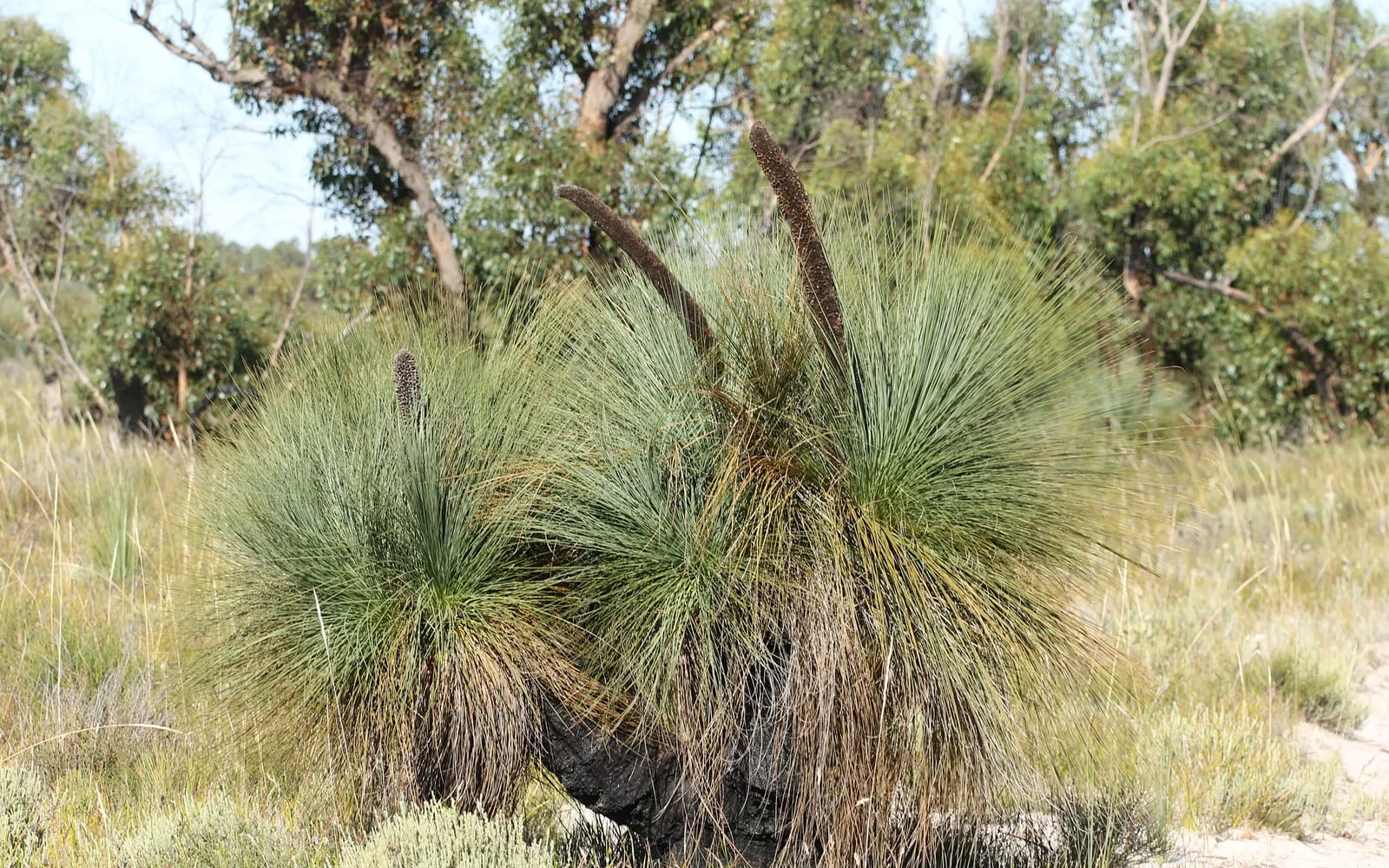
The foliage is a dense skirt of narrow, tough, grass-like leaves radiating from a central growing point, dark green and slightly grey-toned, each leaf only a few millimetres wide but often close to a metre long. In a young plant that rosette sits almost at ground level, since the trunk develops mostly underground at first and only becomes visible above soil after many years.
Older plants develop a thick, dark, fibrous trunk built from the compacted bases of countless shed leaves bound together with resin, giving it real armour against fire and a texture unlike any other garden plant. Trunks occasionally branch after fire or damage, producing the multi-headed specimens most prized by collectors.
The flower spike is the plant’s most dramatic feature when it appears: a tall, dense, cylindrical column of small cream to white flowers rising well above the foliage, sometimes triggered into bloom within months of a bushfire passing through, though established plants also flower periodically without one.
Where it is from
Xanthorrhoea australis is native to southeastern Australia, through Victoria, Tasmania, South Australia and southern New South Wales, growing in open woodland and heath on sandy, nutrient-poor soils that see regular bushfire. Fire is part of its life cycle rather than a threat to it: the thick, resin-bound trunk protects the growing point while the old leaf skirt burns away, and the flush of nutrients and light afterwards often triggers a flowering spike.
That fire-adapted background explains both its toughness and its narrowness of tolerance. It copes with extreme nutrient poverty and periodic scorching that would kill most plants outright, but it evolved in soil that never holds water for long, and a garden setting that traps moisture around the roots removes the one condition it cannot adapt to.
How it grows
Plant in full sun in sandy or gritty soil with sharp drainage, ideally on a slope or a raised bed where water cannot pool around the crown after heavy rain. Avoid any position where the soil stays damp for more than a short period.
Buy a container-grown plant rather than attempting to transplant one from open ground, since the root system is easily damaged and the plant recovers extremely slowly from disturbance, if it recovers at all. Set it at the same depth it was growing in its pot, with the crown slightly proud of the surrounding soil rather than sunk into a hollow that could collect water.
Water occasionally through the first year or two to help the roots establish, then step back almost entirely. An established plant is adapted to long dry periods and is far more likely to be harmed by kindness in the form of regular watering than by neglect.
Never apply a phosphorus-rich fertiliser. Like many Australian native plants adapted to naturally impoverished soils, it is sensitive enough to phosphorus to be damaged or killed by feeds intended for ordinary garden plants.
Through the seasons
Spring and summer are the main growing period in a climate with a distinct dry season, when the plant is most drought tolerant and needs watering only in extreme conditions.
Autumn and winter bring most of the rainfall in its native range, and this is the period when drainage matters most, since wet, cool soil around the crown is when root rot takes hold.
Flowering, when it happens, is not tied tightly to a single season and can follow fire or favourable conditions at almost any time of year in its native range, though a spring flush is common.
Care difficulty
Difficult, not because the plant demands constant attention but because almost none of the mistakes that harm it are reversible. Getting the drainage wrong, feeding it phosphorus, or disturbing the roots during a move can each set a specimen back by years or kill it outright, and its extreme slow growth means a damaged plant does not recover visibly for a very long time, if at all. Growers who accept its pace and give it the sharp drainage it needs are rewarded with one of the toughest, longest- lived plants available; growers expecting quick results or forgiving several years’ worth of ordinary garden habits usually lose it.
Watering
Water lightly and occasionally while a young plant establishes its root system, allowing the soil to dry out fully between waterings rather than keeping any dampness around the crown.
Once established, an Austral grass tree needs little to no supplemental watering in most climates and is markedly more likely to suffer from overwatering than from drought. In a very dry climate, an occasional deep watering during an exceptionally long rainless stretch is more useful than frequent light watering at any stage.
Warning signs, diseases and pests
Root rot from Phytophthora species, especially Phytophthora cinnamomi, is the single greatest threat to this species both in gardens and in the wild, causing wilting, browning foliage and eventual collapse of the whole rosette in wet or compacted soil. There is no cure once established infection sets in; sharp drainage and avoiding soil disturbance in wet weather are the only real defences.
Mealybug can tuck into the dense leaf bases near the crown, showing as small white, cottony masses. Treat with horticultural soap where accessible, though the dense foliage can make thorough treatment difficult.
Scale insects sometimes appear on the leaf bases and trunk as small, flat, brownish bumps. Treat the same way as mealybug, checking the plant periodically since both pests are easy to miss in the dense foliage.
Waterlogging around the crown after heavy rain in poorly drained ground causes the same rot risk as Phytophthora even without the pathogen present, through oxygen starvation at the roots alone. Improving the site’s drainage before replanting is the only fix.
Growing environment
Full sun is essential. A shaded position produces thin, weak growth and all but eliminates any chance of flowering.
Sandy, well-drained, nutrient-poor soil suits it best, mirroring the impoverished ground it grows in naturally. Rich garden soil, especially if heavy or slow-draining, is a worse environment for this species than plain poor ground.
A slope, raised bed or mound gives the crown the drainage advantage it needs in a garden that is otherwise flatter or heavier than its native sandy heath.
Feeding
Feeding is best avoided altogether on reasonable soil. This is a plant adapted to some of the most nutrient-poor soils in the world, and ordinary garden fertiliser, particularly anything containing phosphorus, causes more harm than any nutrient deficiency it might correct.
Where feeding feels necessary on very poor sand, use only a dilute, low-phosphorus formula specifically made for Australian native plants, and apply it sparingly.
Troubleshooting
It has not grown at all in several years. This is normal rather than a sign of trouble. Growth is measured in centimetres per decade once a trunk starts forming, and the absence of visible change year to year is exactly what this species does.
The leaves are yellowing and the crown looks soft. A strong sign of root rot from waterlogged soil. Check the drainage around the base immediately, since this is usually fatal once established and prevention through better drainage on any replacement is the only real answer.
Why has it never flowered? Flowering is irregular and often follows fire, drought-breaking rain or another stress in the wild, so a garden specimen may not have encountered the trigger yet. Age and consistently good growing conditions over many years improve the odds, though there is no reliable way to force it.
I moved it from another spot and it has declined ever since. Root disturbance is very poorly tolerated by this species, and a transplanted specimen, especially an older one dug from open ground, often struggles for years afterwards. Keeping the site as undisturbed as possible from then on gives it the best chance of recovering.
Can I grow it in a container? Yes, for many years while it is young, in a very free-draining, sandy, gritty mix in a pot with generous drainage holes. Its extreme slow growth suits container culture well, though a large, ancient specimen eventually needs open ground and an unrestricted root run.