
Houseplant
Sago palm
Cycas revoluta
Also known as King sago, Japanese sago palm, Cycad
How to care for Cycas revoluta. Watering a cycad that stores its own water, the one flush of fronds a year, treating cycad scale, and why it is lethal to dogs.
At a glance
- Difficulty
- Moderate
- Water
- When the compost has dried out almost completely
- Light
- Bright light, including several hours of direct sun
- Temperature
- 15-24 deg C. It tolerates brief spells near freezing
- Humidity
- Moderate. It tolerates dry air better than most houseplants
- Hardiness
- USDA 9-11, RHS H2, hardy to -5 C
- Type
- Evergreen cycad, extremely slow-growing and living for centuries
- Height
- 60-120 cm indoors over decades
- Native to
- Southern Japan and the Ryukyu Islands
- Best month
- February in the Northern Hemisphere, August in the Southern Hemisphere
A cycad rather than a palm, from a lineage older than the flowering plants. It is the hardiest plant on this shelf and takes several degrees of frost once established, so it lives outdoors through USDA 9 and survives brief cold in USDA 8. Growth is measured in one flush of leaves a year.
Hardiness zones describe winter cold alone. Summer heat, humidity, rainfall and the length of the growing season decide as much, so treat the range as the outer limit rather than as a recommendation.
Every month named in this guide is for the temperate Northern Hemisphere. If you garden in the Southern Hemisphere, shift each one by six months, so February becomes August. Closer to the equator the wet and dry seasons matter more than the calendar, and the shift stops being a useful guide.
Poisonous if eaten
- Do not eat
- Every part, and the seeds far above the rest
- Harm from
- Eating it
- Affects
- People, cats, dogs and horses
Sago palm is the most dangerous houseplant in common cultivation, and the risk is to dogs above all. Every part contains cycasin, which is converted in the gut into a compound that destroys liver cells, and the seeds carry it in by far the highest concentration. Eating one or two seeds can kill a dog. Reported survival rates in dogs treated after eating sago palm are around 50 per cent even with prompt intensive veterinary care, which puts it in a different category from the plants that cause vomiting and an unhappy afternoon. Symptoms begin within a few hours with vomiting, diarrhoea and drooling, followed by a deceptive lull, then liver failure, bleeding, jaundice and seizures over the next two to three days. Any suspected ingestion is an immediate emergency and treatment must start before the liver damage develops. The ASPCA lists it as toxic to cats, dogs and horses. A second compound, BMAA, is a neurotoxin, and the plant has been linked to a cluster of neurodegenerative disease on Guam where cycad seed entered the food chain. Sago starch is produced from the stems of some cycads only after prolonged washing and processing that removes the toxins, and nothing about that makes any part of a garden plant safe to eat. Think hard before keeping one in a home with a dog. If you do, keep it well out of reach, remove any seeds a mature female produces, and sweep up dropped material.
Sources: ASPCA (Sago Palm, Cycas revoluta), RHS potentially harmful garden plants
About
The sago palm is not a palm. It is a cycad, a member of a group that predates flowering plants by a very long way and that was widespread when dinosaurs were the dominant land animals. The resemblance to a palm is coincidence, and the two groups are only distantly related.
That ancient lineage shows in how it behaves. It grows with extraordinary slowness, producing one flush of new fronds a year and sometimes skipping a year entirely, and it lives for centuries. A plant bought at 40 cm will look much the same in a decade.
The other thing to know before buying one is the toxicity, and it is not a footnote. This plant kills dogs, and roughly half of those treated for eating it do not survive. Anyone with a dog should weigh that before bringing one home.
Appearance and character
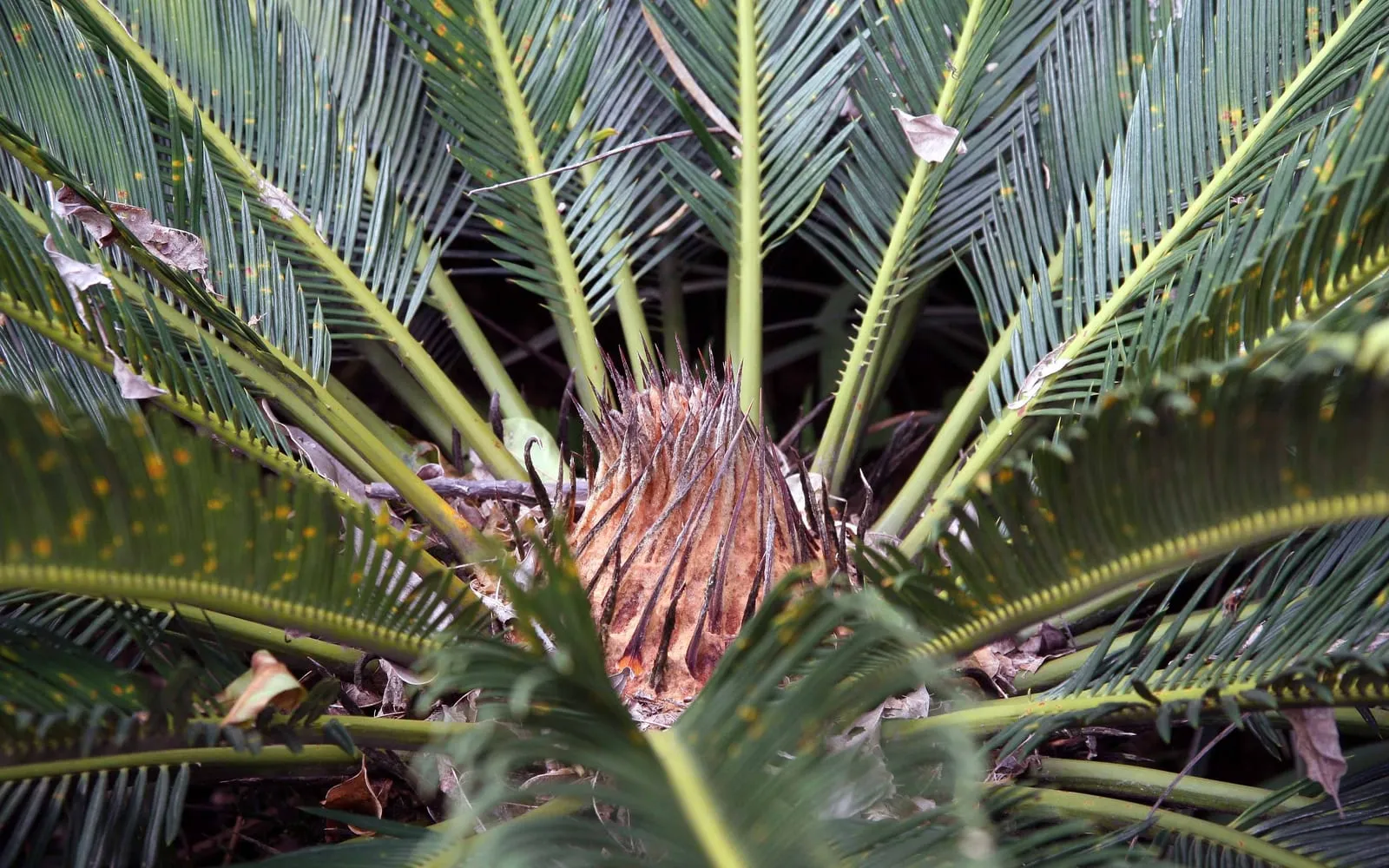
An evergreen cycad with a stout trunk topped by a rosette of stiff fronds, reaching 60 to 120 cm indoors over several decades.
The trunk is thick, dark and shaggy, covered in the persistent woody bases of fallen fronds arranged in a spiral. On a young plant it is a squat rounded knob at soil level.
Fronds are pinnate and hard, 50 cm to 1.5 m long, deep glossy green, and arranged in a symmetrical whorl.
The leaflets are the distinguishing feature. Each is narrow, stiff, sharply pointed, and rolled downward at the margins, which is what revoluta describes. They are sharp enough to prick a finger.
New fronds emerge all at once as a soft pale green flush from the centre, unfurling over a few weeks and then hardening. During that period they are soft and easily damaged, and any injury is permanent.
The plant is dioecious. Male plants produce an upright cone, and female plants a loose golden woolly dome that holds large orange-red seeds.
Offsets form around the base of a mature trunk and can be removed and rooted.
Where it is from
Southern Japan and the Ryukyu Islands, where it grows on rocky coastal slopes and hillsides in thin free-draining soil and full sun.
Rocky exposed ground explains the sharp drainage it requires and the readiness to take direct sunlight, which sets it apart from most plants sold as indoor palms.
Cycads as a group date back at least 280 million years and reached their greatest diversity in the Jurassic. The roughly 350 surviving species are relics of that period, and many are now threatened in the wild.
Cycas revoluta has a curious root adaptation. It forms coralloid roots that grow upward toward the surface and house symbiotic cyanobacteria, which fix nitrogen for the plant.
It has been cultivated in Japan for centuries and is a traditional subject for bonsai and for formal garden planting.
Sago starch is extracted from the trunks of certain cycads in parts of Asia, and only after repeated washing that removes the toxins. The true sago of commerce comes from an unrelated palm.
How it grows
Position it in bright light, including several hours of direct sun. This is not a shade plant, and poor light produces long weak fronds that flop.
Use a very free-draining gritty compost. A cactus mix, or loam-based compost with a third added grit, is right.
Water when the compost has dried out almost completely, then water thoroughly and let it drain fully. The trunk stores water and the plant tolerates drought far better than wet feet.
Reduce watering considerably in winter, to perhaps once a month.
Keep it between 15 and 24 deg C. It withstands brief spells near freezing and grows outdoors in sheltered gardens through USDA 9, and in USDA 8 with protection.
Feed every six to eight weeks in the growing season with a balanced or palm fertiliser at half strength.
Leave the new flush alone. When the soft pale fronds emerge, do not move the plant, do not brush past it, and turn the pot gradually so they harden evenly. Damage at this stage lasts for the life of the frond.
Repot rarely, every four or five years at most. Cycads resent root disturbance and grow better restricted.
Remove only fully brown fronds, cutting close to the trunk. Old lower fronds yellowing one at a time is normal.
Wear gloves and keep the plant away from where a dog can reach it.
Through the seasons
Winter is a rest. Water perhaps monthly, stop feeding, keep it bright and cool, and expect nothing to happen.
Spring is when the new flush usually comes, emerging all at once from the centre. Resume feeding and watering, and protect the soft fronds while they harden.
Summer is when the new fronds mature and harden. Water when the compost dries, feed every six to eight weeks, and give it as much light as possible.
Autumn is the wind-down. Reduce watering and stop feeding from October.
Care difficulty
Moderate, and the difficulty is in patience and vigilance rather than in daily care.
Overwatering is the main way these are killed. The trunk is a water store and the roots rot readily in compost that stays damp.
Cycad scale is a serious pest that has devastated collections worldwide and is difficult to eradicate once established.
The slowness frustrates people. One flush of fronds a year, sometimes none, means a plant changes very little from year to year.
The soft new flush needs protecting for the few weeks it takes to harden.
The toxicity requires a decision rather than a technique, and it is the most important consideration for a household with a dog.
Watering
Water only when the compost has dried out almost completely, which in summer usually means every two to three weeks.
Water thoroughly until it drains from the bottom, then empty the saucer. Never leave the pot standing in water.
Cut back to roughly monthly through winter.
Underwatering causes very little harm, since the trunk holds a reserve. Overwatering rots the roots and the base of the trunk, and it is usually fatal by the time it shows.
A soft or spongy trunk base means rot and is a poor sign.
Use tepid water, and rainwater where the tap water is very hard.
Warning signs, diseases and pests
Cycad scale is the pest to know about. It appears as a white crusty coating spreading over the fronds and the trunk, made up of thousands of tiny insects, and it can cover and kill a plant within months. It is difficult to eradicate. Isolate the plant immediately, wash it thoroughly, treat repeatedly over several weeks, and inspect any new cycad carefully before bringing it into a collection.
Yellowing fronds have several causes worth distinguishing. Uniform yellowing of new fronds with green veins usually means manganese deficiency, which is common in cycads and is corrected with a manganese sulphate feed. General yellowing with wet compost means overwatering. The oldest lower fronds yellowing one at a time is normal ageing.
Root and trunk rot follows overwatering, showing as a softening base and collapsing fronds. Recovery is unlikely.
Long weak pale fronds that flop mean insufficient light.
Permanently deformed or marked new fronds were damaged while soft.
Brown frond tips point to dry air, hard water or fertiliser salts.
Mealybug and ordinary scale also attack cycads and are easier to deal with than cycad scale.
Red palm weevil is an outdoor risk in warm climates rather than an indoor one, hollowing out the crown from within until it collapses with little warning. It is native to Asia and has since spread across North Africa and the Mediterranean, and has never established in most of North America, Australia or New Zealand.
Growing environment
Bright light with several hours of direct sun. A south or west-facing window suits it, and shade produces weak floppy growth.
Warmth of 15 to 24 deg C, with tolerance of brief cold. It survives outdoors in the USDA 9 and warmer in a sheltered spot.
Moderate humidity, and it tolerates dry heated air better than most houseplants.
Very free-draining gritty compost in a heavy pot with drainage holes. A top-heavy plant in a light pot falls over.
Somewhere it will not be brushed past, both because the leaflets are sharp and because the new fronds damage easily.
Well out of reach of dogs. A plant on the floor beside a dog bed is the classic poisoning scenario.
It can stand outside in a sheltered sunny spot through the summer, which suits it well, and should come in before the first frosts in most of the country.
Feeding
Feed every six to eight weeks from April to September with a balanced or specialist palm fertiliser at half strength.
Stop feeding from October to March.
Apply a feed containing manganese, or a separate manganese sulphate treatment, if new fronds emerge yellow. Cycads are prone to this deficiency and it is easily corrected.
Repot only every four or five years. Root disturbance sets the plant back for seasons.
Top-dress with fresh gritty compost each spring instead of repotting.
Troubleshooting
How dangerous is it to dogs? Extremely. Every part contains cycasin and the seeds are worst. One or two seeds can kill a dog, and around half of treated cases do not survive. Any suspected ingestion is an immediate veterinary emergency.
It has not grown at all this year. Normal. Sago palms produce one flush of fronds a year and sometimes skip a year entirely.
The new fronds are yellow with green veins. Manganese deficiency, which is common in cycads. Apply manganese sulphate or a feed containing it.
A white crusty coating is spreading over the fronds and trunk. Cycad scale. Isolate the plant immediately and treat repeatedly. It is difficult to clear and can kill the plant.
The fronds are long, pale and flopping. Not enough light. This plant wants several hours of direct sun.
The base of the trunk has gone soft. Rot from overwatering. Recovery is unlikely. Let the compost dry out almost completely between waterings in future.
Is it a palm? No. It is a cycad, a group that predates flowering plants by millions of years. The resemblance to a palm is coincidental.
Can I put it outside? In a sheltered sunny spot through the summer, yes, which suits it well. Bring it in before the first frosts anywhere colder than USDA 9.
Sago palm problem guides
Not sure what is wrong? See the common houseplant pests guide.