
Houseplant
Elephant Bush
Portulacaria afra
Also known as Spekboom, Dwarf Jade, Porkbush
How to grow Portulacaria afra, the elephant bush or spekboom, with tiny round leaves on red stems, edible and a good bonsai subject in bright, dry conditions.
At a glance
- Difficulty
- Moderate
- Water
- Once the mix has dried right through
- Light
- Bright light to full sun
- Temperature
- Warm; keep above about 5 deg C
- Humidity
- Undemanding; tolerates dry air
- Hardiness
- USDA 9-11, RHS H2, hardy to 5 C
- Type
- Evergreen succulent shrub
- Height
- Up to 3 m outdoors; kept small in a pot
- Native to
- South Africa
A tough shrubby succulent from the dry thicket of South Africa's Eastern Cape, where it feeds browsing elephants and stores carbon. It tolerates heat and long drought and needs strong light, but it has no frost tolerance and is safest above about 5 deg C. A cold, wet root ball can kill it.
Hardiness zones describe winter cold alone. Summer heat, humidity, rainfall and the length of the growing season decide as much, so treat the range as the outer limit rather than as a recommendation.
Not known to be toxic
- Safe to eat
- The leaves, eaten raw as a tart, lemony green
The elephant bush is not only safe but edible. The ASPCA lists Portulacaria afra as non-toxic to cats and dogs, and in its native range people and livestock eat the leaves, which are crisp and pleasantly sour. A pet or child that nibbles a leaf is not expected to be harmed. Grown on a windowsill it is one of the safer succulents to keep, though as with any home plant the leaves are best eaten only from a plant raised without pesticides.
Sources: ASPCA toxic and non-toxic plants, RHS potentially harmful garden plants
About
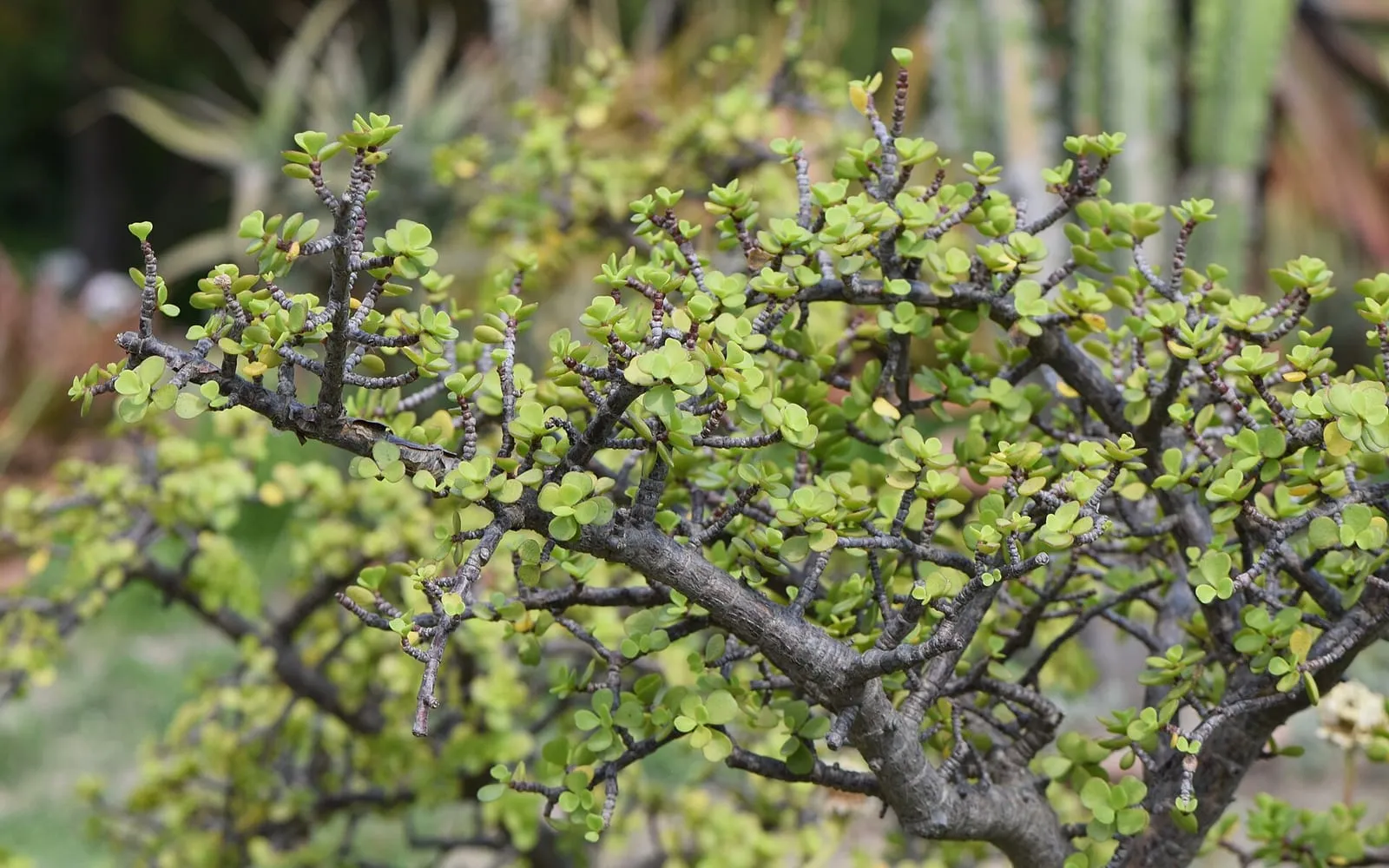
Elephant bush carries hundreds of tiny, round, glossy leaves along wiry, red-brown stems, building into a soft green bush that turns woody and tree-like with age. At a glance it can look like a small jade plant, but the leaves are smaller and flatter, the stems reddish and more supple, and the whole plant far quicker and more forgiving to grow.
In South Africa’s Eastern Cape it forms dense thicket, known as spekboom, that feeds elephants and other browsers and is planted by the hectare for the carbon it stores. The lemony leaves are eaten there in salads and stews.
For a grower it is an easy, fast, drought-tolerant succulent for a bright sill. It can also be trained as a bonsai or grown in a hanging pot in its trailing form. It mainly needs light, sharp drainage and careful watering.
Appearance and character
The leaves are small, round to oval, thick and glossy, a fresh mid-green, packed closely along the stems. A variegated cream-edged form and a low, trailing form are both common in cultivation.
The stems help separate it from a jade plant: slim, supple and a warm red-brown when young, thickening and greying into a gnarled woody trunk as the plant ages.
It grows fast for a succulent, bushing out readily and taking hard pruning well, which is why it is a favourite beginner’s bonsai.
Flowers are small, pink and starry, borne in clusters on mature plants in good light, though indoors it is grown mainly for its foliage and form.
Where it is from
Portulacaria afra is native to the semi-arid thicket of South Africa’s Eastern Cape and Karoo, growing on hot, dry, rocky slopes in strong sun. It is adapted to heat, drought and poor ground.
That origin explains its few needs. It stores water in its leaves and stems, needs strong light and fast drainage, and copes with long dry spells and dry air. Its main weakness is cold combined with wet, which rots the roots.
How it grows
It grows quickly in warmth and good light, bushing out and lengthening its stems, and slows in the short days of winter. Regular pinching keeps it dense, and it recovers fast from a hard cut-back.
Grow it in a gritty, free-draining cactus mix in a pot that suits its size, and water only once the mix has dried right through. Its speed means it takes feeding and pruning better than most succulents, which is part of its appeal for bonsai.
Give it the brightest spot you can, a warm room above about 5 deg C, and dry conditions, and it needs little else. Move a plant that has summered outdoors back in before the first frost.
Cuttings root easily: a broken stem laid on gritty mix roots within weeks, which is how the plant is usually increased.
Through the seasons
Spring starts fast growth as the light returns; prune to shape, repot if needed, and resume watering.
Summer is the main growing season, and a plant can be stood outside in a sunny, sheltered spot. Water when the mix dries through.
Autumn slows growth as the days shorten; ease back the watering and bring an outdoor plant in before frost.
Winter is a rest. Keep it bright, warm and nearly dry, since cold, wet compost in low light is the main cause of rot.
Care difficulty
Moderate, and among the most forgiving succulents once the watering is judged. It grows fast, prunes hard, roots from a snapped stem and tolerates heat, drought and dry air. The single reliable mistake is overwatering, which softens the leaves and rots the roots. Keep it bright and lean, and it is very hard to kill.
Watering
Wait until the gritty mix has dried out completely, then water it through and drain it well. Because it grows faster than most succulents it drinks a little more freely in summer, but it still wants to dry out between waterings.
Cut right back in winter, when a cold, damp pot is a real risk. Leaves that pucker slightly are thirsty; leaves that go soft, yellow and drop are a sign of too much water.
Warning signs, diseases and pests
A pot kept too wet rots at the root, and the plant drops soft, yellowing leaves. Ease off the watering, check the roots, and start fresh cuttings if the base has gone. Because it roots readily, cuttings are often the simplest recovery.
Mealybugs and whitefly can settle on the soft new shoots. Wipe or spray off mealybugs, and treat whitefly early before they multiply on a fast-growing plant.
Sudden heavy leaf drop usually follows a shock, a cold snap, a dark move, or a soaking, instead of disease. Settle the plant in a bright, warm, dry spot and it recovers quickly.
Growing environment
Bright light or full sun gives the firmest, reddest-stemmed growth and, on a mature plant, flowers. In poor light it grows soft, pale and leggy.
Warmth suits it, above about 5 deg C, and it tolerates dry air, needing no added humidity. It can spend summer outdoors in a sunny spot and comes in before the cold.
Grow it in a gritty, free-draining mix on a bright sill, as a bonsai in a shallow tray, or, in its trailing form, in a hanging pot. It responds well to pruning and training.
Feeding
Feed lightly, a couple of times over spring and summer, with a dilute cactus feed. It responds to feeding more than a slow succulent, but rich feeding still forces soft growth.
Give none in winter while it rests, and rely on fresh mix to keep a newly potted or newly pruned plant going.
Troubleshooting
The leaves are going soft and dropping. Overwatering, most often, or a cold shock. Cut back the water, keep it warm and bright, and take cuttings from firm growth if the base has rotted.
How is it different from a jade plant? It is a different plant entirely. Elephant bush has smaller, flatter leaves on slim red stems and grows faster, while the jade plant has plumper leaves on thicker green stems. Both are easy succulents.
Can I eat the leaves? Yes. The leaves are edible and pleasantly sour, eaten in its native South Africa, and the plant is listed as non-toxic to pets. Eat them only from a plant grown without pesticides.
It has grown tall and bare. Age or low light. Prune it back hard, which it takes well, to force bushy new growth, and root the trimmings as cuttings.
Can I grow it as a bonsai? Yes, and it is one of the best beginner’s succulent bonsai, since it grows fast, prunes readily and thickens its trunk with age.
Elephant Bush problem guides
Not sure what is wrong? See the common houseplant pests guide.