
Edible
Cassava
Manihot esculenta
Also known as Tapioca plant, Manioc, Yuca, Mandioca, Garri plant
How to grow cassava, Manihot esculenta. The root that feeds hundreds of millions, why it has to be processed before it is safe, and the difference between the sweet and the bitter kinds.
At a glance
- Difficulty
- Moderate
- Water
- Once a week, and it survives long dry spells
- Light
- Full sun
- Temperature
- 25-30 deg C, and growth stops below 15
- Humidity
- Moderate. It tolerates drought better than any other root crop here
- Hardiness
- USDA 10-12, RHS H1b, hardy to 8 C
- Type
- Tender woody perennial shrub grown from stem cuttings
- Height
- 2-4 m
- Native to
- Brazil, central South America
- Best month
- May in the Northern Hemisphere, November in the Southern Hemisphere
The most drought-tolerant staple in wide cultivation, yielding on exhausted acid soil where nothing else will, and it needs 8 to 24 months without frost to make a root. Growth stops below 15 deg C. Every cultivar contains cyanogenic glycosides, and the bitter sorts must be grated, soaked and cooked before they are safe to eat.
Hardiness zones describe winter cold alone. Summer heat, humidity, rainfall and the length of the growing season decide as much, so treat the range as the outer limit rather than as a recommendation.
Every month named in this guide is for the temperate Northern Hemisphere. If you garden in the Southern Hemisphere, shift each one by six months, so May becomes November. Closer to the equator the wet and dry seasons matter more than the calendar, and the shift stops being a useful guide.
Poisonous if eaten
- Safe to eat
- The root and the leaves, both only after correct processing and thorough cooking
- Do not eat
- Every part when raw or badly prepared, because of cyanogenic glycosides
- Harm from
- Eating it
- Affects
- People, cats and dogs
Cassava is the most important plant on this site to get right. Every part contains linamarin and lotaustralin, cyanogenic glycosides that release hydrogen cyanide when the plant tissue is damaged and its own enzyme reaches them. Cultivars are divided into sweet and bitter types by how much they carry. Sweet cassava, which is what temperate shops sell as yuca, holds most of its glycosides in the peel and is safe after peeling thickly, cutting the root up and boiling it in plenty of water that is then thrown away. Bitter cassava carries far more throughout the flesh and requires real processing: grating or pounding to break the cells, then soaking, fermenting or sun-drying for a day or more so the released cyanide escapes, and only then cooking. That is what makes garri, fufu and farinha. Never eat cassava raw, never eat it after light cooking alone, and never boil it in a covered pan and reuse the water. Getting it wrong causes acute cyanide poisoning, and getting it repeatedly slightly wrong on a low-protein diet causes konzo, an irreversible paralysis of the legs, and tropical ataxic neuropathy. Both are documented across central and eastern Africa in periods of drought and hardship, when processing is shortened. Treat suspected acute poisoning as a medical emergency, and say cyanide is suspected when you get help. The leaves are eaten widely in Africa and are high in protein, and they carry more glycoside than the root, so they are pounded and boiled for at least fifteen minutes with the water discarded. Keep peelings and raw root away from livestock and pets, for whom the same chemistry applies.
Sources: Codex Alimentarius code of practice for reducing hydrocyanic acid in cassava (CAC/RCP 73-2013), RHS potentially harmful garden plants, ASPCA toxic and non-toxic plants
About
Cassava feeds more people than any crop except rice and maize among the tropical staples, something over 800 million by most estimates, and most readers outside the tropics have never seen the plant. The root is sold as yuca, a long brown club with waxy skin and dense white flesh, and the same plant supplies tapioca pearls, garri, farinha, fufu and the starch that thickens a bubble tea.
Its value is that it grows where nothing else will. Cassava tolerates poor acid soil, long dry spells and neglect, produces more calories per hectare than most crops, and can be left in the ground for months as a living store until it is needed. Farmers across Africa call it the crop that will not fail.
The price is a chemistry problem. Every part of the plant carries cyanogenic glycosides and every cassava-eating culture has developed a processing method to remove them. Grating, soaking, fermenting and sun-drying are not culinary flourishes; they are what makes the food safe, and shortening them causes real and permanent harm.
Appearance and character
An upright woody shrub, 2 to 4 m tall, branching from partway up a slender greyish stem marked with prominent raised leaf scars.
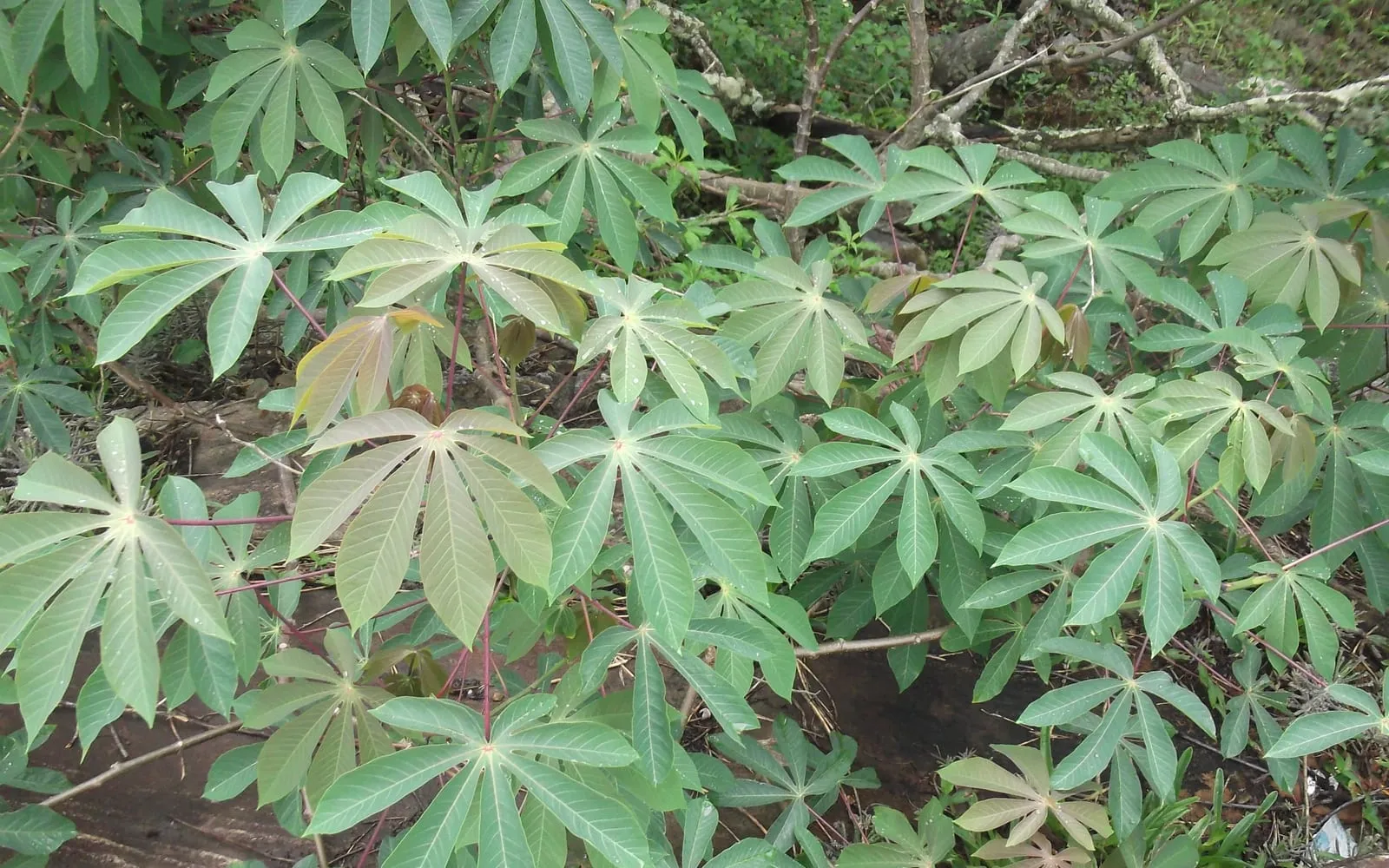
Leaves are the identification. Each is palmate, cut right to the base into five to nine narrow finger-like lobes radiating from the top of a long stalk, 10 to 20 cm across. The stalk is often red or pink.
Foliage clusters towards the branch tips, leaving the lower stem bare, which gives an old plant a leggy look.
Flowers are small, greenish and inconspicuous, in loose panicles, and the plant is rarely grown from seed.
The storage roots swell from the base of the stem in a cluster, cylindrical and tapering, 20 to 50 cm long and 5 to 10 cm thick.
Skin is brown, thin and papery over a pink or white inner rind. Under that the flesh is dense white, with a woody fibrous strand running through the centre that is pulled out before cooking.
Cut roots deteriorate within one to three days of lifting, which is why cassava is sold waxed or frozen and why processing happens near the field.
Where it is from
Manihot esculenta was domesticated in west-central Brazil, from wild Manihot esculenta subspecies flabellifolia, somewhere around 8,000 to 10,000 years ago. It is one of the founding crops of Amazonian agriculture.
Amazonian peoples developed the whole processing repertoire long before contact. The tipiti, a woven tube press that squeezes the poisonous liquid out of grated bitter cassava, is a piece of technology as sophisticated as any in the region.
Portuguese ships carried it to West Africa in the sixteenth century, where it spread inland over the following three hundred years and became a staple across the continent.
Africa now grows more cassava than anywhere else, with Nigeria the largest producer in the world, followed by the Democratic Republic of the Congo, Ghana and Thailand.
Thailand and Vietnam grow it largely for starch and animal feed, and Thai tapioca supplies much of the world’s pearl trade.
It reaches temperate markets through Caribbean, African and South American grocers, and through the tapioca pearls of a bubble tea shop.
How it grows
Grow from stem cuttings rather than from root or seed. A 20 to 30 cm length of mature woody stem with five or more nodes is the standard planting material.
Take cuttings from the middle of a stem, not from the soft tip or the oldest wood.
Plant in May at 25 deg C, pushing the cutting two thirds of its length into free draining compost, right way up. Planted upside down it will not grow.
Grow in a greenhouse or conservatory outside the tropics, in a large deep container or a border.
Give full sun and heat. Growth stops below 15 deg C.
Water sparingly. Cassava is drought-adapted and rots in wet soil.
Feed very little. A rich soil produces a fine shrub and almost no root.
Expect eight to twelve months to a usable root, which outside the tropics means holding the plant through a heated winter.
Harvest by cutting the stem down and levering the root cluster out whole, keeping the roots unbroken.
Process within a day or two of lifting, since the roots spoil fast.
Save 30 cm lengths of stem, store them upright somewhere frost free and dry, and plant them the following May.
Through the seasons
May is for planting stem cuttings in warmth.
June brings rooting and the first shoots, usually within two or three weeks.
July and August are the main stem and leaf growth.
September and October are when the roots begin to bulk, which is later than most gardeners expect.
Winter is a holding period at 15 deg C or above, since the crop is not finished.
The following spring and summer carry the root growth on to a usable size.
Autumn of the second year is harvest, followed immediately by processing.
Care difficulty
Moderate as a plant and demanding as a project.
Eight to twelve months to a crop means a heated greenhouse through the winter.
The plant itself is tough, drought-tolerant and almost free of trouble.
Overwatering and overfeeding are the two commonest mistakes, and both come from treating it like a potato.
Harvest is time-critical, since the root spoils within days.
Processing has to be understood before the crop is lifted rather than afterwards.
Watering
Water once a week, and less in cool weather.
Let the soil dry between waterings.
Increase modestly while the roots are bulking in autumn.
Water at the root rather than over the foliage.
Reduce almost to nothing through a cool winter, since a cold wet root will rot.
Stop watering entirely for a fortnight before harvest, which makes lifting cleaner.
Warning signs, diseases and pests
Fine speckling with webbing under the leaves is red spider mite, which is the main pest under glass and can strip a plant.
Yellow mottling and distorted puckered leaves are cassava mosaic disease, spread by whitefly, which is the biggest constraint on production across Africa and South Asia. It has never established in the Americas, where the crop originated, and growers there treat a suspected case as a biosecurity emergency rather than a routine problem. Plant only certified virus-free cuttings.
Wilting in wet compost is root rot.
White waxy fluff in the leaf axils is mealybug.
Leaves dropping after a cold night below 15 deg C is chill damage.
Tall leggy growth with no root means too much nitrogen or too little light.
Roots that go blue-black and streaky within a day of lifting are showing the normal post-harvest deterioration, which is why processing follows immediately.
Growing environment
A heated greenhouse or conservatory. There is no outdoor option outside the tropics.
Full sun.
Minimum 15 deg C year round, with 25 to 30 deg C for growth.
Light sandy free-draining soil of low fertility.
A large deep container or a border, at least 40 cm deep.
Moderate humidity with good ventilation, which slows red spider mite.
Room for a shrub 2 to 3 m tall.
Feeding
Feed sparingly. Cassava evolved on poor soils and a rich one gives you a shrub.
Skip manure and general fertiliser entirely.
Give a high-potash tomato feed monthly at most, from the second summer.
Work grit into a heavy compost rather than adding organic matter.
Mulch lightly, or not at all.
Stop feeding a month before harvest.
Troubleshooting
Is cassava safe to eat? Yes, once it is prepared correctly, and it is a staple for hundreds of millions of people. Raw or badly prepared, it is dangerous. Read the safety section on this page before cooking any.
What is the difference between sweet and bitter cassava? How much cyanogenic glycoside they carry and where. Sweet types, sold as yuca, hold most of it in the peel and are safe after thick peeling and boiling in plenty of discarded water. Bitter types carry far more throughout the flesh and need grating, soaking or fermenting and drying before cooking.
How do I prepare the yuca I bought? Peel it thickly, taking off the brown skin and the pink inner rind. Cut it into chunks, pull out the woody central strand, and boil in plenty of water in an uncovered pan until soft. Throw the water away.
Can I eat it raw? Never. Not a slice, not a taste.
What is tapioca? The purified starch extracted from cassava root. The pearls in bubble tea are that starch rolled and cooked, and the processing has already removed the glycosides.
Are the leaves edible? Yes, and they are widely eaten in Africa and high in protein. They carry more glycoside than the root, so they are pounded and boiled for at least fifteen minutes in water that is discarded.
What is konzo? An irreversible paralysis of the legs caused by long-term consumption of poorly processed bitter cassava on a low-protein diet. It appears in outbreaks during drought and hardship, when processing is shortened, and it is the reason the preparation methods are treated as non-negotiable.
Why do the roots spoil so fast? Cassava roots begin a vascular deterioration within one to three days of lifting, turning blue-black and streaky. Commercial roots are waxed or frozen to slow it. Process yours immediately.
Can I grow it outdoors in a cool climate? No. It needs 25 deg C and eight to twelve months, so a heated greenhouse is the only route.
How do I start a plant? From a 20 to 30 cm woody stem cutting with several nodes, planted the right way up, two thirds buried, at 25 deg C in May.