
Edible
Kola Nut
Cola acuminata
Also known as Abata Kola
Practical guidance for growing kola nut, Cola acuminata, including shade requirements as a seedling, slow growth to flowering, humid soil, pruning, caffeine content, and pet safety.
At a glance
- Difficulty
- Difficult
- Water
- Regular, consistent watering; never allowed to dry out fully
- Light
- Partial shade while young, full sun once established as a mature tree
- Temperature
- Frost-tender; needs consistent warmth, damaged below about 10 C
- Humidity
- High humidity, reflecting a rainforest origin
- Hardiness
- USDA 11-12, RHS H1a, hardy to 5 C
- Type
- Evergreen tropical rainforest tree
- Height
- 12-20 m in the wild; often kept smaller under cultivation
- Native to
- tropical West Africa
A true lowland rainforest tree that expects warmth, humidity and rainfall spread through the year rather than a marked dry season. Growth slows and leaves can be damaged well above freezing, so it needs consistently warm conditions rather than merely frost-free ones to grow and eventually flower well.
Hardiness zones describe winter cold alone. Summer heat, humidity, rainfall and the length of the growing season decide as much, so treat the range as the outer limit rather than as a recommendation.
Toxic if eaten
- Safe to eat
- The seed, known as the kola nut, chewed fresh or used in extracts and flavouring
- Do not eat
- The seed, in concentrated or large quantities
- Harm from
- Eating it
- Affects
- People, dogs and cats
The kola nut seed is chewed fresh as a traditional stimulant across West Africa and is also processed into extracts used in food and drink flavouring worldwide. It contains caffeine and theobromine, the same two compounds that make chocolate dangerous to dogs and cats, in concentrations high enough that a pet eating a whole seed or a quantity of extract can show the same signs of methylxanthine poisoning as one that has eaten chocolate: restlessness, a raised heart rate, vomiting and, in a large enough dose, seizures. In people, normal chewing or culinary use is broadly equivalent to a strong dose of caffeine, and the same caution around excess applies as with any concentrated caffeine source.
Sources: ASPCA toxic and non-toxic plants, RHS potentially harmful garden plants
About
Kola nut is a slow-growing rainforest tree grown for its seed, chewed fresh as a traditional stimulant across West Africa and long since exported worldwide as a flavouring in food and drink. It needs sustained tropical warmth and humidity, and it takes patience: a seedling grows for years before it flowers, let alone produces a usable crop of seed.
Young trees establish best under the light shade of taller cover, moving into full sun as they mature and build the broad, spreading crown typical of an old specimen.
Appearance and character
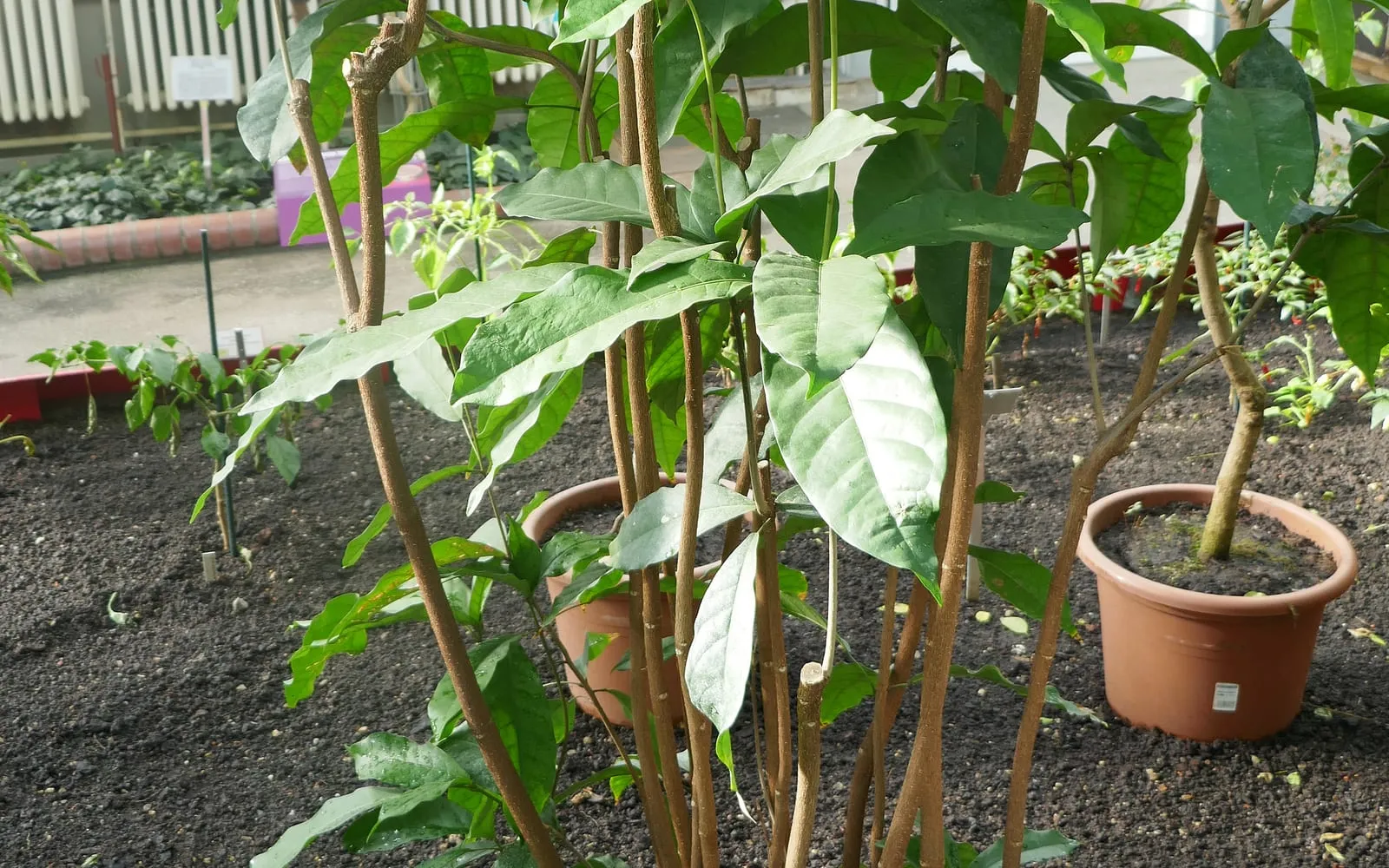
Leaves are large, leathery and glossy dark green, elliptical with a pointed tip, held on stout branches that thicken with age into a substantial trunk. A mature tree develops a dense, wide-spreading crown that shades the ground beneath it heavily.
Flowers are small and have no true petals; their cream-to-yellow colour and dark basal streaking are carried on a petal-like calyx, clustered along the older wood rather than at branch tips. They give way to a star-shaped cluster of thick, woody pods, each containing several large seeds, the kola nuts, packed inside a tough outer shell.
The seeds themselves vary from white through pink to deep red-brown depending on variety, and this colour variation is part of what traditional buyers use to judge and grade a harvest.
Where it is from
Cola acuminata is native to the lowland rainforest of tropical West Africa, from Sierra Leone through to Cameroon and the Congo basin, where it grows in the understorey and canopy gaps of humid forest with rainfall spread across most of the year.
Its forest origin sets the terms for growing it anywhere else. A kola tree needs warmth and humidity every month, with no cool or dry season to endure. Outside true tropical lowland conditions, it survives, if at all, as a slow, unproductive version of a wild tree.
How it grows
Plant in deep, fertile, well-drained soil that still holds moisture reliably, in light shade while young and increasing sun as the tree gains height. A seedling grown in full sun from the start often scorches and struggles, while one kept in deep shade indefinitely grows weak and etiolated.
Shelter from cold wind and any temperature approaching 10 degrees C, since growth slows and leaves suffer chilling damage well before frost would ever be a risk in a climate suited to this tree at all.
Prune only to remove dead, damaged or crossing branches and to manage size in cultivation, since a kola tree left to its own habit forms an attractive, naturally rounded crown without routine shaping.
Propagate from fresh seed, which loses viability quickly once dried, or from grafted material where available, since grafted trees generally reach flowering size faster than one grown from seed.
Through the seasons
Spring in a tropical climate brings renewed growth after any cooler months, with young trees putting on the most height at this time.
Summer is the main growing season, with flowering following on mature trees once conditions are consistently warm and humid.
Autumn carries flowering through to the development of the woody seed pods on a mature, fruiting tree.
Winter in a marginal climate is the period of greatest risk, since even a mild, brief cool spell can check growth on a tree that expects year-round warmth.
Care difficulty
Difficult, mostly because of how narrow its comfort zone is rather than because any single task is hard. It needs sustained heat, high humidity and consistently moist, well-drained soil all at once, a combination that only a true tropical lowland climate supplies without significant extra effort.
Reaching a productive, seed-bearing size also takes years even in ideal conditions. Sustained care matters as much as any one requirement.
Watering
Water regularly and deeply, keeping the soil consistently moist rather than letting it dry out between waterings, reflecting a native climate with rain spread through most months rather than a hard dry season.
Good drainage matters just as much as moisture, since a kola tree in constantly moist but poorly drained soil is at real risk of root rot despite needing that same moisture to thrive.
Warning signs, diseases and pests
Scale insects attach along stems and leaf undersides as small, immobile bumps, weakening growth and excreting honeydew as they feed. Treat with horticultural oil, or scrape off light infestations by hand.
Mealybug shows as small white, cottony masses in leaf axils and new growth, feeding in much the same way as scale. Treat the same way.
Root rot follows soil that stays wet without draining, particularly in a container or heavy clay ground, showing as yellowing leaves and slow decline despite adequate watering. Improve drainage rather than reducing water, since this tree needs the moisture and the problem is usually poor structure in the soil rather than too much water applied.
Leaf spot appears as small brown or black lesions on the foliage in still, humid air with poor ventilation around the crown. Thinning crowded growth and removing badly affected leaves usually controls it.
Growing environment
Light shade while young, moving to full sun as the tree matures, gives the strongest, most balanced growth; a young tree in full sun from the start is prone to leaf scorch.
High humidity is close to essential. A kola tree grown in dry air grows slowly and rarely thrives, whatever the temperature.
Deep, fertile, moisture-retentive but well-drained soil supports the steady, sustained growth this tree needs across many years to reach flowering size.
Feeding
Feed with a balanced fertiliser formulated for tropical fruiting trees every six to eight weeks through the growing season, following product guidance for a large, long-lived tree rather than a fast-growing annual crop.
A young tree benefits from consistent, moderate feeding to support its slow early growth; heavy, irregular feeding does more to stress a seedling than to speed it toward flowering size.
Troubleshooting
My tree is years old and still has not flowered. Kola trees are slow to reach flowering and fruiting maturity even in ideal tropical conditions, and a tree grown outside its native climate range can take considerably longer still, if it flowers at all.
The leaves are scorching in full sun. Likely a young tree exposed to more direct sun than it can yet handle. Provide light shade until the tree has built a larger canopy and thicker leaves, then gradually increase sun exposure as it matures.
Growth has stalled and the leaves look dull. Check humidity and temperature first, since both need to stay consistently high for this species to keep growing, and a spell of dry air or cool temperatures well above freezing can still stall it noticeably.
Is it safe to keep this tree where a dog or cat could reach fallen seed pods? No. The seeds inside contain caffeine and theobromine in concentrations that can seriously harm a dog or cat that eats them, in the same way chocolate does, so fallen pods should be cleared promptly where pets have access.
Can I grow this as a houseplant in a temperate climate? Only with real difficulty, and even then it grows slowly and is unlikely to reach flowering size. It needs sustained heat and very high humidity that a typical home cannot provide without a dedicated heated, humid growing space such as a large greenhouse.