
Edible
Pot Marjoram
Origanum onites
Also known as Greek oregano, Cretan oregano, Turkish oregano
How to grow pot marjoram, Origanum onites. The hardy marjoram that survives a cold winter, how it differs from sweet marjoram and oregano, and why most Greek oregano sold as dried herb is this plant.
At a glance
- Difficulty
- Easy
- Water
- Rarely once established. Weekly in a pot in high summer
- Light
- Full sun
- Temperature
- Hardy to about -10 deg C in dry soil, less in wet
- Hardiness
- USDA 7-10, RHS H4, hardy to -10 C
- Type
- Hardy to half-hardy perennial, woody at the base
- Height
- 30-60 cm
- Native to
- the eastern Mediterranean
- Best month
- May and June in the Northern Hemisphere, November and December in the Southern Hemisphere
Hardier than sweet marjoram and milder than Greek oregano, which puts it between the two in every sense. Winter wet at the crown kills it well before cold does. Give it sharp drainage and it comes through frosts that would finish it in heavy ground.
Hardiness zones describe winter cold alone. Summer heat, humidity, rainfall and the length of the growing season decide as much, so treat the range as the outer limit rather than as a recommendation.
Every month named in this guide is for the temperate Northern Hemisphere. If you garden in the Southern Hemisphere, shift each one by six months, so May becomes November. Closer to the equator the wet and dry seasons matter more than the calendar, and the shift stops being a useful guide.
Not known to be toxic
- Safe to eat
- Leaves and flowering tops
Non-toxic. Pot marjoram is a kitchen herb with no entry on the RHS list of potentially harmful garden plants. The ASPCA lists Origanum vulgare, the nearest relative it holds a record for, as producing only vomiting or diarrhoea in a cat or dog that eats a large amount, which describes quantity rather than poisoning. The leaves are food. Oregano essential oil is a different product entirely, being a concentrated source of carvacrol that irritates skin and mucous membranes undiluted and should not be given to animals.
Sources: RHS potentially harmful garden plants, ASPCA toxic and non-toxic plants
About
Pot marjoram is the marjoram that lives through the winter. Sweet marjoram is tender and dies in November; this one is a woody-based perennial from Crete and western Turkey that will come through a temperate winter if the drainage is sharp enough.
Its flavour sits between the two herbs it is confused with. Stronger and more peppery than sweet marjoram, softer and sweeter than common oregano, and carrying the resinous carvacrol note that makes dried Greek oregano taste the way it does. Much of what is sold as Greek oregano is this species rather than Origanum vulgare.
Three plants in a sunny bed will supply a household. The one condition it insists on is drainage, because winter wet at the crown kills far more of these than cold ever does.
Appearance and character
A bushy sub-shrub, 30 to 60 cm, with a woody base and soft green shoots each year.
Leaves are small, oval, pointed and slightly hairy, mid-green rather than the grey of sweet marjoram, carried in opposite pairs on square stems.
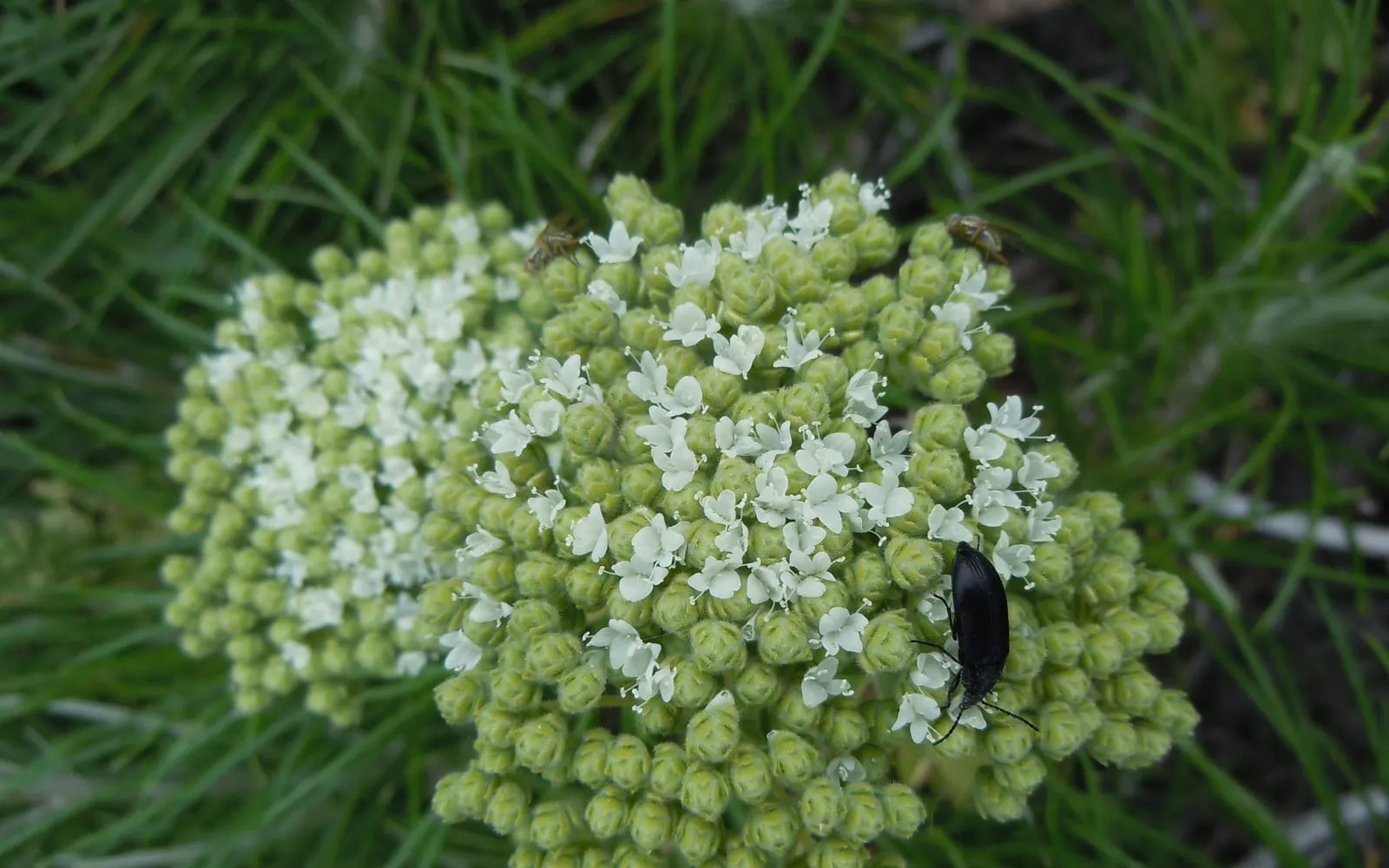
Flowers open in flat-topped branching heads from July, white to pale pink, with green bracts beneath them. They do not gather into the tight knots that name sweet marjoram.
Stems are square, hairy and reddish, going woody and brown at the base by the second year.
The scent is sharply aromatic with a resinous, almost thyme-like edge. Crushing a leaf gives you the smell of a pizza rather than the sweet floral note of sweet marjoram.
An established plant makes a neat dome that holds its shape without staking, which is useful at the front of a dry sunny bed.
Where it is from
Pot marjoram is native to Crete, the Aegean islands, western Turkey and Sicily, growing on dry limestone hillsides and in the low scrub the Greeks call phrygana.
It has been the Greek kitchen herb since antiquity, and the Greek name origanon, meaning brightness of the mountain, covers this and its relatives.
The dried herb trade is where the naming gets tangled. Turkey and Greece export enormous quantities of dried oregano, much of it Origanum onites, and it is sold worldwide as Greek oregano. Anyone buying dried Greek oregano is usually buying this species and not the one growing wild on European chalk.
Britain has grown it since at least the seventeenth century as a pot herb, which is where the English name comes from. Pot in this sense means the cooking pot rather than the container.
Wild collection in Turkey was heavy enough by the 1990s that export controls were introduced, and most of the crop is now cultivated.
How it grows
Buy a named plant or take cuttings. Seed is sold and it is frequently mislabelled, so a plant you have smelt is worth more than a packet.
Take softwood cuttings in June. They root in three weeks in gritty compost on a warm windowsill, and a plant gives you twenty.
Plant in late spring into full sun and sharply drained soil. On clay, plant on a raised ridge or in a gravel bed, or grow it in a terracotta pot.
Space at 30 cm. It makes a wide low dome.
Cut it back by half after flowering in August. That keeps the base furnished and stops it going bare and woody in the middle.
Do not cut into old bare wood in autumn. Wait until growth starts in April, then take out anything dead.
Harvest through the summer by cutting shoots, and cut the crop for drying just as the flowers open, which is when the oil content peaks.
Replace the plant every four or five years. Old specimens go woody and sparse.
Through the seasons
Winter is survival rather than growth. The plant holds some leaf in a mild year and looks miserable in a wet one. Keep mulch away from the crown, because anything holding moisture against the base is what kills it.
Spring brings new shoots from the woody base in April. Cut out the dead wood then, not before, since last year’s stems protect the crown.
Early summer is the growing season. Take cuttings in June.
Midsummer brings the flowers and the best harvest. Cut for drying as the first flowers open.
Late summer is the time to cut the plant back by half, which keeps it compact and gives a flush of tender autumn leaf.
Autumn needs nothing beyond clearing fallen leaves off the crown. A pot is better tipped on its side against a wall than left standing in the rain.
Care difficulty
Easy where the soil drains and difficult where it does not. That single condition accounts for most failures.
Winter wet is the problem rather than winter cold. The plant handles -10 deg C on a dry Cretan hillside and dies at -3 deg C sitting in cold cold wet clay. Grit, a raised bed or a pot solves it.
Once established it is close to maintenance free. It does not need feeding, staking, spraying or regular watering, and it flowers and crops without attention.
Pruning is the one skill. Cut back after flowering into green growth. Cutting into old bare wood usually kills that stem outright, which is true of most Mediterranean sub-shrubs.
Buying the right plant is the other difficulty and it is a real one. Nursery labelling across the whole Origanum genus is unreliable. Crush a leaf before you buy.
Watering
Water new plants weekly through their first summer, then leave them to it.
An established plant in the ground needs watering only in a long drought, and even then it survives without.
Water a container weekly in July and August, letting the compost dry out between times. Terracotta suits it better than plastic.
Water in the morning at the base. This plant resents wet foliage in still weather.
Stop watering from September so the plant goes into winter on the dry side, which is what it needs to survive one here.
Never leave a pot in a saucer, and tip a pot on its side or move it under cover for the winter if you can.
Warning signs, diseases and pests
Root and crown rot is the main risk and the main cause of death. A plant blackens at the base over winter and fails to shoot in spring. Prevention is drainage, and there is no cure.
Powdery mildew whitens the leaves of a crowded plant in a still humid summer. Thin it, cut it back and improve the airflow.
Aphids collect on flowering shoots. Rub them off.
Leafhoppers stipple the leaves with fine pale dots and hop away when disturbed. They rarely need action.
Woody bare stems with growth only at the tips mean the plant has not been cut back for a couple of years. Cut into green growth in spring and replace it if there is none low down.
Yellowing between the veins on very alkaline ground is unusual for a limestone plant and generally means waterlogging rather than a deficiency.
A plant that comes through winter and then dies in April was rotting all along. The damage happens in February and shows in spring.
Growing environment
Full sun, all day. Anything less gives you a lax plant with little scent.
Sharply drained soil, poor rather than rich. Add grit or coarse sand to anything heavy, and consider a gravel garden, a raised bed or a wall top.
Alkaline is ideal, around pH 7 to 8. It grows on chalk without complaint and sulks in acid peat.
Shelter from cold wind helps, though the plant is tough once established.
A container of gritty compost is the safe option on clay. Use terracotta, crock the drainage hole and stand the pot on feet.
It is a good companion in a dry sunny bed with lavender, thyme and rosemary, because all four want the same conditions and none of them wants feeding.
Feeding
None, in the ground. Pot marjoram grown on poor soil is more aromatic than pot marjoram grown on rich soil, and feeding it costs you the flavour.
A container plant needs a little, since compost runs out. A half-strength balanced feed in May and again in July covers the year.
Do not mulch with manure or thick compost. Rich material against the crown holds moisture there, which is what kills the plant in winter.
Top-dress a pot with fresh gritty compost each spring rather than feeding harder.
Gravel or grit as a surface mulch is worth using. It keeps the crown dry, reflects heat up into the plant and suppresses weeds.
Troubleshooting
It died over the winter. Almost certainly rot rather than cold. Improve drainage, plant higher, or grow the replacement in a pot.
Is this oregano or marjoram? Both, in a sense, and the names overlap across the genus. Pot marjoram has green pointed leaves, flat branching heads of white flower and a resinous peppery scent. Sweet marjoram is greyer, softer and sweeter, with knotted buds. Common oregano has a coarser leaf and is fully hardy.
The middle has gone bare and woody. It needed cutting back each August. Prune into green growth in spring, and take cuttings in case the plant does not break from the old wood.
The flavour is weak. Too rich a soil, too much shade or too much water. Harvest as the flowers open rather than before.
It collapsed in July. Root rot from a wet spring, or a pot standing in water. Check the base of the stem for browning.
Can I use it like oregano? Yes. It is what most dried Greek oregano is, and it holds its flavour through long cooking better than sweet marjoram does.
Should I let it flower? The flowers are good for bees and the oil peaks as they open, so let it flower, harvest at that point, then cut it back.