
Outdoor plant
Common honeysuckle
Lonicera periclymenum
Also known as Woodbine, European honeysuckle
How to grow honeysuckle, Lonicera periclymenum. Scent at dusk for the moths, keeping the roots cool and the top in sun, and beating the aphids and mildew.
At a glance
- Difficulty
- Easy
- Water
- Regular in dry spells, since drought brings on mildew
- Light
- Roots in shade and the top in sun or partial shade
- Temperature
- Fully hardy, to about -30 deg C
- Hardiness
- USDA 4-9, RHS H6, hardy to -30 C
- Type
- Deciduous twining climber, long lived and vigorous
- Height
- 5-7 m
- Native to
- Europe, north Africa and western Asia, and native throughout Britain
- Best month
- July in the Northern Hemisphere, January in the Southern Hemisphere
Roots in shade and shoots in sun is the old rule and it holds, because a hot dry root run brings mildew and aphids. It flowers on last year wood, so prune after flowering. This species is the European woodbine and is well behaved. The invasive honeysuckles of North America are different plants, Lonicera japonica and the bush species Lonicera maackii and Lonicera tatarica, all of which are banned or restricted across many American states.
Hardiness zones describe winter cold alone. Summer heat, humidity, rainfall and the length of the growing season decide as much, so treat the range as the outer limit rather than as a recommendation.
Every month named in this guide is for the temperate Northern Hemisphere. If you garden in the Southern Hemisphere, shift each one by six months, so July becomes January. Closer to the equator the wet and dry seasons matter more than the calendar, and the shift stops being a useful guide.
Harmful if eaten
- Do not eat
- The berries
- Harm from
- Eating it
- Affects
- People, cats and dogs
Honeysuckle berries contain saponins and are mildly poisonous, causing vomiting, abdominal pain and diarrhoea if eaten in quantity. They are bright red, held in clusters at the top of the plant, and largely out of reach of small children, which limits the problem in practice. The RHS lists Lonicera as harmful if eaten. A child who has eaten a few berries is likely to have a stomach upset at worst, and a handful is worth a call to a doctor. The flowers are a different matter. Pulling the flower and sucking the drop of nectar from the base is a childhood tradition across Britain and is harmless, which is where the name honeysuckle comes from. That helps the plant is not treated as more dangerous than it is. Birds eat the berries in quantity with no ill effect and they are an important autumn food. Related species vary, and the berries of Lonicera caerulea are grown commercially as honeyberry and are edible, which does not transfer to the native climber.
Sources: RHS potentially harmful garden plants, ASPCA toxic and non-toxic plants
About
Honeysuckle is grown for what happens at dusk on a warm July evening.
The scent is barely there in daylight and builds through the afternoon into something that fills a garden after sunset. That timing is deliberate on the plant’s part, since its pollinators are hawkmoths and other night-flying moths, which find it by smell and hover to reach the nectar at the base of the long tube.
The flowers work the same way. They open cream-white, are strongly scented on the first evening, and fade to deep yellow the following day once they have been visited.
Two rules govern where to plant it. The roots want to be cool, shaded and damp, and the top wants sun or light shade. A honeysuckle with its base baking in dry soil against a south wall will mildew every summer, and the same plant with a shrub or a paving slab shading the root run stays clean.
It is a native climber and one of the better wildlife plants a garden can carry. Moths work the flowers, birds eat the berries, the peeling bark is used by dormice for nests, and the white admiral butterfly lays its eggs on honeysuckle in woodland.
Appearance and character
A deciduous woody climber reaching 5 to 7 m, twining its stems clockwise around any support it can grip.
Leaves are oval, 3 to 7 cm long, held in opposite pairs, dull mid-green above and blue-green beneath, and the uppermost pairs are sometimes joined around the stem.
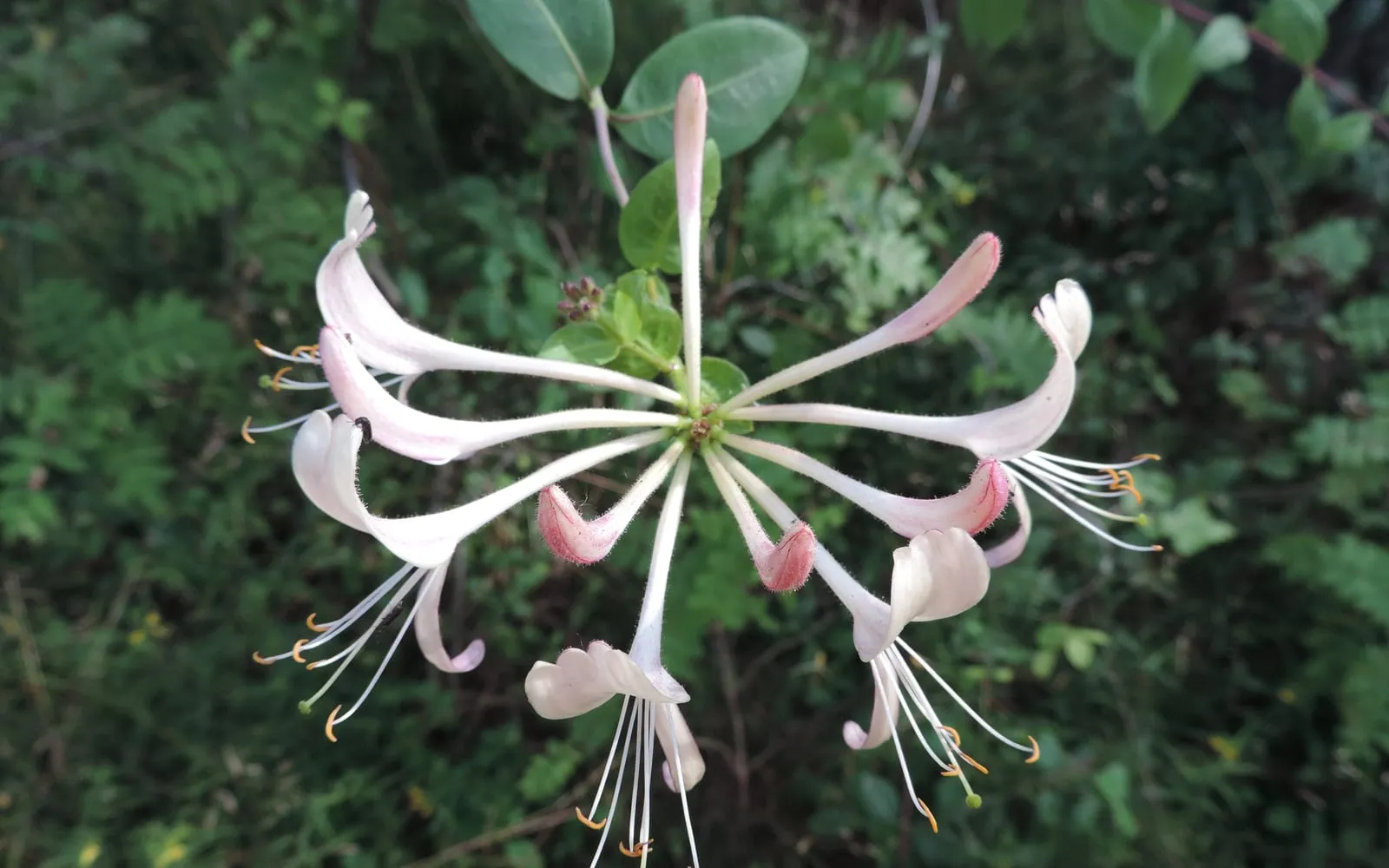
Flowers open from June to September in whorled heads at the ends of the shoots. Each is a long narrow tube 4 to 5 cm long, splitting into two lips at the mouth with the stamens projecting.
Colour opens cream-white, often flushed pink or purple-red on the outside, and turns deep yellow within a day of opening.
Scent is powerful and released in the evening, carrying a long way on still warm air.
Berries ripen from August in tight clusters of glossy translucent red, 6 to 8 mm across.
Stems twist and thicken with age and the bark peels in papery strips, and an old plant goes bare at the bottom with all the growth at the top.
‘Belgica’, the early Dutch honeysuckle, flowers in May and June, and ‘Serotina’, the late Dutch, flowers from July to October. Growing both extends the season.
Where it is from
Europe, north Africa and western Asia, and native throughout Britain and Ireland.
It grows in woodland, along hedgerows, in scrub and on woodland edges, twining up hazel, hawthorn and young trees to reach the light.
That habit explains the requirements. A woodland climber has its roots in cool shaded leaf litter and its flowering growth up in the light, and reproducing that in a garden is the whole of growing it well.
The spiral scars left on a hazel stem by a honeysuckle twining round it produce the twisted wood sold as walking sticks.
Its wildlife associations are unusually rich. The white admiral butterfly lays its eggs only on honeysuckle growing in shade, hazel dormice use the peeling bark to build summer nests and eat the flowers and berries, and elephant hawkmoths and other night moths are the main pollinators.
The English name records the practice of sucking nectar from the flower base, and woodbine records the way it binds itself around wood.
Several exotic species are widely planted and behave differently. Lonicera japonica is evergreen, invasive in North America and vigorous to the point of being a nuisance, and Lonicera nitida is the small-leaved shrub used for hedging.
How it grows
Plant in autumn or spring, and put real thought into the root run.
Shade the roots and give the top light. Plant on the shaded side of a support, or place a paving slab, a low shrub or a group of perennials over the root area. This is the best way to keep a honeysuckle vigorous.
Dig in plenty of compost or leaf mould at planting, since it wants moisture-retentive soil above all.
Avoid the dry strip at the foot of a south-facing wall, which is the classic position for a mildewed unhappy plant.
Give it something to twine around rather than a flat surface. Wires, trellis, a tripod, a pergola post, a hazel wigwam or an old fruit tree all work. It has no tendrils or suckers and cannot climb a bare wall.
Tie in the young growth until it finds its own support, then leave it to twine.
Mulch thickly every spring with compost or leaf mould.
Water in dry spells, which is the main defence against mildew.
Prune after flowering on early-flowering cultivars, and in late winter on those that flower on new wood. For the native species and the Dutch cultivars, cut back the flowered shoots by about a third after flowering.
Take one third of the oldest stems down to 60 cm every few years to keep the base furnished, since honeysuckle otherwise becomes a bare tangle with a bird’s nest of growth on top.
Renovate an overgrown plant by cutting everything to 60 cm in late winter. It regrows readily and loses a season of flower.
Do not let it twine around a young tree or a shrub you value. The stems tighten as they thicken and will constrict the stem beneath.
Propagate from semi-ripe cuttings in late summer or by layering, both of which are easy.
Through the seasons
Winter is bare, and this is the season for hard renovation and for planting.
Spring breaks into leaf early, often in February, and this is mulching and feeding time.
Summer flowers from June to September depending on cultivar, with the scent strongest at dusk. Aphids and mildew both appear now.
Autumn ripens the red berries, which the birds take, and it is a good planting season.
Care difficulty
Easy, provided the roots stay cool and damp.
It is hardy, long-lived, vigorous and tolerant of most soils, and it needs no elaborate training.
The two recurring problems are powdery mildew and aphids, and both are far worse on a plant that is dry at the roots. Getting the position right prevents most of it.
The other job is pruning it often enough to stop it becoming a bare-legged tangle, which is easy to postpone and awkward to fix.
Watering
Water regularly in dry spells, particularly for the first three years and against a wall at any age.
Honeysuckle in dry soil mildews without fail, so watering is disease control rather than a nicety.
Water at the base rather than over the foliage.
Mulch thickly every spring with compost or leaf mould, which holds more moisture than watering adds.
The rain shadow at the foot of a wall or fence is the position that needs the most attention.
Warning signs, diseases and pests
White powdery coating over the leaves from midsummer is powdery mildew. It follows dry roots almost without exception. Water, mulch heavily, shade the root run, and thin congested growth so air moves through. Cut a badly affected plant back after flowering.
Dense colonies of aphids on the shoot tips and flower buds, with sticky leaves and sooty mould below, is honeysuckle aphid. It is worst on dry stressed plants. Wash them off with a jet of water and encourage ladybirds, hoverflies and blue tits.
A bare tangle of stems at the bottom with all the growth and flower at the top is normal neglect. Take one third of the oldest stems to 60 cm every few years.
Few flowers is usually deep shade at the top of the plant, or pruning at the wrong time and removing the flowering wood.
Leaves scorching and dropping in summer is drought.
A tree or shrub with a spiral constriction in its stem has had honeysuckle twining round it. Cut the honeysuckle away.
Honey fungus attacks honeysuckle and is fatal.
Berries disappearing in September is birds, which is the plant doing its job.
Growing environment
Roots in shade and the top in sun or partial shade. This split is the key to the plant.
Moist, humus-rich, free-draining soil. It grows on clay and chalk and dislikes thin dry sand.
Fully hardy to about -30 deg C, and tolerant of exposure.
Allow 4 to 6 m of run and give it a support it can twine around rather than a flat wall.
It suits a pergola, an arch, a fence with wires, a trellis, a hedgerow, an old fruit tree or a wild boundary.
Plant it where you will be in the evening. A honeysuckle beside a seat, a door or an open window pays back the position at dusk.
Grow it with a clematis on the same support for a longer season, or with a rose, which is the traditional cottage pairing.
Its wildlife value is high. Hawkmoths and other night moths pollinate it, bumblebees rob the base of the tube by day, birds take the berries, dormice use the bark and the fruit, and the white admiral butterfly depends on it in woodland.
Grow ‘Belgica’ and ‘Serotina’ together to run the flowering from May to October.
Feeding
Feed once in spring with a balanced general fertiliser.
Mulch every spring with compost or leaf mould, kept clear of the stems, which matters more than the feed because it keeps the roots cool and damp.
Feed a wall-trained plant more attentively, since the soil at the foot of a wall is poor as well as dry.
Avoid high-nitrogen feeds, which give soft growth that aphids and mildew both prefer.
A weak mildewed plant needs water and mulch rather than fertiliser.
Troubleshooting
The leaves have gone white and powdery. Powdery mildew, which follows dry roots. Water it, mulch thickly, shade the root run with a slab or a low shrub, and thin the growth so air moves through. This is a siting problem before it is a disease.
The shoot tips are covered in aphids. Honeysuckle aphid, worst on dry plants. Wash them off with a jet of water and leave the predators to it. Improving the moisture at the roots reduces it long term.
Where should I plant it? With the roots in shade and damp soil, and the top growth in sun or light shade. Avoid the dry strip at the base of a south-facing wall.
It is all bare stems at the bottom with a tangle on top. Normal without pruning. Take one third of the oldest stems down to 60 cm every few years, or cut the whole plant to 60 cm in late winter to start again.
When do I prune it? After flowering for the native species and the Dutch cultivars, cutting the flowered shoots back by about a third. Hard renovation goes in late winter.
Can it climb a bare wall? No. It twines and has no tendrils or suckers. Give it wires, trellis or a post to wrap around.
Are the berries poisonous? Mildly. They contain saponins and cause vomiting and stomach upset in quantity. Sucking nectar from the flower is harmless and is where the name comes from.
It has hardly flowered. Too much shade at the top, or pruning at the wrong time. Move the top growth into more light and prune straight after flowering.
It is strangling my apple tree. The stems tighten as they thicken. Cut the honeysuckle away from anything you value and give it its own support.