
Outdoor plant
Black Swallowwort
Cynanchum atratum
Also known as Bai Wei, Blackened Swallowwort
How to grow black swallowwort, Cynanchum atratum, an upright Asian perennial with dark star flowers, and how it differs from the invasive weed.
At a glance
- Difficulty
- Moderate
- Water
- Keep the soil moist in dry spells
- Light
- Full sun to partial shade
- Temperature
- Hardy; top growth dies back in winter
- Hardiness
- USDA 5-9, RHS H5, hardy to -20 C
- Type
- Herbaceous perennial, dying back in winter
- Height
- 40 to 80 cm
- Native to
- Eastern Asia
A temperate East Asian perennial that dies back each winter and regrows from the root in spring, hardy to moderate cold. It grows on grassy slopes and in thickets in moist, fertile soil in sun or light shade, with a warm growing season. Deep winter cold is its main limit, and it has no special heat requirement.
Hardiness zones describe winter cold alone. Summer heat, humidity, rainfall and the length of the growing season decide as much, so treat the range as the outer limit rather than as a recommendation.
Harmful if eaten
- Do not eat
- The milky sap and the root
- Harm from
- Eating it, handling it and sap in the eyes
- Affects
- People
Like other members of its family, black swallowwort has a milky sap and contains steroidal glycosides, so the sap can irritate skin and eyes and the plant should not be eaten. The root is the part used in traditional Chinese medicine under the name bai wei, prepared and taken deliberately as a remedy, which is the part of concern. Wash off any sap that gets on skin, keep it from eyes, and treat the plant as one to grow instead of to taste.
Sources: RHS potentially harmful garden plants, North Carolina Extension plant toxicity database
About
Black swallowwort is an upright Asian perennial of the milkweed and dogbane family, grown for a root long used in Chinese medicine under the name bai wei. In early summer it opens clusters of small, dark, star-shaped flowers in a deep purple-brown, almost black, which is where the name comes from.
Break a stem or leaf and it bleeds a milky white sap, the mark of its family, which it shares with the milkweeds and periwinkles. The sap contains the active compounds that make the plant both medicinal and mildly toxic, so handle it with a little care.
One point of confusion is worth settling. This Asian medicinal, Cynanchum atratum, is not the same as the black swallow-wort that is an invasive weed in North America, which is a different plant, Vincetoxicum nigrum. They share a common name and a family, and nothing else, and this guide is about the Asian species grown for its root.
Appearance and character
Stems are upright and unbranched or little-branched, softly hairy, rising in a clump to between forty and eighty centimetres, and they bleed milky sap when cut.
Leaves are oval, pointed and hairy, held in opposite pairs up the stems, plain mid green and unremarkable except for the sap they release when broken.
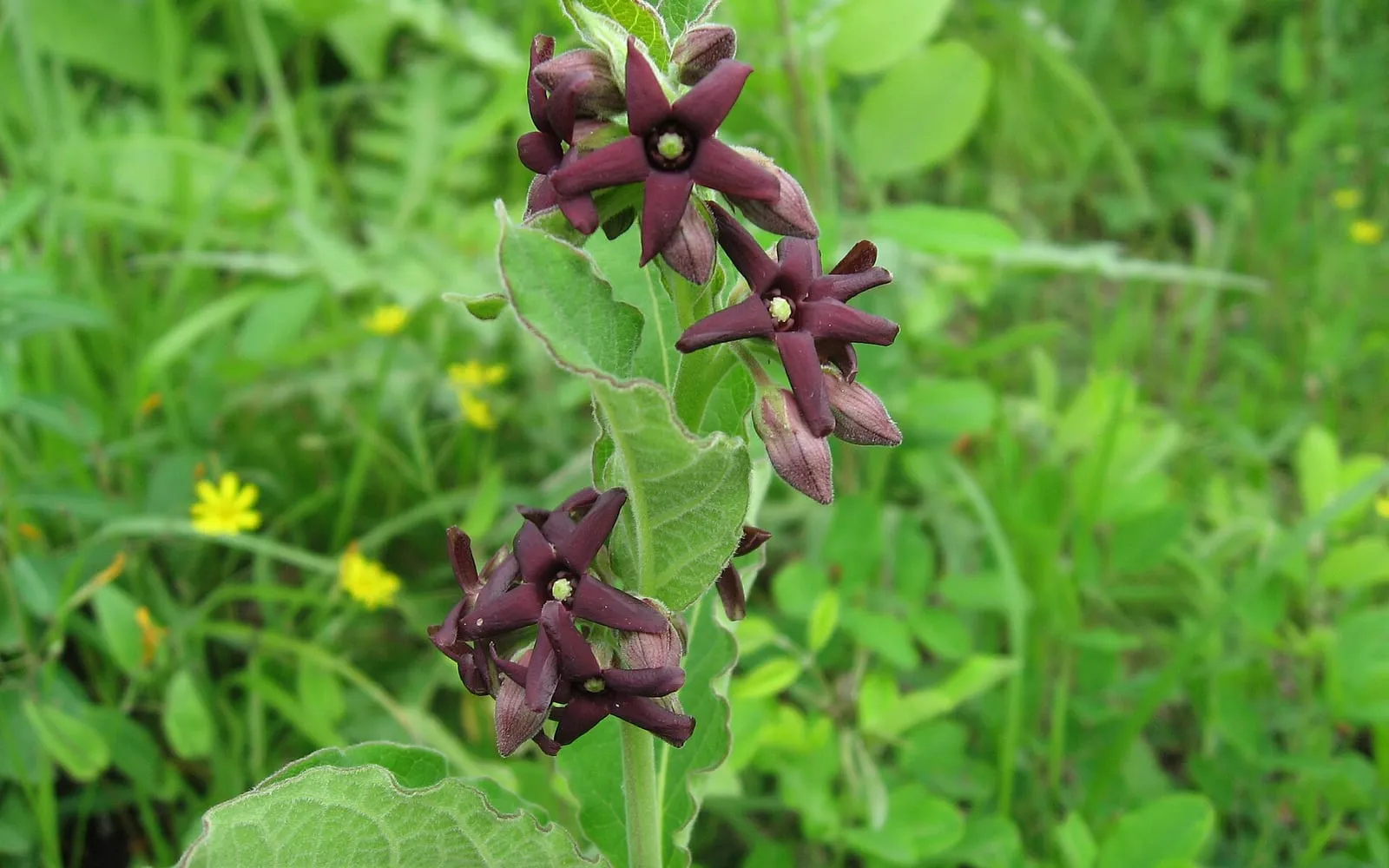
Flowers are small and star-shaped with five lobes, in a dark purple-brown that can look almost black, clustered where the leaves meet the stem and opening in early to mid summer.
Seed pods follow in the manner of the family, slim and pointed, splitting to release seeds carried on silky tufts of hair, though a garden plant may not always set them.
The root is a cluster of slender fleshy roots that is the medicinal bai wei, and it is the part for which the plant is grown and gathered in its native range.
Where it is from
Cynanchum atratum grows across eastern Asia, in China, Korea and Japan, on grassy hillsides, in scrub and thickets and along woodland edges, in sun or light shade on moist, fertile soils. It is a plant of open, grassy, temperate country.
Those conditions make it straightforward in a warm-temperate garden if the soil is decent and it has moisture in summer. It tolerates a fair range of light. Deep winter cold is the main condition it dislikes, and it is not a plant for a severe climate.
How it grows
It grows up each spring from the overwintered root into an upright leafy clump, flowers in early summer, and dies back with the cold. Given moisture and a reasonable soil it is an easy, tough perennial.
Plant it in moist, fertile, free-draining soil in full sun or partial shade, and keep it watered in dry spells. It needs no support and forms a tidy clump rather than spreading aggressively.
Cut the dead stems down in autumn or late winter, and mulch in spring to feed the plant and hold moisture. It can be raised from seed or by careful division of the root in spring, though the root is the medicinal part and is often left undisturbed.
Handle it with gloves if you are cutting a lot of it, since the milky sap can irritate skin, and keep it from your eyes.
Through the seasons
Spring brings new shoots from the root, growing steadily as the soil warms, and the time to divide or mulch.
Early to mid summer is the flowering, the dark star-shaped flowers opening in their axillary clusters, the plant’s main season of interest.
Late summer may bring the slim seed pods, which split to release silky-tufted seeds in the way of the family.
Autumn and winter the plant sets any seed and dies back to the root, resting underground until spring. Cut it down and mulch during this time.
Care difficulty
Moderate, and closer to easy in a temperate climate. It only needs a moist, fertile soil, sun or light shade and protection from the hardest cold, and it grows into a strong, tidy clump with few pests. The one real caution is the irritant milky sap when handling it. As a plant it is undemanding; it is grown for interest and its root instead of for a bold display.
Watering
Keep the soil moist through the growing season, watering in dry spells, since the plant comes from grassy slopes and woodland edges that stay reasonably moist. It is not a drought plant.
An established clump on decent soil needs watering only in a dry spell, and a spring mulch helps hold moisture and reduce the need through summer.
Warning signs, diseases and pests
Aphids may gather on the soft new growth and around the flower clusters, drawn to the sappy stems, and can be dislodged with water or left to natural predators outdoors.
Beyond that it is a tough perennial with few problems, untroubled by most pests and diseases once established.
The milky sap is the main caution. It can irritate skin and eyes, so wash it off promptly and keep it clear of your face, and do not eat any part of the plant.
Growing environment
Full sun to partial shade suits it, with light shade welcome in a hot climate and more sun giving a sturdier plant in a cool one. It is adaptable on light.
The soil should be moist, fertile and free-draining, like the grassy slopes and thicket edges it comes from. It dislikes both drought and cold, waterlogged ground.
Give it a spot in a mixed border or a wildlife or medicinal planting, where its dark flowers and upright habit sit among other perennials. It works best as a quiet part of a planting rather than as a main display plant.
Feeding
Feed lightly. A spring mulch of compost, or a single light dressing of balanced fertiliser on a poor soil, keeps it growing well. It is not a hungry plant, and heavy feeding only pushes soft growth that flops and draws aphids.
Troubleshooting
The stems bleed white sap when cut. That is normal for this family and is the milky latex the plant is known for. The sap can irritate skin and eyes, so handle cut stems with care and wash off any that gets on you.
Is this the invasive black swallow-wort? No. The invasive weed of North America is Vincetoxicum nigrum, a different plant that shares the common name. This is the Asian medicinal species Cynanchum atratum, grown for its root and not known as an aggressive spreader.
Why are the flowers almost black? That dark purple-brown colour is natural and gives the plant its name. The small star-shaped flowers are meant to look that way.
Can I use the root as bai wei? The root is the bai wei of Chinese medicine, but preparing and using it is a matter for a qualified practitioner. The plant contains active compounds and should not be eaten casually.
Is it safe around children and pets? The milky sap can irritate and the plant should not be eaten, so site it with that in mind and teach children not to chew it, though it is not among the most dangerous garden plants. Wash off any sap that gets on skin.