
Houseplant
King Anthurium
Anthurium veitchii
How to grow king anthurium, Anthurium veitchii. Why its huge corrugated leaves need far more humidity than an average anthurium, and what a moss pole does for its pendant habit.
At a glance
- Difficulty
- Difficult
- Water
- When the top layer of the mix has just dried, typically weekly
- Light
- Bright indirect light. Direct sun scorches the thin leaf surface
- Temperature
- 20-27 deg C. Below 16 deg C stalls growth
- Humidity
- 70% or higher. Dry air browns the leaf edges and slows growth badly
- Hardiness
- USDA 11-12, RHS H1b, hardy to 15 C
- Type
- Evergreen epiphytic tropical perennial
- Height
- 1-1.5 m of leaf length on a mature specimen; taller with support
- Native to
- Colombia
A cloud forest epiphyte from the western Andean foothills of Colombia, rooting into mossy bark high in the canopy where mist keeps the air constantly saturated. It has no cold tolerance and no dormancy, and it is markedly less forgiving of dry indoor air than most anthuriums grown as houseplants, since the sheer size of its leaves loses moisture faster than the small, leathery foliage of its lowland relatives.
Hardiness zones describe winter cold alone. Summer heat, humidity, rainfall and the length of the growing season decide as much, so treat the range as the outer limit rather than as a recommendation.
Harmful if eaten
- Do not eat
- Every part, the leaves and stalks most of all
- Harm from
- Eating it and handling it
- Affects
- People, cats and dogs
This species carries the same insoluble calcium oxalate crystals found throughout the anthurium genus. The ASPCA lists Anthurium as toxic to cats and dogs, causing oral irritation, drooling and difficulty swallowing if a piece is chewed, and people handling the sap can develop skin irritation on contact. The burning starts within seconds of a bite, which usually stops an animal or a child taking more than a single mouthful. In practice, a mature specimen of this size is typically grown mounted or trained well off the floor for its own sake, which also happens to keep the enormous leaves further from a curious pet than a small potted houseplant would be.
Sources: ASPCA (Flamingo Flower, Anthurium andraeanum), RHS potentially harmful garden plants
About
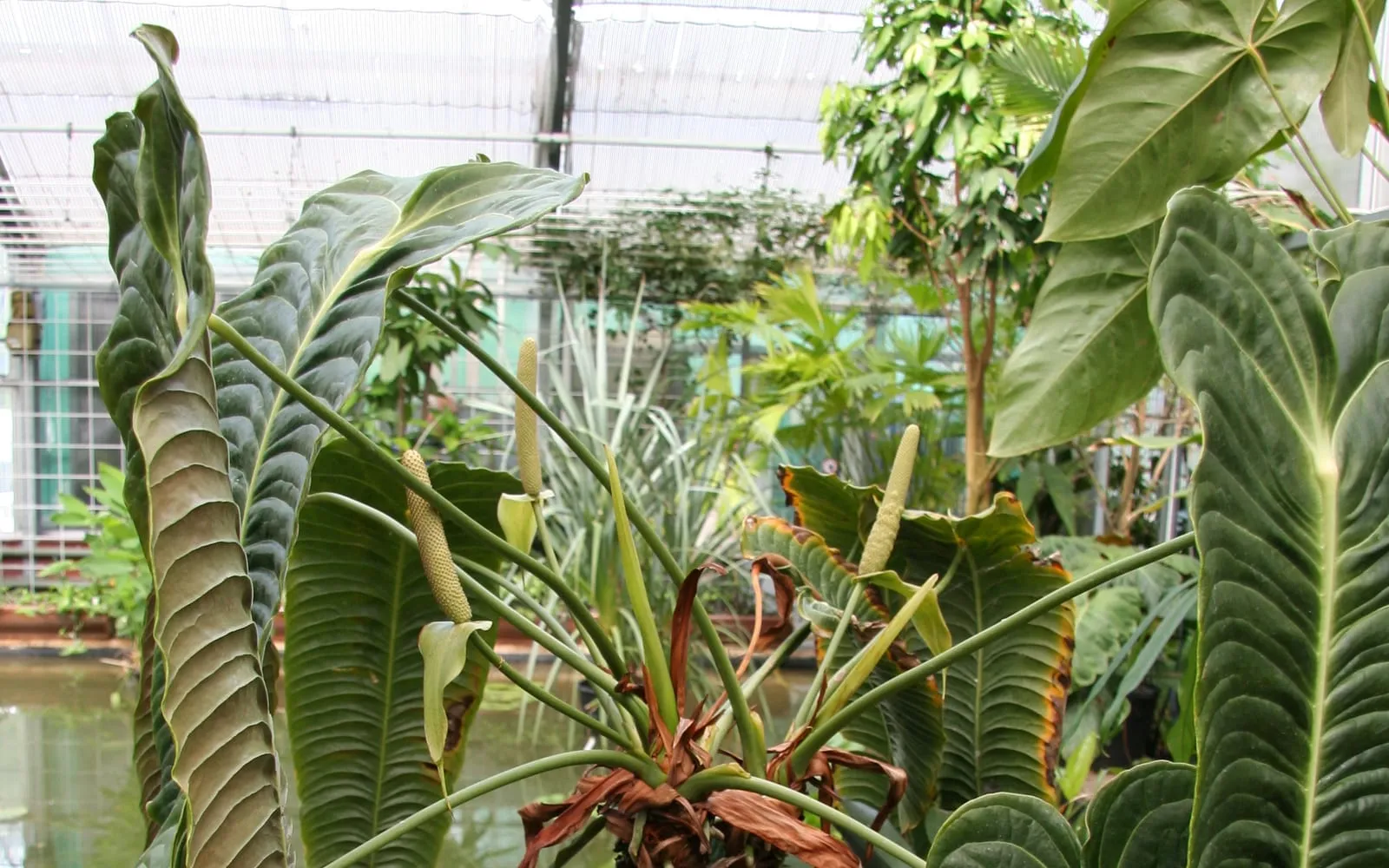
King anthurium is grown for scale and texture rather than for any flower. Its leaves are the largest of any commonly cultivated anthurium, deeply pleated like corrugated card and, once a plant matures, hanging pendant from a climbing stem instead of standing upright the way most foliage houseplants do.
It is a demanding plant to grow well indoors, needing more humidity and more vertical space than almost anything else sold as a houseplant. A young plant in a small pot gives little hint of what a mature specimen eventually becomes, and getting there takes years of consistent conditions rather than any one trick.
Appearance and character
Leaves emerge narrow and relatively flat, then lengthen and develop their signature deep corrugation as they mature, eventually reaching 60 cm or more even on a modestly sized indoor plant and considerably longer on an established specimen given the height and humidity it needs. The surface is deeply quilted between the veins, catching light in a way that makes the whole leaf look almost hammered.
Colour is a dark, matte green, deepening further as each leaf ages. Young leaves are notably thinner and more upright than the older, heavier ones, which arch and eventually hang down once the plant has enough stem length behind them, the pendant habit that gives the plant its common name and its collector appeal.
The stem climbs slowly, clinging to whatever support it is given with aerial roots, and a plant grown without something to climb tends to stay smaller and less impressive than one trained up a moss pole or similar mount from an early stage.
Where it is from
Anthurium veitchii grows as an epiphyte in the cloud forests of the western Andean foothills of Colombia, rooting into mossy bark high in the canopy where near-constant mist keeps humidity saturated and light filters down softened by the trees above.
That canopy habitat explains why this species struggles more than most anthuriums in an average home. Air at canopy height in a cloud forest rarely drops much below full humidity, a condition almost no indoor room replicates without deliberate help, and the plant’s large, thin leaves lose water through their surface faster than the small, tougher leaves of an anthurium adapted to a drier lowland habitat.
Its epiphytic roots also explain why an ordinary dense potting compost suits it so badly. In the wild these roots grip bark and take up water from mist and rain that drains away within minutes, never soil that stays wet for hours or days.
How it grows
Pot it in a very chunky, free-draining aroid mix, bark, sphagnum moss and perlite in roughly equal measure, and provide a totem or moss pole from an early stage so the climbing stem has something to grip as it grows.
Growth is slow, particularly in the first couple of years, and speeds up somewhat once the plant has established a reasonable root system and stem length. Each new leaf tends to be larger than the last, which shows that the plant is settling in well.
Repot every year or two as roots fill the current pot, moving up one size at a time and refreshing the chunky mix, which breaks down and compacts faster than ordinary compost does.
Propagate by stem cuttings that include at least one node and some aerial roots, rooted in damp sphagnum moss under high humidity. Division of an offset at the base works too on a plant mature enough to have produced one.
Through the seasons
Spring brings the start of the strongest growth of the year. Repot if the roots have filled the pot and resume fortnightly feeding.
Summer is peak growth. Water as the mix dries, keep humidity as high as you can manage, and watch closely for spider mite in any hot, dry spell.
Autumn slows growth gradually. Reduce feeding towards the end of the season.
Winter is a quieter period rather than true dormancy. Water a little less often, keep the plant well away from cold glass and draughts, and reduce to monthly feeding.
Care difficulty
Difficult, and humidity is the single biggest reason. This species needs conditions closer to a greenhouse or enclosed cabinet than an open living room, and a plant kept in average household humidity grows slowly, browns at the leaf edges, and never develops the size or texture it is capable of.
Space is the second real constraint. A mature specimen needs height and room to hang its leaves, which rules it out for anyone without a tall, bright spot to give it, and a plant kept perpetually cramped never shows what makes the species worth growing in the first place.
Watering
Water when the top layer of the mix has just dried, typically weekly, adjusting for how warm and humid the room is running.
Water thoroughly until it drains freely from the pot, and avoid letting the chunky mix dry out completely for long stretches, since this species has less drought tolerance than its smaller-leaved relatives despite its free-draining compost.
Misting the leaves adds some short-term humidity but is not a substitute for raising humidity in the room itself, which matters far more to this plant’s long-term growth than any watering routine does.
Warning signs, diseases and pests
Mealybug gathers in the leaf crown and along the climbing stem, showing as small white, cottony tufts. Remove them with a cotton bud dipped in diluted alcohol.
Scale insects appear as small, flat brown discs on stems and leaf undersides. Treat the same way as mealybug and inspect regularly, since scale is easy to miss on a plant this size until numbers build up.
Spider mite favours warm, dry indoor air and shows as fine pale speckling on the leaves, sometimes with webbing in advanced cases. Raising humidity is both prevention and part of the cure.
Root rot follows a mix that stays wet, showing as a stem that softens near the base and leaves that yellow despite otherwise reasonable care. Repot into fresh, properly chunky mix and cut back watering if it has already started.
Growing environment
Bright indirect light suits it best. Direct sun scorches the thin leaf surface, while too little light slows an already slow-growing plant even further.
Keep the room between about 20 and 27 deg C. Growth stalls below about 16 deg C, and this species has essentially no cold tolerance at any stage.
Humidity of 70% or higher is necessary for good growth rather than merely helpful. A humidifier running consistently, or a greenhouse cabinet, gives far more reliable results than a pebble tray alone.
A very chunky, free-draining aroid mix suits the epiphytic roots best. Bark, sphagnum moss and perlite in roughly equal parts, mounted against or trained up a moss pole, comes closest to how this species grows in the wild.
Feeding
Feed fortnightly through spring and summer with a balanced liquid houseplant fertiliser diluted to half strength, which supports the large leaves this species is grown for without overwhelming its relatively slow root system.
Reduce to monthly feeding over winter rather than stopping entirely, since a plant kept warm and humid through winter continues some growth even in the quieter months.
Flush the mix with plain water every couple of months to clear accumulated salts, particularly important in a bark and sphagnum mix that holds fertiliser residue more than ordinary compost does.
Troubleshooting
Growth has almost stopped even though the plant looks healthy. Humidity is the most likely limiting factor. This species needs more than an average room provides, and a humidifier run consistently often restarts growth within a few weeks.
The leaf edges are browning steadily. Dry air, almost always. Raise humidity around the plant and check it is not sitting near a heating vent or an air conditioning outlet.
The leaves have stayed flat and never developed the deep corrugation I expected. Age and light. The pleated texture develops more strongly as the plant matures and with consistently bright conditions, so a young plant’s leaves may not have caught up yet.
The stem has gone soft near the base. Root or stem rot from a mix that has stayed too wet. Cut back to firm, healthy tissue, repot into fresh chunky mix, and water less often going forward.
Does it need a moss pole to grow well? Not strictly, but it grows better with one. Given something to climb, the stem lengthens and the leaves develop their full pendant habit; left without support, the plant tends to stay smaller and less dramatic.
King Anthurium problem guides
Not sure what is wrong? See the common houseplant pests guide.