
Houseplant
Cape Sundew
Drosera capensis
Also known as African Sundew
How to grow Drosera capensis on a windowsill. Sticky tentacles that bend around trapped prey within the hour, and why it needs no winter rest.
At a glance
- Difficulty
- Easy
- Water
- Keep the compost constantly damp; never let it dry out
- Light
- Bright light, ideally several hours of direct sun
- Temperature
- 10-35 deg C; tolerates brief dips towards 5 deg C
- Humidity
- Ordinary room humidity is fine
- Hardiness
- USDA 9-11, RHS H2, hardy to 2 C
- Type
- Tender evergreen perennial
- Height
- 15-30 cm
- Native to
- Southern Africa
From the winter-rainfall Cape region of South Africa, where summers are dry and mild rather than scorching and winters are cool and wet rather than frozen. That even, mild year-round climate is why it grows and traps continuously indoors with no dormancy at all, unlike almost every other sundew in this genus.
Hardiness zones describe winter cold alone. Summer heat, humidity, rainfall and the length of the growing season decide as much, so treat the range as the outer limit rather than as a recommendation.
Not known to be toxic
Cape sundew has no toxicity listing from the RHS or the ASPCA. The sticky mucilage on its leaves is a trap and digestive fluid for insects, not a defensive toxin, and there is no documented case of it causing harm to a person or a pet.
Source: RHS
About
Cape sundew is where most people meet carnivorous plants for the first time, and there is a reason it ends up on so many windowsills. It grows fast, tolerates a fair amount of neglect, produces sticky red leaves that visibly close around anything that lands on them, and needs none of the elaborate winter rest that trips up beginners with other sundews.
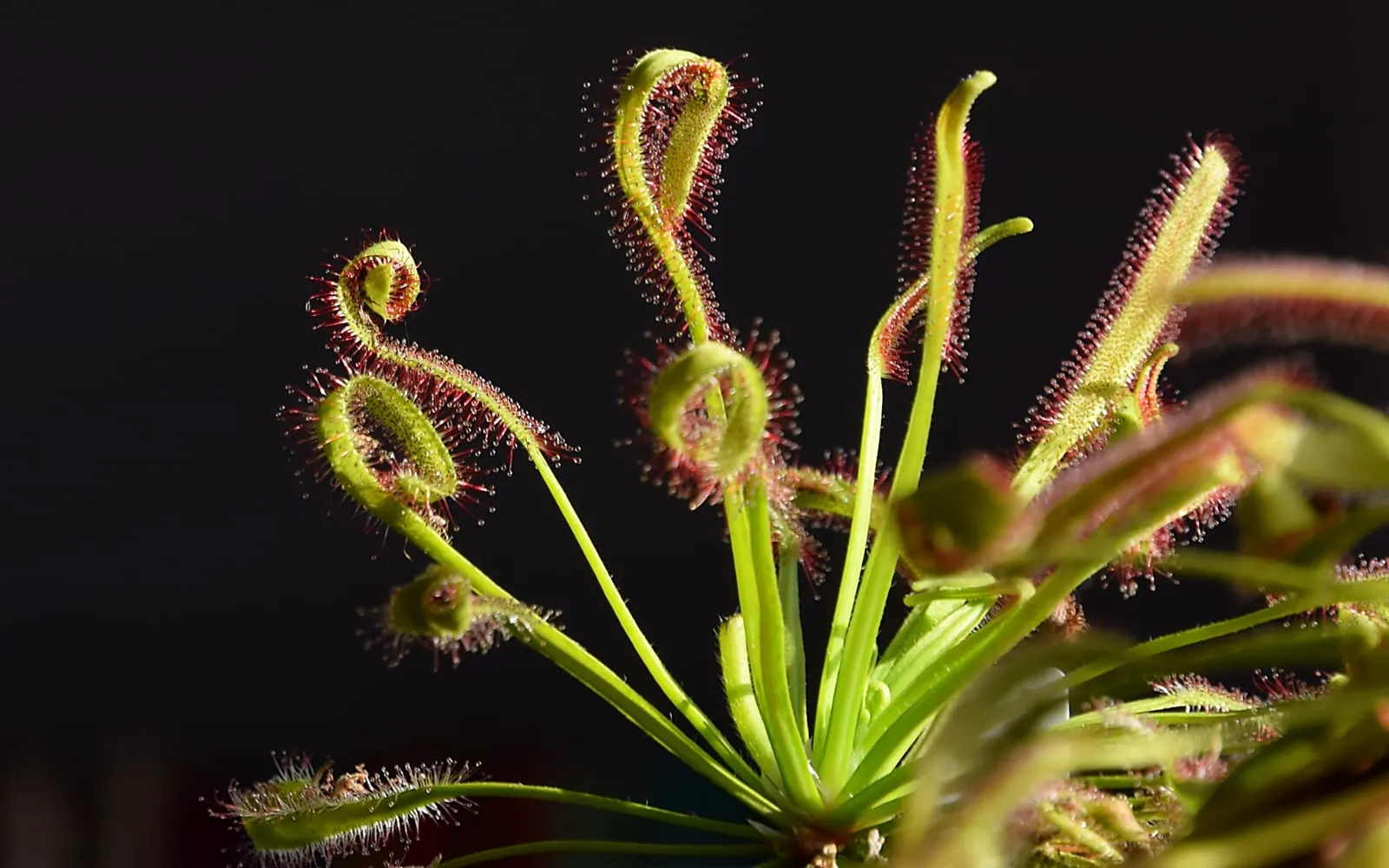
Its trap is a flypaper rather than a snap trap. Each narrow leaf is covered in hundreds of stalked glands, tipped with a bead of glistening mucilage that looks like dew and functions as glue. An insect that brushes against one gland struggles, touches more, and is quickly held fast by dozens of them at once. Over the following hour or two the whole leaf slowly curls lengthwise around the prey, drawing it against a wider surface of digestive glands, a movement that can be watched, in real time, if you have the patience to sit with one long enough.
It self-seeds with almost no encouragement, and a single mature plant left to flower in a sunny spot will often produce a scatter of seedlings around its own pot within a season.
Appearance and character
Leaves grow upright in a loose rosette, each a narrow strap five to ten centimetres long, covered from base to tip in red or reddish-green tentacles tipped with sparkling drops of mucilage. New leaves emerge tightly coiled at the centre, in a distinctive fiddlehead curl, and unfurl gradually as they mature, so a healthy plant usually shows leaves at several different stages of opening at once.
Colour depends heavily on light. A plant given strong direct sun turns a deep, almost uniform red across every tentacle, while one grown in weaker light stays mostly green with only the gland tips showing colour, and grows noticeably leggier as it stretches for more light.
Slim flower stalks rise well above the foliage in summer, carrying a string of small pink, five-petalled flowers that open one or two at a time and self-pollinate readily, which is the source of its enthusiastic seeding.
Where it is from
The Cape region of South Africa, in damp, sandy or peaty ground that stays wet through winter and dries only moderately in summer, under a Mediterranean-type climate with mild temperatures year-round.
Because neither the summers nor the winters at home are severe, the plant never evolved a need to shut down, and it keeps growing and trapping through every month of the year given reasonably steady warmth and light, which is the main reason it adapts so readily to being grown indoors permanently rather than in an outdoor bog bed.
How it grows
Growth is continuous rather than seasonal, with new leaves unfurling every few weeks through spring, summer and autumn, and slowing only modestly over a cooler, darker winter rather than stopping outright. A healthy rosette steadily gets taller and bushier, and older leaves at the base gradually brown and can be trimmed away once they have finished working.
Propagation is straightforward from several directions: leaf cuttings laid flat on damp sphagnum will root and produce plantlets along their length, root cuttings work almost as reliably, and seed sown on the surface of damp peat germinates within a few weeks under bright light. Because it seeds itself so freely, many growers end up with more plants than they intended without deliberately propagating anything.
Through the seasons
Spring brings a burst of new leaf growth as light strengthens, and flower stalks usually appear by mid to late spring.
Summer is the peak growing and flowering season. Keep it in full sun with the compost constantly wet, and expect a steady supply of self-sown seedlings if a flower stalk is allowed to set seed.
Autumn growth slows gradually as light fades, though the plant keeps producing new leaves rather than stopping.
Winter asks only for reduced watering frequency and a slightly cooler spot if one is available, not a true dormancy. A windowsill that drops towards 10 to 15 deg C overnight suits it well; anything close to freezing should be avoided, since this species has no cold tolerance to speak of.
Care difficulty
Easy, and often recommended as the first carnivorous plant to try. It tolerates a wider range of light and humidity than most of its relatives, grows quickly enough that mistakes show up and can be corrected fast, and needs no complicated dormancy period.
The main things it will not forgive are drying out completely and being watered with tap water, both of which show up within days rather than weeks.
Watering
Keep the compost constantly damp, never allowing it to dry out even briefly. Standing the pot in a saucer holding 1 to 2 cm of rainwater or distilled water is the most reliable method, topped up as it is drawn up through the compost.
Tap water, mineral water and softened water all carry dissolved salts that build up in the peat and eventually damage the roots, showing first as blackened leaf tips and stunted new growth. Rainwater collected from a water butt, or water that has been through a reverse osmosis or distillation process, are both suitable substitutes where rain is scarce.
Warning signs, diseases and pests
Aphids sometimes target the flower stalks rather than the sticky leaves, since the leaves themselves offer little foothold for most insects. Wipe them off by hand or spray the stalk with water; established plants rarely suffer lasting harm.
Mealybugs can settle at the base of the rosette among older, less sticky tissue. Remove them with a cotton bud dipped in diluted washing-up water, checking again after a week or two for any missed.
Botrytis, a grey mould, occasionally develops on dead leaf bases in crowded, poorly ventilated conditions. Trim away affected material and space plants further apart to improve airflow.
Leaves that have stopped producing sticky dew, looking dry and dull rather than glistening, usually mean the plant has been kept too dry or the humidity has dropped too low for a spell; increased watering typically brings new leaves back to full stickiness within a couple of weeks.
Growing environment
Bright light has the strongest effect on how well this species performs; several hours of direct sun daily produces a compact, deeply coloured plant, while low light produces a pale, floppy one that traps poorly. A south or west-facing windowsill, or a grow light kept close to the foliage, both work well.
Ordinary room humidity is perfectly adequate, which sets it apart from most tropical carnivorous plants and is part of why it succeeds as a low-fuss houseplant. Keep it within 10 to 35 deg C, with only brief dips towards 5 deg C tolerated and nothing colder.
Grow it in a nutrient-poor, low-mineral mix such as peat-free sphagnum moss combined with perlite, in a pot with drainage, standing in a shallow tray of rainwater.
Feeding
No fertiliser of any kind applied to the compost. The plant catches fruit flies, fungus gnats and other small insects on its sticky leaves without help, and a windowsill plant usually gets enough passing insects to sustain itself.
If insects are scarce, a small pinch of dried bloodworm or fish flake placed on a leaf, moistened slightly to trigger the digestive response, can be offered every few weeks, though most growers find it unnecessary once the plant is established.
Troubleshooting
Leaves have stopped producing sticky dew. Usually a sign the plant has dried out or humidity has dropped. Increase watering and check new leaves recover their stickiness as they emerge.
The rosette is tall, pale and leggy. Not enough light. Move it somewhere brighter; deep red colouring is a reliable sign the light level is right.
Seedlings are appearing all around the pot. Expected, not a fault. This species self-seeds readily once a flower stalk is allowed to mature; remove seedlings if unwanted or pot them up individually.
A leaf has curled around nothing at all. Sundew leaves sometimes curl in response to being brushed, watered heavily, or handled, not only in response to prey. It will unfurl again over the following days.
Black, dry patches are appearing at the leaf tips. A sign of mineral buildup from tap water. Flush the compost with rainwater repeatedly and switch to rainwater or distilled water going forward.
The flower stalk is tall and floppy, flopping over the rosette. Ordinary growth habit rather than a problem; the stalks are thin and often need no support, though a discreet cane can be used if it becomes untidy.
Can it be grown outdoors in summer? Yes, in a sheltered, sunny spot once night temperatures stay reliably above 10 deg C, but bring it back indoors before the first cold snap, since it has no frost tolerance at all.
Cape Sundew problem guides
Not sure what is wrong? See the common houseplant pests guide.