
Edible
Oregon Grape
Mahonia aquifolium
Also known as Holly-leaved barberry, Mountain grape, Mahonia
How to grow Oregon grape, Mahonia aquifolium. The shade-tolerant evergreen with holly leaves, its yellow spring flowers and blue berries, and the berberine in its root.
At a glance
- Difficulty
- Easy
- Water
- Weekly for the first two summers, then rarely
- Light
- Part shade to full shade. It tolerates deep shade better than most
- Temperature
- Fully hardy, to about -25 deg C
- Hardiness
- USDA 5-9, RHS H6, hardy to -25 C
- Type
- Hardy evergreen shrub
- Height
- 100-180 cm, occasionally 2 m
- Native to
- western North America
- Best month
- March and April in the Northern Hemisphere, September and October in the Southern Hemisphere
Dry shade is where it is most useful, since few evergreens crop fruit in it, and cold does not trouble it. It has naturalised widely across central and northern Europe from gardens and is treated as invasive in Germany and the Netherlands. Birds do the spreading.
Hardiness zones describe winter cold alone. Summer heat, humidity, rainfall and the length of the growing season decide as much, so treat the range as the outer limit rather than as a recommendation.
Every month named in this guide is for the temperate Northern Hemisphere. If you garden in the Southern Hemisphere, shift each one by six months, so March becomes September. Closer to the equator the wet and dry seasons matter more than the calendar, and the shift stops being a useful guide.
Edible, with limits
- Safe to eat
- The ripe berries, which are edible and very tart
- Do not eat
- The root and stem bark, which are rich in berberine
- Harm from
- Eating it
- Affects
- People
The berries are edible. They are tart and full of seed, and they make a good jelly, which is the traditional use in the Pacific Northwest. The root and inner bark are a different matter: they are a concentrated source of berberine, the yellow alkaloid that also colours barberry and goldenseal, and berberine in quantity causes stomach upset, and is advised against in pregnancy and for newborns because of its effect on bilirubin. Oregon grape root preparations are sold as herbal medicines and are not something to improvise with. The RHS does not list Mahonia aquifolium among potentially harmful garden plants and the ASPCA holds no entry for it, so as a garden shrub it presents no meaningful risk beyond its spiny leaves, which are sharp enough to draw blood when weeding underneath.
Sources: RHS potentially harmful garden plants, ASPCA toxic and non-toxic plants
About
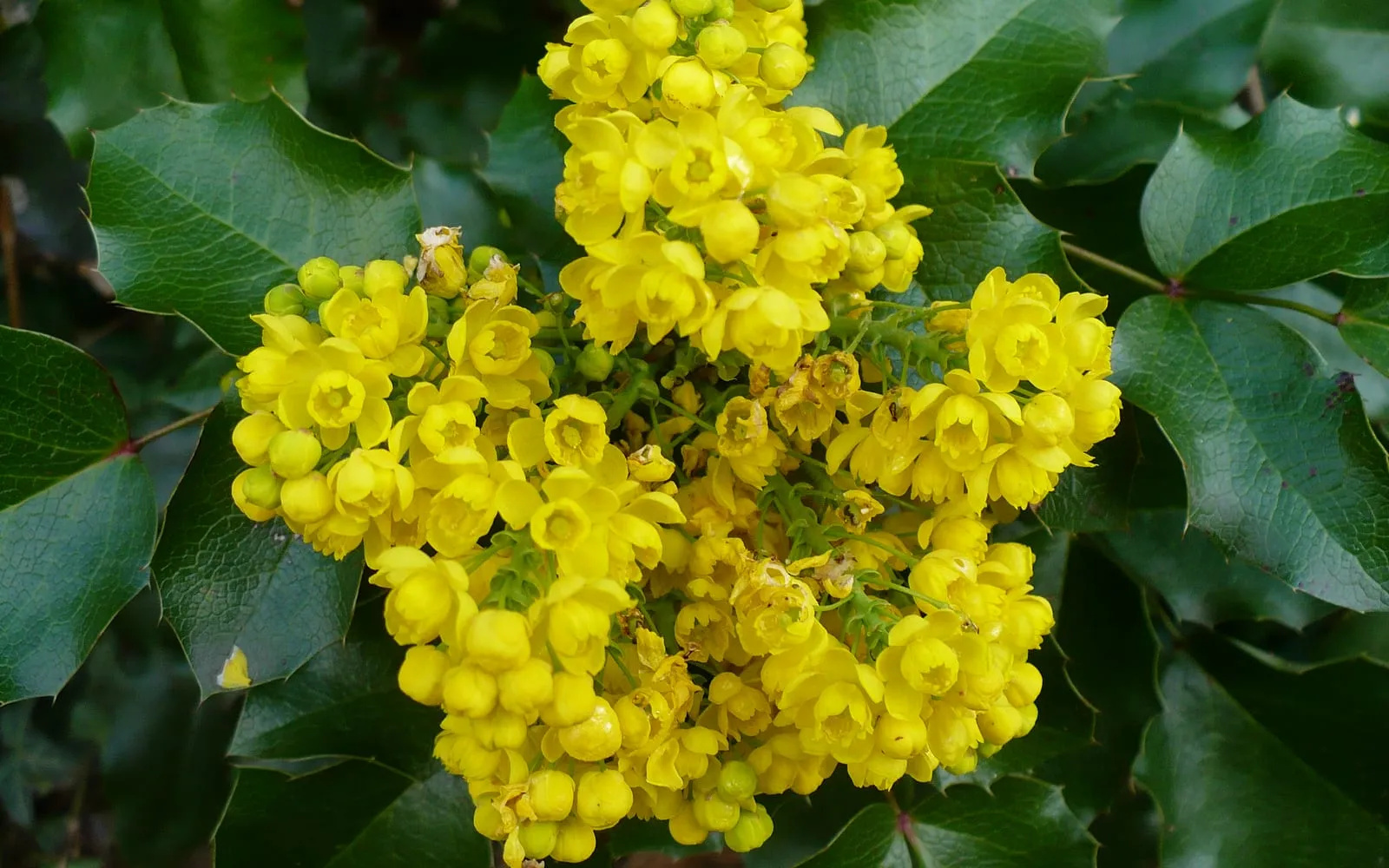
Oregon grape is one of the most useful evergreens for a difficult shady corner. It takes dry shade under trees, it is fully hardy, it flowers bright yellow in March when little else does, and it carries blue-black berries through late summer.
The leaves look like holly and belong to the barberry family. They are glossy, spined along every margin, and they flush bronze and purple in a cold winter, which is one of the better winter effects available from a plant that asks for nothing.
It suckers. Over ten years a single plant becomes a low thicket a couple of metres across, which is exactly what you want for ground cover under trees and a nuisance in a small border. Choose the position with that in mind.
Appearance and character
An upright evergreen shrub, 1 to 1.8 m, spreading by suckers into a broad clump.
Leaves are pinnate, 15 to 30 cm long, with five to nine glossy leaflets, each edged with sharp spines in the manner of holly. New growth is coppery red and mature foliage is dark glossy green, turning bronze and purple through winter.
Flowers open in dense upright clusters at the shoot tips in March and April, bright yellow and honey-scented, and they are one of the first substantial nectar sources of the year.
Berries follow from July, round, blue-black with a waxy bloom, hanging in bunches that do look faintly like small grapes.
Stems are stout with corky brown bark, and the wood is bright yellow inside from the berberine, which is visible the moment you cut one.
The plant holds its shape without pruning and needs none for years.
Where it is from
Oregon grape is native to western North America, from British Columbia south through Washington, Oregon and northern California, growing in coniferous forest and on open rocky slopes.
It is the state flower of Oregon, adopted in 1899.
Indigenous peoples of the Pacific Northwest used the root as a yellow dye and as a medicine, and ate the berries, usually mixed with sweeter fruit because they are so tart.
David Douglas introduced it to Britain in the 1820s, and it was expensive and fashionable for a decade before becoming so widely planted that it naturalised in woodland across much of the country.
Victorian estates planted it as pheasant cover, which is why it turns up in quantity in old plantations and shelter belts, and it has spread from there.
How it grows
Buy a plant. Named forms such as Apollo are more compact and flower more heavily than the species.
Alternatively divide a suckering clump in autumn, or take semi-ripe cuttings in late summer.
Plant in autumn or spring into any reasonable soil in part or full shade. It tolerates dry shade under trees better than almost any other evergreen.
Space at 1 m for ground cover, or give a single specimen 1.5 m.
Water for the first two summers while it establishes, then leave it.
Prune only to control size or to renovate. Cutting stems to the ground in spring produces vigorous new growth, and the plant takes hard renovation well.
Mulch with leaf mould or compost in spring, which suits a woodland plant.
Remove suckers with a spade each spring if you want to keep it in bounds.
Harvest berries in late summer for jelly, which needs a good deal of sugar.
Through the seasons
Winter is when the foliage colours, going bronze and purple in cold weather. Flower buds are visible from January.
Early spring is flowering, in March and April, bright yellow and scented, and the bees find it before almost anything else.
Late spring brings the coppery new growth, which is a second display in its own way.
Summer is when the berries form and ripen from July, going from green to waxy blue-black.
Autumn is planting and dividing time, and the last of the berries go to the birds.
Care difficulty
Easy. Oregon grape is one of the least demanding shrubs in this collection and it succeeds in conditions that defeat most plants.
Dry shade is where it earns its place. Under trees, against a north wall or in the shadow of a building, it grows steadily where laurel struggles and most flowering shrubs fail.
Suckering is the one thing to plan for. It spreads into a thicket over years, which is a feature in a woodland planting and a problem in a small bed. Remove suckers with a spade or accept the spread.
Mahonia rust spots the leaves in a damp season. It is disfiguring rather than dangerous, and removing the worst leaves is enough.
The spines make weeding underneath a job for thick gloves.
Beyond that it needs no feeding, no watering once established and no regular pruning.
Watering
Water weekly through the first two summers while the roots establish.
After that, nothing. An established plant copes with dry shade, which is a harder condition than open drought because tree roots take the moisture first.
Water in an extended drought if a young plant is wilting.
Mulch with leaf mould or compost in spring, which does more for a woodland shrub than watering.
A container needs weekly watering in summer and is a workable option for a compact cultivar, though the plant is happier in the ground.
Water at the base rather than over the foliage.
Warning signs, diseases and pests
Mahonia rust produces dark red and orange spots on the leaves, worst in a damp season and on plants in still air. Remove badly affected leaves and improve airflow. It rarely threatens the plant.
Powdery mildew whitens the foliage on a crowded shaded plant.
Leaf scorch browns the margins on foliage exposed to cold drying wind in winter, particularly on a plant in an open site. Move it or accept it.
Vine weevil notches the leaf edges in neat semicircles, and the grubs eat the roots of container plants. Treat pots with nematodes.
Yellowing leaves on very alkaline soil mean the plant would rather have slightly acid ground. Mulch with leaf mould.
Suckers a metre from the plant are normal behaviour rather than a problem.
Bare leggy stems with growth only at the top mean the plant needs renovating. Cut stems to the ground in spring.
Growing environment
Part shade to full shade. It flowers and fruits better with some light and tolerates deep shade better than nearly anything else evergreen.
Any reasonable soil that drains. It prefers slightly acid, humus-rich ground and grows on chalk with a little yellowing.
pH from 5 to 7.5.
Dry shade under trees, a north-facing border, the base of a wall or a woodland edge all suit it, and it is one of the standard answers to those positions.
It is fully hardy anywhere in its range, though foliage scorches in cold wind on an exposed site.
For wildlife it is valuable twice over, feeding early bees in March and birds in late summer, which is more than most evergreen shrubs manage.
Feeding
Little is needed. Mulch with leaf mould or garden compost in spring, spread over the root area.
A balanced feed once in spring helps a young plant establish and is unnecessary afterwards.
Avoid high-nitrogen feeds, which produce soft growth that scorches in winter wind.
Feed a container plant with a balanced feed monthly through summer.
On very alkaline soil, an ericaceous feed or a mulch of composted bark helps with yellowing.
Troubleshooting
It is spreading everywhere. Suckering is what the plant does. Cut suckers away with a spade each spring, or plant it where a thicket is welcome.
Orange and red spots on the leaves. Mahonia rust, common in a damp year. Remove the worst leaves and improve airflow. It does not kill the plant.
Can I eat the berries? Yes, and they are very tart and seedy. They make a good jelly with plenty of sugar, which is the traditional use.
Is the root medicinal? It contains berberine and is sold as a herbal preparation. It causes stomach upset in quantity and is advised against in pregnancy, so it is not something to improvise with.
It has gone bare and leggy. Renovate it. Cut stems to the ground in spring and it will regrow strongly.
The leaves went brown at the edges. Cold wind scorch over winter, common on an exposed site. Move it into shelter.
Will it grow in dry shade? Yes, and that is its main garden use. Water it for the first two summers and it will manage on its own afterwards.