
Houseplant
Neem
Azadirachta indica
Also known as Margosa, Indian lilac, Nimba
How to grow Azadirachta indica indoors outside the tropics. A conservatory tree that needs constant warmth, why it cannot legally be sold as a pesticide in Britain, and the infant poisoning record.
At a glance
- Difficulty
- Moderate
- Water
- When the top few centimetres are dry in summer, sparingly in winter
- Light
- As much direct light as you can give it
- Temperature
- Tender. Never below 10 deg C, and it prefers 25 to 35
- Humidity
- Moderate. It tolerates dry air better than most tropical trees
- Hardiness
- USDA 10-12, RHS H1b, hardy to 10 C
- Type
- Evergreen tree, grown as a container plant outside USDA 10
- Height
- 15-20 m outdoors, 2-3 m in a large pot
- Native to
- the Indian subcontinent, Myanmar
The dry tropics of the Indian subcontinent, and a 20 m tree in the ground. It is drought-hardy to a fault and frost-tender absolutely, dying outright at 0 deg C. Outdoors year round in USDA 10 and warmer, though it is a declared weed across the Northern Territory of Australia and invasive in parts of west Africa, so check before planting one out.
Hardiness zones describe winter cold alone. Summer heat, humidity, rainfall and the length of the growing season decide as much, so treat the range as the outer limit rather than as a recommendation.
Toxic if eaten
- Do not eat
- The seed oil above all, and the fruit stones
- Harm from
- Eating it
- Affects
- People, cats and dogs
The tree is handled daily across India, where twigs are used as toothbrushes and leaves go into stored grain, and the leaf has no record of harm in ordinary use. The concentrated seed oil is a different substance. LiverTox, the United States National Library of Medicine reference on drug-induced liver injury, carries a monograph on margosa oil recording severe and sometimes fatal poisoning in infants and young children given neem oil, producing vomiting, drowsiness, seizures and liver injury in a pattern resembling Reye syndrome. Neem oil should be kept away from children and never given to them. The tree does not appear on the RHS list of potentially harmful garden plants and the ASPCA does not list it, both of which reflect its absence from temperate gardens and North America. Neem is also documented as an antifertility agent in animal studies and is traditionally avoided in pregnancy. Handling the plant, brushing past it or potting it on carries no known risk.
Sources: LiverTox, Margosa oil, RHS potentially harmful garden plants, ASPCA toxic and non-toxic plants, NHS on herbal medicines
About
Neem is the tree that Indian villages are built around. It grows on poor dry ground where little else does, holds its leaves through the hot season, and supplies shade, timber, toothbrush twigs, leaves for the grain store and oil from the seed. Sanskrit texts name it, and it has been planted along roads and around temples for as long as there are records.
The oil is what brought it to Western attention. Neem seed contains azadirachtin, a compound that disrupts insect moulting and feeding, and from the 1970s onward it was studied hard as a botanical insecticide. That research is also why the tree turns up on so many gardening forums, usually alongside advice a gardener in Britain cannot legally follow.
As a plant to grow here it is a conservatory tree. It needs heat all year, strong light and free-draining compost, and it will not survive a cool temperate winter outdoors under any circumstances. Grown in a large pot it makes a graceful small tree with fine feathery evergreen foliage.
Appearance and character
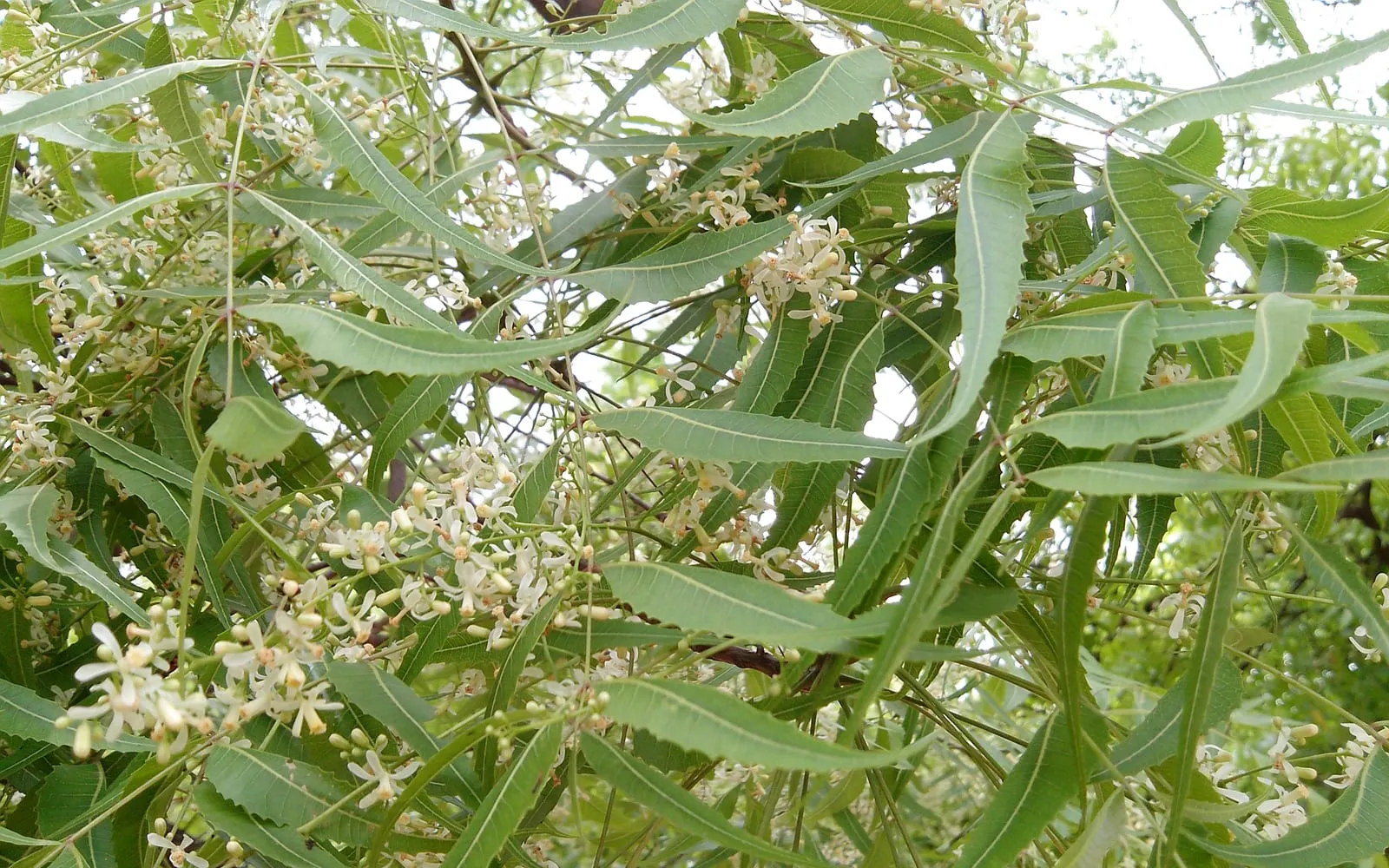
Leaves are pinnate, 20 to 40 cm long, with nine to fifteen leaflets arranged along a central stalk. Each leaflet is narrow, curved like a sickle, sharply toothed, and comes to a fine point, and new growth flushes red-bronze before turning deep green.
The tree is evergreen in constant warmth and drops its leaves in a severe drought or a cold snap, which is what a conservatory plant does after any sudden chill. It recovers if the roots are sound.
Flowers, which a potted plant rarely produces, come in loose sprays of small white five-petalled flowers with a strong honey scent. The fruit that follows is a smooth green drupe ripening yellow, about 2 cm long, looking like a small olive, with a single seed inside. That seed is the source of the oil.
Where it is from
Neem is native to the Indian subcontinent and Myanmar, in dry deciduous forest and open country, and it has been planted so widely for so long that its exact original range is uncertain. It grows on poor stony soil, tolerates drought and salt, and survives in places with 400 mm of annual rainfall.
It has been introduced across Africa, the Middle East, the Caribbean, Australia and Central America, both for shade and for the oil, and it has naturalised widely. In parts of West Africa and northern Australia it is treated as an invasive tree.
What it cannot take is cold. Neem is damaged below about 4 deg C and killed by frost, which is what confines it to a heated glasshouse outside the tropics and to the tropics and subtropics everywhere else.
How it grows
Growth is fast in the warmth it wants, and a seedling can reach a metre in its first year at 30 deg C. In a conservatory at 15 to 20 deg C in winter it grows through the summer and then stops, which is normal.
Seed is the usual route and it is awkward. Neem seed loses viability within a few weeks of ripening, so old seed from a packet almost never germinates, and fresh seed from a reliable source is the only reliable start. Semi-ripe cuttings root with bottom heat.
The tree is deep-rooted, which is what makes it drought tolerant in the field and what makes it want a deep pot in cultivation. Pot on annually while young, and top-dress once the plant is in its final container.
Through the seasons
Growth runs from April to September in a Northern Hemisphere conservatory. Feed monthly, water when the top of the compost dries, and give the plant every hour of direct light available.
From October, cut watering right back and stop feeding. The plant is not dormant so much as idling, and cold wet compost is what kills conservatory neem trees over winter.
Prune in spring if the plant needs shaping, cutting back to an outward-facing bud. It responds well to pruning and can be kept at two metres indefinitely. Repot in April every second year.
Care difficulty
The plant is not difficult, and its requirements are hard to meet in a cool temperate house. It wants year-round warmth above 10 deg C, high light, and compost that never stays wet, and an ordinary centrally heated room in winter is darker than it wants.
Leaf drop is the symptom people report, and a chill almost always precedes it. A cold windowsill will do it, so will an open door in January or a delivery left standing outside. The plant usually recovers from a warm dry rest and does not always.
Sourcing is the other difficulty. Fresh viable seed is hard to buy outside its range and established plants are uncommon, so most attempts start with seed that has been in a packet too long.
Watering
Water thoroughly in summer whenever the top few centimetres of compost are dry, letting the excess drain away completely. The tree is drought tolerant and does not like sitting wet.
Cut back sharply from October to a fraction of the summer routine. A plant in a cool room in winter uses very little water, and overwatering then is the commonest way to kill it.
Never leave the pot standing in a saucer of water. Free drainage matters more to this plant than humidity, feeding or pot size.
Warning signs, diseases and pests
Red spider mite is the main pest in a warm dry conservatory, producing fine pale speckling on the leaves and eventually webbing. Raising humidity and washing the foliage regularly keep it down.
Scale insects settle along the leaf ribs and stems as small brown limpets, and mealybug collects in leaf axils as white fluff. Both are dealt with by hand on a plant this size, wiping them off with a damp cloth.
Sudden leaf loss is a cultural signal rather than a pest. It follows cold, draughts or a soaking, and the response is warmth, better light and much less water until new growth appears.
Growing environment
The brightest position you can offer, ideally a conservatory or a greenhouse with direct sun. Neem grows in full tropical sun and nothing indoors comes close.
Temperature must stay above 10 deg C at all times and the plant grows properly between 25 and 35. That combination means a heated greenhouse or a warm conservatory rather than a spare room.
Compost should be loam-based with added grit for drainage, in a deep pot with plenty of drainage holes. The tree tolerates poor soil and does not tolerate waterlogging.
Feeding
A balanced liquid feed monthly from April to September supports the season’s growth. Neem is not a hungry plant and half-strength feed suits a container specimen.
Stop feeding entirely from October. A plant that is not growing cannot use fertiliser, and salts accumulating in cold compost damage the roots.
Repot in spring every second year into fresh compost rather than relying on feeding to sustain an exhausted pot.
Troubleshooting
Can I use neem oil as a pesticide in my garden? No. Azadirachtin has no approval for amateur plant protection use in Great Britain, so neem oil cannot legally be sold or used here as a pesticide. Products on sale are labelled as leaf shine or cosmetic oils, and using them against pests would be using an unapproved plant protection product.
Will it survive outside in a cool climate? No. The tree is damaged below about 4 deg C and killed by frost. It can stand outdoors from June to September in a sheltered sunny spot and must come in well before autumn.
Why has my plant dropped all its leaves? Cold, almost certainly, or a cold draught. Move it somewhere warmer and brighter, water much less until new growth appears, and check the roots are sound.
Why will my seed not germinate? Neem seed loses viability within weeks of ripening. Packet seed of any age is usually dead. Fresh seed from a specialist supplier germinates readily in warmth.
Is it safe around children and pets? The tree itself is not a garden hazard. Concentrated neem oil is a different matter and has caused severe poisoning in infants given it by mouth, so keep any oil out of reach and never give it to a child.
How big will it get in a pot? Two to three metres over many years, and it responds well to pruning, so it can be held smaller. In the ground in the tropics it reaches twenty metres.
Why are the leaves speckled and dull? Red spider mite in dry warm air. Look on the undersides for fine webbing, raise the humidity and wash the foliage.
Neem problem guides
Not sure what is wrong? See the common houseplant pests guide.