
Edible
Moringa
Moringa oleifera
Also known as Drumstick tree, Horseradish tree, Sahjan, Malunggay, Ben oil tree
How to grow moringa, Moringa oleifera. One of the fastest-growing trees there is, the seed that clears muddy water, and why the leaves and the root bark are treated so differently.
At a glance
- Difficulty
- Moderate
- Water
- Once a week in growth, almost nothing in winter
- Light
- Full sun, as much as possible
- Temperature
- 25-35 deg C, and it is damaged below 10
- Humidity
- Low to moderate. It is a dry-country tree
- Hardiness
- USDA 9-11, RHS H1c, hardy to 0 C
- Type
- Tender deciduous tree
- Height
- 10-12 m in the tropics, 2-3 m in a large pot
- Native to
- the foothills of the western Himalaya, north-western India
- Best month
- May in the Northern Hemisphere, November in the Southern Hemisphere
Dry sub-Himalayan India, and one of the fastest-growing trees in cultivation, reaching 3 m in its first year. It takes drought and poor soil and dies at a hard frost, though it reshoots from the root after a light one. It has naturalised across the dry tropics and is weedy on some Pacific islands.
Hardiness zones describe winter cold alone. Summer heat, humidity, rainfall and the length of the growing season decide as much, so treat the range as the outer limit rather than as a recommendation.
Every month named in this guide is for the temperate Northern Hemisphere. If you garden in the Southern Hemisphere, shift each one by six months, so May becomes November. Closer to the equator the wet and dry seasons matter more than the calendar, and the shift stops being a useful guide.
Toxic if eaten
- Safe to eat
- The leaves, the young pods, the flowers and the seeds, all cooked
- Do not eat
- The root and the root bark, which contain spirochin and are not food
- Harm from
- Eating it
- Affects
- People
The parts of moringa that are eaten across South Asia and Africa are safe. Leaves are cooked as a green, young pods are the drumsticks of a South Indian sambar, the flowers are eaten and the seeds are boiled or roasted. The root is a different plant altogether. Moringa root and root bark contain spirochin, an alkaloid that is neurotoxic in quantity, and the tradition of using scraped root as a horseradish substitute is one to leave alone rather than to try. Bark and root preparations have a long history as abortifacients in South Asia, and moringa root, bark and seed extracts are avoided in pregnancy for that reason. Eating a large quantity of raw leaf can be laxative. Neither the RHS nor the ASPCA lists Moringa oleifera, and cooked leaf in small amounts is harmless to cats and dogs.
Sources: RHS potentially harmful garden plants, ASPCA toxic and non-toxic plants
About
Moringa grows faster than almost any other tree, reaching 3 m in its first year from seed and flowering in the same season. Everything above the root is useful, which is why aid agencies have planted it across the dry tropics for decades.
The leaves are the main crop. They are small, soft, and unusually rich in protein, vitamin A, vitamin C, calcium and iron for a leafy green, and they are cooked fresh or dried and powdered. The powder in health food shops is this.
The pods are the drumsticks of South Indian cooking, long ribbed green rods that go into sambar whole, where the flesh is scraped out of the fibrous casing at the table.
The seeds do something else again. Crushed and stirred into muddy water they carry a cationic protein that clumps suspended particles and much of the bacterial load, dropping both to the bottom. Rural water treatment programmes across Africa and Asia use exactly that.
Appearance and character
An open deciduous tree, 10 to 12 m where it is happy, kept to 2 or 3 m in a pot by cutting it back hard.
Growth is fast and the wood is soft and brittle. Branches snap in wind and under their own weight, and the tree is not one to plant where that matters.
The root of a young plant swells into a tuber, which is what carries it through a dry season.
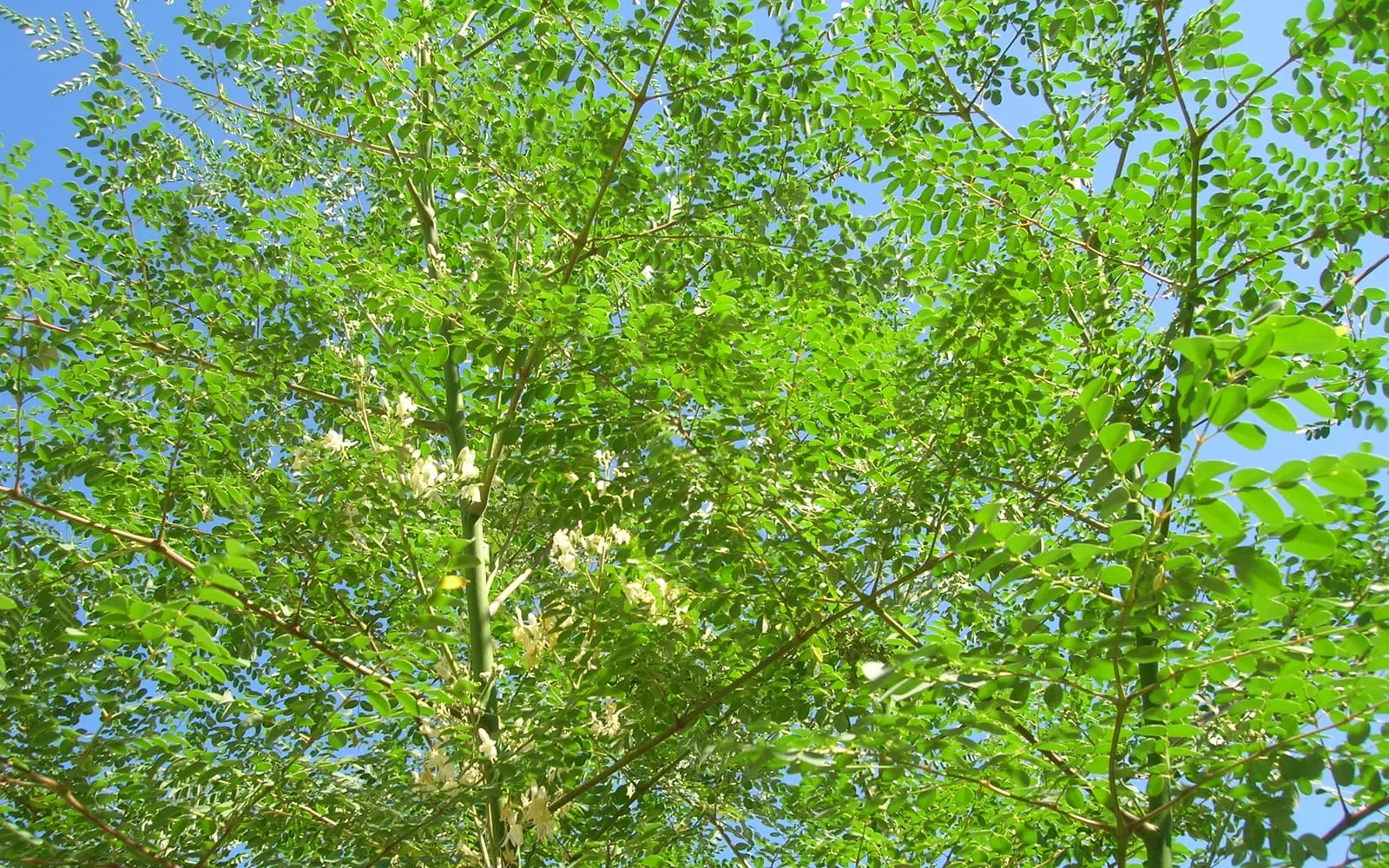
Leaves are the identification. Each is tripinnate, divided three times, so a single leaf 30 to 60 cm long is made of hundreds of small pale green oval leaflets a centimetre across. The whole thing looks like a fern rather than a tree leaf, and it drops as one unit.
Flowers are cream-white, 2 cm across, fragrant, in loose drooping panicles, appearing within a year of sowing.
Pods are long, slender, three-angled and ribbed, 20 to 50 cm, green ripening to brown, splitting to release winged brown seeds.
Seeds are round, dark brown, about 1 cm, with three papery wings, and they float.
Where it is from
Moringa oleifera is native to the southern foothills of the western Himalaya, in north-western India and probably Pakistan, in dry deciduous forest and scrub.
Indian cultivation is ancient, and the tree appears in Sanskrit medical texts as shigru. Tamil, Telugu and Hindi kitchens have used the pods and leaves for millennia.
It travelled early through the Arab world into Africa and, later, with Indian migration, to the Caribbean, the Philippines and the Pacific. Filipino cooking uses the leaves as malunggay in soups.
Development programmes spread it further in the twentieth century, on the grounds that it grows fast on poor dry soil, tolerates drought, and produces food within a year of sowing.
India remains by far the largest producer, growing drumsticks as a field crop in Tamil Nadu, Andhra Pradesh and Karnataka.
How it grows
Sow seed fresh in spring at 25 to 30 deg C. It germinates within one to two weeks and loses viability within a year, so old seed is a waste of time.
Sow into deep pots, since the seedling puts down a taproot fast and resents being checked.
Use a gritty free-draining compost. Wet compost kills seedlings faster than cold does.
Grow in a heated greenhouse or conservatory outside the tropics, in the largest pot you can manage.
Give full sun and as much heat as possible, 25 to 35 deg C in summer.
Water sparingly and let the compost dry between waterings.
Cut it back hard. Left alone it makes a leggy brittle pole; cut to 1 m each spring it makes a bushy plant with far more leaf, which is how it is managed for leaf production everywhere it is grown.
Harvest leaves by stripping the leaflets from the stalks, taking no more than a third of the plant at once.
Keep it dry and above 10 deg C in winter, when it will drop its leaves and sit dormant.
Cuttings of hardwood 1 m long root readily in the tropics, and less readily in a heated greenhouse.
Through the seasons
March and April are for sowing fresh seed in warmth and for cutting an established plant back hard.
May and June are rapid growth, and a seedling can reach a metre in this period alone.
July and August are the main leaf harvest, and the months to take cuttings if you want more plants.
September brings flowers on a plant in its second year or later.
October is when to reduce watering as the light drops.
Winter is dormancy. Keep it above 10 deg C, nearly dry, and expect it to drop every leaf.
Late winter is the point to check the compost is not damp, since a cold wet root is what kills it.
Care difficulty
Moderate, and the failures are nearly all the same failure.
Overwatering kills more moringa in cultivation than cold does, and a wet root in a cool greenhouse is fatal.
Germination is easy with fresh seed and impossible with old seed.
Growth is extraordinarily fast, which makes it a rewarding plant to raise.
Winter is the test, since it wants 10 deg C as an absolute floor and dry compost.
Hard annual pruning is what turns a brittle pole into a productive leaf bush.
Pods outside the tropics are unlikely, and leaves are entirely achievable.
Watering
Water once a week through the growing season.
Let the compost dry well between waterings, which suits a dry-country tree.
Increase slightly in a hot bright spell when the plant is growing fast.
Reduce sharply from October.
Keep it nearly dry through winter dormancy, watering perhaps once a month.
Never let it stand in a saucer of water at any time of year.
Warning signs, diseases and pests
Wilting in damp compost is root rot, and it is the commonest way to lose the plant.
Seedlings collapsing at soil level are damping off from cold wet compost.
Leaf drop in autumn is normal deciduous behaviour rather than a problem.
Leaf drop in July means cold, drought, or a sudden move.
Fine speckling with webbing is red spider mite under dry glass.
A tall bare stem with leaves only at the top means the plant needs cutting back.
Branches snapping is the wood being what it is, and a wind-free position and hard pruning both help.
Blackened shoot tips after a cold night are chill damage below 10 deg C.
Growing environment
A heated greenhouse or a bright conservatory.
Full sun.
Minimum 10 deg C in winter, with 25 to 35 deg C in summer.
Low to moderate humidity, and good ventilation.
Light gritty sharply drained compost.
A deep pot for the taproot, and the largest one you can manage.
Shelter from anything that could break the brittle branches.
Feeding
Feed lightly. Moringa evolved on poor dry soil and rich feeding makes soft growth that snaps.
Give a balanced liquid feed monthly through summer at most.
Skip manure and heavy nitrogen entirely.
Add grit to the compost rather than organic matter.
Feed nothing from October to March.
Top dress with fresh gritty compost each spring after cutting the plant back.
Troubleshooting
How fast does it grow? Three metres in the first year from seed in the tropics, and a metre or more in a heated greenhouse. It is the fastest tree in this collection.
Why did mine die over winter? A wet root in a cool greenhouse, in nine cases out of ten. Keep it above 10 deg C and nearly dry through dormancy.
Can I eat the leaves raw? In small amounts, yes, and they are usually cooked. A large quantity of raw leaf is laxative.
What about the root? Leave it. Moringa root and root bark contain spirochin and are not food, whatever the horseradish tree name suggests.
Will I get drumsticks outside the tropics? Unlikely. Pods need a long hot season and a large plant. Leaves are the realistic crop here.
Is the powder in health food shops the same thing? Yes, dried and milled leaf from this species.
Do the seeds clean water? They flocculate it. Crushed seed releases a protein that clumps suspended particles and much of the bacterial load so they settle out. It reduces turbidity and contamination rather than sterilising the water.
My plant is a tall bare stick. It needs cutting back. Take it down to about a metre each spring and it will branch into a leafy bush.
My seed never germinated. Moringa seed loses viability within about a year. Buy fresh seed and sow it at 25 to 30 deg C in gritty compost.
Is it safe in pregnancy? The leaves are eaten widely, and root, bark and seed preparations are avoided, since they have a long traditional use as abortifacients. Ask a midwife or doctor rather than relying on a plant page.